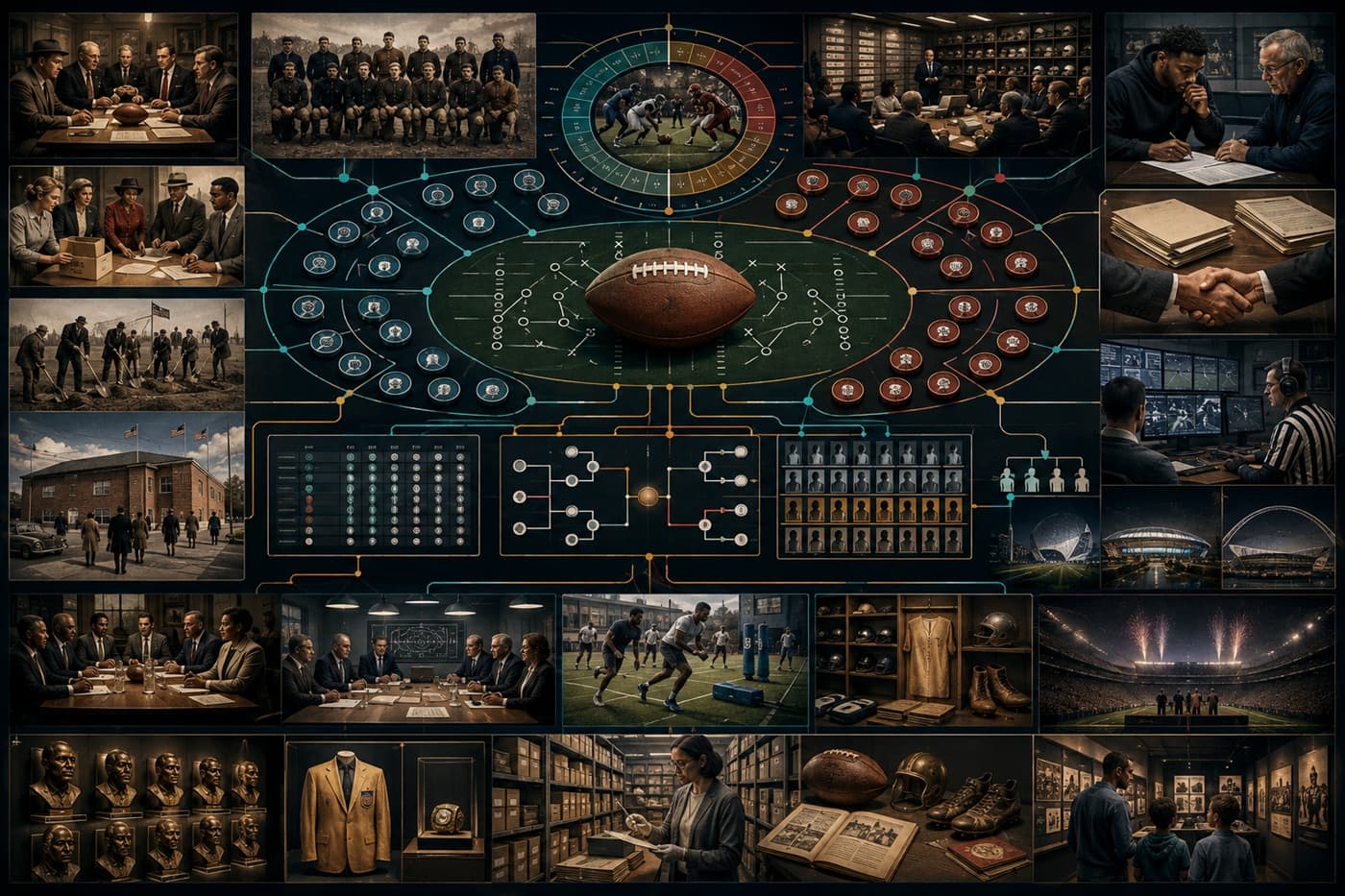
The NFL is often described as though it were one company controlling 32 branch offices. That description is incomplete. Each club has its own ownership, executives, coaches, players, local operations, stadium relationships, and business decisions, while agreeing to compete under shared league rules.
The shared system is extensive. The league creates the schedule, administers player transactions, coordinates officiating, negotiates national media arrangements, conducts the draft, manages central replay, enforces policies, and stages the postseason. Club owners vote on major rules and league policies, while the players union negotiates wages, hours, benefits, health protections, and working conditions.
This structure tries to balance two goals that can conflict. Every club wants freedom to build a competitive advantage, but the league needs opponents that remain credible, financially stable, and capable of producing meaningful games.
That is why the NFL uses divisions, reverse-order drafting, revenue sharing, scheduling rotation, free agency, a salary cap, roster limits, common rules, and a postseason bracket. None guarantees competitive equality, but together they prevent the league from operating as 32 unrelated businesses.
The NFL organization at a glance in 2026
- Clubs
- 32
- Conferences
- AFC and NFC
- Divisions
- Eight divisions with four clubs each
- Regular season
- 17 games per club across 18 weeks
- League matchups
- 272 regular-season games
- Bye weeks
- One per club
- Postseason
- 14 clubs, seven from each conference
- First-round byes
- One per conference
- Standard roster
- 53-player active/inactive list
- Gameday maximum
- 48 active players when at least eight offensive linemen are active
- Practice squad
- 16 players, or 17 with a qualifying designated international player
- Draft
- Seven rounds
- 2026 salary cap
- $301.2 million per club
- Current CBA term
- Through the 2030 season
- 2026 international games
- Nine regular-season games outside the United States
The 32 clubs by conference and division
AFC
American Football Conference
AFC East
- Buffalo Bills
- Miami Dolphins
- New England Patriots
- New York Jets
AFC North
- Baltimore Ravens
- Cincinnati Bengals
- Cleveland Browns
- Pittsburgh Steelers
AFC South
- Houston Texans
- Indianapolis Colts
- Jacksonville Jaguars
- Tennessee Titans
AFC West
- Denver Broncos
- Kansas City Chiefs
- Las Vegas Raiders
- Los Angeles Chargers
NFC
National Football Conference
NFC East
- Dallas Cowboys
- New York Giants
- Philadelphia Eagles
- Washington Commanders
NFC North
- Chicago Bears
- Detroit Lions
- Green Bay Packers
- Minnesota Vikings
NFC South
- Atlanta Falcons
- Carolina Panthers
- New Orleans Saints
- Tampa Bay Buccaneers
NFC West
- Arizona Cardinals
- Los Angeles Rams
- San Francisco 49ers
- Seattle Seahawks
How each club’s 17 opponents are determined
The formula identifies opponents. League schedule makers then determine dates, times, byes, travel patterns, international assignments, and broadcast windows.
- 6
Division games
Each club plays the other three teams in its division twice: once at home and once away.
- 4
Rotating same-conference division
Each club plays all four teams from another division in its own conference.
- 4
Rotating interconference division
Each club plays all four teams from one division in the other conference.
- 2
Same-place conference games
The club plays one team from each of the two remaining divisions in its conference, based on the prior season’s divisional finish.
- 1
Seventeenth game
The club plays a same-place opponent from a division in the other conference that is not part of that season’s four-game interconference rotation.
NFL organization compared with major college football
College football contains several divisions and associations. The comparison uses the NCAA Football Bowl Subdivision when discussing the most visible college system.
| Feature | NFL | Major college football |
|---|---|---|
| Team ownership | Separately operated professional clubs participating in one league | Teams sponsored by colleges and universities |
| Primary governing system | League constitution, club votes, commissioner authority, rulebook, and collective bargaining | Schools, conferences, NCAA rules, state and federal law, and separate CFP governance |
| Conferences | Two fixed competitive conferences, AFC and NFC | Multiple conferences that can change membership and negotiate separately |
| Divisions | Eight permanent four-team divisions under the current alignment | Conference structures vary; some use divisions and many do not |
| Regular season | Seventeen games determined through a league formula | Schedules combine conference assignments and individually contracted nonconference games |
| Postseason access | Four division winners and three wild cards per conference | Selection committee, conference-champion access, rankings, bowls, and current CFP rules |
| Player entry | Draft, undrafted signings, free agency, waivers, trades, and international pathways | Recruiting, admission, eligibility, scholarships, walk-ons, and transfers |
| Player compensation | Employment contracts under a collective bargaining agreement | Scholarships, NIL, and settlement-era direct benefits under changing rules |
| Player movement | Contract status, free agency, tags, trades, waivers, and releases | Transfer notification, recruiting, admission, eligibility, and roster availability |
| Spending control | League-wide salary cap and collectively bargained spending rules | No equivalent universal football salary cap across institutions |
| Rule approval | Competition Committee and club proposals generally require approval by at least 24 clubs | NCAA playing-rules committee and governance processes |
| Championship | AFC champion versus NFC champion in the Super Bowl | The CFP determines the FBS champion outside the NCAA championship system |
A simplified NFL organization map
The map describes authority and working relationships. It does not imply that every node is owned or controlled in the same way.
NFL system
Connects to
- Thirty-two club ownership groups
- League office and commissioner
- NFL Players Association
- Shared competition structure
Thirty-two club ownership groups
Connects to
- Club football operations
- Club business operations
- League Votes
League office and commissioner
Connects to
- Schedule Operations
- Officiating
- Player Personnel System
- Media And International
- Compliance
NFL Players Association
Connects to
- Collective bargaining agreement
- Player Rights
- Benefits And Working Conditions
Shared competition structure
Connects to
- Afc
- Nfc
- Seventeen-game regular season
- Fourteen-team postseason
Club football operations
Connects to
- General Manager
- Coaching Staff
- Scouting
- Medical And Performance
- Player Roster
Club business operations
Connects to
- Tickets And Stadium
- Local Sponsors
- Community And Brand
- Local Media
Collective bargaining agreement
Connects to
- Salary Cap
- Free Agency
- Roster Rules
- Practice Rules
- Benefits
Seventeen-game regular season
Connects to
- Division Games
- Rotation Games
- Same Place Games
- International Games
Fourteen-team postseason
Connects to
- Wild Card Round
- Divisional Round
- Conference Championships
- Super Bowl
The NFL is one league made from 32 distinct clubs
Each club controls its own coaches, front office, scouting department, player evaluations, medical and performance staff, local business operations, and many stadium decisions.
The clubs are competitors, but they also depend on one another. A football team cannot sell a meaningful season without credible opponents, shared rules, recognized standings, and an agreed championship.
The league therefore centralizes systems that must be consistent while leaving clubs room to make different strategic and business choices.
A strong organization may separate authority among an owner, club president, general manager, head coach, and other executives differently from another club.
Most clubs have controlling owners; Green Bay uses a unique community structure
NFL clubs generally operate through private ownership groups with a controlling owner or designated representative.
The Green Bay Packers are the major exception. The franchise has operated as a publicly owned nonprofit corporation since 1923 and is governed through a board and executive committee.
Packers shares do not function like ordinary publicly traded stock and do not pay dividends.
In 2024, club owners approved limited private-equity investment in franchises under league restrictions. That change allowed approved funds to acquire minority interests rather than control entire clubs.
Club owners make major league decisions collectively
Owners or their designated club representatives vote on rules, bylaws, franchise matters, major policies, and other league business.
A proposal does not become a playing rule merely because the commissioner or Competition Committee supports it. Playing-rule changes generally require approval by at least 24 of the 32 clubs.
Club interests do not always align. A proposal can affect teams differently depending on roster construction, stadium, market, travel, strategy, or financial position.
Collective voting gives each club a role while requiring a substantial majority for major change.
The league office coordinates systems that clubs cannot run separately
The commissioner and league staff administer competition, discipline, scheduling, officiating, player transactions, major events, media operations, international growth, compliance, and common business functions.
The commissioner does not call plays or build club rosters. Those decisions remain with each team.
League authority comes from the NFL constitution, bylaws, club agreements, playing rules, policies, and collective bargaining obligations.
Some disputes are decided through procedures involving the league, an arbitrator, jointly appointed experts, or the players union rather than through one unrestricted commissioner decision.
The AFC and NFC reflect the AFL–NFL merger
The American Football League and National Football League agreed to merge in 1966 and completed the competitive merger in 1970.
Most former AFL clubs entered the American Football Conference. The remaining established NFL clubs formed the National Football Conference, with Baltimore, Cleveland, and Pittsburgh moving into the AFC to balance the new structure.
The conference system survives because it creates two parallel championship races that meet in the Super Bowl.
Conference membership also affects scheduling, playoff seeding, tiebreakers, and which opponents a club can face before the championship game.
Eight four-team divisions create the league’s recurring rivalries
Each conference contains East, North, South, and West divisions.
Division opponents play twice every regular season. Those six games create the most stable part of each club’s schedule.
Winning a division guarantees a postseason place and a top-four conference seed, even when a wild-card club has a better record.
The current eight-division alignment began in 2002 when Houston joined as the 32nd club.
The opponent formula is mostly known before the schedule is released
The league does not invent every matchup from scratch for television.
The rotation and prior-year standings determine all 17 opponents after the previous regular season ends.
The formula ensures that clubs play every division in the opposite conference once every four years and creates repeated cycles within each conference.
What remains unknown until schedule release is when the games occur, which receive national windows, where byes fall, and how international or stadium requirements are handled.
Scheduling dates is a large optimization problem
The league places 272 regular-season games while accounting for stadium availability, travel, rest, broadcast windows, holidays, international games, competitive fairness, local events, and other constraints.
Each club receives one bye week.
Home-game totals alternate because a 17-game schedule cannot divide evenly: a club hosts nine regular-season games in one season and eight in the next, with the conference rotation controlling the pattern.
The final result is not purely mathematical. The league also weighs audience interest and operational risk.
Flexible scheduling can move selected late-season games
Flex scheduling lets the league move eligible games into or out of certain national broadcast windows.
The purpose is to place meaningful or attractive matchups where a wider audience can see them while giving clubs and broadcasters required notice.
Week 18 times are handled especially carefully because simultaneous or strategically placed games can protect competitive integrity when playoff races remain unresolved.
Flex rules, eligible weeks, and notice periods can change and should be reviewed each season.
International games are part of the regular schedule, not exhibitions
An international regular-season game counts in the standings like any domestic game.
The league must assign a designated home club, coordinate travel, fields, customs, broadcast timing, security, medical services, and recovery.
The 2026 season includes nine regular-season games outside the United States, the largest international slate to that date.
International scheduling can affect bye placement and the sequence of games before and after long-distance travel.
Standings begin with won-lost-tied percentage
Clubs are ranked by their regular-season won-lost-tied percentage.
A tie counts as one-half win and one-half loss in the percentage calculation.
Division records and conference records appear in the standings because they are important in tiebreaking, but the overall record remains the starting point.
A club can win its division with a weaker overall record than a wild-card club from another division because division races are separate.
Division and wild-card ties use ordered procedures
The NFL applies one tiebreaking step at a time until the tie is resolved.
Head-to-head results, division record, common games, conference record, strength of victory, strength of schedule, scoring measures, and other steps can appear depending on the type of tie.
Multi-club ties may return to an earlier step after one club is separated.
The tiebreaking procedures also help determine draft order among clubs with equal records.
Fourteen clubs reach the playoffs
Seven clubs qualify from each conference.
The four division champions receive seeds one through four. The next three clubs with the best qualifying records receive wild-card positions.
Only the number-one seed in each conference receives a first-round bye.
The other six clubs in each conference enter the Wild Card Round.
The postseason narrows each conference to one champion
The Wild Card Round reduces each conference from seven clubs to four.
The Divisional Round matches the number-one seed with the lowest remaining seed, while the other two clubs meet in the second game.
The winners play for the AFC or NFC championship.
The two conference champions advance to the Super Bowl at a predetermined host site.
Seeding determines byes and home games
The number-one seed receives a bye and home-field advantage throughout the conference playoffs unless it is eliminated.
Division winners host wild-card clubs in the opening round even when the wild-card club has a better record.
After the first round, the higher remaining seed normally hosts the lower seed.
The Super Bowl is played at a neutral site selected in advance rather than at the higher seed’s stadium.
The draft distributes new eligible players through a controlled order
Before the first NFL draft in 1936, eligible players could negotiate directly with any club.
The draft was created partly to give weaker clubs earlier access to college talent.
Today the event contains seven rounds. Draft choices can be traded, forfeited, or supplemented by compensatory selections.
A drafted player receives negotiating rights with the selecting club rather than an unconditional permanent assignment.
Draft eligibility is based on time after high school, not only college class
A prospective player must satisfy the league’s three-year eligibility rule after high school.
Underclassmen seeking special eligibility must renounce their remaining college eligibility and notify the league by the applicable deadline.
College participation is the most common path, but the NFL eligibility rule is not written as a requirement to complete a four-year degree or play four college seasons.
Players who are eligible but not selected may sign as undrafted free agents after the draft.
Draft order generally places weaker records earlier
Non-playoff clubs select first in reverse-standings order.
Playoff clubs are grouped according to the round in which they were eliminated, with regular-season record and tiebreakers ordering clubs within those groups.
The Super Bowl winner selects last in each round, subject to traded or forfeited choices.
The system creates opportunity for struggling clubs but does not guarantee that they will evaluate or develop players successfully.
Compensatory selections adjust the normal draft order
Clubs that lose more or better qualifying free agents than they sign may receive compensatory choices.
Regular compensatory selections fall from Rounds 3 through 7 and use a formula that includes salary, playing time, and postseason recognition.
Special compensatory selections can also be awarded under separate league policies.
Compensatory rules influence free-agency strategy because a signing or loss may affect future draft capital.
The draft is not the only entry route
When the draft ends, eligible unselected players may negotiate with clubs as undrafted free agents.
That market can provide more choice than being drafted because the player and agent can compare roster depth, scheme, coaching, bonus, location, and opportunity.
An undrafted signing still begins with a contract and usually a place on the offseason roster rather than a guaranteed regular-season job.
Many clubs reserve signing-bonus resources and roster plans specifically for priority undrafted players.
Free agency contains several different levels of player mobility
An unrestricted free agent with an expired contract can negotiate broadly, subject to annual calendar and CBA rules.
A restricted free agent may sign an offer sheet, while the original club can retain matching rights and possibly receive draft compensation depending on the tender.
An exclusive-rights free agent generally cannot negotiate elsewhere when the original club makes the required minimum tender.
The phrase free agent therefore does not always mean complete freedom to sign with any club.
Tags allow a club to retain limited control over a pending free agent
The non-exclusive franchise tag permits outside negotiation but gives the original club matching rights and potential draft compensation.
The exclusive franchise tag prevents negotiation with other clubs for that league year.
The transition tag provides matching rights without the same draft compensation.
Tag salary formulas and deadlines are collectively bargained and change with league economics.
Player movement depends on contract status
Clubs may trade player contracts and draft choices within league rules and before the trade deadline.
When a contract is terminated, the player may become an immediate free agent or enter the waiver system depending on accrued experience and timing.
Waivers allow other clubs to claim the existing contract in priority order.
A release should not be confused with an expired contract, trade, practice-squad signing, or placement on a reserve list.
The regular-season roster is larger than the gameday group
The standard active/inactive roster contains 53 players during the regular season and playoffs.
Not all 53 dress for every game. A club may use up to 48 active gameday players when at least eight offensive linemen are active; otherwise the maximum is 47.
Injuries, elevations, reserve lists, suspensions, exemptions, and position needs can change the weekly group.
Roster limits force tradeoffs among starters, backups, special-teams roles, developmental players, and emergency depth.
The practice squad is a working developmental roster
The standard 2026 practice squad contains 16 players.
A club can carry a seventeenth player when one qualifies and is designated through the international-player provision.
Eligibility rules allow a mixture of inexperienced players and a limited number of veterans.
Standard elevations let a club use a practice-squad player for a game without permanently adding him to the 53-player list, subject to limits.
Reserve lists preserve rights while changing roster accounting
Reserve/Injured, Physically Unable to Perform, Non-Football Injury or Illness, suspended, exempt, and other lists serve different purposes.
Placement can remove a player from the active roster while the club retains contractual rights.
Return designations and minimum absence periods depend on the applicable list and current rules.
A player described casually as on injured reserve may have a very different return outlook from another player on the same general list.
An NFL contract contains more than one salary number
Compensation may include base salary, signing bonus, roster bonus, workout bonus, reporting bonus, incentives, and guarantees.
A contract’s announced total value can exceed the amount likely to be earned or guaranteed.
Guarantees can apply for skill, injury, salary-cap termination, or combinations of those conditions.
First-round rookie contracts include a club option for a fifth season, while later-round players can qualify for performance-based fourth-year escalators.
The salary cap limits accounting charges, not every cash payment in one year
The NFL salary cap is a league-wide accounting limit negotiated through collective bargaining.
The 2026 cap is $301.2 million per club.
Signing bonuses are commonly prorated across eligible contract years for cap purposes, so the timing of cash and cap charges can differ.
A restructure can create current relief by converting salary into bonus, but it usually pushes charges and potential dead money into future seasons.
Cap space is a planning resource, not a simple measure of wealth
Cap space is the difference between a club’s current accounting commitments and the applicable limit, subject to adjustments.
Dead money is a cap charge for a player no longer on the active roster or for compensation accelerated after a transaction.
A club can create space through releases, restructures, extensions, trades, or other permitted accounting decisions, but those moves may reduce future flexibility.
Two clubs with similar cap space can have very different roster quality, cash commitments, draft capital, and long-term obligations.
The NFL uses several systems to promote competitive balance
The reverse-order draft gives weaker clubs earlier access to eligible players.
The salary cap limits roster spending accounting, while collectively bargained minimums and cash-spending rules protect player compensation.
The schedule adds same-place games, meaning division winners generally face other division winners in selected matchups.
Revenue sharing and national business arrangements help clubs in different market sizes participate in one competition, although financial and organizational advantages still exist.
The NFLPA represents players as workers
The NFL Players Association represents players in matters involving wages, hours, working conditions, benefits, health and safety, discipline, and contract rights.
It monitors compliance with the collective bargaining agreement and negotiates future agreements with the league.
The union is separate from club management and the league office.
Player representatives connect each locker room with union leadership and collective decision-making.
The CBA is a central operating document
The current collective bargaining agreement was negotiated in 2020 and runs through the 2030 season.
It governs the salary cap, free agency, contracts, minimum salaries, benefits, roster sizes, practice conditions, discipline procedures, offseason work, health protections, and many other employment rules.
The 2020 agreement enabled the current 14-team postseason and the move to a 17-game regular season.
A club and player can negotiate an individual contract only within the boundaries created by the CBA.
Rules change through study, proposals, and club votes
The Competition Committee studies game data, film, officiating, coaching, strategy, and injury information.
Input can come from clubs, coaches, general managers, players, the NFLPA, medical experts, officials, media, and other advisory groups.
The committee and individual clubs can submit proposals.
A playing-rule proposal generally needs at least 24 club votes for adoption, after which the league teaches the change to players, coaches, and officials.
Not every league rule appears in the playing rulebook
The playing rulebook governs what happens during games.
Bylaws cover competition and roster procedures that may operate outside individual plays.
Policies address areas such as injury reporting, integrity, media access, equipment, uniforms, conduct, and game operations.
Collective bargaining can limit or shape all of these systems when player employment rights are involved.
Officials are managed as a league-wide third team
Seven on-field officials have defined positions and areas of responsibility.
Crews prepare through film, rules study, mechanics, physical training, and weekly review.
League supervisors grade every official on every play.
Postgame review can affect assignments, playoff eligibility, training, rule interpretation, and future rule proposals.
Replay connects the stadium crew with league headquarters
Replay review is supported through Art McNally GameDay Central in New York.
Central personnel communicate with on-field officials and help administer review under the current rulebook.
The system does not allow every judgment call to be retried from the beginning; reviewability and standards are defined by rule.
Replay decisions also become teaching material for officials, clubs, media, and the Competition Committee.
Competitive integrity extends beyond penalties during the game
League compliance systems address playing-rule violations, uniforms, equipment, player conduct, club procedures, transactions, injury reporting, and other policies.
On-field conduct can produce a penalty, postgame fine, suspension, or multiple forms of accountability.
Appeal rights and decision-makers vary according to the policy and the CBA.
The purpose is consistent treatment across clubs, although individual decisions can remain controversial.
The International Player Pathway creates another roster route
The International Player Pathway develops selected foreign-born athletes for possible NFL opportunities.
Participants may compete for offseason, active-roster, or practice-squad positions under program rules.
The pathway includes roster provisions intended to let clubs develop international players without using every standard spot immediately.
It supplements rather than replaces the draft, free agency, college scouting, or ordinary tryout process.
National media makes local clubs part of one product
The league coordinates national broadcast and streaming arrangements, while clubs manage local relationships within league rules.
Scheduling and media are connected because national partners require defined windows and flexible scheduling procedures.
League-owned media, digital products, sponsorship, licensing, international events, and major events operate alongside local club businesses.
Commercial coordination increases league-wide value but creates continuing arguments about kickoff times, subscription access, international travel, and athlete workload.
A new fan can understand an NFL season through seven questions
Which conference and division is the club in?
How is it performing in the division race?
Which rotating divisions and same-place opponents appear on the schedule?
Does the club currently hold a division or wild-card position?
What are its important roster, injury, and salary-cap constraints?
Which draft choices and contract decisions shape the next season?
Which current rules or tiebreakers matter to the situation?