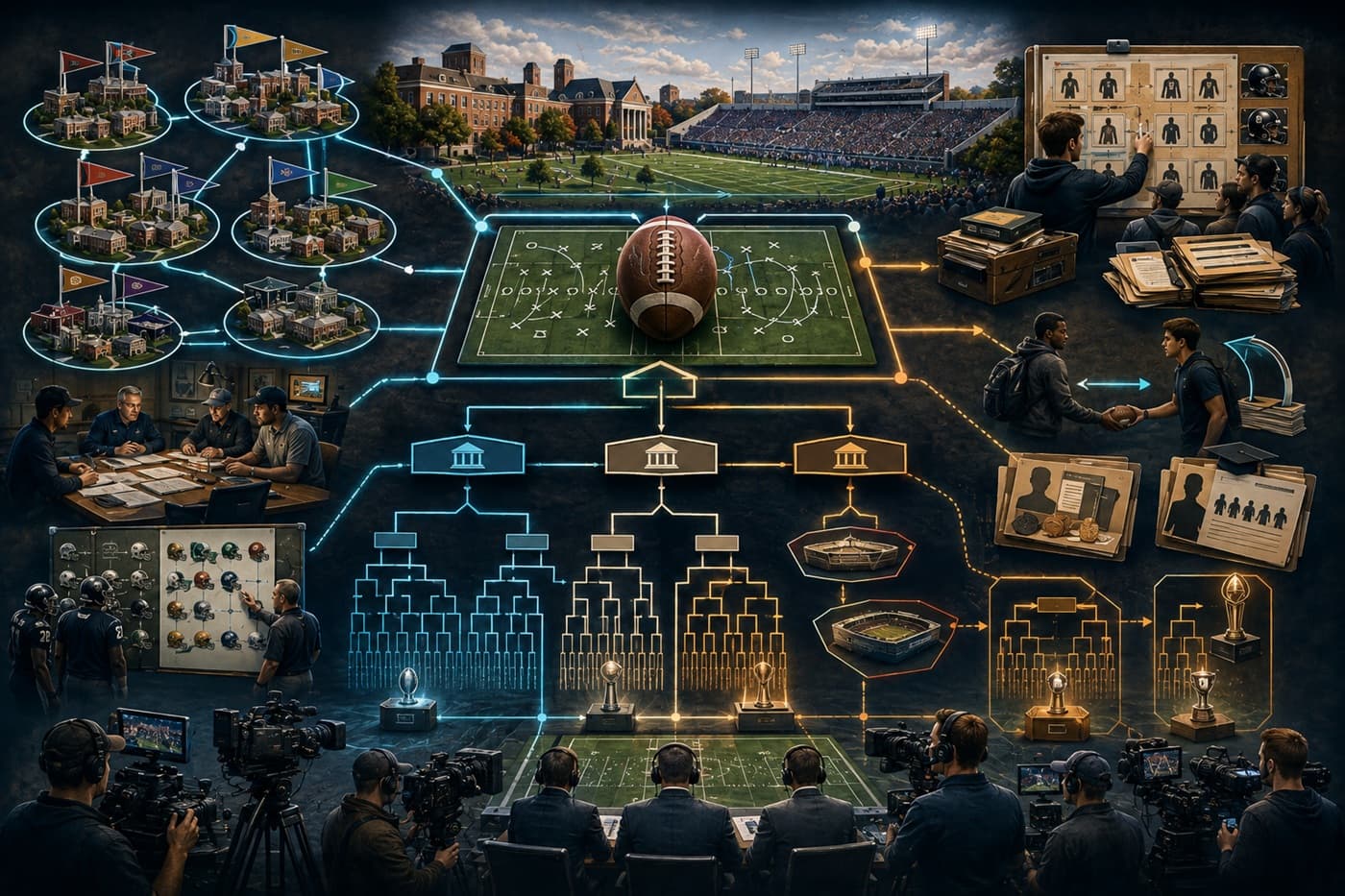
Professional football is organized around a league that owns the competition framework and admits a fixed group of franchises. College football works differently. The teams belong to educational institutions, and those institutions join conferences and athletic associations that divide authority among themselves.
A school can be an NCAA Division I member, an FBS football program, a member of a conference, a participant in a conference championship, a candidate for the College Football Playoff, and a party to a bowl agreement—all at the same time. Each label answers a different organizational question.
This layered structure explains why college football can feel difficult to follow. The NCAA writes or administers many rules but does not operate the FBS playoff. Conferences control important scheduling and revenue decisions but do not own their member schools. Polls rank teams but do not all determine postseason access. Bowl games and the playoff overlap without being identical systems.
The structure also changes frequently. Conference membership, postseason formats, transfer rules, roster limits, and athlete compensation should be treated as current arrangements rather than permanent features.
College football’s organizational layers
- Institution
- The college or university sponsors the team, employs coaches and staff, admits students, provides facilities, and accepts responsibility for compliance.
- Athletic association
- The NCAA, NAIA, NJCAA, or another organization establishes membership, eligibility, competition, and championship frameworks.
- Division or subdivision
- A classification such as NCAA Division I FBS, Division I FCS, Division II, or Division III defines major requirements and postseason pathways.
- Conference
- A group of schools organizes league competition, standings, schedules, revenue arrangements, and often a championship game.
- Independent status
- A school without a football conference builds its schedule and postseason relationships through individual agreements.
- Postseason organization
- The CFP, NCAA championship committees, bowl organizations, the NAIA, and the NJCAA operate different postseason systems.
- Media and commercial partners
- Networks and streaming services influence game times, distribution, revenue, conference strategy, and postseason presentation.
- Athlete rules and agreements
- Eligibility, recruiting, transfers, NIL, financial aid, and direct-benefit frameworks shape who may join and remain on a roster.
The main college-football classifications compared
Classification describes governance, aid, membership, and postseason structure. It is not a guarantee that every team in one classification is better than every team in another.
| Classification | Governance | Postseason | Financial-aid model |
|---|---|---|---|
| NCAA Division I FBS | NCAA Division I membership and football oversight, with conferences exercising major operational authority | College Football Playoff plus other bowl games | Division I financial aid and settlement-era roster and direct-benefit rules for participating institutions |
| NCAA Division I FCS | NCAA Division I and FCS oversight | A 24-team NCAA championship bracket | Division I financial aid rules with FCS-specific football limits and conference structures |
| NCAA Division II | Membership-driven Division II structure | A 32-team NCAA championship bracket under the current format | Partial athletics scholarships may be combined with academic and need-based aid |
| NCAA Division III | Membership-driven Division III structure with each member school holding an equal vote | A 40-team NCAA championship bracket under the current format | No athletics-based scholarships; need-based and merit-based aid remain available |
| NAIA | A separate national association with its own rules and member institutions | NAIA Football National Championship | NAIA financial-aid and eligibility rules |
| NJCAA Division I | National Junior College Athletic Association and member regions or conferences | NJCAA Division I football championship | Athletics aid permitted within NJCAA Division I rules |
| NJCAA Division III | National Junior College Athletic Association and member regions or conferences | NJCAA Division III football championship | No athletics scholarships under the NJCAA divisional model |
| College club football | Campus recreation, student organizations, and club-football associations | Association championships or independently arranged competition | Normally outside varsity athletics scholarship systems |
A simplified organization map
The map shows common relationships. It does not imply that one organization owns every organization beneath it.
College football
Connects to
- NCAA member football
- NAIA football
- Two-year college football
- College club football
NCAA member football
Connects to
- NCAA Division I
- NCAA Division II
- NCAA Division III
NCAA Division I
Connects to
- Football Bowl Subdivision
- Football Championship Subdivision
Football Bowl Subdivision
Connects to
- Fbs Conferences
- Fbs Independents
- Cfp
- Bowls
Football Championship Subdivision
Connects to
- Fcs Conferences
- Fcs Independents
- Fcs Championship
NCAA Division II
Connects to
- Dii Conferences
- Dii Championship
NCAA Division III
Connects to
- Diii Conferences
- Diii Championship
NAIA football
Connects to
- Naia Conferences
- Naia Championship
Two-year college football
Connects to
- Njcaa Division I
- Njcaa Division Iii
College club football
Connects to
- Club Associations
- Independent Clubs
Schools sponsor teams; the NCAA does not own them
A college football team is part of a college or university. The institution hires coaches, controls facilities, admits students, arranges financial aid, manages medical services, signs contracts, and accepts responsibility for following the rules of its memberships.
The NCAA is an association of member schools and conferences. It does not operate those institutions as branch offices, and it does not own their football teams.
This distinction matters when a school changes conferences, adds or drops football, replaces a coach, builds a stadium, enters a media agreement, or decides whether to participate in a settlement framework. Those are institutional decisions made within applicable association and conference rules.
The NCAA governs many shared rules—but not every football decision
The NCAA organizes membership into Divisions I, II, and III. It establishes association-wide and division-specific rules covering areas such as eligibility, recruiting, academic progress, financial aid, transfers, health and safety, and enforcement.
Football playing rules are developed through NCAA committee processes and approved through the association’s playing-rules governance.
The NCAA conducts national football championships for FCS, Division II, and Division III.
The FBS national championship is the major exception. The College Football Playoff is managed outside the NCAA governance structure by the FBS conferences and Notre Dame.
Division I football splits into FBS and FCS
Division I includes schools with the broadest athletics programs and substantial institutional commitments, but not every Division I school sponsors football.
Football-playing Division I schools are classified in the Football Bowl Subdivision or Football Championship Subdivision.
FBS and FCS are subdivisions within the same NCAA division, not separate numbered divisions. They differ in membership requirements, financial-aid structures, scheduling, governance, and postseason organization.
A school moving from FCS to FBS completes a formal reclassification process rather than changing labels immediately after one successful season.
FBS is organized through ten conferences and independent programs
For the 2026 season, FBS consists of ten conferences: the Atlantic Coast, American, Big Ten, Big 12, Conference USA, Mid-American, Mountain West, Pac-12, Southeastern, and Sun Belt conferences.
A small number of schools compete as football independents rather than joining an FBS conference.
Conference membership affects schedules, revenue, championship access, media distribution, travel, rivalries, recruiting, and bowl relationships. It does not mean the conference owns the university.
The phrase power conference is common in media and fan discussion, but it is not a complete explanation of NCAA membership or postseason access. Official rules should be described using the current conference, NCAA, and CFP frameworks.
FCS combines conference races with an NCAA championship
FCS schools also compete through conferences and independent schedules, but their national postseason is an NCAA-run championship.
The current championship contains 24 teams. Eligible conference champions receive automatic qualification, and the selection committee fills the remaining places with at-large teams.
The committee seeds part of the field and builds a single-elimination bracket leading to the NCAA Division I Football Championship game.
Conference participation can differ. A league’s schedule, championship method, or separate postseason commitments may affect how its teams enter the NCAA bracket.
Divisions II and III use NCAA championship brackets
Division II and Division III conduct national championships through NCAA committees rather than through bowls or the College Football Playoff.
Division II expanded its football championship to 32 teams beginning with the 2025 season and moved to automatic qualification for eligible conferences. Its institutional model permits partial athletics scholarships.
Division III expanded to a 40-team bracket. Division III schools do not award athletics-based scholarships, although athletes may receive need-based and academic aid.
Both divisions include conferences, automatic access, at-large selection, regional considerations, and campus-hosted playoff rounds.
The NCAA is not the only college-football association
The NAIA is a separate association for four-year institutions. It has its own governance, eligibility rules, financial-aid rules, conferences, ratings, and national football championship.
The NJCAA organizes two-year college athletics. Its football structure includes Division I and Division III competition under different financial-aid models.
College club football exists outside varsity athletics. Club teams may join an association, arrange schedules, and compete for championships while depending on student dues, fundraising, campus recreation, or limited institutional support.
Calling all college football NCAA football erases these distinct systems.
Conferences organize competition among member schools
A conference is a group of institutions that conducts competition and determines champions in one or more sports.
For football, a conference may create a league schedule, establish standings and tiebreakers, assign officials, negotiate media rights, distribute revenue, operate a championship game, coordinate bowls, and represent members in governance.
Conference rules operate alongside NCAA rules. A conference can impose additional standards, but it cannot silently replace an NCAA playing or eligibility rule that applies to its members.
Conference authority is substantial because membership determines many of the opponents a school plays and the financial and postseason systems it can access.
Independent teams replace a conference schedule with individual agreements
A football independent does not compete for a conference championship. It contracts separately with opponents to create its schedule.
Independence can provide scheduling flexibility and preserve national rivalries, but it also requires the school to secure enough home and away games, media distribution, officiating arrangements, and postseason relationships.
Independent teams remain members of an athletic association and must satisfy the same applicable subdivision, eligibility, and playing rules as conference teams.
Notre Dame has a special role in CFP governance and receives playoff access under the current format if it finishes in the top 12 of the final selection committee ranking.
A college schedule combines conference and nonconference games
Conference offices determine or approve the league portion of a schedule. The number of conference games and the method for rotating opponents differ by league.
Schools negotiate nonconference games, often years in advance. Agreements can include home-and-home series, neutral-site games, one-time road games, cancellation terms, and financial guarantees.
An FBS team normally schedules 12 regular-season games. Conference championships, bowls, and CFP games are additional postseason contests.
Schedule strength matters because playoff and at-large selection committees compare teams that do not all play one another. There is no complete round-robin across college football.
Conference champions are determined by league rules
A conference uses results from designated conference games to create its standings. Nonconference wins may affect national ranking but usually do not count directly in the conference table.
Tiebreakers are conference-specific and may include head-to-head results, records against common opponents, opponent winning percentages, rankings, or computerized procedures.
Many conferences stage a championship game. The participants may be the top two teams in one divisionless table or winners determined through another conference formula.
A conference championship can produce a trophy, a playoff automatic berth, bowl priority, or stronger committee consideration depending on the level and current rules.
Not every ranking controls the postseason
The Associated Press and coaches polls are influential measures of public and media opinion, but they do not select the College Football Playoff.
The CFP Selection Committee produces its own rankings and selects and seeds the FBS playoff field under a written protocol.
FCS, Division II, and Division III use NCAA committees and division-specific selection criteria for their championship brackets.
Computer ratings and analytical systems may inform discussion or committee tools, but no single public formula ranks every level and automatically assigns every postseason place.
The 2026–27 College Football Playoff uses a 12-team bracket
The 2026–27 playoff includes the champions of the ACC, Big Ten, Big 12, and SEC, plus the highest-ranked team from the American, Conference USA, Mid-American, Mountain West, Pac-12, or Sun Belt conferences.
The remaining places go to the next seven highest-ranked teams. Notre Dame is included if it appears in the top 12 of the final ranking.
The four highest-ranked teams receive first-round byes. Seeds five through twelve play first-round games hosted by the higher seed.
Quarterfinals and semifinals are played through the CFP bowl rotation, followed by the national championship game. The bracket is not reseeded.
This arrangement is current for the 2026 season and should not be treated as permanent.
The CFP crowns the FBS champion outside NCAA governance
The College Football Playoff is managed by the ten FBS conference commissioners and the athletics director at Notre Dame, with university presidents and chancellors serving through its board structure.
The NCAA provides the membership and playing-rule environment in which FBS teams compete, but it does not operate the CFP as an NCAA championship.
This is why FBS can be part of NCAA Division I while using a postseason organization separate from the NCAA championship system.
The distinction also explains why CFP format changes are announced by CFP governance rather than by an NCAA championship committee.
Bowl games form a second FBS postseason network
Bowls are separately organized postseason games rather than rounds in one universal tournament.
Conferences and bowl organizations create agreements that influence which eligible teams may be invited. Rankings, geography, ticket demand, rematches, conference order, and contractual provisions can affect the matchup.
Some major bowls serve as CFP quarterfinals or semifinals in a given season. Other bowls remain outside the playoff bracket.
Bowl eligibility is governed through NCAA rules defining deserving teams and exceptions when there are not enough eligible teams. The details can change and should be checked for the applicable season.
FCS, Division II, and Division III use selection committees and brackets
Eligible conference champions can receive automatic qualification to NCAA championship brackets. Committees then select at-large teams to complete the fields.
Committees evaluate records, strength of schedule, results against selected teams, regional criteria, and other division-specific information.
Higher-seeded or selected teams may host early rounds. The bracket narrows through single-elimination games until the championship site.
This system resembles a conventional tournament more closely than the FBS combination of the CFP and bowls.
Recruiting fills rosters, but admission and eligibility still matter
College coaches identify prospective players through game film, live evaluation, camps, communication, academic records, and roster needs.
Recruiting rules govern when and how coaches may contact prospects, visit schools, host visits, and make offers. Rules differ by division and sport.
A football opportunity does not replace the college admissions process. The athlete must be admitted, satisfy applicable initial-eligibility rules, and remain academically eligible.
Scholarship, walk-on, roster, and admissions language should be confirmed directly with the institution. Social-media announcements do not substitute for official documents.
The Transfer Portal changed how college rosters are rebuilt
The NCAA Transfer Portal records an athlete’s notification of intent to explore opportunities at another institution. It does not itself transfer the athlete or guarantee a new roster place.
Coaches now manage high-school recruits, returning players, transfers, graduate students, roster limits, and professional departures at the same time.
Transfer windows and eligibility rules can change. Academic credit, admission, conference rules, and the receiving school’s roster still matter.
The result is greater player movement and a shorter planning cycle for coaches and athletes.
College football compensation now has several separate parts
Financial aid can include athletics scholarships, academic awards, grants, and need-based assistance, depending on the association and division.
NIL compensation involves legitimate commercial use of an athlete’s name, image, and likeness through endorsements, appearances, camps, content, and related activity.
Under the House settlement framework, participating Division I institutions may also provide direct financial benefits within an annual cap and use settlement-era roster rules.
NIL, scholarships, and direct institutional benefits are related parts of the modern system, but they are not interchangeable labels.
The legal and governance framework remains unsettled and requires frequent review.
Media agreements help shape conference geography
Conference media agreements determine where games appear, when they are scheduled, and how revenue is distributed.
A school considering conference membership may weigh television exposure, revenue, travel, rivalries, academic relationships, postseason access, and long-term stability.
The result is that conferences are not always geographically compact. A league can contain schools separated by several time zones because media and institutional strategy outweigh older regional logic.
Realignment changes more than logos on a schedule. It can affect athlete travel, missed class time, recruiting, traditional rivalries, championship paths, and the financial position of entire athletic departments.
Rules are enforced at several levels
Officials enforce playing rules during games. Conference offices often assign and evaluate officials.
Schools monitor their own compliance and report violations. Conferences and the NCAA may investigate or process cases under applicable rules.
Eligibility and academic certification involve campus offices as well as association requirements.
Postseason organizations also apply participation, selection, availability-reporting, and event policies.
Because authority is distributed, a dispute about a targeting call, a transfer, a conference tiebreaker, and CFP selection may each belong to a different decision-making process.
A new fan can understand the season by following five questions
First, identify the classification: FBS, FCS, Division II, Division III, NAIA, NJCAA, or club.
Second, identify the conference or independent status. That explains most of the schedule and the first championship race.
Third, learn the postseason route. Is the team pursuing the CFP, a bowl, an NCAA bracket, or another association championship?
Fourth, distinguish rankings from access rules. A poll position may influence discussion without controlling an automatic berth.
Fifth, check the current season’s rules. Conference membership, tiebreakers, playoff access, transfers, rosters, and compensation can change.
The complexity reflects college football’s history
College football grew from games arranged by individual schools before a national professional league or central college championship existed.
Conferences developed around geography and recurring opponents. Bowls developed as destination events. The NCAA developed governance and championships, while the largest football programs retained a separate postseason tradition.
Television, litigation, conference expansion, athlete rights, and new compensation systems were added to that older structure rather than replacing it with one league office.
The system can change, but every reform must negotiate institutions with different resources, missions, contracts, histories, and competitive interests.