Learn Football
Offensive Formations in American Football
A formation places eligible receivers and blockers before the snap to create spacing, leverage, and assignment clues.
19 minute read
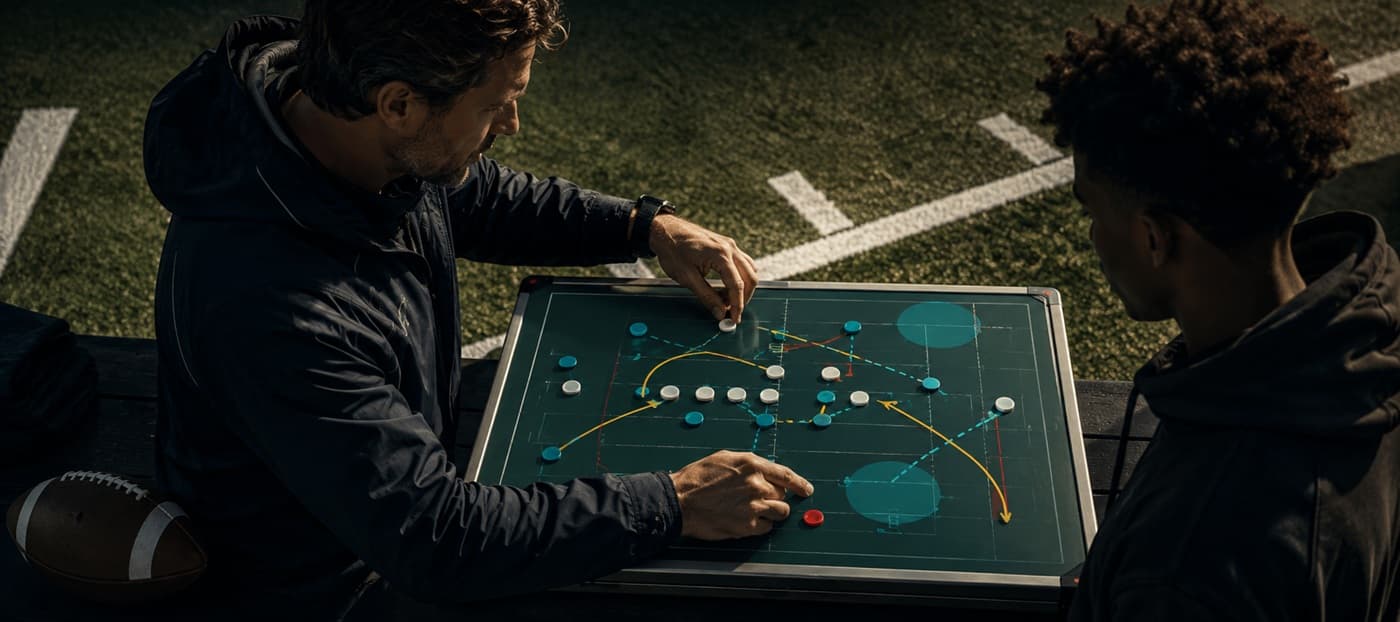
An offensive formation is the arrangement of the offense's players before the snap. It describes where players line up—such as where the quarterback stands, how receivers are distributed, where the running back aligns, and whether a tight end is attached to the offensive line or split away from it.
The most important distinction for beginners is:
Personnel describes who is on the field. Formation describes where those players line up.
For example, an offense using 11 personnel has one running back, one tight end, and three wide receivers. Those same five skill-position players might line up in a balanced 2x2 formation, a 3x1 trips formation, a condensed set, or another legal alignment.
Formation also is not the same thing as the play. A shotgun formation does not automatically mean pass. A tight formation does not automatically mean run. The same formation can support different runs, passes, protections, play-action concepts, motions, and quarterback reads.
Once you learn to recognize formations, the football you see on television or in a play diagram becomes much easier to understand.
What Is an Offensive Formation?Link to this section
Before every normal offensive snap, 11 players arrange themselves according to the rules and the play call.
That arrangement is the formation.
A formation can tell you several useful things before the ball moves:
- Where the quarterback will receive the snap
- How many receivers are positioned on each side
- Where the running back is aligned
- Whether a tight end is attached to the line
- Whether receivers are spread widely or condensed toward the formation
- Which side appears stronger by alignment
- What space the offense is trying to create
- What the defense must communicate before the snap
A formation does not tell you with certainty what will happen next.
Two plays that begin with an almost identical pre-snap picture might become:
- Inside zone
- Outside zone
- A quick pass
- A screen
- Four Verticals
- Mesh
- Play-action
- A quarterback run
- Another concept entirely
Think of the formation as the starting geometry of the play.
Formation vs. Personnel vs. Play ConceptLink to this section
These three ideas are related, but they answer different questions.
| Term | Question it answers | Example |
|---|---|---|
| Personnel | Who is on the field? | 11 personnel: 1 RB, 1 TE, 3 WR |
| Formation | Where are those players lined up? | Shotgun trips |
| Concept | What are they trying to execute after the snap? | Stick, Mesh, Inside Zone |
| Motion/shift | How does the alignment change before the snap? | Receiver motions across formation |
This distinction is fundamental.
An offense could put 11 personnel on the field, align in shotgun with two eligible receivers to each side, and run Inside Zone.
The next snap could use the same personnel and a very similar formation but run Mesh.
Then the offense could rearrange those same players into trips and run Stick.
The players did not necessarily change. Their locations and assignments did.
For a deeper explanation of who is on the field, see football personnel groups.
Why Offensive Formations MatterLink to this section
Formations allow the offense to manipulate space before the play even begins.
By moving players around, an offense can attempt to:
- Widen defenders
- Compress defenders
- Create favorable blocking angles
- Isolate a receiver
- Put several receivers on one side
- Create open space on the opposite side
- Reveal how the defense plans to cover certain players
- Make defensive communication more difficult
- Change the apparent strength of the formation
- Improve the angles for a particular running or passing concept
Defenses respond by adjusting fronts, coverage responsibilities, leverage, pressures, and communication.
Formation is therefore part of the conversation between offense and defense before the snap.
Offensive Line and Eligible ReceiversLink to this section
A beginner does not need the entire formation section of the rulebook to understand offensive structure, but one rule explains much of what you see.
Under current NFL rules, an offense must have at least seven players on the line of scrimmage at the snap, with eligible receivers legally positioned at the ends of that line. Players covered up by another offensive player on the line may become ineligible to receive a forward pass. Other levels of American football have their own rulebooks, so specific eligibility details should not automatically be assumed to be identical everywhere. See the NFL's official rulebook (opens in a new tab) for the professional rules.
In an ordinary formation, the five offensive linemen are:
- Left tackle
- Left guard
- Center
- Right guard
- Right tackle
The center snaps the football.
Eligible skill players then align either on the ends of the line or in the backfield in legal positions.
This is why you will sometimes see a wide receiver slightly behind another receiver rather than directly on the line. That small difference can affect whether both are eligible.
Under CenterLink to this section
When a quarterback lines up under center, the quarterback positions directly behind the center and receives the snap immediately into the hands.
A simplified picture looks like this:
WR        TE LT LG C RG RT        WR
                  QB
                  RB
Under-center football can support many concepts, including:
- Traditional handoffs
- Inside and outside runs
- Play-action
- Dropback passes
- Bootlegs
- Screens
Because the quarterback starts close to the line of scrimmage, the running back can often receive a handoff while moving downhill from greater depth.
Under center can also help sell certain play-action fakes because the quarterback and running back can make the backfield action resemble a traditional run.
But under center does not mean the offense is running the ball.
A concept such as Play-Action Cross illustrates how run action can influence defenders before receivers attack the space behind them.
Shotgun FormationLink to this section
In shotgun, the quarterback stands several yards behind the center and receives a longer snap.
A basic shotgun alignment might look like:
WR        LT LG C RG RT        WR
      SLOT              SLOT

                QB
             RB
Shotgun gives the quarterback depth immediately rather than requiring a traditional drop from under center.
That can help with:
- Seeing the defensive structure
- Quick passing
- Spread concepts
- Read-option and quarterback-run games
- Pass protection timing
- Running-back routes
- Run-pass options in systems that use them
Shotgun is extremely flexible. It can support both running and passing.
OpenPlay's Inside Zone, for example, uses a shotgun structure in its current Playbook representation. So do passing concepts such as Mesh, Slant-Flat, and Four Verticals.
The formation alone does not reveal which one is coming.
What Is the Pistol Formation?Link to this section
The pistol combines elements commonly associated with shotgun and under-center structures.
The quarterback takes the snap from behind the center, while the running back is aligned deeper and generally more directly behind the quarterback.
A simplified picture:
WR        LT LG C RG RT        WR

                QB
                RB
The quarterback is not as close to the center as in an under-center alignment, while the running back can still begin from a relatively downhill position.
Pistol formations can support:
- Gap runs
- Zone runs
- Play-action
- Option concepts
- Dropback passes
OpenPlay's Power provides an example of a gap-running concept represented from a pistol structure.
Again, pistol is a formation family, not a specific play.
Single-Back FormationsLink to this section
A single-back or singleback structure generally uses one running back in the offensive backfield rather than pairing that runner with a traditional fullback.
The quarterback may be under center, depending on the terminology being used.
The remaining eligible players can be arranged in many ways.
For example:
- Two receivers and two tight ends
- Three receivers and one tight end
- Condensed receivers
- Wide receivers
- Balanced or unbalanced-looking distributions
OpenPlay's Outside Zone uses a Singleback Tight formation in its current Playbook representation. Play-Action Cross begins from the same listed formation family.
That is a useful demonstration of an important principle: one formation can support both a running play and a passing play.
What Is a 2x2 Formation?Link to this section
A 2x2, often called doubles in some systems, generally means the offense has two receiving threats distributed to each side of the formation.
A simple shotgun version might look like:
WR    SLOT     LT LG C RG RT     SLOT    WR

                       QB
                    RB
The exact positions can vary. One of the inside players might be a tight end rather than a wide receiver.
The important feature is the balanced two-by-two distribution.
A 2x2 formation can help an offense:
- Create balanced spacing
- Attack either side of the field
- Make the defense distribute coverage resources
- Create isolated matchups
- Run concepts that stretch both sides
OpenPlay currently represents Mesh, Four Verticals, Inside Zone, and Slant-Flat from a Gun Doubles structure.
Those plays do completely different things after the snap.
That is exactly why formation and concept should not be confused.
What Is a 3x1 or Trips Formation?Link to this section
A 3x1 formation places three receiving threats to one side and one to the other.
The three-receiver side is commonly called trips.
WR       LT LG C RG RT      SLOT SLOT WR

                QB
             RB
The arrangement of the three players can vary greatly.
Trips formations can create several problems for a defense:
- Three threats must be distributed on one side.
- Defenders must communicate route responsibilities.
- The single receiver on the opposite side may become isolated.
- The offense can create horizontal and vertical spacing.
- Defensive rotations may become easier for a quarterback to diagnose.
A defense might respond by changing coverage, shifting a safety, adjusting linebacker alignment, or treating each side differently.
None of those reactions is guaranteed.
OpenPlay's Stick is shown from a Gun Trips formation, where multiple receivers can create a compact quick-game stretch.
What Is an Empty Formation?Link to this section
An empty formation has no running back aligned in the traditional offensive backfield with the quarterback.
Five eligible receivers are distributed away from the quarterback.
A common appearance might be:
WR SLOT       LT LG C RG RT       SLOT SLOT WR

                       QB
This does not necessarily mean the roster contains no running back. A running back can remain on the field but align as a receiver.
That illustrates the personnel-versus-formation distinction again:
The player can still be a running back by personnel while the formation is empty.
Empty formations can:
- Spread defenders across the field
- Make coverage assignments more visible
- Create one-on-one matchups
- Open underneath space
- Remove a traditional backfield pass protector
- Create quarterback-run opportunities in some systems
Defenses must decide how to distribute defenders across five receiving threats while still accounting for the quarterback.
Empty does not guarantee a pass.
Bunch FormationsLink to this section
A bunch places multiple eligible receivers close together, typically on the same side of the formation.
Instead of spreading three receivers across a large area, the offense might cluster them within a few yards of one another.
A simplified bunch:
                         WR
                   SLOT
                 TE
LT LG C RG RT

        QB
The exact shape varies significantly.
Bunch formations can create:
- Difficult releases for defenders to anticipate
- Natural spacing opportunities after the snap
- Traffic against man coverage
- Multiple route combinations from similar starting points
- Challenges for defensive communication
Defenders may need to decide whether they are following individual receivers, exchanging assignments, zoning areas, or using another coverage rule.
Bunch does not guarantee a crossing route or a particular coverage response.
Stack AlignmentsLink to this section
A stack places two receivers at different depths, with one positioned behind or nearly behind another.
For example:
        WR
        WR
One receiver may be on the line while the other is set slightly behind.
Stacks can make it difficult for defenders to immediately press both receivers at the line of scrimmage. They can also create uncertainty about which receiver will release inside, outside, or vertically.
Bunch and stack are related ideas but are not identical:
- Bunch: usually three or more players clustered together.
- Stack: usually emphasizes receivers positioned one behind another.
Terminology differs among coaching systems, so the visual structure matters more than memorizing one universal naming convention.
Tight and Condensed FormationsLink to this section
In a condensed formation, receivers align closer to the offensive line than they would in a traditional wide split.
Instead of a receiver standing near the sideline, that player might line up relatively close to the formation.
Condensed alignments can change:
- Blocking angles
- Route releases
- Crossing-route spacing
- Defensive leverage
- Safety positioning
- Run-support responsibilities
A receiver who begins close to the formation can cross the field without needing to travel as far horizontally. The same alignment can also place that player in a useful position to block on a running play.
OpenPlay's Outside Zone and Play-Action Cross illustrate how a tight formation can support very different post-snap intentions.
Wide and Spread FormationsLink to this section
A spread formation generally distributes eligible receivers across more of the field's width.
That can force defenders to cover more horizontal space.
Wide receiver splits may create:
- Larger underneath areas
- More isolated matchups
- Wider defensive alignments
- Clearer pre-snap leverage indicators
- Space for inside running lanes
But spreading the field creates tradeoffs too.
A receiver positioned far from the core of the formation may have a less favorable angle for certain blocks. The offense may also reveal aspects of its protection or leave fewer players close to the quarterback.
“Spread” is a broad description rather than one exact formation.
Attached and Detached Tight EndsLink to this section
A tight end can align in several places.
Attached tight endLink to this section
An attached tight end lines up beside an offensive tackle near the line of scrimmage.
LT LG C RG RT TE
That player may be involved immediately in:
- Run blocking
- Pass protection
- Route releases
- Combination blocks
Detached tight endLink to this section
A detached tight end is separated from the offensive line.
The tight end might align:
- In the slot
- As a wing slightly behind the line
- Wide like a receiver
- In another backfield or flex position
The player remains a tight end by personnel designation, but the formation has changed how that player is positioned.
This is another reason personnel groups and formations should be learned separately.
Running-Back AlignmentLink to this section
Running backs do not always stand directly behind the quarterback.
From shotgun, a back might align:
- Offset left
- Offset right
- Directly behind the quarterback
- Beside the quarterback
- Away from the backfield as a receiver
That location can matter.
A defense may consider whether the alignment suggests:
- A possible run direction
- Pass-protection responsibilities
- A screen
- A route release
- An option concept
But good offenses deliberately break tendencies, so back alignment should be treated as information, not proof.
A halfback aligned beside the quarterback can run the ball, block, release into a route, or participate in a concept such as a screen.
What Is Formation Strength?Link to this section
Formation strength describes the side of the offensive formation that is considered stronger according to the offense's or defense's rules.
The definition is not universal.
A team might determine strength by:
- Tight-end location
- Number of eligible receivers
- Running-back alignment
- Passing strength
- The wide side of the field
- A specific formation rule
For example, a formation with a tight end and two receivers to the right may be treated as strong right.
But another system could define strength differently.
This matters because defenses often use offensive strength to set:
- Front alignment
- Linebacker positioning
- Safety rotation
- Coverage calls
- Pressure rules
When you hear “strong side,” remember that it usually reflects a team's system for organizing the formation, not an immutable law of football.
What Is a Receiver Split?Link to this section
A receiver's split describes how far that receiver aligns from another reference point, often the offensive tackle, another receiver, the numbers, or the sideline.
A receiver can use:
- A wide split
- A normal split
- A reduced split
- A very tight or condensed split
Changing a split by only a few yards can alter a play.
A wider receiver may create more inside space.
A condensed receiver may have more room to break outside and a shorter path across the formation.
Splits can also influence defensive leverage. A cornerback may align differently when a receiver is close to the sideline than when that receiver has large amounts of space outside.
The formation name gives you part of the picture. Receiver splits provide more detail.
Boundary and FieldLink to this section
When the football is positioned on or near a hash mark, one side of the formation may have more available horizontal field than the other.
Coaches often call:
- The wider side the field
- The shorter side the boundary
The exact geometry depends on the field and the rule set. NFL and college hash-mark locations are different, so field/boundary spacing is not identical at every level.
Offenses can use that asymmetry when deciding:
- Where to put trips
- Where to isolate a receiver
- Where to run the football
- Which passing concept has enough space
- How to position a tight end
Defenses make corresponding adjustments.
Field and boundary are therefore additional pieces of the pre-snap picture rather than separate formation families.
How Formations Create Spacing and LeverageLink to this section
Two of the most important words in formation analysis are spacing and leverage.
SpacingLink to this section
Spacing asks where offensive players are positioned relative to one another and the defense.
An offense may spread receivers apart to make defenders cover more ground.
Or it may condense them to create crossing routes, blocking angles, and difficult releases.
LeverageLink to this section
Leverage describes positional advantage.
If a defender is aligned inside a receiver, the receiver may have more immediate access toward the outside.
If the defender is outside, an inside route may have more favorable initial leverage.
Formations help create these relationships before the snap.
Concepts such as Slant-Flat become easier to understand when you see how two receivers use their alignment to stretch a defender in different directions.
For a broader introduction, see passing concepts in football.
Formations Can Force Defensive CommunicationLink to this section
Modern offenses frequently use formations to make defenses solve problems before the snap.
Trips may force defenders to decide how three receiving threats will be covered.
A bunch can require defenders to communicate what happens if routes cross immediately.
A running back detached from the backfield may force a linebacker, safety, or corner to adjust.
An empty formation can spread the defense across the entire field.
Sometimes these reactions give the quarterback information.
For example, if a receiver moves across the formation and a defender follows closely, that may provide a clue about man coverage. If defenders instead pass the receiver between zones, that may suggest something different.
But these are clues—not guarantees.
Defenses disguise coverage specifically to prevent quarterbacks from knowing the answer too early.
Learn more about those clues in Reading a Defense.
Motion and ShiftsLink to this section
A formation describes an alignment. Motion and shifts describe movement before the snap.
The distinction matters.
ShiftLink to this section
A shift generally involves one or more offensive players moving to new positions before becoming set again.
An offense might begin in a 2x2 appearance, shift a receiver across the formation, and finish in trips.
The final formation is different from the original formation.
MotionLink to this section
Motion usually refers to a player moving before—and sometimes at—the snap, subject to the rules of the competition.
Motion can be used to:
- Change formation strength
- Create leverage
- Force defensive communication
- Identify possible man or zone behavior
- Give a player momentum
- Change a blocking angle
- Create misdirection
Precise motion rules differ by level. For example, the NFL places restrictions on which players may be moving when the ball is snapped and how that movement may occur.
The strategic point is simpler:
Formation is the picture; motion can change the picture.
The Same Formation Can Produce Many PlaysLink to this section
Perhaps the best way to understand offensive formations is to compare plays that begin similarly.
OpenPlay currently represents several concepts from Gun Doubles, including:
- Inside Zone — a running concept
- Mesh — crossing routes
- Four Verticals — a vertical passing concept
- Slant-Flat — a quick-game stretch
The formation does not determine the play.
Instead, it gives the play a starting structure.
Likewise, Singleback Tight can support Outside Zone as well as Play-Action Cross.
That uncertainty is strategically valuable.
If an offense can run many concepts without dramatically changing its pre-snap appearance, the defense receives less reliable information from the formation alone.
Common Misconceptions About Offensive FormationsLink to this section
“Shotgun means pass.”Link to this section
No. Teams routinely run the football from shotgun.
“Under center means run.”Link to this section
No. Under-center formations can produce dropback passes, play-action, screens, bootlegs, and other passing concepts.
“Trips means three wide receivers are on the field.”Link to this section
Not necessarily. Trips describes the distribution of eligible receivers. A tight end or running back can potentially occupy one of those locations.
“Empty means there is no running back in the personnel group.”Link to this section
No. A running back may simply be lined up as a receiver.
“Formation and personnel are the same.”Link to this section
No. Personnel tells you which types of players are participating. Formation tells you where they are aligned.
“A formation tells you the play.”Link to this section
No. Good offensive systems intentionally run multiple concepts from the same formations.
“Bunch always means crossing routes.”Link to this section
Bunch can help create crossing-route opportunities, but offenses can run many different route and run concepts from bunch.
“There is one universal name for every formation.”Link to this section
No. Terminology differs considerably among teams and coaching systems. One team's “Doubles Right” might resemble an alignment another staff names differently.
For a viewer, recognizing the structure is often more useful than memorizing every possible label.
How to Read an Offensive Formation Before the SnapLink to this section
When watching football, try scanning the offense in this order.
1. Find the quarterbackLink to this section
Is the quarterback:
- Under center?
- In shotgun?
- In pistol?
2. Find the running backLink to this section
Is there:
- One back?
- More than one?
- No back in the backfield?
- An offset back?
- A back directly behind the quarterback?
3. Count receiving threats on each sideLink to this section
Does the offense appear:
- 2x2?
- 3x1?
- Empty?
- Bunched?
- Stacked?
4. Locate the tight endLink to this section
Is the tight end:
- Attached?
- In a slot?
- In a wing?
- Split wide?
5. Look at receiver splitsLink to this section
Are receivers:
- Wide?
- Condensed?
- Stacked?
- Clustered?
6. Watch the defense reactLink to this section
Does a defender:
- Follow a motioning receiver?
- Widen with a slot?
- Rotate toward trips?
- Move into the box?
- Back away from the line?
Now the formation has become useful information rather than simply a name.
The next step is connecting that information to running-play structure, passing concepts, and defensive reads.
Why Formations Matter to Football StrategyLink to this section
Formation is one of the offense's most powerful tools because it changes the problem before the ball is snapped.
The offense can take the same 11 players and rearrange them to create:
- Different spacing
- Different blocking surfaces
- Different matchups
- Different coverage questions
- Different run fits
- Different leverage
Then it can execute several different concepts from each alignment.
That is the larger strategic idea:
Personnel determines the available pieces. Formation places those pieces on the board. The play tells them what to do.
Once you begin viewing formations this way, a football diagram becomes much more informative. Instead of seeing 11 dots, you can identify the quarterback's depth, receiver distribution, formation strength, back alignment, available space, and the defensive problems the offense may be trying to create.
OpenPlay's animated offensive Playbook lets you carry that pre-snap analysis into the play itself, where formations become routes, blocks, reads, and decisions.
Frequently Asked QuestionsLink to this section
What is an offensive formation in football?Link to this section
An offensive formation is the arrangement of the offense's players before the snap. It describes where the quarterback, running backs, receivers, tight ends, and offensive linemen are positioned.
What is the difference between formation and personnel?Link to this section
Personnel describes who is on the field; formation describes where those players line up. For example, 11 personnel contains one running back, one tight end, and three wide receivers, but those players can line up in many different formations.
What is shotgun formation?Link to this section
Shotgun places the quarterback several yards behind the center for the snap. It is used for both passing and running concepts and should not be treated as an automatic indication of a pass.
What is pistol formation?Link to this section
In pistol, the quarterback aligns behind the center at depth while a running back commonly aligns deeper and more directly behind the quarterback. It combines some characteristics associated with shotgun and traditional downhill backfield structures.
What does trips mean in football?Link to this section
Trips generally means three eligible receiving threats are aligned to one side of the formation. It is commonly described as a 3x1 distribution when one receiving threat is on the opposite side.
What does 2x2 mean in football?Link to this section
A 2x2 formation distributes two receiving threats to each side. Some offenses call this general structure “doubles,” although terminology varies by system.
What is an empty formation?Link to this section
Empty means there is no traditional running back aligned in the backfield with the quarterback. Five eligible receiving threats are distributed away from the quarterback. A player who is normally a running back may still be on the field as a receiver.
What is a bunch formation?Link to this section
A bunch formation places several eligible receivers close together, usually on the same side. It can create difficult releases, route combinations, blocking opportunities, and communication problems for the defense.
What is a stack formation?Link to this section
A stack places receivers at different depths, with one aligned behind or nearly behind another. This can make immediate press coverage more difficult and create uncertainty about how each receiver will release.
Does an offensive formation tell you whether the play is a run or pass?Link to this section
No. The same formation can produce runs, passes, screens, play-action, quarterback runs, and other concepts. Formation provides the starting alignment; assignments after the snap define the play.
Take it to the field