Learn Football
Football Personnel Groups Explained
Personnel groups identify the types of skill players on the field and shape what formations and concepts are credible.
20 minute read
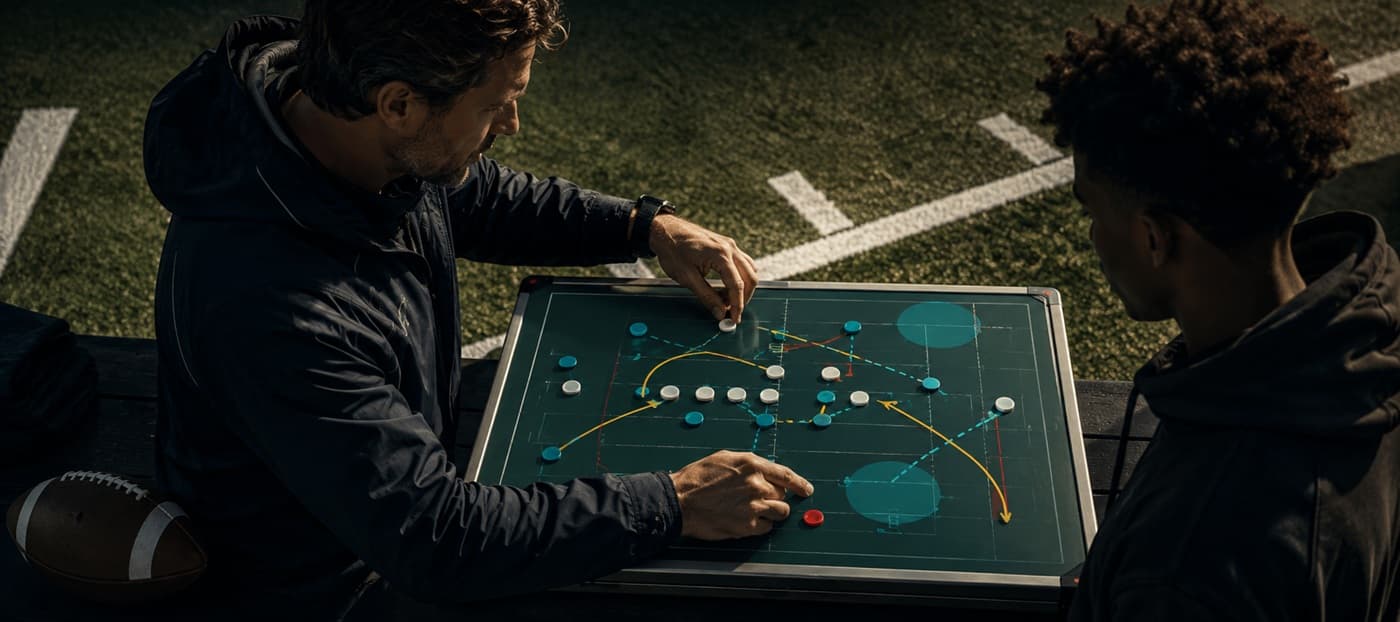
A personnel group in football describes the types of players a team has on the field for a particular play. On offense, coaches commonly use a two-digit numbering system such as 11 personnel, 12 personnel, or 21 personnel. On defense, you are more likely to hear package names such as base, nickel, and dime.
For offensive personnel numbers, the common convention is straightforward:
- First digit = number of running backs
- Second digit = number of tight ends
- Wide receivers are usually inferred from the remaining eligible skill-position spots
So 11 personnel means one running back and one tight end. With five offensive skill-position players available in a standard grouping, that normally leaves three wide receivers.
That gives you:
1 RB + 1 TE + 3 WR = 11 personnel
The most important distinction to understand is this:
Personnel describes who is on the field. Formation describes where those players line up.
A team can use 11 personnel and arrange those players in a 2x2 formation, trips, bunch, empty, or another alignment. The same personnel group can also run many different plays.
Personnel is the cast of players. Formation is where they stand. The play call tells them what to do.
How Offensive Personnel Numbers WorkLink to this section
Football personnel terminology can look like code until you know how to read it.
Take 12 personnel.
The first digit tells you there is:
- 1 running back
The second tells you there are:
- 2 tight ends
Five offensive linemen and the quarterback account for six players. That leaves five skill-position players.
If one is a running back and two are tight ends, the remaining two are generally wide receivers:
1 RB + 2 TE + 2 WR = 12 personnel
Now look at 21 personnel:
- 2 running backs
- 1 tight end
- 2 wide receivers
Or 10 personnel:
- 1 running back
- 0 tight ends
- 4 wide receivers
The numbering system gives you a quick description of the offensive skill-position grouping without needing to list every player individually.
Common Offensive Personnel GroupsLink to this section
| Personnel | RB | TE | WR | General flexibility |
|---|---|---|---|---|
| 10 | 1 | 0 | 4 | Spreads four receivers while retaining a back for runs, protection, or routes |
| 11 | 1 | 1 | 3 | Highly flexible balance of receiving, blocking, and backfield options |
| 12 | 1 | 2 | 2 | Can create either heavy-looking sets or spread formations depending on TE alignment |
| 13 | 1 | 3 | 1 | Adds multiple tight ends for blocking surfaces while retaining passing possibilities |
| 20 | 2 | 0 | 3 | Two-back structure with three receivers and no traditional tight end |
| 21 | 2 | 1 | 2 | Traditional two-back versatility with a tight end and two receivers |
| 22 | 2 | 2 | 1 | Heavier grouping that can create multiple run surfaces and play-action possibilities |
These descriptions are tendencies and structural possibilities, not predictions.
A team can throw from 22 personnel.
It can run from 10 personnel.
It can spread the field with 12 personnel.
It can use 11 personnel in a tight, condensed formation.
The personnel label tells you which player types are present—not what the offense is required to do next.
What Is 11 Personnel?Link to this section
11 personnel means:
- 1 running back
- 1 tight end
- 3 wide receivers
It is one of the most useful personnel groups for understanding modern offensive flexibility because those five skill players can be arranged in many different ways.
For example, the same 11 personnel could appear as:
- Shotgun 2x2
- Shotgun trips
- Under-center singleback
- Tight or condensed formation
- Bunch
- Empty, with the running back or tight end detached from the backfield
- Motion into a new alignment before the snap
The offense could then call:
- Inside zone
- Outside zone
- A quick passing concept
- Play-action
- A screen
- A vertical passing concept
- A quarterback run
- Another play entirely
OpenPlay's Inside Zone and Slant-Flat help illustrate how the same broad personnel structure can support very different post-snap ideas.
That is why 11 personnel should not be read as shorthand for “passing formation.”
What Is 12 Personnel?Link to this section
12 personnel means:
- 1 running back
- 2 tight ends
- 2 wide receivers
Beginners sometimes assume that two tight ends automatically mean a heavy running formation.
That is not necessarily true.
The two tight ends might both be attached to the offensive line, creating a compact appearance.
Or one tight end might be attached while the other lines up:
- In the slot
- As a wing
- Wide like a receiver
- In motion
- In the backfield
An offense could even detach both tight ends and create a spread-looking formation while still technically using 12 personnel.
This flexibility becomes especially valuable when the tight ends can both block and receive.
If a defense treats the grouping as a heavy run package and puts slower defenders on the field, the offense may spread those defenders out.
If the defense answers with smaller coverage players, the offense may bring the tight ends closer to the formation and attack with the running game.
The personnel group has not changed. The formation and tactical problem have.
What Is 21 Personnel?Link to this section
21 personnel means:
- 2 running backs
- 1 tight end
- 2 wide receivers
Traditionally, the two backs might be a halfback and a fullback, but player roles vary by offensive system.
One back could:
- Carry the ball
- Lead-block
- Protect the quarterback
- Run a route
- Motion out of the backfield
The other might perform an entirely different combination of jobs.
A traditional-looking 21 personnel formation might place the quarterback under center, a fullback and halfback in the backfield, a tight end attached, and two receivers outside.
But that is only one possibility.
A versatile fullback or second running back can align in the slot, motion across the formation, or create a different pre-snap picture.
Again, personnel identifies the players, not their exact locations.
What Is 10 Personnel?Link to this section
10 personnel means:
- 1 running back
- 0 tight ends
- 4 wide receivers
This grouping puts four wide receivers on the field while retaining one running back.
A common structure might spread the defense horizontally with two receivers on each side.
But 10 personnel does not automatically mean pass.
The offense still has:
- Five offensive linemen
- A running back
- A quarterback
If the defense removes larger box defenders to cover the four receivers, the offense may find favorable numbers for the running game.
Likewise, the back can remain in protection or release as a fifth receiving threat.
The strategic value comes from forcing the defense to account for width without necessarily abandoning the run.
What Is 13 Personnel?Link to this section
13 personnel means:
- 1 running back
- 3 tight ends
- 1 wide receiver
This is a heavier grouping, but “heavy” should not be confused with “run only.”
Three tight ends can create several potential blocking surfaces, particularly when multiple players line up close to the offensive line.
But a tight end who can release into a route remains an eligible receiving threat.
The offense might use:
- Power running concepts
- Zone runs
- Play-action
- Bootlegs
- Tight-end releases
- Formations that spread one or more tight ends away from the core
The more multidimensional those tight ends are, the harder the personnel group may be to classify as purely run-oriented.
What Is 20 Personnel?Link to this section
20 personnel means:
- 2 running backs
- 0 tight ends
- 3 wide receivers
This creates a two-back grouping without a traditional tight end.
The backs might align:
- Together in the backfield
- On opposite sides of a shotgun quarterback
- With one in the slot
- With one in motion
- In pistol-style arrangements
This personnel can support option concepts, screens, split-flow action, multiple-back runs, protection adjustments, and passing concepts.
A defense therefore cannot simply assume that seeing two running backs means both will stay in the backfield.
What Is 22 Personnel?Link to this section
22 personnel means:
- 2 running backs
- 2 tight ends
- 1 wide receiver
This gives the offense several potential blockers near the formation.
It can be useful near the goal line, in short-yardage situations, or anywhere an offense wants to create a physical run threat.
But it still contains eligible receivers.
A play-action pass from a heavy formation can be particularly effective when defenders react aggressively to what appears to be a run.
The principle remains consistent:
Personnel can influence defensive expectations without guaranteeing the play call.
Personnel Is Not FormationLink to this section
This is the distinction worth remembering above everything else.
Suppose an offense sends out:
- 1 running back
- 1 tight end
- 3 wide receivers
That is 11 personnel.
Now imagine three different alignments.
Formation A: 2x2Link to this section
Two receiving threats are distributed to each side.
The running back remains beside the quarterback.
Formation B: TripsLink to this section
Three receiving threats line up to one side and one to the other.
Still 11 personnel.
Formation C: EmptyLink to this section
The running back moves out of the backfield, and the offense presents five receiving threats.
Still 11 personnel.
The personnel never changed because the same players remained on the field.
Only their locations changed.
See Offensive Formations for a deeper explanation of shotgun, pistol, trips, bunch, empty, condensed formations, receiver splits, and other alignments.
Personnel Is Not the Play CallLink to this section
Personnel also does not tell you which play is being run.
An offense could break the huddle in 11 personnel and call Inside Zone.
On the next snap, the same group might call Slant-Flat.
Then it could run play-action, a screen, a quarterback keeper, or something else entirely.
This is strategically important.
If the offense had to substitute every time it wanted to change between run and pass, the defense would receive an obvious clue.
A versatile personnel group lets the offense change the tactical problem without changing players.
Why Teams Substitute PersonnelLink to this section
Offenses substitute because different players provide different abilities.
A team may want:
- Another wide receiver
- Another tight end
- A fullback
- An extra running back
- A stronger blocker
- A better receiving matchup
- A player with a particular skill set
- A package designed for short yardage
- A package designed to spread the defense
But every substitution can also communicate information.
If a team removes two receivers and sends in extra tight ends, the defense sees it.
That may cause the defense to substitute as well.
Personnel decisions therefore create a pre-snap strategic exchange.
The offense asks:
Which five skill players create the problem we want?
The defense asks:
Which defenders give us the best answer?
Defensive Personnel Does Not Use the Same Numbering SystemLink to this section
Defensive personnel is usually described differently.
You may hear terms such as:
- Base
- Nickel
- Dime
- Goal-line package
- Heavy front
- Big nickel
- Other team-specific package names
These labels generally describe the mix of defensive linemen, linebackers, and defensive backs.
Unlike offensive personnel numbers, however, defensive terminology is less standardized.
A team's “base defense” could be structurally different from another team's base defense.
A nickel package may replace a linebacker in one system but alter the front more significantly in another.
It is more useful to understand the purpose of the package than to assume every roster uses identical definitions.
What Is Base Defensive Personnel?Link to this section
Base personnel means the defense's foundational personnel grouping.
Historically, familiar examples include structures commonly described as:
- 4 defensive linemen, 3 linebackers, 4 defensive backs
- 3 defensive linemen, 4 linebackers, 4 defensive backs
Those descriptions gave rise to labels such as 4-3 and 3-4.
Modern defenses blur these categories considerably because edge defenders can function like linebackers on one play and defensive linemen on another.
Personnel roles can also change after the snap.
The useful general principle is that base personnel usually contains fewer defensive backs than nickel or dime packages and is designed to provide a balance against both running and passing threats.
For more on the players nearest the line of scrimmage, see Defensive Fronts.
What Is Nickel Personnel?Link to this section
A nickel defense normally puts five defensive backs on the field.
The fifth defensive back is commonly called the nickel or nickelback.
A traditional version might include:
- 4 defensive linemen
- 2 linebackers
- 5 defensive backs
But that exact structure is not mandatory.
A defense could use different fronts while still having five defensive backs on the field.
Nickel personnel often gives the defense another coverage-capable player to handle:
- Slot receivers
- Multiple-receiver formations
- Passing situations
- Mobile tight ends
- Space-oriented offenses
But nickel should not be interpreted as “pass defense only.”
Modern nickel defenders may need to:
- Cover receivers
- Defend the run
- Blitz
- Fit gaps
- Set an edge
- Tackle in space
The success of the package depends heavily on the skills of the players involved.
What Is a Dime Defense?Link to this section
A dime defense normally uses six defensive backs.
Compared with nickel, the defense adds yet another defensive back, usually at the expense of a linebacker or another front player depending on the system.
Dime packages can be useful when a defense wants more:
- Speed
- Coverage ability
- Matchup flexibility
- Defenders capable of operating in open space
You may see dime in situations such as long-yardage downs, but it is not restricted to one down or distance.
Some defenses use specialized defensive backs who can function partly like linebackers, making the distinction between “small” and “heavy” personnel less obvious than the names suggest.
The term dime follows the same informal naming idea as nickel: if five defensive backs is nickel, six became dime.
Heavier Defensive PackagesLink to this section
Defenses can move in the other direction as well.
Against offenses showing multiple backs, tight ends, or short-yardage intentions, a defense may substitute larger players onto the field.
A heavier defensive package might include:
- Additional defensive linemen
- Larger linebackers
- Fewer defensive backs
- Players selected specifically for interior run defense
Goal-line defense is an obvious example.
If the offense needs only a yard near the end zone, the defense may value immediate strength at the line of scrimmage more than deep-field coverage.
But even a heavy defensive package must respect eligible receivers.
If those tight ends release into routes, the defense still needs someone capable of covering them.
Why Defenses SubstituteLink to this section
Defensive substitutions are largely about matching threats.
Suppose the offense sends four wide receivers onto the field.
The defense might answer with nickel or dime personnel because it wants enough defenders who can cover in space.
Now suppose the offense brings in a second tight end.
The defense might respond with a bigger linebacker or defensive lineman.
That sounds simple, but offenses deliberately make the decision difficult.
If the offense's larger personnel can still spread the field, the defense risks being too slow.
If the defense responds with smaller players, the offense may create favorable blocking matchups.
Personnel strategy is therefore not simply:
Big offense = big defense. Small offense = small defense.
It is a matchup problem.
Why Versatile Tight Ends Complicate Defensive PersonnelLink to this section
Few positions demonstrate personnel conflict better than tight end.
Imagine an offense has a tight end who can:
- Block a defensive end
- Lead through a running lane
- Run from the slot
- Catch passes downfield
- Align wide against a defensive back
Now imagine it has two such players.
That offense can use 12 personnel and present a heavy formation with both tight ends attached.
If the defense responds with larger linebackers, the offense can detach the tight ends and spread them across the field.
If the defense instead uses smaller coverage personnel, the offense can condense the formation and ask those defenders to handle the running game.
The personnel group stays the same while the formation changes.
This is sometimes described as creating a personnel conflict: whichever type of defender the defense chooses may face an uncomfortable matchup somewhere.
How 12 Personnel Can Look Heavy or SpreadLink to this section
Consider a fictional offense using 12 personnel.
The five skill players are:
- RB
- TE
- TE
- WR
- WR
Heavy appearanceLink to this section
Both tight ends line up attached to the offensive line.
The offense looks compact and capable of running in either direction.
The defense may bring an extra defender closer to the box.
Spread appearanceLink to this section
One tight end moves into each slot while the wide receivers stay outside.
The offense now appears much more spread out.
But the personnel is still:
1 RB + 2 TE + 2 WR
Nothing about the personnel designation changed.
Only the formation changed.
This is why identifying both personnel and formation gives you more information than either one alone.
How 11 Personnel Can Create Multiple PicturesLink to this section
Now consider 11 personnel:
- RB
- TE
- WR
- WR
- WR
The offense could line up in:
2x2 shotgunLink to this section
Two receiving threats on each side, with the running back in the backfield.
TripsLink to this section
Three receiving threats to one side.
BunchLink to this section
Three players compressed together on one side.
EmptyLink to this section
The running back leaves the backfield.
Condensed formationLink to this section
Receivers move closer to the offensive line.
Each alignment presents the defense with different spacing.
Yet the defense may not be able to substitute because the offense has not changed personnel.
That flexibility is one reason personnel identification is only the beginning of pre-snap analysis.
Defenses Often Match Personnel Before Formation Is FinalLink to this section
Substitution decisions frequently begin as soon as the defense sees which players the offense sends onto the field.
That can happen before the offense has revealed its final formation.
Suppose the defense sees 11 personnel enter.
It may respond with nickel.
Then the offense lines up in a condensed formation with the tight end attached and all three receivers positioned closer to the formation.
The defense has already chosen nickel, but now those defensive backs may have significant run-support responsibilities.
Alternatively, the defense could stay in a larger package and then watch the offense spread the same personnel across the width of the field.
This sequencing is part of the personnel chess match.
How Substitutions Reveal InformationLink to this section
When either team substitutes, the opponent learns something.
An offensive substitution can suggest:
- A different personnel grouping
- A short-yardage package
- A receiver-heavy package
- A specialized role
- A possible formation family
A defensive substitution may suggest:
- Nickel or dime
- A heavier front
- A particular matchup plan
- A pressure package
- A short-yardage response
None of those clues proves what the next play or coverage will be.
Teams deliberately disguise intentions.
But substitutions are still useful pre-snap information.
This is one of the layers involved in reading a defense.
Personnel and Defensive CoverageLink to this section
Personnel also interacts with coverage.
Imagine the offense uses 11 personnel and places three receivers on the field.
A defense could respond with nickel personnel and still play:
- Man coverage
- Zone coverage
- Match coverage
- Pressure
- Various split-safety or single-high structures
Nickel is a personnel package, not a coverage.
Likewise, a defense in base personnel could play man or zone.
This distinction parallels the offensive side:
- Defensive personnel: Who is on the field?
- Defensive front: How are defenders near the line arranged?
- Coverage: How are passing threats defended?
- Call: What is each defender assigned to do?
A concept such as Cover 1 Robber describes a coverage structure and responsibilities; it should not be confused with the defense's personnel package.
For the broader coverage distinction, see Man vs. Zone Coverage.
Fictional Example: 11 Personnel Against NickelLink to this section
The offense sends out:
- 1 RB
- 1 TE
- 3 WR
The defense responds with five defensive backs.
The offense then aligns in shotgun trips.
The defense now has to determine:
- Who covers the three-receiver side?
- How will the tight end be treated?
- How many defenders remain in the box?
- What happens if the running back releases into a route?
- Who fits the run if the offense calls inside zone?
Now suppose the offense calls Inside Zone.
On the next snap, without substituting, it calls Slant-Flat.
The defense could not safely assume that the offensive personnel identified either play.
Fictional Example: 12 Personnel Creates a Matchup ProblemLink to this section
The offense enters with:
- 1 RB
- 2 TE
- 2 WR
The defense answers with a heavier package.
The offense initially shows both tight ends close to the line but then shifts one into the slot.
Now one of the defense's larger players may have to defend that tight end in space.
On the next series, the defense responds to the same 12 personnel with a smaller nickel grouping.
This time the offense keeps both tight ends attached and runs toward one of the smaller defensive edges.
Neither result is guaranteed.
The example simply demonstrates how versatile personnel can make defensive matching more difficult.
Fictional Example: Third-and-Long Does Not Tell the Whole StoryLink to this section
It is third-and-10.
The offense uses 10 personnel:
- 1 RB
- 4 WR
- 0 TE
The defense responds with dime personnel.
That seems naturally suited to a passing situation.
But suppose the defense spreads six defensive backs across the field and leaves a lighter box.
The offense may decide that a run has a favorable matchup, especially if it plans to treat fourth down as another potential offensive down.
Down and distance matter, but so do personnel, formation, field position, score, clock, and coaching philosophy.
Football strategy rarely reduces to one label.
How to Identify Personnel Before the SnapLink to this section
When watching football, start by identifying the five offensive skill-position players.
Ask:
1. How many running backs?Link to this section
Count players functioning as backs in the personnel grouping, not merely who is currently standing in the backfield.
2. How many tight ends?Link to this section
Look for players designated or used as tight ends, remembering they may be detached from the offensive line.
3. Infer the wide receiversLink to this section
Subtract the running backs and tight ends from the five skill-position spots.
For example:
1 RB + 1 TE = 2
Five minus two leaves:
3 WR
So that is 11 personnel.
Then move to the next question:
Where did those players line up?
That is formation.
Then ask:
What is the defense doing in response?
Now you are beginning to connect personnel, formation, matchup, and scheme.
Common Misconceptions About Personnel GroupsLink to this section
“11 personnel means 11 players.”Link to this section
The offense always has 11 players in standard football. The digits refer specifically to running backs and tight ends.
“The first 1 in 11 means one receiver.”Link to this section
No. The first digit is the number of running backs. The second is the number of tight ends.
“12 personnel means 12 offensive players.”Link to this section
No. It means one running back and two tight ends.
“11 personnel means pass.”Link to this section
No. Teams can run or pass from 11 personnel.
“22 personnel means run.”Link to this section
It can create a strong running structure, but eligible receivers remain available and play-action or other passes are possible.
“Personnel and formation are interchangeable.”Link to this section
No. Personnel describes the types of players on the field; formation describes where they align.
“Nickel means zone coverage.”Link to this section
No. Nickel means five defensive backs. The defense can play many different coverages from nickel personnel.
“Dime always means prevent defense.”Link to this section
No. Dime simply refers broadly to a package with six defensive backs. How those players are deployed depends on the defensive call.
“A tight end must line up next to a tackle.”Link to this section
No. Tight ends can align attached, in the slot, as wings, in the backfield, or even wide depending on the system and legal formation.
Why Personnel Groups MatterLink to this section
Personnel provides one of the first clues about what each team is trying to accomplish.
Before formation, motion, protection, route concepts, and defensive coverage fully reveal themselves, the players entering the field already create strategic possibilities.
A good personnel package can give an offense:
- Run-pass flexibility
- Matchup advantages
- Formation versatility
- Protection options
- Motion possibilities
- Fewer obvious tendencies
A good defensive package tries to answer those threats without becoming vulnerable somewhere else.
The key is not memorizing that one personnel group is “running personnel” and another is “passing personnel.”
The better question is:
What can these particular players do, and how can the offense arrange them?
That is where personnel becomes football strategy rather than vocabulary.
OpenPlay uses personnel labels alongside formations and assignments in its structured play definitions. When you look at an OpenPlay play diagram, the personnel label tells you which kinds of offensive pieces are available, while the formation and assignments show how those pieces are being used.
Frequently Asked QuestionsLink to this section
What is 11 personnel in football?Link to this section
11 personnel means one running back and one tight end. The remaining three skill-position players are normally wide receivers, giving the offense 1 RB, 1 TE, and 3 WR.
What does 12 personnel mean?Link to this section
12 personnel means one running back and two tight ends, normally leaving two wide receivers. It can be used in compact, heavy-looking formations or spread formations depending on where the tight ends align.
What is 21 personnel?Link to this section
21 personnel means two running backs, one tight end, and normally two wide receivers. The backs may have different roles, and teams can use the grouping for both running and passing concepts.
What is the difference between personnel and formation?Link to this section
Personnel describes who is on the field. Formation describes where those players line up. The same 11 personnel group could appear in trips, 2x2, bunch, empty, or another formation.
What is nickel personnel?Link to this section
Nickel personnel generally means the defense has five defensive backs on the field. The exact mix of defensive linemen and linebackers varies by system.
What is a dime defense?Link to this section
A dime defense normally uses six defensive backs. It can provide additional coverage speed and matchup flexibility, but it does not automatically identify the coverage being played.
Why do football teams change personnel?Link to this section
Teams substitute to create better matchups, add blocking or receiving skills, adjust to down and distance, answer the opponent's personnel, or create a specific tactical package.
Does 12 personnel mean the offense will run?Link to this section
No. Two tight ends can provide additional blocking, but they can also run routes or align away from the offensive line. Modern offenses can run and pass from the same personnel group.
Can 11 personnel be an empty formation?Link to this section
Yes. Personnel describes which players are participating, not where they stand. A running back or tight end can move away from the backfield, creating an empty formation without changing the personnel group.
Is nickel a formation or a coverage?Link to this section
Nickel is primarily a personnel package indicating five defensive backs. Those defenders can then align in different fronts and play many forms of man, zone, or match coverage.
Take it to the field