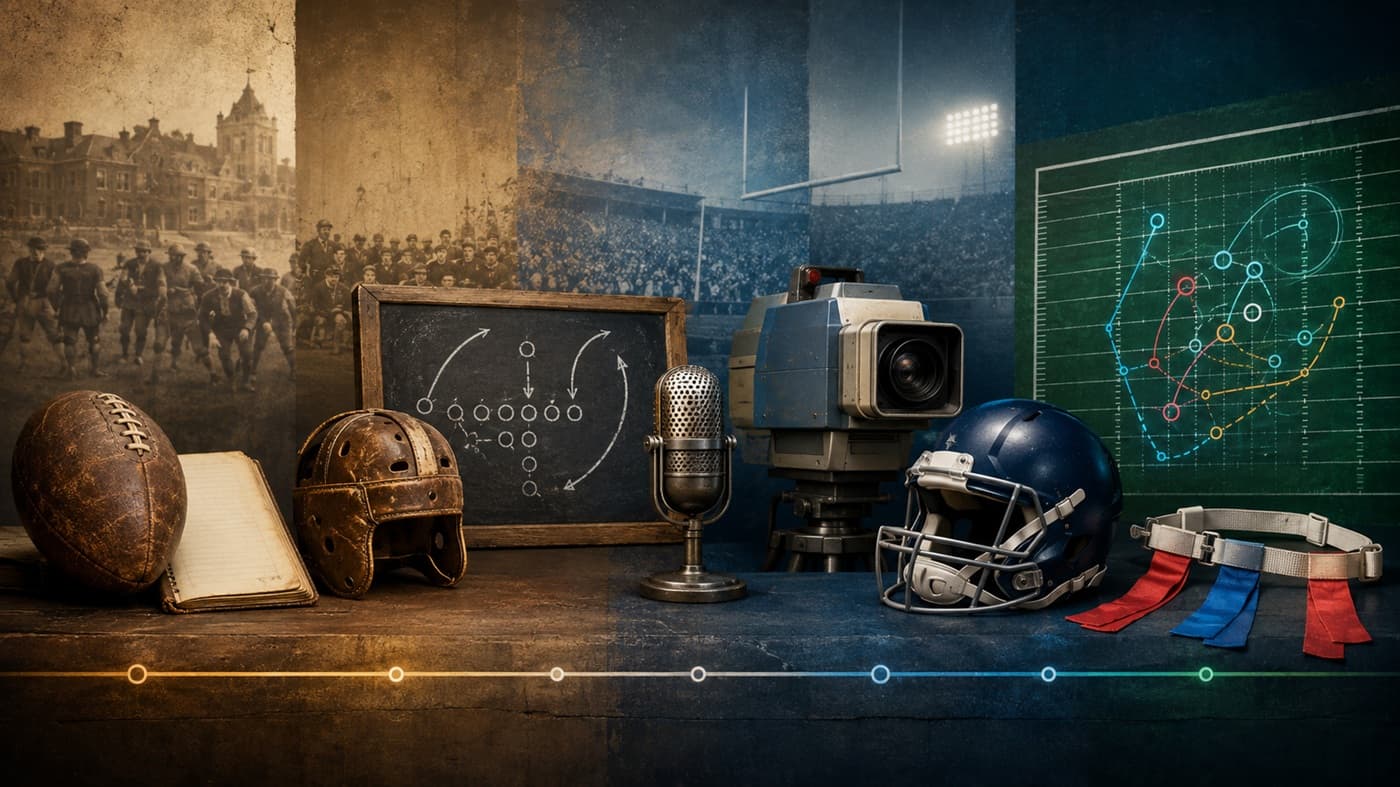
The history of football is not a simple story in which one person invented a finished sport. It is a history of adaptation. Schools began with different local versions of football, borrowed from association football and rugby, and then argued over how many players should take the field, how possession should begin, how a team should advance the ball, and what kinds of contact should be permitted.
The game became recognizable through repeated rule changes. The line of scrimmage changed how possession began. Downs created a measured contest for territory. The forward pass opened space that mass running formations had compressed. Professional leagues added schedules, contracts, championships, drafts, and national media. Television changed how plays were presented to audiences and how the sport was financed. Modern concerns about head impacts, player health, access, compensation, and technology continue to reshape football.
This page provides the broad map. Separate Football Explained articles will examine the major eras and debates in greater detail.
Football grew from a family of related games
During the nineteenth century, the word football described several related games rather than one universal set of rules. Some emphasized kicking a round ball toward a goal. Others allowed players to carry an oval ball, tackle opponents, and contest possession in ways associated with rugby.
American colleges adopted different versions. A team might therefore prepare not only for an opponent but also for the opponent’s preferred rules. The gradual creation of shared rules was essential. Without standardization, football could remain a collection of local contests, but it could not become a stable intercollegiate sport.
Why 1869 is treated as a starting point
On November 6, 1869, Rutgers and Princeton played a contest that is commonly recognized as the first intercollegiate football game. Rutgers won, but the game did not resemble a modern contest. The teams used large groups of players, and the rules were closer to a kicking game than to the modern combination of running and passing.
The importance of 1869 is therefore institutional as much as tactical. Two colleges arranged a football contest against one another, helping establish the idea that schools could meet under agreed rules and build continuing competition.
Rules made the game distinctly American
In the 1870s and 1880s, colleges moved toward rugby-influenced play, but the American game soon developed its own structure. Walter Camp became the figure most closely associated with many formative changes. Reforms attributed to Camp and the rulemaking bodies of the period helped establish eleven-player teams, the line of scrimmage, the snap, the quarterback position, and a requirement to gain territory within a limited number of downs.
Those ideas changed football from a largely continuous struggle for the ball into a sequence of organized plays. Teams could huddle, align in formations, assign individual jobs, and choose a planned method of attacking a defined line to gain. The logic that powers a modern playbook—and an OpenPlay Football record—begins with that transformation.
The early game faced a crisis over violence
Late-nineteenth- and early-twentieth-century football often concentrated many players into mass formations. Protective equipment was limited, and dangerous collisions generated public criticism. The 1905 season became a focal point for reports of serious injuries and deaths, leading colleges, political leaders, and rulemakers to confront whether the game could continue without major change.
The reform movement contributed to the creation of the organization that became the NCAA. In 1906, the forward pass was legalized as part of a broader attempt to open the field and reduce the dominance of tightly packed mass play. The pass did not immediately turn football into a modern aerial game; early restrictions made it risky and unfamiliar. Its importance grew as coaches learned how spacing and eligible receivers could stress a defense.
College football became important before professional football
For much of football’s early history, colleges supplied the game’s most visible institutions, rivalries, traditions, and rule debates. Universities could draw students, alumni, newspapers, and local communities into recurring contests. Thanksgiving games, marching bands, school songs, cheerleading, and regional rivalries helped make football part of campus and public culture.
The college game was never one uniform style. Rules became more standardized, but teams developed different formations and strategic identities. That diversity remains one of college football’s defining characteristics.
Professional football needed organization and legitimacy
Players were compensated before a durable national professional league existed, but early professional football was unstable. Teams appeared and disappeared, schedules could be uncertain, and competition for players created financial and organizational problems.
In 1920, club representatives formed the American Professional Football Association in Canton, Ohio. The organization adopted the National Football League name in 1922. A league structure made it easier to establish membership, schedules, standings, player rules, and recognized championships, even though professional football still took decades to achieve its later national prominence.
Radio and television turned football into a national spectacle
Radio allowed listeners to imagine a game unfolding beyond the stadium. Television went further by making formations, collisions, personalities, and crowd rituals visible in living rooms. Professional football benefited especially from television’s growth during the 1950s, when national exposure helped teams and players reach audiences far beyond their home markets.
The competition between the established NFL and the newer American Football League intensified professional football during the 1960s. Their merger agreement created an annual championship meeting between the leagues. The first AFL–NFL World Championship Game was played in January 1967 and later became known as Super Bowl I. The championship game eventually grew into both a sporting event and a major entertainment platform.
Broadcasting also influenced how fans understand strategy. Camera angles, instant replay, telestration, graphics, and commentary made concepts such as coverage rotation and route combinations easier to discuss. OpenPlay Football’s visual language belongs to that longer tradition of turning the hidden structure of a play into something viewers can see.
Football strategy keeps changing
Football’s rules define a framework, but coaches continually search for new ways to use space, timing, personnel, and deception. The single wing, T formation, option football, West Coast passing concepts, zone running, spread offenses, run-pass options, pattern-match coverage, simulated pressure, and modern analytics each reflect different answers to the same basic problem: how can one side create an advantage before or after the snap?
Innovation often moves in several directions. College teams may adopt new formations rapidly because their personnel and competitive environments differ from professional teams. Professional teams may refine concepts around specialized players and more extensive practice systems. Defensive ideas then evolve to answer offensive success, and offenses respond again.
Many concepts that appear new are adaptations of older principles. Motion still tests communication. Play-action still manipulates defenders whose responsibilities begin with the run. Formations still create numbers and leverage. Technology changes the presentation, but the contest remains rooted in alignment, assignment, timing, and execution.
Equipment improved, but safety questions did not disappear
Early players wore little protection by modern standards. Helmets, shoulder pads, face masks, mouthguards, playing surfaces, medical procedures, and equipment testing developed over time. Rulemakers also changed definitions of legal contact and added protections for players considered especially vulnerable.
Equipment can reduce some risks, but it cannot remove the forces created by a collision sport. Concussions and repetitive head impacts have become central subjects in medicine, public policy, youth-sports decisions, rulemaking, and the ethics of football. The history of safety is therefore not a completed progression from dangerous to safe. It is an ongoing effort to understand risk, change behavior, improve recognition, and decide what level of contact is acceptable at different ages and levels.
Football is larger than one league or one form of the game
The sport includes youth, high school, college, club, amateur, semi-professional, and professional competition. Tackle football remains the most familiar form in the United States, but flag football has grown as a distinct game with its own spacing, timing, and defensive techniques.
Women have participated in football as players, coaches, officials, administrators, journalists, and cheerleaders, often while challenging assumptions about who belongs in the sport. International federations and national teams have also expanded the game beyond North America. Flag football’s scheduled Olympic debut at the Los Angeles 2028 Games places one version of football on a new global stage.
Football history is still being written
Modern football is shaped by questions that earlier generations could not have anticipated in their current form: digital player tracking, artificial intelligence, name-image-and-likeness compensation, transfer rules, sports wagering, streaming media, international expansion, and new medical evidence.
History does not provide one automatic answer to these debates. It does show that football has survived by changing. The same sport that once resisted the forward pass later built entire offenses around it. The same professional game that struggled for public legitimacy later became a television institution. Understanding that pattern makes it easier to evaluate current claims that a proposed change will either save football or destroy it.