Learn Football
Running Plays in American Football
Running concepts coordinate blocking angles and a ball carrier's read to attack defined gaps or stretch the defense.
25 minute read
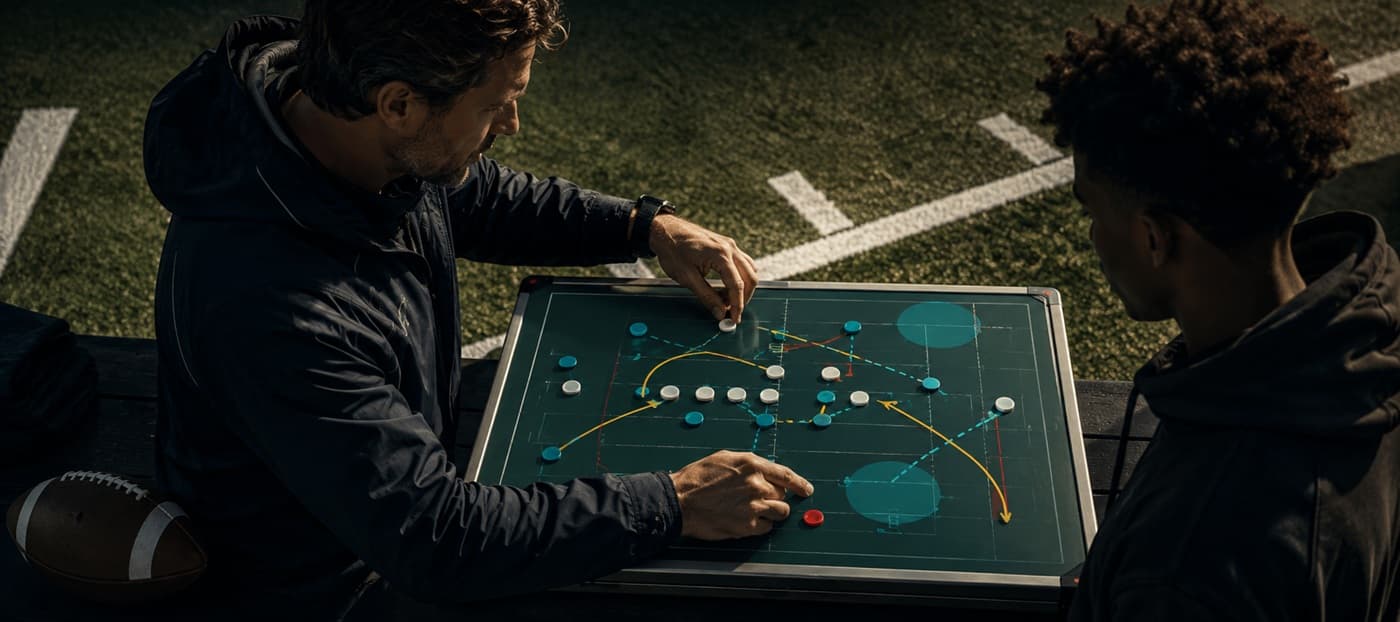
A running play is more than handing the football to a running back and asking the offensive line to move defenders. A well-designed run coordinates several things at once:
- Blocking assignments — which defenders each blocker is responsible for
- Point of attack or aiming point — where the play initially intends to threaten the defense
- Defensive leverage — where defenders are positioned relative to blockers and running lanes
- The ball carrier's track and reads — where the runner starts and what the runner watches
- Post-snap adjustments — how blockers and the runner react when defenders move, penetrate, flow, or get blocked differently than expected
That is why two runs that initially look similar can work in very different ways.
The major run-game families include zone concepts, such as Inside Zone and Outside Zone, and gap concepts, such as Power and Counter. Other ideas—including Duo, Trap, Draw, Sweep, and Toss—add further ways to attack a defense.
The purpose of this guide is not to turn every run concept into a complete coaching manual. Instead, it gives you the framework needed to understand what you see in a football game or play diagram and then explore individual concepts in greater detail.
Start With Football GapsLink to this section
To understand running plays, first understand gaps.
Gaps are the spaces between offensive blockers. Coaches use letter names so players can quickly identify areas of the line.
A simplified offensive line looks like this:
        C gap   B gap   A gap   A gap   B gap   C gap
          |       |       |       |       |       |
       TE   LT      LG      C      RG      RT   TE
The terminology can vary slightly depending on the formation and coaching system, but the basic structure is widely used.
| Area | Basic location | Why it matters |
|---|---|---|
| A gap | Between center and guard | Interior runs often threaten this area |
| B gap | Between guard and tackle | Common target or entry area for several run concepts |
| C gap | Outside the tackle or between tackle and attached tight end | Important for off-tackle runs, Power, Counter, and edge-setting |
| Edge/perimeter | Outside the core formation | Where sweeps, tosses, wide runs, and bounce decisions may develop |
A running play does not always end in the gap it initially threatens.
A play aimed toward a B gap might eventually cut into an A gap because a defender widened. A runner on an outside-zone track may press toward the perimeter before cutting sharply inside.
Think of gaps as the structure of the defense and blocking surface, not railroad tracks that the ball carrier must follow no matter what happens.
How a Running Play WorksLink to this section
Imagine an offense calls a run to the right.
Before the snap, the offense has a plan for:
- How the line will block the defensive front
- Whether blockers will work individually or together
- Which linebackers need to be reached
- Whether anyone will pull across the formation
- Where the running back will initially aim
- Which defender or gap the runner will read
- Who is responsible for the edge
- Whether the quarterback has any read, fake, or option responsibility
Then the ball is snapped.
The defense may immediately change the picture.
A defensive tackle can slant into another gap. A linebacker can shoot downhill. An edge defender can crash inside. A safety can enter the run fit. A blocker can win leverage in an unexpected direction.
Good run concepts are built with rules that allow the offense to react to these movements rather than requiring every defender to remain exactly where the offense expected.
That ability to solve a moving problem is fundamental to the run game.
Zone Blocking vs. Gap BlockingLink to this section
One of the most useful beginner distinctions is between zone and gap run concepts.
The distinction is not as simple as “zone means everyone blocks an area” and “gap means everyone blocks one specific defender.” Real blocking systems are more detailed than that.
At a high level:
Zone conceptsLink to this section
Zone schemes generally ask offensive linemen to work according to rules based on defensive alignment, leverage, and movement.
Adjacent linemen may use combination blocks, initially working together against a defensive lineman before one blocker climbs to a linebacker.
The running back often has a defined track but must read how blocks develop.
Gap conceptsLink to this section
Gap schemes generally create specific blocking angles and often use down blocks and pulling blockers to build numbers or leverage near the point of attack.
Power and Counter are classic examples.
The runner still has reads and adjustments, but the architecture of the play differs from zone.
USA Football coaching material distinguishes the horizontal combination blocks commonly associated with zone concepts from the more vertical double teams often found in gap schemes such as Power and Counter.
Neither family is inherently better. Teams choose concepts based on personnel, philosophy, formations, defensive structure, and how they want different plays to complement one another.
Major Running Concepts ComparedLink to this section
| Concept | Family | General aiming point | Blocking idea | Runner's key problem |
|---|---|---|---|---|
| Inside Zone | Zone | Interior, often around inside gaps | Zone rules, combination blocks, work to linebackers | Find the best interior entry based on leverage |
| Outside Zone | Zone | Wider track toward outside leg/edge area | Stretch defense horizontally, reach or displace defenders | Press outside while recognizing bounce, cut, or cutback opportunities |
| Power | Gap | Interior/off-tackle area | Down blocks plus a pulling blocker leading toward the point of attack | Follow leverage and the puller's path while reacting to penetration |
| Counter | Gap | Often attacks opposite initial backfield action | Misdirection plus one or more pullers depending on system | Allow deception and blocks to develop, then hit the created lane |
| Duo | Often classified as gap/man-like | Interior | Vertical double teams with reads based on linebacker movement | Read linebacker leverage and choose the available interior lane |
| Trap | Gap/man concept | Interior | Allow a defender penetration, then block that defender with a puller | Time the path behind the trap block |
| Sweep/Toss | Perimeter | Outside edge | Get blockers and ball carrier toward perimeter | Win or turn the edge without being forced too wide |
| Draw | Delay/misdirection | Usually interior | Initially resemble pass protection before creating run lanes | Use defensive pass reaction to find developing space |
Exact definitions and coaching rules vary. Different teams may teach similar concepts with different aiming points, footwork, reads, and terminology.
Inside ZoneLink to this section
Inside Zone is one of football's foundational running concepts.
The offense is trying to create movement and useful leverage across the front while giving the runner options inside.
A common misconception is that Inside Zone means:
“The running back runs into one assigned inside gap.”
That misses the central idea.
The back normally begins with a defined track or aiming point, but the actual entry can change based on how defenders react and how blocks develop.
Combination blocksLink to this section
Suppose a guard and tackle have a defensive lineman positioned between them, with a linebacker behind that defender.
Rather than treating those defenders as two unrelated one-on-one assignments, the two offensive linemen may initially work together on the defensive lineman.
As the block develops, one lineman can come off and work to the linebacker.
That is a combination block.
USA Football's teaching material on Inside Zone emphasizes covered/uncovered rules and combination blocks that allow linemen to handle different defensive alignments while eventually working to the second level.
Working to the second levelLink to this section
Football defenses are often described in levels.
The first level includes defenders on or near the line of scrimmage.
The second level typically includes linebackers.
An offensive lineman cannot simply focus on moving the nearest defensive tackle forever. If a linebacker remains free to step into the running lane, that defender may make the tackle.
Zone blocking therefore requires timing:
- Secure the immediate defensive threat.
- Create movement or control.
- Release a blocker toward the second level when appropriate.
Leaving too early can allow a defensive lineman to split the block.
Leaving too late can allow the linebacker to enter the lane untouched.
The running back's readLink to this section
Different systems teach Inside Zone differently, so there is no universal read sequence.
But conceptually the back is looking at how defenders and blockers create leverage.
The intended path may:
- Open as designed
- Widen
- Close completely
- Create a lane farther inside
- Produce a backside cut
OpenPlay's Inside Zone animation is useful for watching the relationship between the offensive line's coordinated movement and the running back's initial track. Focus on how the blocking structure creates possibilities rather than viewing the runner's drawn path as the only place the play could ever go.
Outside ZoneLink to this section
Outside Zone uses related zone principles but stresses the defense more horizontally.
The offensive line generally works to create lateral movement and leverage while the running back threatens a wider path.
That does not mean the play must reach the sideline.
The wide track puts defenders under pressure.
If defenders remain inside, the runner may continue toward the edge.
If defenders race outside, they can create lanes behind their movement.
USA Football describes Outside Zone techniques that attempt to widen or reach defenders while preventing inside penetration, helping establish a clearer read for the runner.
Stretching the defenseLink to this section
Imagine linebackers seeing the offensive line and running back moving toward the right.
They must react.
If they are too slow, the runner might reach the perimeter.
If they run too aggressively toward the sideline, they can lose leverage against an inside cut.
The offense is forcing the defense to move laterally while trying to create an advantageous running lane.
Bounce, cut, and cutbackLink to this section
Terminology differs, but Outside Zone runners are often taught a progression that involves possibilities such as:
- Continuing toward the outside
- Making a decisive cut into an available lane
- Cutting back behind defenders who have over-pursued
The runner is not improvising randomly.
The back's track and read structure are designed to make the defense reveal where the best opportunity is.
OpenPlay's Outside Zone animation can help you observe the horizontal stress of the concept. Watch the relationship between the runner's initial path and the blockers trying to establish leverage across the front.
What Does “Zone” Actually Mean?Link to this section
A common beginner misunderstanding is that zone blocking means:
“Each lineman blocks a geographic zone and waits for someone to enter it.”
That description is too simplistic.
Zone systems use blocking rules that help linemen determine responsibilities based on:
- Defensive alignment
- Whether a blocker is covered or uncovered
- The direction of the play
- Adjacent blockers
- Defender movement after the snap
- Linebacker location
The objective is still to block actual defenders.
The “zone” idea refers more to the coordinated rules governing how the line accounts for the defensive front than to players guarding empty patches of grass.
PowerLink to this section
Power is one of the classic gap-scheme runs.
Although teams teach it in different ways, a familiar version combines:
- Down blocks
- A blocker handling or kicking out an edge defender
- A backside offensive lineman pulling toward the play side
- A runner following the created structure
USA Football describes traditional Power as a gap-blocked concept that can use a backside pulling guard while creating favorable blocking angles at the point of attack.
What is a down block?Link to this section
A down block generally means blocking toward the interior or toward a defender aligned inside the blocker.
Instead of trying to reach a defender moving away, the offense attempts to use an advantageous angle to seal or displace that defender.
What is a pulling blocker?Link to this section
A puller is an offensive blocker who does not immediately block the defender in front of the original alignment.
Instead, that blocker moves laterally behind the line and enters another area of the formation.
On Power, a guard is commonly associated with this role.
The puller can become an extra blocker near the intended point of attack.
Kick-out and lead ideasLink to this section
A kick-out block attempts to force a defender outward, ideally creating an inside lane.
Another blocker may lead through that lane toward a linebacker or other defender.
Different versions of Power divide these assignments differently depending on personnel and formation.
OpenPlay's Power animation lets you watch the pulling action develop. Pay particular attention to how the offense is creating a new blocking angle instead of simply asking every lineman to drive straight forward.
CounterLink to this section
Counter is another major gap-family concept, and its name reflects the use of misdirection.
The offense initially gives the defense one picture and then attacks in another direction.
For example, backfield action may initially suggest movement one way while blockers pull toward the eventual point of attack in the opposite direction.
This can influence defenders who are trained to react quickly to offensive movement.
Why misdirection mattersLink to this section
Defenders cannot simply wait until the running back has the ball and then begin moving.
Linebackers and defensive linemen must react rapidly to:
- Offensive line movement
- Backfield flow
- Pulling blockers
- Tight-end movement
- Quarterback action
Counter attempts to use those reactions against the defense.
A linebacker who steps aggressively toward the initial action may make the eventual blocking angle easier for the offense.
Counter and pulling blockersLink to this section
Many Counter variations use pullers.
One blocker might kick out an edge defender while another leads through the created lane. Other versions use different personnel or blocking rules.
That is why “Counter” should be understood as a concept family rather than one universal diagram.
OpenPlay's Counter animation is especially useful for observing the contrast between the initial backfield action and the direction of the blocking scheme.
Zone vs. Gap RunsLink to this section
A useful beginner comparison looks like this:
| Zone concepts | Gap concepts |
|---|---|
| Blocking rules respond heavily to defender alignment and movement | Blocking design often creates planned angles and surfaces |
| Combination blocks are central | Down blocks and pullers are common |
| Runner frequently reads how multiple lanes develop | Runner often follows a more defined blocking structure |
| Inside Zone and Outside Zone are core examples | Power and Counter are core examples |
| Can create cutback lanes when defenders overrun the play | Can create extra numbers at the point of attack through pulling |
| Still blocks specific defenders | Still requires adjustment to defensive movement |
This distinction is useful, but football schemes do not always fit into perfectly isolated boxes.
Teams combine techniques, create variations, and use terminology differently.
The goal is to recognize the general architecture.
DuoLink to this section
Duo is an interior run that can look similar to Inside Zone at first glance because offensive linemen may create multiple double teams.
It is often discussed with gap or man-style concepts because of its emphasis on vertical combinations and how the offense accounts for linebackers.
The running back's read may involve the movement of a particular linebacker rather than the same landmarks associated with a team's zone system.
For a beginner, the main takeaway is:
Similar-looking blocks do not necessarily mean the running play is the same concept.
The runner's read and the blocking rules can distinguish two plays that look nearly identical from the stands.
TrapLink to this section
A Trap concept intentionally allows a particular defensive lineman to initially penetrate rather than blocking that defender directly from the original alignment.
A pulling blocker then attacks the penetrating defender from an angle.
The idea uses the defender's aggression against the defense.
Instead of fighting a powerful defensive lineman straight ahead, the offense may encourage penetration and then block that player from the side.
Trap is one example of why effective run blocking is not simply about overpowering the person directly in front of you.
Sweep and TossLink to this section
Sweep and toss concepts generally attack farther toward the perimeter.
The offense may:
- Toss the ball to the running back
- Pull offensive linemen
- Use receivers or tight ends as perimeter blockers
- Attempt to get the runner outside the defensive front
The defense's edge players become especially important.
If the defense maintains outside leverage and forces the runner back inside toward help, the play may compress.
If the offense seals or turns the edge, the runner may find open space outside.
DrawLink to this section
A draw attempts to make the defense initially react as though the offense is passing.
The quarterback and offensive line may present pass-like action before the ball is handed to a runner.
If defensive linemen rush aggressively upfield and linebackers react to pass, interior running space can develop behind them.
Draw concepts demonstrate how the running game and passing game can influence one another even without formal play-action.
Defensive Fronts Change the Blocking ProblemLink to this section
An offense cannot understand a run concept without accounting for the defensive front.
Suppose the offense calls Inside Zone.
The defense could show:
- A defender directly over the center
- Two defensive tackles shaded toward the guards
- A light box
- A heavy box
- An odd front
- A four-down front
- An extra safety close to the line
The play name remains Inside Zone, but the blocking combinations can change.
A lineman who expected help from the guard against one front may need a different combination against another.
A linebacker who was the second-level target in one alignment may move before the snap and change the responsibility.
This is why defensive fronts are essential to understanding the running game.
What Are Box Counts?Link to this section
The box is the area near the line of scrimmage where defenders are positioned to influence the interior run game.
A box count is a way of asking:
How many defenders are positioned close enough to become immediate run defenders?
Offenses use different counting systems, so there is no single universal formula.
Conceptually, however, the offense wants to know whether it has enough blockers to account for the defenders threatening the run.
Imagine an offense has six potential blockers near the core formation.
If the defense places an additional unaccounted-for defender in the box, the offense may need to:
- Change the blocking scheme
- Read that defender rather than block the player
- Bring another player into the blocking structure
- Motion someone
- Check to another play
- Accept the matchup
Box count helps explain why formation and personnel affect the run game.
See offensive formations and personnel groups for how teams change the pre-snap numbers without necessarily changing the underlying run concept.
What Is a Run Fit?Link to this section
A run fit describes how defenders account for running lanes or gaps when defending the run.
If the offense is trying to create lanes, the defense is trying to close them.
Different defenders may be responsible for:
- Interior gaps
- Cutback lanes
- The edge
- Quarterback runs
- Additional support from the secondary
A linebacker reading a zone play may step into a developing gap.
A safety may become an extra run defender.
An edge player may keep the runner from reaching the perimeter.
The offense and defense are therefore fighting over the same spatial structure.
The offense asks:
Can we create an open gap?
The defense asks:
Can every dangerous gap be accounted for?
Leverage Is More Important Than Simply Moving a DefenderLink to this section
Blocking is often described as pushing defenders backward.
Vertical movement can certainly be valuable, but leverage is frequently just as important.
Imagine a running back wants to enter the B gap.
If the blocker keeps the defender sealed to the inside, the runner may have access outside that block even if the defender was not driven several yards backward.
Likewise, a defender who controls the correct side of a blocker may destroy the intended lane without making an immediate tackle.
USA Football's blocking instruction emphasizes body position, angles, and force deflection rather than treating every block as a simple contest of horizontal pushing strength.
That is a better way to understand run blocking:
The offense is trying to create useful leverage and space, not win a weightlifting contest.
What Is a Cutback Lane?Link to this section
A cutback lane develops when the defense flows toward the apparent direction of the run and space opens behind that movement.
Cutbacks are especially associated with zone concepts, though runners can change direction in many run schemes.
Imagine Outside Zone going right.
The defense sees the line and running back moving right and aggressively pursues.
A backside defender also runs too far toward the play side.
The running back now sees open space behind that defender and cuts left.
The play may finish far from its original aiming point even though the initial track was crucial in causing the defense to move.
This is why simply drawing an arrow from the running back to the final gap does not fully explain a run.
The Edge and ContainLink to this section
Interior gaps are only part of run defense.
Someone must also prevent the runner from freely reaching the outside.
This responsibility is often described in terms such as:
- Setting the edge
- Containing the run
- Maintaining outside leverage
- Forcing the runner back inside
Exact terminology and responsibility vary by defense.
The general principle is simple.
If every defender attacks inside and nobody protects the perimeter, a runner can escape outside.
If the edge defender stays too wide or too passive, the offense may create a useful lane inside.
Outside Zone, Power, Counter, Sweep, and quarterback-run concepts can all stress edge responsibilities in different ways.
Why the Designed Path Changes After the SnapLink to this section
A play diagram often shows one neat arrow for the running back.
Real football is messier.
Suppose Inside Zone is initially aimed toward the right interior.
At the snap:
- The defensive tackle slants hard into that area.
- The guard responds and pushes the defender farther inside.
- The linebacker flows outside.
- A backside combination block creates an opening behind the original point of attack.
- The running back plants and cuts into that opening.
The runner did not “ignore the play.”
The runner executed the concept by reacting to the leverage created after the snap.
This is why running backs need vision, timing, discipline, and decisiveness—not simply speed.
Fictional Example: Inside Zone Against Two Different FrontsLink to this section
The offense calls the same Inside Zone concept on consecutive plays.
Play 1Link to this section
The defense has six defenders near the box.
Two adjacent offensive linemen combine on a defensive tackle before one works to the linebacker.
The running back presses the intended track, sees the interior open, and gets downhill.
Play 2Link to this section
The defense walks a safety closer to the line and shifts the front.
Now the original interior lane becomes crowded.
The running back presses the same initial track, causes the linebackers to flow, then cuts behind the movement.
Same play call.
Different defensive picture.
Different final path.
Fictional Example: Power and Defensive LeverageLink to this section
The offense calls Power to the right.
The right-side blockers use favorable inside angles while the backside guard pulls.
The edge defender attacks too far upfield.
Instead of needing to overpower that defender directly backward, the offense uses the defender's position to create an inside lane.
The puller enters the lane and looks for a second-level defender.
The runner follows the structure.
The success of the play comes from:
- Angles
- Timing
- Assignment discipline
- Leverage
- The runner's path
—not merely physical strength.
Fictional Example: Counter Uses Defensive FlowLink to this section
After several successful runs to the right, linebackers begin reacting quickly when the running back initially steps that way.
The offense calls Counter.
The backfield initially suggests the familiar direction.
A linebacker takes two fast steps toward that action.
But the blocking structure develops the other way.
That linebacker's reaction has now created a more favorable angle for a pulling blocker.
The offense has used its previous tendency to influence the defense.
That is run-game strategy.
How Running Plays Connect to Play-ActionLink to this section
A strong run concept can also support the passing game.
Play-action attempts to make the early action of a pass resemble a running play.
The quarterback may:
- Extend the ball toward the running back
- Use footwork associated with a handoff
- Turn away from the defense
- Present backfield action resembling a familiar run
The offensive line and other players may also contribute to the illusion within the limits of the rules.
Why does this work?
Defenders have run responsibilities.
A linebacker who sees familiar run action cannot simply ignore it. If the linebacker steps forward to fit the expected run, passing space may open behind that movement.
The relationship works both ways.
Passing threats can make defenders less aggressive against the run, while credible running action can influence pass defenders.
This is why offenses often build runs and passes that resemble one another before the defense can confidently identify them.
Formation Changes a Run Without Changing Its Core ConceptLink to this section
A run concept does not always require one formation.
An offense might run Inside Zone from:
- Shotgun 2x2
- Trips
- A condensed formation
- Pistol
- Another legal alignment
Changing the formation can alter:
- Box count
- Defensive strength
- Run-support location
- Tight-end blocking surfaces
- The edge
- Linebacker spacing
Yet the core Inside Zone rules may remain recognizable.
USA Football coaching material specifically notes the value of carrying concepts such as Inside Zone, Outside Zone, Power, and Counter across multiple formations and personnel packages.
That flexibility helps an offense disguise intentions.
Personnel Also Changes the Run-Game PictureLink to this section
Consider the difference between running from:
11 personnel
- 1 RB
- 1 TE
- 3 WR
and:
12 personnel
- 1 RB
- 2 TE
- 2 WR
The offense might call the same broad run family from both packages.
But the defense may respond differently.
Additional tight ends can create more blocking surfaces near the formation.
More wide receivers can widen defenders.
A versatile tight end can line up attached on one play and detached on the next.
Personnel therefore influences how the defense aligns before anyone executes the run.
See personnel groups for a full explanation of 10, 11, 12, 21, 22 and other packages.
Down, Distance, and Field Position Affect Run CallsLink to this section
A run cannot be evaluated without game context.
Consider 3rd-and-1.
A team might prefer a physical interior concept because only a short gain is needed.
But another team may spread the formation and run into a lighter defensive box.
Now consider 2nd-and-15.
A run might seem conservative, but if the defense is playing aggressively against a pass, the offense could see favorable numbers for a draw or another running concept.
Near its own goal line, the offense must consider the consequences of penetration and negative plays.
Near the opponent's goal line, the compressed field changes defensive spacing.
Field position, down and distance, score, clock, and opponent all influence the call.
There is no run concept that is automatically correct in a particular situation.
Reading the Defense Before a RunLink to this section
Quarterbacks, centers, and other offensive players may identify several things before the snap:
- Defensive front
- Box count
- Safety location
- Linebacker alignment
- Edge leverage
- Defensive strength
- Possible pressure
- Late movement
A quarterback may then:
- Keep the original play
- Change its direction
- Adjust protection or blocking communication
- Check to another concept
- Use motion to gather information
The exact responsibilities depend on the offense.
For a broader introduction to these clues, see Reading a Defense.
Common Beginner Misconceptions About Running PlaysLink to this section
“The running back is supposed to run through one exact hole.”Link to this section
Not always. Many concepts give the runner an aiming point and a series of reads. Defensive movement can change the final lane.
“Zone blocking means blocking an empty area.”Link to this section
No. Zone schemes use coordinated rules to account for actual defenders based on alignment and movement.
“Gap blocking means every lineman blocks the defender directly in front of him.”Link to this section
No. Gap schemes frequently use down blocks, double teams, and pulling blockers that create different angles.
“Outside Zone means the runner must get outside.”Link to this section
No. Threatening the perimeter can create opportunities to cut inside or back against defensive flow.
“Power is just a power-running back smashing forward.”Link to this section
No. Power is a blocking concept built around angles and typically a pulling blocker. The name describes the scheme, not the runner's body type.
“Counter is just running the other direction.”Link to this section
Counter uses misdirection and blocking structure to influence defenders before attacking the intended area.
“Successful run blocking means pushing every defender backward.”Link to this section
Not necessarily. Positioning and leverage can create a useful running lane even without dramatic vertical movement.
“A stacked defensive box means the offense cannot run.”Link to this section
A heavier box changes the mathematical and blocking problem, but offenses can use formations, reads, motions, pullers, quarterback runs, or other adjustments to attack it.
“A run that gains only a few yards was a bad play.”Link to this section
Context matters. Four yards on first-and-10 may produce a useful second down. The same gain on fourth-and-6 would not reach the line to gain.
How to Watch a Running PlayLink to this section
Instead of watching only the ball carrier, try following this sequence.
Before the snapLink to this section
Ask:
- What personnel is on the field?
- What formation is the offense using?
- How many defenders are in or near the box?
- Where are the defensive linemen aligned?
- Is there an attached tight end?
- Which side appears stronger?
At the snapLink to this section
Look at the offensive line.
Are the linemen:
- Stepping together in one direction?
- Creating combination blocks?
- Blocking down?
- Pulling across the formation?
- Releasing quickly toward linebackers?
Then find the runnerLink to this section
Ask:
- What was the runner's initial track?
- Did the original lane stay open?
- Did defenders flow too far?
- Was there a cutback?
- Did an edge defender force the runner inside?
This approach makes the play much easier to understand than simply asking:
Where did the running back go?
Why Running Plays Matter StrategicallyLink to this section
The run game is a coordinated attempt to manipulate numbers, angles, leverage, movement, and defensive responsibility.
Inside Zone can make defenders solve combination blocks and multiple potential entry points.
Outside Zone stretches them horizontally.
Power can create an extra blocker at the point of attack.
Counter can punish defenders for reacting too quickly.
Trap can exploit penetration.
Sweep concepts threaten the perimeter.
Draw can use pass-rush behavior against the defense.
The offensive line matters enormously, but successful rushing is not just a contest to determine which group is stronger.
It is a spatial problem.
The offense tries to create a lane faster than the defense can close it.
Once you begin seeing gaps, fronts, pullers, combination blocks, box counts, leverage, and runner reads, running plays stop looking like a mass of players colliding at the line of scrimmage.
They start looking like designed solutions to specific defensive problems.
Frequently Asked QuestionsLink to this section
What are the main types of running plays in football?Link to this section
Major run families include zone concepts such as Inside Zone and Outside Zone and gap concepts such as Power and Counter. Teams also use concepts such as Duo, Trap, Draw, Sweep, and Toss. Terminology and blocking rules vary among systems.
What is zone blocking in football?Link to this section
Zone blocking uses coordinated rules that help offensive linemen account for defenders according to alignment, leverage, and movement. Linemen often use combination blocks before one blocker works to a linebacker.
What is the difference between zone and gap blocking?Link to this section
Zone concepts generally emphasize coordinated blocking rules and runner reads across the front. Gap concepts more often use planned blocking angles, down blocks, double teams, and pulling blockers to create a particular structure near the point of attack.
What is Inside Zone?Link to this section
Inside Zone is an interior zone-running concept in which blockers work according to zone rules while the running back presses an initial track and reads how the defensive front and blocks develop.
What is Outside Zone?Link to this section
Outside Zone is a zone concept that stresses the defense horizontally. The runner threatens a wider path but may continue outside, cut into an opening, or cut back behind over-pursuing defenders.
What is Power in football?Link to this section
Power is a gap-running concept that commonly uses down blocks and a pulling backside lineman to create favorable angles and an additional blocker near the point of attack.
What is Counter in football?Link to this section
Counter is a gap-family concept that uses misdirection. Initial backfield action can influence defenders one way before the blocking scheme and runner attack another area.
What are A, B, and C gaps?Link to this section
A gaps are between the center and guards. B gaps are between guards and tackles. C gaps are generally outside the tackles or between a tackle and attached tight end. The perimeter lies farther outside.
How does a running back know which hole to use?Link to this section
It depends on the play. Some concepts establish a more defined path, while others give the runner a track and specific reads. The runner reacts to blocking leverage and defender movement rather than simply choosing a hole at random.
Why do running backs cut back against the direction of a play?Link to this section
Defenders often flow toward the apparent point of attack. If they over-pursue, blocks can create space behind them. A disciplined runner may recognize that leverage and use the resulting cutback lane.
Take it to the field