Learn Football
Passing Concepts in American Football
Passing concepts combine routes so one defender or coverage rule must account for competing threats.
21 minute read
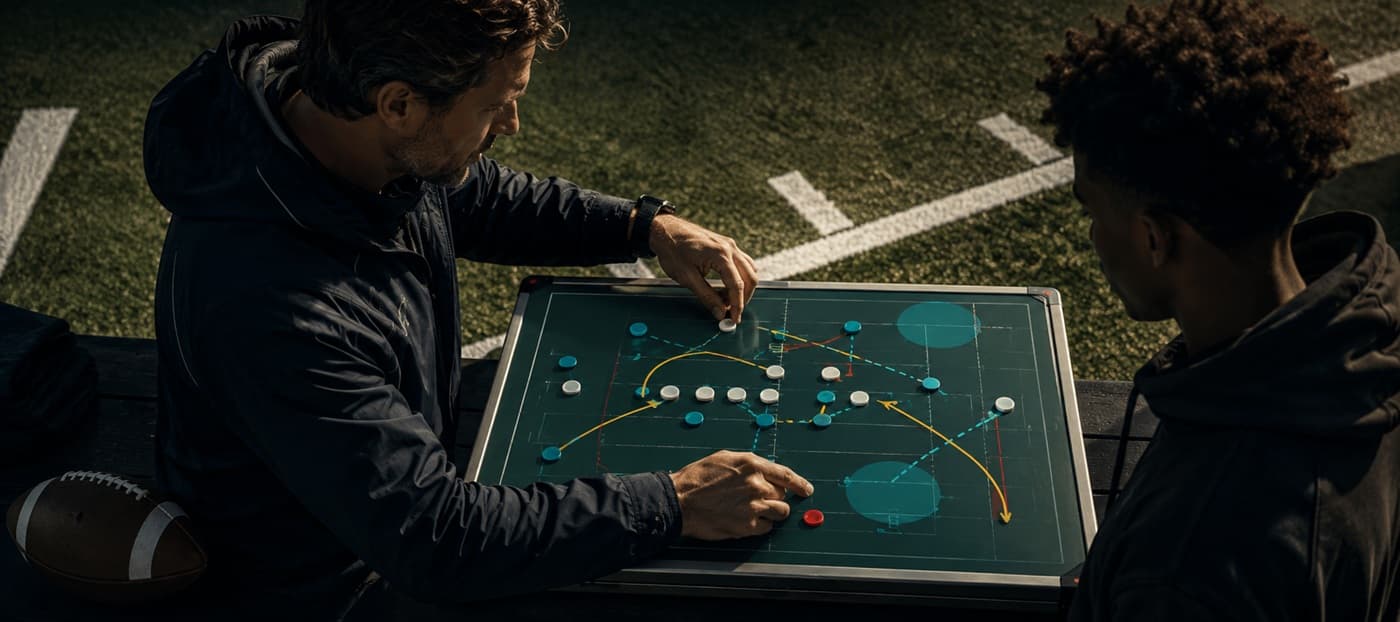
A passing concept is a coordinated relationship among routes, timing, spacing, pass protection, and quarterback reads. It is not simply a collection of receivers running unrelated routes.
The offense is trying to create a specific problem for the defense.
One route may pull a defender away from another. Two routes may stretch a zone horizontally. A short route and deeper route may place one defender in a high-low conflict. Crossing routes can force defenders to navigate traffic in man coverage. Vertical routes can make deep defenders choose which threat to protect.
At the same time, the quarterback needs a structured way to interpret what happens.
That is the central idea:
Passing concepts organize receivers and quarterback reads so the offense can attack space, leverage, defenders, or coverage rules as one coordinated play.
Understanding that relationship is much more useful than memorizing a list of route names.
Route vs. Concept vs. Complete PlayLink to this section
These terms describe different levels of the passing game.
RouteLink to this section
A route is the path and assignment of one eligible receiver.
Examples include:
- Slant
- Flat
- Curl
- Hitch
- Out
- Corner
- Post
- Go or vertical
- Crossing route
A slant is a route.
A flat is a route.
Neither one by itself necessarily describes the complete passing idea.
Passing conceptLink to this section
A passing concept combines routes so they interact with one another and the defense.
For example, Slant-Flat pairs an inside-breaking slant with a route toward the flat.
The value is not merely that one receiver runs a slant while another runs outside. Together, the routes can create a horizontal conflict for a defender who cannot easily occupy both areas at once.
Complete playLink to this section
A complete passing play contains more than the route concept.
It may also specify:
- Personnel
- Formation
- Receiver alignment
- Motion
- Protection
- Quarterback drop
- Backfield assignment
- Route adjustments
- Coverage alerts
- Quarterback progression
- Checkdown
- Possible audible or adjustment rules
So when you see an OpenPlay concept such as Slant-Flat, the route relationship is only one part of the full football play.
Why Timing and Spacing MatterLink to this section
Two receivers can run the correct routes and still ruin a passing concept if their timing or spacing is poor.
TimingLink to this section
The quarterback may expect a receiver to reach a particular area at a particular point in the drop.
If the receiver gets there too early, a defender may have time to recover.
If the receiver arrives too late, pressure may reach the quarterback before the throwing window develops.
Quick-game concepts are especially dependent on precise timing because the ball may be expected to come out almost immediately.
SpacingLink to this section
Receivers also need enough separation from one another to stress different defensive areas.
If two routes finish too close together, one defender may be able to influence both.
Good spacing tries to make the defense defend multiple threats without allowing defenders to overlap unnecessarily.
A passing concept therefore depends on:
where the receivers go + when they get there.
How Quarterbacks Read Passing ConceptsLink to this section
Quarterback reads are often described as a progression, but not every passing play is read in exactly the same way.
Depending on the offense, a quarterback may use:
- A receiver progression
- A defender-based read
- A coverage-based read
- A leverage read
- A pre-snap alert followed by a post-snap progression
- A combination of several methods
Terminology and teaching systems vary significantly among teams.
Receiver progressionLink to this section
A quarterback might be taught:
- Look at the first receiver.
- If that receiver is unavailable, move to the second.
- Continue to the next option.
- Use the checkdown if appropriate.
This is easy to understand, but real quarterback reads are often more conditional than simply scanning one receiver after another.
Defender-based readLink to this section
Instead of asking only whether a receiver is open, the quarterback may read a particular defender.
For example:
- If the defender widens, throw inside.
- If the defender stays inside, throw outside.
Now the two routes work together to create the answer.
The quarterback is effectively asking the defender to choose.
Leverage: Where the Defender Is PositionedLink to this section
Leverage describes positional advantage relative to the receiver, route, or field.
Suppose a receiver wants to run an inside-breaking route.
If the defender is positioned well outside the receiver, the offense may have favorable inside leverage.
If the defender is aligned inside and protecting that area, the route may face a more difficult path.
Quarterbacks evaluate leverage both before and after the snap.
Useful questions include:
- Is the defender inside or outside the receiver?
- Is the corner playing tight or with cushion?
- Is a linebacker positioned underneath a route?
- Where is safety help?
- Which direction can the receiver release most cleanly?
A concept can be designed to manipulate leverage, but the defense can also disguise its intentions.
That is why reading a defense continues after the ball is snapped.
What Is a Passing Window?Link to this section
A window is an area where the quarterback can deliver the ball between or away from defenders.
Windows can open and close quickly.
Against zone coverage, one receiver may enter an open area between underneath and deep defenders.
Against man coverage, the window may depend on the receiver gaining leverage on the defender.
Pressure can make a theoretically open window irrelevant if the quarterback does not have enough time to throw.
Passing concepts therefore coordinate:
- Receiver location
- Defender location
- Ball timing
- Quarterback vision
- Protection
A route is not truly useful merely because it eventually reaches open grass. It must become available when the quarterback can actually throw it.
Major Passing Concepts ComparedLink to this section
| Concept | Main stress created | Typical route relationship | What the QB watches |
|---|---|---|---|
| Slant-Flat | Horizontal conflict | Inside-breaking slant paired with outside flat route | Leverage of the underneath defender |
| Stick | Short-area horizontal/vertical stress | Stick route paired with flat/outside threat | Defender controlling the hook/flat area |
| Curl-Flat | High-low and horizontal stress | Curl settles deeper while flat route widens underneath | Whether underneath defender sinks or widens |
| Mesh | Traffic and horizontal crossing stress | Shallow crossers with complementary routes | Man/zone indicators, crossers, leverage and open space |
| Four Verticals | Vertical stress on deep coverage | Multiple receivers threaten seams and outside vertical lanes | Safety structure, leverage and deep defender distribution |
| Halfback Screen | Pass-rush manipulation | Back delays and releases behind blockers | Rush timing, screen space and pursuit |
| Play-Action Cross | Run-pass conflict plus crossing stress | Run action followed by crossing/deeper routes | Defender reaction to run fake and coverage behind it |
These descriptions explain the core problem each concept can present. They do not mean a concept automatically succeeds whenever a particular defense appears.
Horizontal StretchesLink to this section
A horizontal stretch forces a defender or group of defenders to account for threats separated across the width of the field.
Imagine one receiver breaking inside while another attacks the flat.
An underneath defender may have to choose between:
- Staying inside and giving up outside space
- Widening and giving up inside space
- Attempting to split the difference
The offense wants that decision to create an accessible throwing window.
Slant-FlatLink to this section
Slant-Flat is a clean beginner example.
One receiver runs an inside-breaking slant.
Another attacks the flat.
Together, they stretch an underneath defender horizontally.
If the defender expands toward the flat, the quarterback may find space inside.
If the defender stays inside, the flat may become available.
The exact read and adjustments depend on the offensive system and defensive coverage, but the relationship between the routes is what makes this a concept rather than two independent routes.
Vertical StretchesLink to this section
A vertical stretch attacks defenders at different depths or forces deep defenders to protect multiple vertical threats.
The offense is essentially asking:
How much depth can this defender cover, and which vertical route receives help?
Vertical concepts can attack:
- Safeties
- Seam defenders
- Cornerbacks
- Deep zones
- Rules for passing receivers from one defender to another
Four VerticalsLink to this section
Four Verticals is the clearest example.
Four eligible receivers release vertically from a balanced or related formation.
That does not mean all four simply sprint straight ahead while the quarterback randomly chooses one.
The concept stresses the defense's ability to distribute deep coverage.
The quarterback may evaluate:
- Single-high or split-safety structure
- Seam leverage
- Corner technique
- Safety movement
- Whether an underneath defender carries a vertical route
- Matchups created by the formation
Routes may also include adjustments depending on coverage and offensive terminology.
The important principle is that multiple vertical threats interact with the rules of the coverage.
High-Low ReadsLink to this section
A high-low concept places two offensive threats at different depths against a defender or area of coverage.
One route attacks deeper.
Another stays underneath.
The quarterback reads whether the defender:
- Drops toward the deeper route
- Drives toward the shorter route
- Attempts to split the difference
If the defender sinks, the underneath throw may open.
If the defender attacks the short route, the deeper window may become available.
Curl-FlatLink to this section
Curl-Flat provides a common example.
A curl route settles at intermediate depth while another receiver threatens the flat.
An underneath defender may be placed in conflict between widening toward the flat and gaining depth beneath the curl.
Again, the offense does not receive an automatic answer.
Another defender may help. Pressure may arrive. The coverage may rotate. The quarterback still must confirm the post-snap picture.
Triangle ReadsLink to this section
Some concepts create a triangle of receiving threats at different horizontal and vertical locations.
Instead of stretching one defender along a simple line, the offense can create a three-point structure.
Conceptually, the quarterback may be evaluating:
- A deeper option
- An underneath inside option
- An underneath outside option
That can stress multiple zone defenders and provide answers if the defense takes away one portion of the concept.
Triangle reads can be useful for understanding why receivers are deliberately spaced at different depths and widths.
They are not simply “three routes near one another.”
Each route helps define the space available to the others.
StickLink to this section
Stick is a foundational quick passing concept that illustrates several ideas at once.
A receiver—often an inside eligible receiver—runs the Stick route, working into short intermediate space and reacting according to the concept's rules.
Another receiver threatens the flat or outside area.
Additional routes can provide spacing or complementary answers.
The quarterback can evaluate the leverage of an underneath defender.
If the defender expands outside, interior space may become available.
If the defender stays inside, the outside route may have favorable room.
Stick demonstrates why passing concepts are often built around putting one defender in a difficult two-threat relationship.
MeshLink to this section
Mesh uses shallow crossing routes that intersect across the field.
The crossers can create particular problems against man coverage because defenders must navigate:
- Traffic
- Other receivers
- Other defenders
- Changes in leverage as receivers cross the field
Against zone coverage, the receivers may work through underneath zones and find space depending on the version of the concept.
Mesh often includes additional routes at intermediate or deeper levels, so the complete concept is more than two players running shallow crosses.
Why Mesh can stress man coverageLink to this section
A defender following a receiver across the field may have to avoid bodies in the middle.
That can create natural separation.
But saying “Mesh beats man” is too absolute.
A defense can:
- Communicate well
- Switch responsibilities
- Pressure the quarterback
- Use favorable leverage
- Disrupt releases
- Execute other answers
The offense still has to execute.
Mesh against zoneLink to this section
Against zone, the crossers may enter or pass through open areas underneath.
The quarterback's read changes because defenders may no longer chase individual receivers all the way across the formation.
This shows why one concept can have answers against several structures while requiring different quarterback decisions.
Man-Coverage AnswersLink to this section
Against man coverage, defenders are primarily responsible for individual eligible receivers according to the defense's rules.
Offenses may try to create separation through:
- Crossing routes
- Rub or traffic effects within legal limits
- Option routes
- Double moves
- Speed
- Receiver leverage
- Stacks and bunch formations
- Motion
- Isolated matchups
Mesh is a familiar example because crossing routes can make man defenders navigate congestion.
But no route combination simply guarantees separation.
A good man defender may win the matchup.
The pass rush may arrive.
The quarterback may misread leverage.
The receiver may lose at the line.
The useful language is therefore:
This concept can create problems for man coverage, not this concept always beats man.
For the foundational distinction, see Man vs. Zone Coverage.
Zone-Coverage AnswersLink to this section
Zone defenses assign defenders to areas, landmarks, receivers entering those areas, or combinations of rules depending on the system.
Passing concepts can attack zone by:
- Stretching one defender horizontally
- Stretching a defender vertically
- Flooding an area with multiple threats
- Occupying one zone defender and entering the space behind
- Creating windows between underneath defenders
- Attacking seams between deeper zones
Slant-Flat, Stick, and Curl-Flat all provide accessible examples of defenders being put into spatial conflicts.
But “zone coverage” describes a broad family of defenses.
Cover 2, Cover 3, Cover 4, match variations, and other structures distribute defenders differently.
A concept that creates an appealing answer against one zone may run directly into another defender against a different coverage.
Learn those larger structures in Coverage Families.
No Concept Automatically Beats Every CoverageLink to this section
Football diagrams often make passing concepts look deterministic:
- Defense plays X.
- Offense runs Y.
- Receiver is open.
Real football does not work that cleanly.
Success depends on factors including:
- Coverage
- Defensive disguise
- Technique
- Route execution
- Receiver leverage
- Quarterback timing
- Pass protection
- Pressure
- Personnel matchups
- Formation
- Field position
- Down and distance
A concept can have a theoretical advantage and still fail.
Likewise, a concept that is not considered the ideal call against a certain coverage can still succeed because a player wins an individual matchup.
Passing concepts provide structured answers, not guaranteed outcomes.
Formation Can Change a ConceptLink to this section
The same concept can often be run from multiple formations.
Slant-Flat might appear from:
- 2x2
- Trips
- A condensed formation
- A motion-created alignment
- Another legal structure
Changing the formation can change which defenders are stressed.
It can also alter:
- Receiver splits
- Coverage leverage
- Defensive communication
- Safety alignment
- Matchups
- Available space
The core route relationship may remain recognizable.
This is why offensive formations should be understood separately from passing concepts.
Formation tells you where the players begin.
Concept tells you how their routes work together.
Motion Can Reveal or Influence CoverageLink to this section
Pre-snap motion can change the defensive picture.
Suppose a receiver moves across the formation.
If a defender follows closely, that may suggest man responsibilities.
If defenders exchange responsibilities instead, that may suggest zone or match principles.
Those are clues rather than proof.
Defenses know offenses are looking for information and may disguise their intentions.
Motion can also:
- Change receiver leverage
- Create a cleaner release
- Move a defender
- Alter formation strength
- Change the spacing of a concept
- Force defensive communication
- Help create a favorable matchup
Motion is therefore both an information tool and a way to alter the geometry of the play.
Protection and Routes Must Work TogetherLink to this section
The quarterback cannot throw a developing route if the protection cannot keep the pocket intact long enough.
That sounds obvious, but it explains why protection is inseparable from passing concepts.
Quick conceptLink to this section
A short route combination may develop rapidly.
The quarterback can often make a quick decision before a complex pressure has time to arrive.
Intermediate conceptLink to this section
Routes breaking farther downfield require more time.
The protection must account for the rush while the quarterback reaches the appropriate point in the progression.
Deep conceptLink to this section
Vertical and deep-breaking routes can require even more time.
If the defense brings pressure that the offense cannot block, the quarterback may never reach the intended downfield read.
Teams solve this in different ways through:
- Protection schemes
- Hot routes
- Sight adjustments
- Checkdowns
- Motion
- Extra blockers
- Quick throws
- Quarterback movement
See Pass Protection for how the offense attempts to create enough time for the concept to develop.
Quick-Game Passing ConceptsLink to this section
The quick game is built around passes designed to develop rapidly.
Examples can include:
- Slant-Flat
- Stick
- Curl-Flat variations
- Hitches
- Quick outs
- Other short combinations
Quick concepts may help an offense:
- Get the ball out before pressure arrives
- Attack soft underneath leverage
- Put linebackers or nickel defenders in conflict
- Create manageable completions
- Get receivers the ball in space
But “quick” does not automatically mean “safe.”
A poorly read underneath defender can intercept a short throw.
A defensive back can jump a route.
An inaccurate pass can create a turnover opportunity.
Timing makes these concepts efficient; it also means decisions must often be made rapidly.
Intermediate Passing ConceptsLink to this section
Intermediate concepts attack areas beyond the immediate quick game without necessarily requiring a deep vertical throw.
They may use:
- Crossers
- Digs
- Curls
- Outs
- Intermediate seams
- Layered route combinations
Mesh can create intermediate opportunities through complementary routes even though its signature crossers are shallow.
Play-Action Cross can also attack the intermediate portions of the field after influencing defenders with run action.
Intermediate concepts often ask the quarterback to combine:
- Pre-snap recognition
- Protection awareness
- Post-snap coverage confirmation
- Timing with route breaks
Deep Passing ConceptsLink to this section
Deep concepts threaten large gains and force defenders to protect the entire vertical field.
Four Verticals is the clearest OpenPlay example.
Deep passing can create stress because a defense has only so many players available to protect multiple vertical lanes.
But deeper routes also create challenges for the offense:
- They take longer to develop.
- Protection must hold.
- The quarterback must manage the rush.
- Throws travel farther.
- Safeties can disguise rotation.
- Receivers must maintain spacing and leverage.
A deep concept therefore connects route design directly to protection and quarterback decision-making.
ScreensLink to this section
A screen pass deliberately uses defensive pursuit rather than simply trying to beat coverage downfield.
In a Halfback Screen, the offense may initially present an ordinary passing picture.
The pass rush is encouraged to move toward the quarterback.
The running back delays, then releases into space.
Offensive linemen can release into position to block farther downfield according to the design and rules.
The quarterback delivers the ball behind the rush.
The concept asks:
Can we invite the defense forward, then put the ball into the space it vacated?
Screens therefore occupy an unusual position between traditional passing and open-field blocking.
Their success depends heavily on:
- Timing
- Pass-rush behavior
- Blocking angles
- Recognition by the defense
- Space available after the catch
A screen is not simply a very short pass.
It is a coordinated attempt to manipulate pursuit.
Play ActionLink to this section
Play action combines the passing game with the threat of a run.
The quarterback and backfield initially present action that resembles a running play.
Defenders with run responsibilities must decide how strongly to react.
If a linebacker steps toward the line of scrimmage, space may develop behind that player.
If safeties react to the apparent run, deeper routes may gain favorable leverage.
Play-Action Cross illustrates how a crossing concept can work behind run action.
The objective is not merely to “fake the handoff convincingly.”
The larger goal is to influence defenders whose jobs require them to respect both possibilities.
A play-action pass can therefore create a run-pass conflict before the quarterback begins attacking the coverage.
Fictional Example: One Defender, Two RoutesLink to this section
The offense faces second-and-5.
It calls Slant-Flat to the right.
The slot defender is responsible for an underneath area.
At the snap:
- The outside receiver breaks inside on the slant.
- Another eligible receiver releases toward the flat.
- The defender widens aggressively with the flat.
- Space develops behind and inside that defender.
- The quarterback delivers the slant.
The next time the offense calls the concept, the defender stays inside.
Now the flat may be the better answer.
The play works because the quarterback and receivers are solving the same defender together.
Fictional Example: Four Verticals Against Split SafetiesLink to this section
The offense aligns in 2x2 and calls Four Verticals.
Two safeties begin deep.
All four receivers release vertically.
The inside receivers threaten the seams while the outside receivers occupy the corners.
The quarterback watches how the safeties distribute themselves.
If a safety widens aggressively toward an outside threat, a seam may gain space.
If the safety stays inside, the outside matchup may become more attractive.
But underneath defenders may carry the seams, corners may maintain excellent leverage, and pressure may arrive.
Four Verticals creates the stress.
The quarterback still must solve the actual defense.
Fictional Example: Mesh Against Man and ZoneLink to this section
The offense calls Mesh.
Against man coverageLink to this section
The two shallow receivers cross.
Their defenders must follow through traffic.
One defender loses leverage while navigating the middle.
The quarterback finds the crosser moving away from coverage.
Against zone coverageLink to this section
The defenders do not chase the crossers in the same way.
Instead, the receivers move through underneath zones.
The quarterback waits for one crosser to enter open space between defenders while also considering the concept's complementary routes.
Same concept.
Different defensive structure.
Different quarterback problem.
Common Beginner Misconceptions About Passing ConceptsLink to this section
“A passing play is just several routes called at once.”Link to this section
A real passing concept coordinates routes so they work together with timing, spacing, protection, and quarterback reads.
“The quarterback throws to the primary receiver no matter what.”Link to this section
The first option is not automatically the throw. Coverage and leverage determine whether that receiver is available.
“A quarterback reads every receiver from left to right.”Link to this section
Some plays use receiver progressions, but many reads are defender-based, coverage-based, leverage-based, or combinations of those methods.
“Mesh beats man coverage.”Link to this section
Mesh can create difficult traffic and leverage problems against man, but no concept guarantees success.
“Zone means the quarterback just throws into empty space.”Link to this section
Open space changes as defenders move. The quarterback must understand which windows will open and whether they remain accessible when the ball arrives.
“Four Verticals means throw a bomb.”Link to this section
Four Verticals is a coordinated vertical stretch. Depending on coverage, a seam or adjusted route may become the best option rather than an outside deep throw.
“A short pass is automatically safer than a deep pass.”Link to this section
Short passes can still be intercepted, disrupted, or tackled for little gain. Risk depends on coverage, leverage, timing, field position, and execution.
“A receiver is open if no defender is standing beside him.”Link to this section
The quarterback must consider where defenders are moving, how quickly a window will close, and when the ball can arrive.
“Changing formation means changing the concept.”Link to this section
Not necessarily. Teams often run the same core concept from several formations and personnel groups.
“Good pass protection means nobody ever gets near the quarterback.”Link to this section
Protection is closely tied to timing. The offense often needs to protect long enough for the concept and quarterback progression to develop—not create an unlimited pocket.
How to Watch a Passing ConceptLink to this section
Instead of watching only the receiver who catches the ball, try following the play in stages.
Before the snapLink to this section
Ask:
- What personnel is on the field?
- What formation is the offense using?
- Is the formation 2x2, trips, bunch, or another structure?
- How are the receivers split?
- Is there motion?
- How many safeties appear deep?
- Are defenders aligned with man-like or zone-like leverage?
Immediately after the snapLink to this section
Watch the defense.
Ask:
- Do defenders follow receivers?
- Do they drop toward landmarks or areas?
- Do safeties rotate?
- Does a linebacker widen?
- Does pressure come?
Then watch the route relationshipLink to this section
Ask:
- Which defender is being stretched?
- Are routes attacking different depths?
- Are receivers creating horizontal spacing?
- Is one route clearing space for another?
- Are crossing routes creating traffic?
- Is the quarterback reading one defender or progressing between options?
That method turns a passing play from a collection of moving receivers into a coordinated tactical problem.
Why Passing Concepts MatterLink to this section
Passing offense is fundamentally about creating and exploiting relationships.
Routes relate to one another.
Receivers relate to defenders.
Protection relates to route timing.
Formation relates to leverage.
Motion relates to defensive communication.
The quarterback's read connects all of those pieces.
Slant-Flat creates a simple horizontal conflict.
Stick combines spacing with an underneath read.
Curl-Flat can place defenders into layered conflicts.
Mesh uses crossing routes and traffic.
Four Verticals stretches the defense deep.
A Halfback Screen manipulates pass-rush pursuit.
Play-Action Cross uses the threat of the run to influence defenders before attacking through the air.
These are not seven isolated collections of routes.
They are seven different ways of asking the defense a question.
That is the best framework for learning the passing game:
What stress is the offense creating, which defender or rule must respond, and what does the quarterback do with the answer?
Explore the PhysicsLink to this section
Football strategy explains where the quarterback wants to deliver the ball and when it should arrive. The throw itself adds another layer involving velocity, launch angle, gravity, aerodynamic drag, and rotation. Guided Physics offers a deeper look at the physics of American football (opens in a new tab).
Frequently Asked QuestionsLink to this section
What is a passing concept in football?Link to this section
A passing concept is a coordinated combination of routes, spacing, timing, protection, and quarterback reads designed to stress particular defenders or coverage rules. It is more than simply assigning each receiver a route.
How does a quarterback read a passing play?Link to this section
It depends on the offense and concept. Quarterbacks may use receiver progressions, defender-based reads, leverage reads, coverage recognition, or combinations of those approaches. Pre-snap information is usually confirmed or adjusted after the snap.
What is a high-low read?Link to this section
A high-low read places receiving threats at different depths against a defender or coverage area. If the defender drops deep, the quarterback may use the underneath route; if the defender attacks the short route, a deeper window may open.
What is a horizontal stretch?Link to this section
A horizontal stretch places threats at different widths of the field, forcing an underneath defender to choose where to position. Slant-Flat is a simple example because one route attacks inside while another attacks outside.
What is a vertical stretch?Link to this section
A vertical stretch attacks different depths or multiple deep lanes, making defenders account for threats above and below them or across several vertical areas. Four Verticals is a classic example.
What is Mesh in football?Link to this section
Mesh is a passing concept built around shallow crossing routes, usually with complementary routes around them. The crossers can create traffic against man coverage and work through underneath space against zone.
What is Four Verticals?Link to this section
Four Verticals sends four receiving threats vertically to stress deep coverage. The quarterback reads safety structure, leverage, and how defenders distribute themselves among the vertical routes.
What is the Stick concept?Link to this section
Stick is a quick-game concept that typically combines a Stick route with an outside or flat threat. The route relationship can place an underneath defender in a conflict between protecting interior and outside space.
Does every passing concept beat a specific coverage?Link to this section
No. Some concepts are designed to create useful stress against particular coverage structures, but execution, leverage, pressure, disguise, personnel, and defensive adjustments all affect the result.
What is the difference between a route and a passing concept?Link to this section
A route is one receiver's path or assignment. A passing concept coordinates multiple routes so they create a combined strategic problem for the defense.
Take it to the field