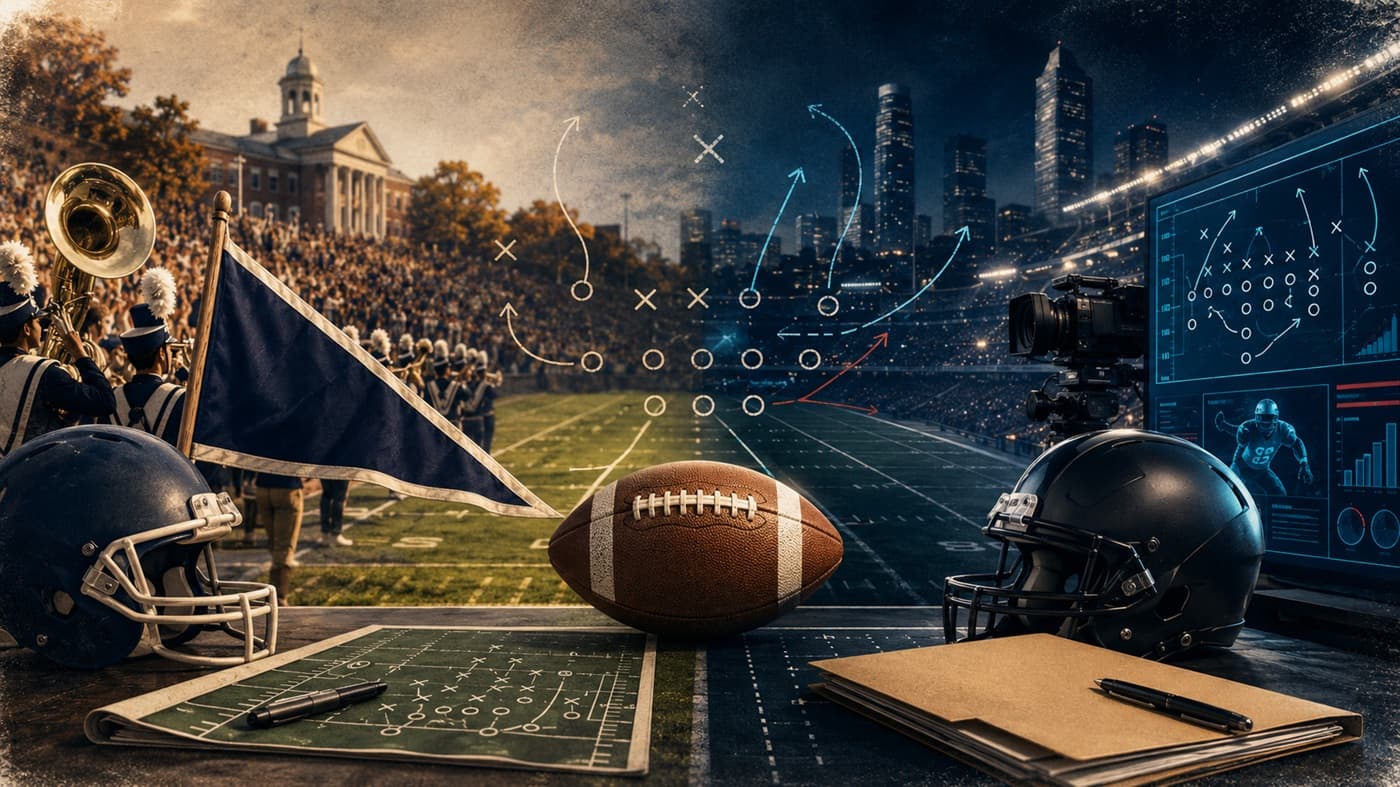
College football and professional football are close relatives, but they are not the same competition played by athletes of different ages. They share eleven-player teams, four downs, touchdowns, field goals, formations, blocking, passing, tackling, coverages, and the struggle for field position. A viewer who understands one version can recognize the other immediately.
The differences begin beneath that shared surface. College teams represent educational institutions and compete within conferences, divisions, and multiple postseason systems. Professional teams are franchises in leagues whose players work under contracts and collectively bargained rules. College rosters are assembled through recruiting and transfers. Professional rosters are assembled through a draft, free agency, trades, waivers, and contract decisions.
Rules also change what happens on the field. A sideline catch may be complete in college and incomplete in the NFL. A runner who slips without being touched may be down in college but free to continue in the NFL. Wider college hash marks alter formations and angles. Overtime is an alternating-possession contest in college, while NFL overtime continues from a kickoff under timed-period rules.
This article uses NCAA football and the NFL as the primary comparison because they provide the best-known American college and professional rule codes. Other college associations and professional leagues may use different rules.
College and professional football at a glance
These are broad comparisons. College football includes several divisions and governing organizations, while professional leagues outside the NFL may use different formats.
| Topic | College football | Professional football |
|---|---|---|
| Primary institution | A college or university competing within a conference, division, or association. | A franchise competing within a professional league. |
| Player relationship | Student-athletes must satisfy enrollment, eligibility, and academic-progress rules. Compensation may include scholarships, NIL agreements, and, at participating Division I schools, direct financial benefits under the current settlement framework. | Players are paid under individual contracts within a collectively bargained league system. |
| How rosters are built | Recruiting, signing, eligibility certification, development, and transfers. | Draft selections, free agency, trades, waiver claims, undrafted signings, and practice-squad development. |
| Inbounds catch | One foot or another body part inbounds can satisfy the boundary element when the complete catch process is met. | Two feet or another body part other than the hands must be inbounds while the complete catch process is met. |
| Runner down | The ball is normally dead when a runner's body other than a hand or foot touches the ground, even without contact. | A runner is generally down after opponent contact, going out of bounds, stopped forward progress, or clearly giving himself up. |
| Hash marks | Hash marks are 60 feet from each sideline and therefore farther apart. | NFL hash marks are 70 feet 9 inches from each sideline and therefore much closer together. |
| Clock after an offensive first down | Outside the final two minutes of each half, the clock generally continues. After the two-minute timeout, it stops for the first down and restarts on the referee's signal. | A first down by itself does not create the college-style administrative clock stop. |
| Defensive pass interference | A spot foul when fewer than 15 yards downfield; otherwise generally 15 yards from the previous spot, with a first down. | Generally a first down at the spot of the foul, subject to goal-line enforcement rules. |
| Ineligible receiver downfield | An originally ineligible receiver may not be more than three yards beyond the neutral zone before a qualifying forward pass is thrown. | The comparable limit is generally one yard. |
| Overtime | Alternating possession series begin at the opponent's 25-yard line; later periods require two-point attempts and then alternating two-point plays. | A timed period begins with a kickoff. Current NFL rules generally give both teams an opportunity to possess the ball, with regular-season ties still possible when the 10-minute period expires. |
| Postseason | Varies by level. FBS combines the College Football Playoff with bowl games; FCS and other divisions use NCAA championship brackets. | League standings and tiebreakers determine a centralized playoff leading to the league championship. |
| Cultural center | Campus identity, alumni ties, student sections, marching bands, regional rivalries, and long institutional traditions. | Franchise identity, metropolitan and regional markets, league-wide parity systems, national broadcasts, and professional careers. |
The same game operates inside two different systems
On the field, both versions ask the offense to advance the ball and the defense to stop it. The core vocabulary is shared: formation, personnel, down, distance, protection, route, progression, front, coverage, pressure, red zone, and field position.
Off the field, the systems differ fundamentally. A college program belongs to a school and participates in an educational, conference, and association structure. A professional club belongs to a league system built around franchises, player contracts, revenue sharing, labor agreements, competitive-balance rules, and centralized league operations.
That distinction affects nearly everything: who can join a team, how long a player remains, how practices are regulated, how rosters change, how championships are organized, and what obligations exist beyond football.
College football is not one single level
The phrase college football often brings nationally televised Football Bowl Subdivision games to mind, but the college game includes multiple NCAA divisions and football subdivisions as well as other governing organizations. Division I includes the FBS and FCS. The FBS postseason combines the College Football Playoff with bowl games, while the FCS uses an NCAA single-elimination championship. Divisions II and III have their own competitive structures and championships.
Resources, stadium size, scholarship policies, media exposure, roster rules, and travel demands can differ substantially across levels. A comparison with professional football should therefore avoid treating every college program as if it operates like the most visible FBS teams.
The playing rules are broadly recognizable across NCAA football, but the institutional experience of a Division III athlete can be very different from that of a player at a nationally prominent Division I program.
Recruiting and the draft solve different roster problems
College coaches recruit prospective students. They evaluate football ability, academic eligibility, roster need, development potential, and fit with the institution. Players may enter from high school, another college, junior college, or other permitted pathways. Transfer rules have made roster movement more visible and more immediate than it was in earlier eras.
Professional clubs acquire players through the draft, free agency, trades, waiver claims, undrafted signings, and developmental roster mechanisms. Draft order and salary-cap rules are designed partly to distribute incoming talent and limit the ability of the wealthiest or most successful franchises to acquire every established player.
The result is a different planning horizon. A college staff is continually replacing players whose eligibility will end and developing athletes whose physical and technical growth may be incomplete. A professional staff manages contracts, salary-cap consequences, injury designations, veteran decline, and the pressure to obtain immediate production from a limited roster.
The old amateur-versus-professional label is no longer enough
Professional players are paid employees working under contracts governed by league rules and collective bargaining. Their football performance is their occupation, even though careers are often short and roster security can be limited.
College athletes remain students subject to enrollment and eligibility requirements, but describing all college football simply as unpaid amateur sport is outdated. Athletes may receive scholarships and educational benefits, earn third-party name, image, and likeness compensation, and—in the current Division I framework—receive direct financial benefits from participating schools.
College football has not become identical to professional football. Academic requirements, eligibility periods, institutional affiliation, conference governance, and school-specific policies still distinguish it. The better comparison is not paid versus unpaid; it is an educational athletics system with expanding compensation opportunities versus a professional labor and franchise system.
A college catch may be incomplete in the NFL
Both rule codes require control of the ball and completion of the catch process. The visible boundary difference is the number of feet required inbounds.
Under NCAA rules, a receiver can satisfy the inbounds element by touching the ground inbounds with any part of the body. In ordinary sideline language, that means one foot can be enough. Under NFL rules, the receiver must touch both feet inbounds or put another body part other than the hands on the ground inbounds.
This affects route placement and quarterback accuracy. College offenses can use more of the narrow space beside the sideline because a receiver needs only one controlled foot. Professional quarterbacks and receivers must coordinate throws, body position, and footwork precisely enough to complete the two-foot requirement.
A fallen runner may continue in professional football
In college football, the ball is generally dead when any part of the runner's body other than a hand or foot touches the ground. Defensive contact is not required. A runner who slips, places a knee down, or falls while changing direction has usually ended the play.
In the NFL, a runner who falls without opponent contact may get up and continue unless the runner has gone out of bounds, has clearly given himself up, has been ruled stopped by forward progress, or another dead-ball rule applies.
This difference changes player behavior and fan expectations. College defenders can stop pursuit once the runner is clearly down by rule. Professional defenders must confirm that contact occurred or that the runner gave himself up, while still avoiding late or unnecessary contact.
The same-width field produces different spacing
College and NFL fields are the same overall width, but their hash marks are placed differently. College hash marks are farther apart, so the ball can be spotted closer to one sideline. NFL hash marks are much nearer the middle of the field.
A college snap from a wide hash creates a pronounced boundary side and a large field side. The offense can use formations, motion, option concepts, screens, and quick throws to exploit the extra width. The defense must decide how to balance numbers across an uneven amount of space.
Professional offenses begin from more centralized spots. That reduces some extreme field-versus-boundary geometry and makes the available space more balanced. The difference is one reason a concept can look different even when the formation name and assignments appear similar.
Clock rules change late-game strategy
Both versions use four fifteen-minute quarters, play clocks, team timeouts, incompletions, out-of-bounds rules, and end-of-half timing procedures. The details are not identical.
College football now has an automatic two-minute timeout in the second and fourth quarters. Outside the final two minutes of a half, the clock generally continues after an offensive first down. After the two-minute timeout, the clock stops when the offense earns a first down and restarts on the referee's signal after the ball is ready.
The NFL uses a two-minute warning and does not stop the clock merely because the offense earned a first down. Professional offenses therefore cannot depend on the brief college first-down stoppage during a final drive.
Fans should also remember that timing rules have changed over time. A strategy remembered from an older college season may no longer match the current rulebook.
Some penalty differences influence play design
Defensive pass interference is one important example. Under NCAA rules, interference fewer than fifteen yards beyond the previous spot is enforced at the spot; deeper interference is generally limited to fifteen yards from the previous spot, with a first down. In the NFL, defensive pass interference is generally enforced at the spot of the foul.
That difference changes the cost of interfering with a deep receiver. A professional defender who commits interference far downfield can surrender most of the intended gain. In college, a deep interference penalty may prevent a touchdown while costing fifteen yards.
The ineligible-receiver-downfield rule also affects modern run-pass option and play-action design. NCAA rules generally permit an originally ineligible receiver to be as much as three yards beyond the neutral zone before the qualifying pass is thrown. The NFL limit is generally one yard. Professional linemen must therefore delay their climb downfield more carefully when a pass remains possible.
These are not merely officiating details. They influence what coaches are willing to call and how long a quarterback can hold a run-pass decision.
Overtime is a different kind of contest
College overtime is built around alternating possession series rather than a timed extension of normal field-position football. Each team receives the ball at the opponent's 25-yard line in the first extra periods. Beginning with the second extra period, a touchdown must be followed by a two-point attempt. Beginning with the third, the teams alternate one-play two-point attempts.
NFL overtime begins with a kickoff and preserves normal field position, punts, kickoffs, and clock management. Under the current rules, both teams generally receive an opportunity to possess the ball. Regular-season overtime is limited to one ten-minute period, so a tie remains possible if time expires. Postseason overtime uses fifteen-minute periods and continues until a winner is determined.
College overtime emphasizes red-zone execution, short-field play calling, two-point concepts, and possession matching. Professional overtime continues the full-field game and makes kickoff strategy, field position, time, and possession order part of the outcome.
College often shows greater system variety; professional football compresses the margin for error
College football contains a wide range of talent levels, roster profiles, academic missions, recruiting territories, coaching resources, and institutional ambitions. A coach may build an unusual system around the athletes the program can recruit. Option offenses, tempo systems, extreme formations, quarterback-run packages, and aggressive fourth-down decisions can become defining identities.
Professional teams also innovate, but the league environment creates different pressures. Rosters are smaller, opponents are more evenly talented, defenders are faster at recognizing concepts, and every player is a high-level specialist. Successful ideas must survive detailed film study, contract-driven roster turnover, and opponents capable of punishing small technical errors.
The professional game is not automatically more complex on every snap, and the college game is not merely simpler. College staffs may use enormous call menus and sophisticated checks. The difference is often where the complexity appears: college football may create problems through pace, formation width, option decisions, and system identity, while professional football may emphasize disguise, matchup isolation, protection adjustment, route conversion, and precise situational execution.
College championships emerge from several connected systems
A professional league can create one centralized schedule, use common standings and tiebreakers, and move qualifying teams into one league playoff.
College football is more layered. Programs belong to conferences or compete independently. Conference schedules, rivalry games, nonconference agreements, championship games, rankings, selection committees, bowls, and subdivision-specific playoffs can all matter.
At the FBS level, the current postseason includes a twelve-team College Football Playoff along with a broader bowl system. The FCS uses an NCAA championship bracket, and Divisions II and III conduct their own championships. Because formats and conference alignments can change, readers should treat detailed bracket descriptions as dated information rather than permanent features.
The cultures overlap, but their centers of gravity differ
College football is tied to campuses, alumni identity, marching bands, student sections, homecoming, rivalry trophies, regional traditions, and the idea that players represent an educational institution. Some rivalries predate professional leagues and remain important even when championship stakes are limited.
Professional football is organized around franchises, cities, regions, player careers, league history, television windows, fantasy participation, sponsorship, and a centralized championship. Support can pass through families just as strongly as college loyalty, but the institution at the center is a professional club rather than a school.
The two cultures continuously influence one another. College schemes reach the professional game. Professional presentation affects college broadcasts and stadium experiences. Coaches and players move between levels. Fans often follow both, valuing college football for tradition and variety and professional football for elite concentration and league-wide stakes.
Which version is harder?
The question has no useful single answer. Professional football concentrates the best available players, reduces talent mismatches, and demands execution against opponents with exceptional speed, technique, preparation, and experience. A mistake that survives on Saturday may be punished immediately on Sunday.
College players face a different challenge. Many are still developing physically and technically while balancing academic obligations. Rosters change rapidly, coaching resources vary, and some teams face major talent disadvantages. A college quarterback may need to master a fast system while also adapting to teammates with limited shared experience.
The better question is what each level demands. College football rewards recruiting, teaching, development, system fit, and adaptation to unequal rosters. Professional football rewards talent evaluation, contract management, precision, disguise, matchup control, and consistent performance against elite opponents.