Learn Football
How to Read a Defense in American Football
Reading a defense means turning alignment, leverage, movement, and situation into a disciplined post-snap decision.
26 minute read
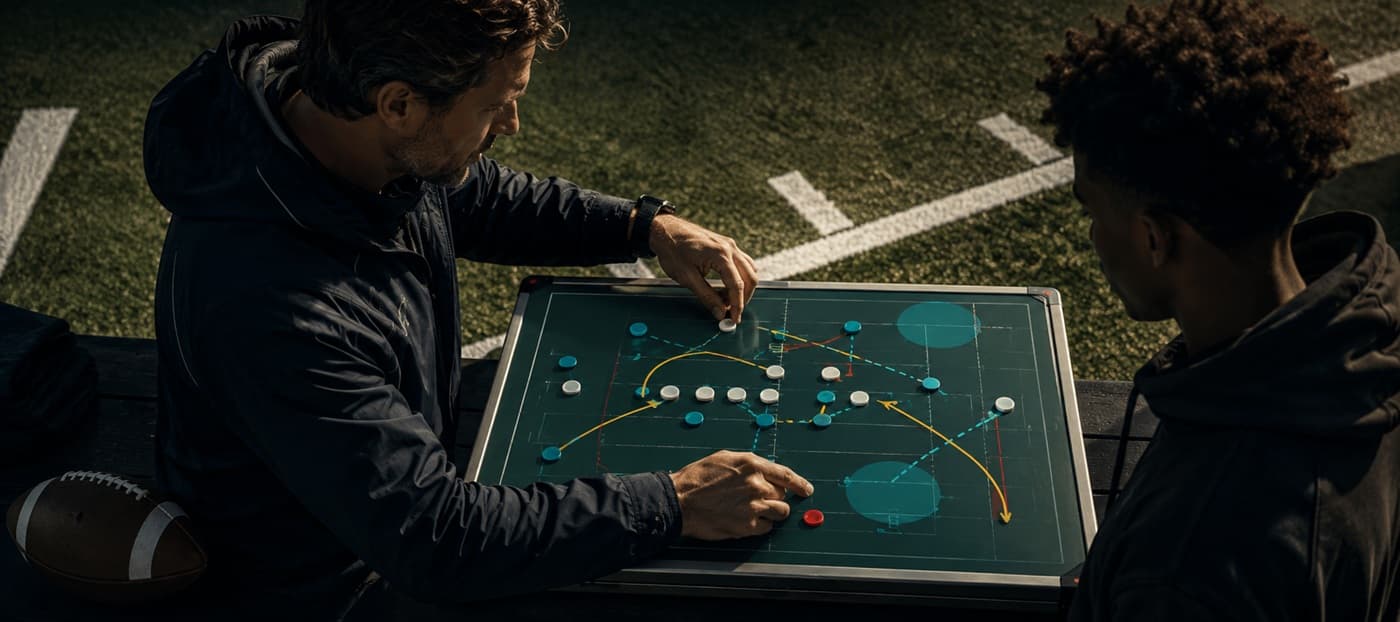
Reading a defense is the process of gathering clues about how defenders are aligned, what threats they present, and how they react after the snap so the offense can make better decisions.
For a quarterback, that can mean identifying potential pressure, locating safety help, recognizing favorable receiver leverage, and finding the defender who determines where the football should go.
For the running game, it can mean counting defenders in the box, identifying the front, locating the edge, and determining whether the offense has favorable numbers or blocking angles.
The most important principle is:
Pre-snap information creates a hypothesis. Post-snap movement confirms, changes, or disproves it.
A quarterback usually cannot look at the defense before every play and announce with certainty, “That is Cover 3 Sky with this exact pressure and these exact match rules.”
Defenses deliberately make that difficult.
They disguise safeties. Linebackers threaten blitz and then drop. Corners show one leverage and play another technique. A two-high secondary can rotate into a single-high coverage. Zone structures can convert into receiver matchups after routes release.
A better approach is to use a repeatable sequence:
- Understand the situation.
- Identify who is on the field.
- Count the box.
- Identify the front.
- Locate the safeties.
- Examine corner leverage.
- Find slot defenders and linebackers.
- Identify possible pressure.
- Use motion for additional information.
- Connect the picture to the offensive concept.
- Confirm the defense after the snap.
That process turns “reading the defense” from guesswork into structured observation.
What Is a Pre-Snap Read?Link to this section
A pre-snap read is the offense's assessment of the defense before the ball is snapped.
The quarterback may examine:
- Defensive personnel
- Number of defenders in the box
- Defensive front
- Safety structure
- Cornerback alignment
- Slot-defender leverage
- Linebacker depth
- Potential blitzers
- Defensive response to motion
Those observations help answer practical questions.
For example:
- Does the run have favorable numbers?
- Does the protection account for every likely rusher?
- Is one receiver isolated?
- Is a defender positioned poorly against the called route?
- Which coverage families are plausible?
- Which defender will the quarterback read after the snap?
The pre-snap read narrows possibilities.
It does not eliminate uncertainty.
What Is a Post-Snap Read?Link to this section
The post-snap read begins when the football moves.
Now the quarterback can see what defenders actually do.
Important information includes:
- Safety rotation
- Cornerback technique
- Linebacker drops
- Actual pass rushers
- Defensive-line movement
- Whether defenders follow or pass receivers
- How zones or match responsibilities develop
A defender who appeared ready to blitz may drop.
A two-high shell may rotate to Cover 3.
A corner who looked like a man defender may sink into a zone.
The post-snap read updates the quarterback's pre-snap hypothesis.
In many passing concepts, the quarterback does not need to identify the formal name of the entire defense. The quarterback may simply need to determine what one key defender does and react according to the concept.
That distinction is important.
A Repeatable Defensive Reading ChecklistLink to this section
| Read stage | What to examine | Question to ask | What it can tell you |
|---|---|---|---|
| Situation | Down, distance, field position, score, clock | What does each team need right now? | Likely strategic priorities |
| Personnel | DL, LB, DB types and substitutions | Who is actually on the field? | Possible fronts, matchups, and packages |
| Box count | Defenders near the run structure | How many immediate run defenders are there? | Run numbers and potential pressure |
| Front | DL techniques, gaps, edge players | How is the offense being blocked? | Run lanes, combinations, protection threats |
| Safety shell | Zero-, one-, or two-high | Which coverage families are possible? | Initial coverage hypothesis |
| Corners | Press/off, inside/outside leverage | Where are they trying to influence receivers? | Possible man, zone, or help structure |
| Slots/LBs | Alignment, depth, leverage | Who can cover, fit the run, or blitz? | Underneath coverage and pressure clues |
| Pressure | Walked-up defenders, overloads, mugs | Are there more threats than blockers? | Protection or hot-read problem |
| Motion response | Defender movement and communication | Does someone travel, bump, or rotate? | Additional man/zone/match clues |
| Concept key | Defender stressed by the called play | Who determines the quarterback's decision? | Actual progression/read structure |
| Post-snap | Rotation, rush, drops, route matching | What did the defense really become? | Final execution decision |
Step 1 — Know the SituationLink to this section
Reading the defense begins before looking at the defense.
Start with:
- Down
- Distance
- Field position
- Score
- Time remaining
A defense facing 3rd-and-12 has a different strategic problem from one facing 3rd-and-1.
A defense protecting a late lead may make different choices from one that needs an immediate stop.
A defense backed up near its goal line has less field behind it.
A defense near midfield may be more concerned about both the run and explosive passes.
Understanding how downs work and field position therefore provides the context for every defensive read.
The defense is not aligning in a vacuum.
It is trying to solve the current game situation.
Step 2 — Identify Defensive PersonnelLink to this section
Next, ask:
Who is on the field?
A defense might have:
- Four defensive backs
- Five defensive backs in nickel
- Six defensive backs in dime
- Extra defensive linemen
- Hybrid linebacker/safety types
Personnel can provide clues about the defense's options.
For example, nickel personnel may give the defense another coverage-capable player against multiple receivers.
A heavier package may provide more size near the line.
But personnel does not determine the final front or coverage.
The same nickel group could show:
- Four-man front
- Odd front
- Double-mug pressure
- Cover 1
- Cover 3
- Quarters
- A zone blitz
Just as offensive personnel groups describe who is on the field rather than exactly where they align, defensive personnel is only one layer of the picture.
Step 3 — Count the BoxLink to this section
The box is the area near the line of scrimmage containing defenders who can quickly influence the run.
A box count asks:
How many immediate defenders are positioned to participate in the run fit?
There is no single universal boundary defining the box. Teams use their own counting systems.
Conceptually, though, the offense wants to compare:
- Available blockers
- Immediate run defenders
Suppose the offense is spread across the field and the defense keeps both safeties deep.
The offense may see relatively few defenders near the core run structure.
That could make a run attractive.
If a safety moves down into the box, the numbers change.
The quarterback might:
- Keep the run
- Change its direction
- Check to a pass
- Read an unblocked defender
- Make another adjustment according to the offense
A box count does not automatically tell the quarterback whether to run or pass.
It tells the offense something about the numerical problem.
Step 4 — Identify the Defensive FrontLink to this section
Now examine the defensive linemen and edge players.
Ask:
- Is someone head-up on the center?
- Is there a 1-technique?
- Where is the 3-technique?
- Are the guards covered?
- Are edge defenders wide?
- Is the defense showing an even or odd structure?
- Is someone threatening an interior gap?
The Defensive Fronts guide explains technique numbers, even and odd fronts, Over, Under, Bear, Tite/Mint concepts, and run fits in detail.
For reading the defense, the important question is:
What blocking problem does this front create?
Against Inside Zone, for example, the offense may examine where combination blocks are available and which linebacker needs to be reached.
Against pass protection, the offense wants to identify:
- Immediate rushers
- Possible stunts
- Interior pressure threats
- Edge pressure
- Who the offensive line can account for
The front is both a running-game and passing-game clue.
Step 5 — Find the SafetiesLink to this section
Now move your eyes away from the line of scrimmage and find the deepest defenders.
A useful first classification is:
- No-high
- Single-high
- Two-high
This is called the coverage shell.
The shell helps organize possibilities.
It does not identify the final coverage.
No-high shellLink to this section
No obvious deep safety may suggest possibilities such as:
- Cover 0
- Heavy pressure
- A disguised rotation
Single-high shellLink to this section
One deep middle safety commonly suggests families such as:
- Cover 1
- Cover 3
Two-high shellLink to this section
Two deep safeties may support:
- Cover 2
- Cover 4 / Quarters
- Cover 6
- Two-man
- Other split-field or match structures
This is one of the most important reading rules:
Safety count narrows the possibilities. It does not finish the diagnosis.
Step 6 — Inspect Cornerback LeverageLink to this section
Next, examine the cornerbacks.
Useful questions include:
- Are they pressing at the line?
- Are they playing several yards off?
- Do they have inside leverage?
- Outside leverage?
- Are they looking strongly toward the receiver?
- Are they positioned as though they expect safety help?
Press vs. offLink to this section
A press corner aligns close to the receiver near the line of scrimmage.
An off corner gives more cushion.
Press can appear in man or zone structures.
Off alignment can also appear in both.
So:
Press does not prove man.
Off coverage does not prove zone.
Inside vs. outside leverageLink to this section
Leverage can reveal which space the defender appears most concerned about protecting.
A corner with inside leverage may be trying to deny an inside release or funnel the receiver elsewhere.
An outside-leverage defender may be protecting the sideline or steering the receiver toward inside help.
But leverage must be interpreted with the safety structure and complete coverage.
Step 7 — Locate Nickel Defenders and LinebackersLink to this section
Slot defenders and linebackers can reveal crucial information.
Look for:
- Depth
- Inside/outside leverage
- Alignment directly over a receiver
- Position near a run gap
- Potential blitz posture
- Relationship to the running back
A nickel defender tightly aligned over a slot receiver could be preparing for man coverage.
Or that defender could have an underneath zone or match responsibility.
A linebacker directly over a running back may suggest a possible man matchup.
Or the linebacker may blitz while another defender replaces the coverage responsibility.
Again:
Alignment creates a hypothesis.
The assignment is revealed after the snap.
Step 8 — Look for PressureLink to this section
Quarterbacks also have to identify defenders who might rush.
Common pressure clues include:
- Linebackers walking toward the line
- A safety creeping toward the edge
- Nickel defender showing blitz
- Multiple defenders threatening one side
- Two linebackers entering the A gaps
Overloaded surfaceLink to this section
An overload occurs when the defense threatens more rushers in one area than the offense can easily block using its original protection.
For example, the defense might place:
- An edge defender outside the tackle
- A linebacker in the B gap
- A nickel defender outside both
Now the protection must determine how those three threats will be handled.
Double-mug lookLink to this section
A double-mug presentation places two linebackers close to the interior, often threatening both A gaps around the center.
The offense must account for the possibility that:
- Both rush
- One rushes
- Neither rushes
- One drops while another defender comes from elsewhere
The Pass Protection guide explains how protection counts, slide rules, running backs, Mike declarations, and hot reads help solve these problems.
Step 9 — Use Motion CarefullyLink to this section
Motion is one of the most useful pre-snap tools in football.
It is also one of the easiest to oversimplify.
Suppose a receiver motions across the formation.
Defender followsLink to this section
If one defender travels across the formation with that receiver, man coverage becomes a more plausible hypothesis.
But it does not prove man.
The defense may travel a defender to:
- Preserve zone spacing
- Maintain match rules
- Disguise a later rotation
- Keep the front aligned correctly
Defense bumpsLink to this section
Instead of one defender following, several defenders may adjust.
A linebacker widens.
A nickel shifts.
A corner changes position.
That may suggest zone or match principles.
But man defenses can also exchange responsibilities.
Why motion still mattersLink to this section
Motion can reveal:
- Communication rules
- Leverage
- Who is responsible for a receiver
- Whether the secondary rotates
- How the defense handles formation strength
The correct lesson is:
Motion gives the offense more evidence. It does not give an infallible answer.
Step 10 — Identify the Key Defender for the ConceptLink to this section
This is where defensive reading connects directly to the offensive play call.
A quarterback often does not need to identify all 11 defensive assignments.
The quarterback may only need to determine what one important defender does.
StickLink to this section
On a concept such as Stick, the quarterback may focus on an underneath defender being stretched between inside and outside threats.
If that defender widens, one answer may open.
If the defender stays inside, another may become preferable.
Four VerticalsLink to this section
On Four Verticals, the quarterback may pay particular attention to:
- Safety structure
- Seam leverage
- Corner technique
- Post-snap rotation
The important question becomes:
How are the deep defenders distributing themselves among the vertical threats?
Inside ZoneLink to this section
For Inside Zone, the offense may focus on:
- Box count
- Front
- Defensive tackle alignment
- Linebacker leverage
- Edge defender
- Backside run fit
The concept determines which defensive information matters most.
This is why reading a defense is not merely memorizing coverage diagrams.
You must connect the defense to the offensive question being asked.
Step 11 — Confirm After the SnapLink to this section
This is where the real answer appears.
Watch several things immediately.
Safety rotationLink to this section
Do two deep safeties remain deep?
Does one rotate toward the middle?
Does another come down?
Safety movement is one of the strongest indicators of the final coverage structure.
Corner techniqueLink to this section
Does the corner:
- Turn and run with one receiver?
- Sink into a deep zone?
- Squat underneath?
- Pass the receiver to another defender?
Linebacker movementLink to this section
Does the linebacker:
- Blitz?
- Drop underneath?
- Carry a receiver?
- Fit the run?
Rush vs. dropLink to this section
A linebacker threatening pressure may drop.
A defensive end may unexpectedly drop while another defender rushes.
The protection must process the actual rush, not just the pre-snap picture.
Route distributionLink to this section
Watch how defenders respond as receivers release.
Do they:
- Follow individuals?
- Pass routes between defenders?
- Carry vertical threats?
- Switch crossers?
This helps distinguish traditional zone behavior from man and match coverage.
Coverage Clues: What Different Families May Look LikeLink to this section
Coverage identification is best treated probabilistically.
The following clues help organize possibilities, but none should be used as a guaranteed tell.
| Coverage | Possible pre-snap clues | Important post-snap confirmation |
|---|---|---|
| Cover 0 | No deep safety, defenders aligned tightly over receivers, pressure look | Man defenders stay attached; no defender rotates to deep help |
| Cover 1 | Single-high safety, possible man leverage underneath | One deep-middle safety remains while underneath defenders match receivers |
| Cover 2 | Two-high safeties, corners may show underneath leverage | Safeties remain in deep halves while corners/underneath defenders handle shorter areas |
| Cover 3 | May show single-high or disguise from two-high | Three deep defenders emerge, often through safety rotation |
| Cover 4 / Quarters | Two-high structure, safeties aligned to inside receivers | Four-deep or match-quarter responsibilities develop based on routes |
| Cover 6 | Often two-high, frequently against asymmetric formations | Opposite sides operate with different Quarter/Quarter/Half-type rules |
For a full explanation, see Coverage Families.
How to Tell Cover 2 From Cover 3Link to this section
This is one of the most common beginner questions.
Before the snapLink to this section
Cover 2 often presents a two-high structure.
Cover 3 often presents a single-high structure.
But that is not reliable enough by itself.
A defense can show two-high and rotate to Cover 3.
After the snapLink to this section
In Cover 2, the two safeties generally remain responsible for deep halves.
In Cover 3, the defense creates three deep defenders:
- One outside third
- Deep middle third
- Opposite outside third
A safety commonly rotates into the deep middle while the corners handle the outside thirds.
OpenPlay's Cover 3 Sky is particularly useful for seeing this rotation.
Instead of pausing the animation only before the snap, watch the first several defensive steps. That movement explains more than the original shell.
Cover 1 vs. Cover 3Link to this section
Cover 1 and Cover 3 can both present single-high safety structures.
The difference becomes clearer underneath.
Cover 1Link to this section
Defenders generally match receivers man-to-man beneath the deep safety.
Cover 3Link to this section
Defenders generally distribute underneath and deep responsibilities using zone or match rules.
The quarterback may look at:
- Slot defender behavior
- Corner technique
- Linebacker eyes
- Motion response
Then confirm after the snap.
For the larger distinction, see Man Coverage vs. Zone Coverage.
Cover 4 and Match CoverageLink to this section
Two-high safeties can also indicate Quarters.
But modern Cover 4 Quarters often uses match principles.
A safety may begin from a deep-quarter alignment and then match an inside receiver vertically.
From a television view, that can look like man coverage.
This is why simply asking:
“Are they playing man or zone?”
does not always capture the full structure.
Modern match defenses can begin with zone landmarks and convert to receiver-specific assignments based on route releases.
Reading Cover 6Link to this section
Cover 6 is useful because it demonstrates another key defensive idea:
The defense does not have to play the same coverage on both sides of the field.
A traditional Cover 6 structure combines Quarters-type principles on one side with Cover 2-type principles on the other.
This can be especially useful against formations such as trips.
When reading Cover 6, do not assume the secondary is symmetrical.
Look independently at:
- Trips side
- Backside receiver
- Safety depth
- Corner technique
A split-field defense may give different answers on each side of the formation.
Disguise: Why the Defense Tries to LieLink to this section
Defenses know quarterbacks use all these clues.
So they deliberately manipulate them.
A defense can:
- Show two-high and rotate to one-high
- Show one-high and return to two-high
- Press a corner before playing zone
- Show blitz and drop
- Hide a safety near the box
- Walk linebackers into gaps
- Match routes from an apparent zone shell
The objective is not always to fool the quarterback completely.
Sometimes making the quarterback hesitate for half a second is enough.
That delay can:
- Give the pass rush time
- Close a throwing window
- Disrupt route timing
- Force the quarterback away from the preferred read
Coverage disguise therefore works together with pressure.
Reading the Defense in the Running GameLink to this section
Reading a defense is not only a quarterback passing skill.
The run game also depends heavily on defensive identification.
Useful run-game questions include:
How many defenders are in the box?Link to this section
Numbers influence whether the offense can account for immediate run defenders.
What front is being played?Link to this section
Defensive tackle and edge alignments determine blocking combinations.
Where is the edge?Link to this section
The offense must know who controls the perimeter.
Where might a safety fit?Link to this section
A safety outside the traditional box may become an additional run defender after the snap.
Where is defensive leverage?Link to this section
The running back and blockers need to understand which lanes defenders are positioned to close.
These questions are explored in Running Plays.
Box Count and Offensive NumbersLink to this section
Imagine an offense in a spread formation with five blockers and a running back.
The defense has only five immediate defenders near the run structure.
The offense may see a favorable mathematical picture.
Now a safety walks down.
There are six immediate run threats.
The offensive response might change.
Depending on the system, the quarterback might:
- Change the run
- Read one defender instead of blocking that player
- Throw outside
- Motion another blocker into the formation
- Keep the original call
The numbers do not dictate one universal answer.
They tell the offense what problem must be solved.
Run Fits and Safety StructureLink to this section
Safety alignment matters to the run game as well as the pass.
A two-high defense may initially keep both safeties farther from the line.
But one safety may be responsible for fitting the run aggressively after reading the play.
A single-high structure may already place another safety closer to the box.
The offense therefore asks:
Who is the extra run defender, and how quickly can that player enter the fit?
This is one reason play action can be effective.
A defender who has both run and pass responsibilities must react to the first information presented by the offense.
Reading Pressure and Pass ProtectionLink to this section
Defensive reading and Pass Protection are inseparable.
Suppose the offense uses six-man protection.
The defense presents seven potential rushers.
The quarterback must know:
- Which six can be handled by the protection?
- Which defender is outside the count?
- What happens if that player rushes?
- Is there a hot route or sight adjustment?
Now suppose the defense drops two of those apparent rushers and sends another defender from the secondary.
The post-snap picture has changed.
Good defensive reading therefore requires the offense to solve two questions simultaneously:
Who is rushing?
What coverage is behind the rush?
Worked Example 1 — Two-High Shell Rotates to Cover 3Link to this section
The offense has:
2nd-and-7 near midfield
It aligns in a balanced 2x2 formation.
Before the snapLink to this section
The quarterback sees:
- Two safeties deep
- Corners playing with cushion
- Linebackers inside
- No obvious heavy pressure
The initial hypothesis includes:
- Cover 2
- Quarters
- Cover 6
- Possible rotation
The quarterback does not declare that the defense must be Cover 2.
At the snapLink to this section
One safety drives toward an underneath area.
The other rotates to the deep middle.
The corners gain depth outside.
Now the defense resembles a three-deep structure.
What changed?Link to this section
The original two-high shell was disguise.
The post-snap movement revealed Cover 3 principles.
If the offense is running Four Verticals, the quarterback now evaluates:
- Seam defenders
- Deep-middle safety
- Corner leverage
- Whether underneath defenders carry vertical routes
OpenPlay's Cover 3 Sky can be used to practice watching this safety rotation.
Worked Example 2 — Double-Mug Pressure With a DropperLink to this section
It is:
3rd-and-8
The offense uses shotgun with a running back in the backfield.
Before the snapLink to this section
The defense shows:
- Four line-of-scrimmage threats
- Two linebackers mugging the A gaps
- One deep safety
- Tight alignment over receivers
The offense sees six potential rushers near the front.
The quarterback and center organize the protection.
A linebacker outside the protection may be associated with a hot answer.
At the snapLink to this section
The defense changes the picture:
- One mugged linebacker blitzes.
- The other drops underneath.
- An edge defender rushes.
- Another defender also drops.
- The secondary plays tight coverage behind the pressure.
This resembles the type of assignment problem illustrated by Man Pressure.
What did the offense learn?Link to this section
The pre-snap picture correctly warned of pressure.
But it did not reveal which linebacker would actually rush.
The line needed protection rules capable of handling movement.
The quarterback needed to see whether the supposed hot defender actually came.
If the quarterback threw automatically based only on the pre-snap picture, the dropping linebacker could move directly into the throwing lane.
Worked Example 3 — Light Box Against a Spread FormationLink to this section
The offense has:
1st-and-10 at its own 35
It uses 11 personnel in a spread 2x2 formation.
Before the snapLink to this section
The quarterback sees:
- Two safeties deep
- Corners outside
- Nickel over the slot
- Only six defenders close enough to immediately affect the box
- No obvious extra safety inserted into the run fit
The offense has Inside Zone called.
The initial numbers appear manageable.
The quarterback's questionLink to this section
The quarterback does not necessarily need to identify whether the defense is Cover 2, Quarters, or another two-high structure.
For this run call, the more useful question may be:
Can our blocking structure account for the immediate run defenders?
At the snapLink to this section
The line begins Inside Zone.
One safety recognizes the run and comes downhill, but the runner has already pressed the interior track.
The offense now relies on:
- Blocking angles
- Combination blocks
- Runner read
- Whether the safety reaches the fit in time
This illustrates an important principle:
The information that matters depends on the play.
A quarterback running Inside Zone may care more about the box and front than the formal name of the deep coverage.
Worked Example 4 — Fire-Zone Look Changes the Protection and CoverageLink to this section
The offense faces:
2nd-and-10
The defense shows several players near the line.
Pre-snapLink to this section
A linebacker appears ready to blitz.
A defensive end is aligned as a conventional rusher.
The quarterback considers pressure and adjusts the protection.
Post-snapLink to this section
The linebacker comes.
The defensive end drops underneath.
Another rusher attacks from the opposite side.
Behind the rush, the defense rotates into zone coverage.
This is the broader problem illustrated by Fire Zone Blitz.
The offense cannot solve it merely by counting who was standing near the line.
It has to process the exchange:
Who rushed?
Who dropped?
Where did the zone defenders replace them?
That is defensive reading in real time.
The Quarterback Does Not Need to Name EverythingLink to this section
A common misconception is that elite quarterbacks identify a complete defensive call before every snap.
Sometimes they may recognize a highly specific structure.
But often the practical objective is simpler.
A quarterback might need to know:
- Is the middle of the field open or closed?
- Which safety rotates?
- Is the nickel inside or outside the slot?
- Is the linebacker blitzing or dropping?
- Does the flat defender widen?
- Which rusher is unblocked?
- Which receiver has favorable leverage?
For example, on Stick, the quarterback may read one underneath defender.
On a quick slant, the quarterback may primarily evaluate leverage.
Against pressure, the key may be identifying the hot defender.
The goal is not to win a vocabulary contest.
The goal is to make the correct football decision.
How Passing Concepts Guide Defensive ReadsLink to this section
A passing concept tells the quarterback which defensive information is most important.
Passing Concepts explains these relationships in detail.
Examples include:
Horizontal stretchLink to this section
A concept such as Stick or Slant-Flat can stress a defender horizontally.
The quarterback reads whether that defender expands or stays inside.
Vertical stretchLink to this section
Four Verticals forces the quarterback to examine deep coverage distribution.
High-lowLink to this section
The quarterback may read whether a defender sinks to a deeper route or drives on an underneath route.
Crossing conceptsLink to this section
Against Mesh, the quarterback evaluates man/zone behavior, leverage, and where the crossing routes gain space.
This gives defensive reading a purpose.
Do not try to watch all 11 defenders equally.
Know which part of the defense your concept is designed to stress.
Common Mistakes When Reading a DefenseLink to this section
“Two safeties means Cover 2.”Link to this section
Incomplete.
Two-high can lead to:
- Cover 2
- Cover 4
- Cover 6
- Two-man
- Match structures
- Post-snap rotation to single-high
The safeties give you a shell, not certainty.
“One safety means Cover 1.”Link to this section
Not necessarily.
Cover 3 commonly uses single-high structure as well.
Watch the underneath defenders and post-snap corner behavior.
“Motion always tells you man or zone.”Link to this section
No.
A defender following motion can suggest man.
But zone and match defenses may travel defenders, while man defenses can switch assignments.
Use motion as another clue.
“A blitz look means everyone showing blitz will rush.”Link to this section
Defenses deliberately threaten more rushers than they intend to send.
Double-mug and simulated-pressure structures exploit this assumption.
“If someone rushes unblocked, the protection failed.”Link to this section
Not necessarily.
The quarterback may be responsible for that defender through a hot read or sight adjustment.
“The quarterback must identify the entire defense.”Link to this section
No.
Often the quarterback only needs to identify the shell, pressure structure, and one or two defenders relevant to the concept.
“A coverage has one guaranteed weakness.”Link to this section
Every coverage has structural tradeoffs, but defenses use leverage, match rules, disguise, pressure, and individual technique to address them.
There is no guaranteed completion simply because a coverage name has been identified.
“The defense stays where it lined up.”Link to this section
Modern defenses regularly:
- Rotate safeties
- Slant fronts
- Drop apparent rushers
- Blitz from depth
- Exchange coverage responsibilities
The snap changes the picture.
“Reading the defense is only about passing.”Link to this section
No.
Box count, fronts, run fits, edge defenders, and leverage are central to the running game.
“The pre-snap read tells the quarterback what will happen.”Link to this section
It provides the best available hypothesis.
The quarterback must remain willing to change that conclusion immediately after the snap.
How to Practice Reading a DefenseLink to this section
A useful way to learn is to practice in layers rather than trying to identify everything at once.
First pass: safety shellLink to this section
Watch a play and identify only:
- No-high
- Single-high
- Two-high
Then watch what happens after the snap.
Second pass: front and boxLink to this section
Replay the same play.
Now ignore the secondary and examine:
- Defensive front
- Box count
- Edge defenders
- Linebacker alignment
Third pass: corners and slotsLink to this section
Look at:
- Press/off
- Leverage
- Defender response to receiver release
Fourth pass: pressureLink to this section
Identify:
- Who threatened
- Who actually rushed
- Who dropped
Fifth pass: connect it to the offenseLink to this section
Ask:
Which defender did this play force into the difficult decision?
OpenPlay's animated Playbook is well suited to this style of study because you can compare offensive and defensive assignments in a controlled diagram.
For example:
- Use Stick to follow an underneath conflict.
- Use Four Verticals to study deep coverage distribution.
- Use Cover 3 Sky to watch safety rotation.
- Use Cover 6 to compare opposite sides of a split-field coverage.
- Use Fire Zone Blitz to identify rushers and droppers.
- Use Man Pressure to study pressure with man responsibilities.
- Use Inside Zone to connect front, box count, blocking, and runner reads.
Then play an OpenPlay simulated drive and apply the same sequence in context, where down, distance, and field position change the importance of each clue.
A Simple Reading Routine for Watching FootballLink to this section
If the full process feels like too much at first, reduce it to five questions before every snap:
- What is the situation?
- How many defenders are near the box?
- What front is the offense facing?
- How many safeties are deep?
- What changes after the snap?
Once that becomes comfortable, add:
- Corner leverage
- Pressure threats
- Motion response
- Key concept defender
Over time, you stop seeing a defense as 11 unrelated players.
You begin seeing layers:
Front → box → pressure → shell → leverage → rotation → assignment
That is the foundation of reading defensive football.
Why Reading a Defense MattersLink to this section
Football offenses operate under uncertainty.
The defense is trying to hide information.
The offense is trying to uncover enough of it to make a good decision.
The quarterback sees a two-high shell—but one safety might rotate.
Two linebackers threaten the A gaps—but only one might rush.
A corner follows motion—but the defense may be using match rules rather than pure man.
The box appears light—but a safety may fit aggressively after the snap.
That is why reading a defense should never be reduced to memorizing diagrams such as:
“Two safeties equals Cover 2.”
The stronger method is:
Observe the situation. Identify personnel and numbers. Read the front. Locate the safeties. Study leverage and pressure. Use motion for more evidence. Know which defender your play stresses. Then confirm everything you can after the snap.
The quarterback does not need perfect information.
The quarterback needs the right information for the play being run.
That is the real skill behind reading a defense.
Frequently Asked QuestionsLink to this section
How do you read a defense in football?Link to this section
Start with the game situation, identify defensive personnel, count defenders in the box, recognize the front, locate the safeties, examine corner and linebacker leverage, look for possible pressure, and use motion for additional information. After the snap, confirm the hypothesis by watching safety rotation, rushers, drops, and route responsibilities.
What do quarterbacks look at before the snap?Link to this section
Quarterbacks may examine down and distance, field position, defensive personnel, box count, defensive front, safety shell, corner leverage, linebacker alignment, possible blitzers, and the defense's response to motion. The exact sequence varies by offense and play call.
What is a defensive shell?Link to this section
A defensive shell describes the broad pre-snap secondary structure, especially the number of deep safeties. Common descriptions are no-high, single-high, and two-high.
How can you tell Cover 2 from Cover 3?Link to this section
Cover 2 often begins with two deep safeties, while Cover 3 often uses a single-high structure. But defenses disguise coverage, so the stronger clue comes after the snap: Cover 2 maintains two deep halves, while Cover 3 creates three deep defenders.
How can you tell Cover 1 from Cover 3?Link to this section
Both can use a single-high safety. In Cover 1, underneath defenders generally match individual receivers. In Cover 3, defenders use zone or match rules beneath a three-deep structure. Post-snap defender behavior is critical.
Does motion tell a quarterback whether the defense is playing man or zone?Link to this section
Motion can provide useful clues. A defender following a receiver may suggest man coverage, while defenders bumping responsibilities may suggest zone or match principles. Neither response proves the final coverage.
How do quarterbacks identify a blitz?Link to this section
They look for potential rushers near the line, linebackers threatening gaps, safeties or nickel defenders creeping toward the line, overloaded surfaces, and double-mug alignments. They must still confirm after the snap because defenders showing pressure can drop.
What is a box count?Link to this section
A box count estimates how many defenders are positioned close enough to become immediate run defenders. Offenses compare those defenders with available blockers and use the count as one part of the run/pass decision.
Does a quarterback need to know the exact defensive coverage?Link to this section
Not always. A quarterback often needs only the information relevant to the play—for example, safety rotation, one underneath defender's leverage, which linebacker blitzes, or who is responsible for an unblocked rusher.
Why do defenses disguise coverage?Link to this section
Disguise makes it harder for the quarterback to know where defenders will go after the snap. Even a short hesitation can disrupt timing, give the pass rush more time, or cause the quarterback to choose the wrong progression.
What is the difference between a pre-snap and post-snap read?Link to this section
A pre-snap read uses alignment and situation to form a hypothesis about the defense. A post-snap read uses actual defender movement to confirm, modify, or reject that hypothesis.
Can reading the defense help the running game?Link to this section
Yes. Running plays depend heavily on box counts, defensive fronts, linebacker leverage, edge defenders, run fits, and safety support. Reading a defense is just as relevant to blocking and run decisions as it is to pass coverage.
Take it to the field