Learn Football
Pass Coverage Families in American Football
Coverage families describe how defenders divide deep space, underneath zones, and receiver matchups after the snap.
23 minute read
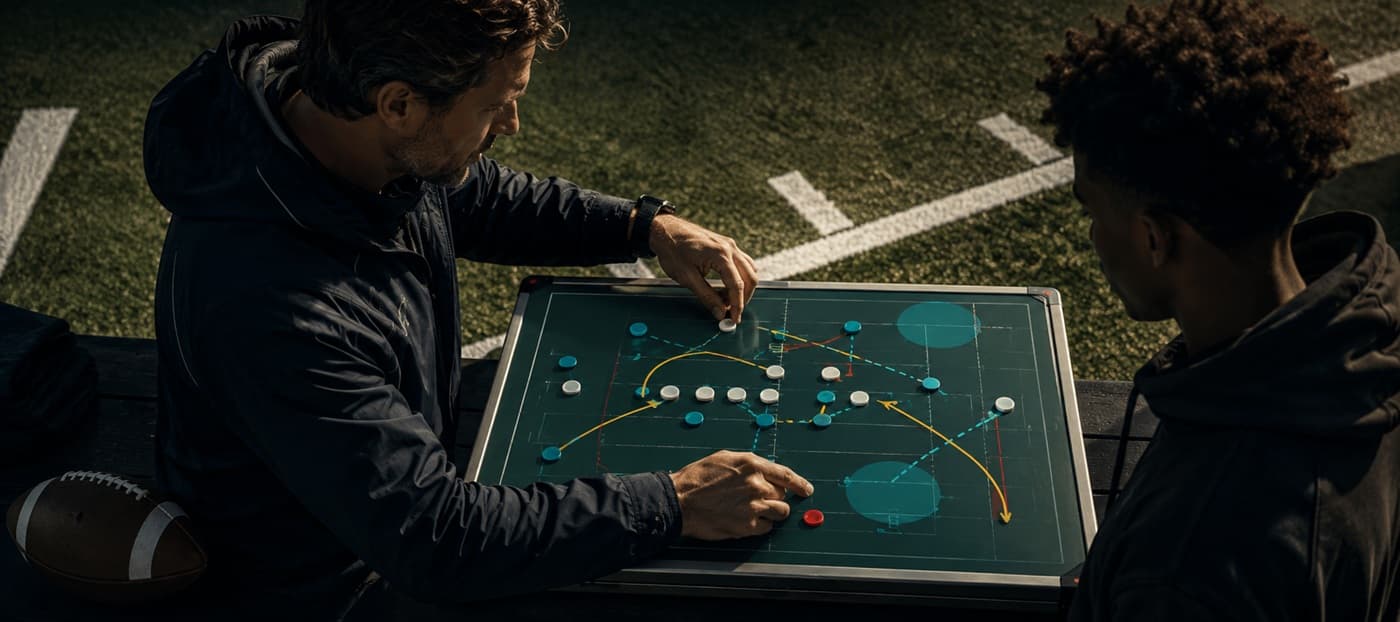
Football defenses use coverage families to organize how defenders protect receivers and areas of the field against the pass. Familiar names include Cover 0, Cover 1, Cover 2, Cover 3, Cover 4, and Cover 6.
At a beginner level, the coverage number often provides a useful clue about the defense's deep structure:
- Cover 0: no dedicated deep safety
- Cover 1: one deep middle defender
- Cover 2: two deep defenders
- Cover 3: three deep defenders
- Cover 4: four deep quarters
- Cover 6: commonly a split-field combination of Quarters and Cover 2
But that shorthand has limits.
A coverage number does not necessarily tell you every defender's assignment, technique, or post-snap responsibility.
Modern defenses use man coverage, zone coverage, pattern matching, split-field calls, rotations, pressures, brackets, and team-specific terminology. A defense that looks like Cover 2 before the snap may rotate into Cover 3. A Cover 3 call may use match rules that cause defenders to cover vertical receivers almost like man coverage. A Cover 4 defense may behave very differently from a simple four-deep spot-drop diagram.
The coverage name is the beginning of the explanation—not the entire defense.
What Does the Number in a Football Coverage Mean?Link to this section
The traditional coverage numbers are easiest to understand as shorthand for the number or arrangement of defenders responsible for the deepest part of the field.
For example:
- Cover 1 generally has one deep middle safety.
- Cover 2 generally divides the deep field between two defenders.
- Cover 3 generally divides it into three deep areas.
- Cover 4 traditionally divides it into four deep quarters.
Cover 0 is the logical exception at the beginning: there is no dedicated deep safety behind the man coverage.
Cover 6 is a different type of label. It commonly refers to Quarter-Quarter-Half, with a Quarters structure on one side and a Cover 2-style half-field structure on the other. Even here, terminology is not universal; defensive systems can use the same number differently.
So avoid treating coverage numbers like a universal mathematical code.
They tell you something important about the structure, but you still need to know:
- Who is playing man or zone?
- Who has underneath responsibilities?
- Is the coverage spot-drop or match?
- Which safety rotates?
- Which defender has the flat?
- How does the defense adjust to the formation?
- Is pressure being added?
Those questions turn a coverage label into an actual defensive call.
Coverage Shells: No-High, Single-High, and Two-HighLink to this section
Before quarterbacks identify an exact coverage, they often begin with the coverage shell.
A shell is the general pre-snap appearance of the secondary, especially the safeties.
Three useful categories are:
- No-high
- Single-high
- Two-high
These are starting clues, not final answers.
What Is a No-High Coverage Shell?Link to this section
A no-high look has no safety obviously positioned as a dedicated deep middle or deep-half defender before the snap.
This appearance often suggests:
- Cover 0
- Heavy pressure
- Tight man coverage
- A possible disguise that will rotate someone deep after the snap
If defenders are aligned directly over the offense's eligible receivers and everyone else appears near the line of scrimmage, the quarterback may suspect Cover 0.
But a defense can disguise.
A safety may begin low and retreat after the snap. A corner or another defensive back may change responsibility.
No-high is an observation about the picture—not proof of the final coverage.
What Is Single-High Coverage?Link to this section
A single-high structure places one safety prominently in the deep middle of the field.
Two major coverage families commonly associated with this picture are:
- Cover 1
- Cover 3
That creates an important quarterback problem.
Both can look similar before the snap.
In Cover 1, underneath defenders are generally playing man coverage.
In Cover 3, the defense generally has three deep defenders and underneath zone or match responsibilities.
The quarterback has to gather more information—and then confirm the answer after the snap.
What Is Two-High Coverage?Link to this section
A two-high shell shows two safeties positioned deep before the snap.
Possible coverages include:
- Cover 2
- Tampa 2
- Cover 4 / Quarters
- Cover 6
- Two-man structures
- Various match and split-field coverages
Once again, two-high does not automatically mean Cover 2.
One safety can rotate down after the snap to create a single-high defense. Both safeties may play Quarters rules. The defense may play one coverage to one side of the formation and another to the opposite side.
Quarterbacks use the shell to narrow the possibilities, then read the actual movement.
Major Coverage Families ComparedLink to this section
| Coverage | Typical deep structure | General underneath idea | Common strategic tradeoff |
|---|---|---|---|
| Cover 0 | No dedicated deep safety | Man assignments | Can add pressure/help near LOS but leaves little deep help if a matchup loses |
| Cover 1 | One deep middle safety | Man coverage underneath, sometimes with robber/help player | Deep-middle help supports man coverage but underneath matchups still matter |
| Cover 2 | Two deep halves | Underneath zone defenders protect shorter areas | Protects with two deep safeties but creates spacing conflicts between underneath and deep defenders |
| Tampa 2 | Two deep safeties with a deeper middle linebacker | Cover 2 family with added middle-depth help | Better protects deep middle while asking the middle runner to cover significant space |
| Cover 3 | Three deep thirds | Typically underneath zone or match responsibilities | Strong three-deep structure but underneath defenders can be stretched by route combinations |
| Cover 4 / Quarters | Four deep quarters conceptually | Can be spot-drop, zone-match, or man-match depending on system | Strong vertical distribution but assignments can be stressed by formations, underneath routes, and run-pass conflicts |
| Cover 6 | Quarter-Quarter-Half split-field structure | Different rules on opposite sides | Lets defense tailor coverage by formation but increases communication and split-field rule complexity |
These tradeoffs are structural tendencies, not guaranteed weaknesses.
A well-executed defense can adjust to an offense's preferred attack. An offense can also win a matchup even when the defensive call is theoretically well suited to the play.
Cover 0Link to this section
Cover 0 is primarily a man-coverage family with no dedicated deep safety protecting the field behind the man defenders.
Eligible receivers are typically matched by individual defenders, leaving other defenders available to rush, pressure, spy, or perform another responsibility.
Conceptually:
Man coverage underneath + no dedicated deep safety
That can allow the defense to put significant pressure on the offense.
But removing deep safety help creates an obvious tradeoff.
If a receiver wins cleanly against a defender, there may be no safety stationed behind the matchup to erase the mistake.
What Cover 0 can accomplishLink to this section
Cover 0 can allow the defense to:
- Put extra defenders near the line of scrimmage
- Create difficult pass-protection problems
- Challenge receivers aggressively
- Force the quarterback to make a rapid decision
- Use pressure to prevent slower-developing concepts
What the offense may examineLink to this section
The offense may look for:
- Favorable individual matchups
- Quick throws
- Crossing routes
- Routes that exploit leverage
- Protection answers
- Screens or other responses to pressure
None is an automatic solution.
A quick pass can be disrupted. A defender can win the matchup. A pressure can reach the quarterback before the intended answer develops.
Cover 1Link to this section
Cover 1 combines man coverage with one deep middle safety.
A basic structure may include:
- Defenders matched man-to-man with eligible receivers
- One safety protecting the deep middle
- Remaining defenders rushing or performing specialized responsibilities
USA Football educational material describes Cover 1 as man coverage underneath with a free safety remaining in deep coverage.
The deep safety changes how the underneath defenders can play.
A corner who knows there is help toward the deep middle may use different leverage than a defender isolated in Cover 0.
Cover 1 and leverageLink to this section
Man defenders might play:
- Inside leverage
- Outside leverage
- Press
- Off-man
- Trail technique
The technique depends on:
- Where the help is
- Receiver alignment
- Down and distance
- Formation
- Defensive rules
Cover 1 therefore means more than “everyone has a man except the safety.”
The defense's leverage structure matters.
Cover 1 RobberLink to this section
A Cover 1 Robber variation adds an underneath help defender—the robber—who can read routes and the quarterback.
Instead of dropping into another deep zone, that defender can work in intermediate space.
A robber might be positioned to:
- Cut an in-breaking route
- Help against crossers
- Jump a quarterback's throw
- Close a middle passing window
- Provide help around a particular matchup
The exact robber rules vary among defenses.
OpenPlay's Cover 1 Robber lets you see how the single-high safety, man defenders, and robber fit together. Watch the defense as a structure: the man assignments matter, but so does where the help is located.
Cover 2Link to this section
A traditional Cover 2 structure divides the deep field between two safeties.
Each safety is generally responsible for a deep half, while underneath defenders protect shorter portions of the field.
A basic Cover 2 picture commonly includes:
- Two deep safeties
- Corners responsible for shorter outside areas
- Linebackers or other underneath defenders working inside zones
USA Football uses this traditional two-deep-half structure when introducing Cover 2.
Why Cover 2 creates layered defenseLink to this section
Cover 2 places defenders at multiple depths.
The offense may encounter:
- A corner underneath
- A safety above that corner
- Linebackers working inside
- Another safety covering the opposite deep half
That creates relatively clear defensive layers.
The offense tries to stretch those layers without allowing one defender to influence multiple routes.
Structural tradeoffs in Cover 2Link to this section
Because two safeties divide the deep field, the defense must account for areas such as:
- The deep middle between the safeties
- Space between underneath defenders and safeties
- Sideline windows
- Route combinations that put an underneath defender in conflict
Those are stress areas, not automatic completions.
Defensive techniques and match variations exist specifically to reduce those problems.
Explore the traditional structure in OpenPlay's Cover 2 Zone.
What Is Tampa 2?Link to this section
Tampa 2 is an important variation within the Cover 2 family.
The defense still begins with the familiar two-deep-safety structure, but the middle linebacker—or another designated middle defender—can run deeper through the middle of the field when the pass develops.
That deeper middle presence helps address a major structural challenge of traditional Cover 2: protecting the area between the two deep safeties.
The important distinction is:
Tampa 2 is not simply “Cover 3 with a linebacker.”
The two safeties still operate from the Cover 2 family structure, while the middle runner adds depth through the middle according to the defense's rules.
Traditional descriptions of Tampa 2 emphasize this deeper drop by the middle linebacker.
Different defenses vary the linebacker's landmark, depth, route-matching responsibility, and run-pass read. Do not assume every Tampa 2 call uses identical coaching rules.
Why the middle runner mattersLink to this section
Imagine a receiver attacking the deep middle.
In ordinary spot-drop Cover 2, that receiver may threaten the space between the safeties.
In Tampa 2, the middle linebacker attempts to gain enough depth to disrupt that route and shrink the window.
That requires a linebacker who can:
- Read pass quickly
- Gain depth
- Relate to vertical routes
- Handle a large amount of middle-field space
The defense gains another answer in the deep middle, but that defender still has to execute a difficult assignment.
Cover 3Link to this section
Cover 3 traditionally divides the deep field into three sections:
- Deep outside third
- Deep middle third
- Deep outside third
A common version uses:
- Two cornerbacks in outside thirds
- One safety in the deep middle
- Four underneath defenders
This is a single-high family because one safety commonly occupies the deep middle.
But Cover 3 encompasses far more than one static diagram.
Spot-Drop Cover 3Link to this section
In a traditional spot-drop version, defenders work toward designated areas and react to the quarterback and routes entering those spaces.
An underneath defender may be responsible for an area such as:
- Curl/flat
- Hook
- Middle hook
The defender tries to maintain spacing relative to nearby defenders and break on throws entering the zone.
This basic version is useful for learning the coverage.
Modern defenses frequently add more sophisticated match rules.
Match Cover 3Link to this section
A Cover 3 defense can retain its three-deep structure while using pattern-match rules.
For example, an underneath defender or safety may carry an inside receiver vertically rather than simply passing that receiver into open space.
USA Football's material on Rip/Liz Cover 3 illustrates exactly this type of adjustment: defenders use receiver releases to trigger match responsibilities while the overall defense remains a Cover 3 family structure.
This matters because the phrase:
“Four Verticals beats Cover 3”
is too simplistic.
Four vertical routes can place serious stress on a traditional three-deep structure, especially through the seams. But match rules can help the defense carry those vertical threats rather than leaving them to attack static zones.
What Is Cover 3 Sky?Link to this section
Terms such as Sky, Cloud, and related tags often identify who handles an underneath or force responsibility within a coverage.
In a common Cover 3 Sky structure, a safety rotates down while the corner remains responsible for a deep outside third.
That safety can become an underneath defender and potentially participate more directly in run support.
But terminology varies considerably by coaching system.
The important concept is rotation.
A defense may begin with two safeties deep, then move one safety down and the other toward the deep middle after the snap.
The offense saw two-high.
The final coverage became single-high.
OpenPlay's Cover 3 Sky is useful for seeing that transformation. Watch the safety movement immediately after the snap and how the rotation creates the three-deep structure.
Cover 4 / QuartersLink to this section
Cover 4, commonly associated with Quarters, conceptually divides the deep field into four quarters.
A simple spot-drop diagram might show:
- Two cornerbacks protecting the outside quarters
- Two safeties protecting the inside quarters
- Underneath defenders working beneath them
That beginner picture is useful.
But modern Quarters coverage is often much more sophisticated.
Quarters as Match CoverageLink to this section
Many Quarters defenses use match rules based on how receivers release.
A safety might not simply backpedal into a quarter of the field and wait.
Instead, the safety could:
- Match an inside receiver who goes vertical
- Drive on another route if the inside receiver releases underneath
- Help a corner according to route distribution
- Change responsibility based on the formation
USA Football's detailed Quarters material distinguishes traditional zone principles from zone-match and man-match approaches in which receiver releases determine who defenders ultimately cover.
That makes this statement important:
Cover 4 does not automatically mean four defenders standing in four deep zones.
Some versions can look remarkably similar to man coverage after the receivers declare their routes.
Why Quarters Is Strategically InterestingLink to this section
Quarters can provide four defenders capable of handling vertical threats while allowing safeties to react differently than they would in a traditional deep-half coverage.
Those safeties may also have significant run responsibilities depending on the call.
That creates a run-pass conflict.
A safety needs to:
- Respect vertical routes
- Read receiver releases
- Understand formation
- Communicate with teammates
- Potentially fit the run
Play action and route combinations can attempt to exploit those competing responsibilities.
OpenPlay's Cover 4 Quarters provides a starting point for seeing the four-deep family. As you watch, focus on which receivers can threaten each safety rather than imagining four permanently fixed boxes.
Cover 6Link to this section
Cover 6 traditionally refers to a split-field Quarter-Quarter-Half coverage.
One side of the defense operates with Quarters-type principles.
The opposite side operates with Cover 2-type principles.
So one side may conceptually have:
- Corner + safety dividing deep space into quarters
while the other has:
- A safety responsible for a deep half
- A corner playing an underneath Cover 2-type responsibility
This is why Cover 6 is often described as combining Cover 4 and Cover 2.
Traditional Cover 6 is commonly referred to as Quarter-Quarter-Half, but exactly which side receives each coverage and how the defense determines strength varies by system. Some defensive playbooks also use numbers differently.
Why Use Split-Field Coverage?Link to this section
Offensive formations are not always balanced.
Consider a 3x1 trips formation:
- Three receiving threats on one side
- One receiver on the other
The defense may not want to solve both sides with identical rules.
A split-field call can allow the defense to say, conceptually:
We will defend the trips side one way and the isolated receiver another way.
That flexibility is increasingly important against formations designed specifically to create different problems on opposite sides of the center.
OpenPlay's Cover 6 can help you see why the defense should not always be viewed as one symmetrical structure stretching from sideline to sideline.
Spot-Drop Zone vs. Match CoverageLink to this section
One of the biggest steps from beginner to intermediate coverage understanding is recognizing the difference between spot-drop zone and match coverage.
Spot-drop zoneLink to this section
In a simplified spot-drop system, a defender:
- Drops toward a landmark or zone.
- Maintains spacing with nearby defenders.
- Reads the quarterback and routes.
- Breaks on throws.
This is the version often shown in introductory coverage diagrams.
Match coverageLink to this section
In match coverage, receiver routes can trigger changes in responsibility.
A defender might begin with zone principles but then:
- Carry a receiver vertically
- Exchange a crosser with a teammate
- Match a receiver man-to-man
- Release one route and take another
USA Football distinguishes zone-match and man-match systems by how defenders distribute receivers and where their eyes are placed during the play.
This is why television coverage can be difficult to identify.
A defense can start looking like zone and finish looking like man.
What Is Pattern Matching?Link to this section
Pattern matching means defenders use the pattern of receiver releases to determine how coverage responsibilities unfold.
Imagine two receivers to one side.
The defense's rules might depend on whether the inside receiver:
- Goes vertical
- Breaks outside
- Crosses inside
- Stays shallow
Each route can trigger a different defensive response.
The goal is to preserve the structural advantages of zone coverage while avoiding the problem of simply allowing receivers to run freely through open seams.
Pattern matching makes modern coverage more adaptive—but it also requires strong communication.
One defensive mistake can leave a receiver uncovered if two defenders interpret the route combination differently.
Rotation and DisguiseLink to this section
A defense does not have to line up in its final coverage before the snap.
Rotation occurs when safeties or other defenders move into their actual coverage responsibilities as or after the ball is snapped.
For example:
Pre-snapLink to this section
Two safeties appear deep.
The quarterback considers:
- Cover 2
- Cover 4
- Cover 6
Post-snapLink to this section
One safety drives down.
The other rotates toward the deep middle.
Now the defense may be presenting Cover 3.
This is disguise.
The defense wants the quarterback to reach the wrong conclusion—or at least delay the correct one.
Pre-Snap Coverage Is a HypothesisLink to this section
Quarterbacks use several pre-snap clues:
- Safety count
- Safety depth
- Cornerback leverage
- Corner depth
- Linebacker location
- Alignment over slot receivers
- Reaction to motion
- Formation adjustments
- Potential pressure
Those observations help narrow the possibilities.
They do not prove the coverage.
A useful quarterback process is:
Pre-snap hypothesis → post-snap confirmation
USA Football's quarterback teaching material similarly uses safety structure as an early coverage clue while emphasizing the need to interpret the defense as the play develops.
Single-High vs. Two-HighLink to this section
You will frequently hear analysts simplify defensive football into single-high and two-high families.
That distinction is useful.
Single-highLink to this section
Common families include:
- Cover 1
- Cover 3
Potential strategic characteristics include:
- A defender occupying the deep middle
- More potential bodies available underneath or near the box
- Different leverage rules for corners
- Stress on seams and outside areas depending on the call
Two-highLink to this section
Common families include:
- Cover 2
- Tampa 2
- Cover 4
- Cover 6
- Two-man
- Other split-field structures
Potential characteristics include:
- Two safeties initially removed from the immediate box
- More flexibility in protecting vertical routes
- Opportunities to disguise which safety will rotate
- Different run-fit responsibilities
But the pre-snap shell can lie.
A quarterback cannot identify Cover 3 solely because one safety appears high or Cover 4 solely because two do.
How Formation Changes CoverageLink to this section
Coverage calls do not exist independently of offensive formation.
Defenses must adjust to:
- 2x2
- Trips
- Empty
- Bunch
- Stack
- Condensed splits
- Running backs detached as receivers
- Attached tight ends
Consider Quarters.
Against 2x2, both safeties may have relatively symmetrical route distributions to read.
Now the offense shifts to trips.
Three receivers threaten one side while only one remains opposite.
The defense needs rules for:
- The No. 3 receiver
- Crossers
- Vertical routes
- The isolated backside receiver
- The running back
- Potential run fits
That may lead to split-field calls such as Cover 6 or another formation-specific adjustment.
This is why understanding offensive formations makes coverage much easier to understand.
How Offenses Stretch CoveragesLink to this section
Passing concepts are built to create conflicts in defensive structures.
An offense can create:
- Horizontal stretches
- Vertical stretches
- High-low conflicts
- Crossing traffic
- Overloads
- Isolated matchups
The concept matters because different coverages distribute defenders differently.
Four VerticalsLink to this section
Four Verticals sends multiple receiving threats downfield.
Against a traditional Cover 3 structure, four vertical lanes can stress three deep defenders—particularly around the seams.
That historical problem helped encourage the development and use of match Cover 3 systems that carry vertical receivers rather than playing only static zones. USA Football's Rip/Liz material describes this relationship directly.
Against Quarters, the defensive problem changes because four deep defenders are available, but their route-match rules and leverage still must be executed correctly.
Same offensive concept.
Different coverage problem.
MeshLink to this section
Mesh creates shallow crossing traffic.
Against man coverage, defenders may have to follow receivers across the field while navigating bodies and changing leverage.
Against zone coverage, those crossers can move through underneath areas while complementary routes stress defenders at other depths.
Against match coverage, defensive switch and distribution rules become especially important.
Mesh therefore demonstrates why saying a play simply “beats man” is incomplete.
The offense creates a particular stress.
The defense still has possible answers.
Stick and Underneath Zone DefendersLink to this section
Stick can place underneath defenders in conflicts involving inside and outside threats.
Against a zone structure, the quarterback may watch whether a defender widens, stays inside, gains depth, or matches a route.
Against man, the quarterback may instead evaluate individual leverage.
The same concept can therefore be read differently depending on the coverage family.
See Passing Concepts for a deeper explanation of horizontal stretches, high-low reads, windows, and quarterback progressions.
Coverage “Weaknesses” Are Really TradeoffsLink to this section
Football coverage is often taught with lists such as:
“Cover 2 is weak here.”
“Cover 3 is weak there.”
Those can be useful starting points, but structural tradeoff is usually a better term.
Every defense has only 11 players.
Putting two safeties deep means those players cannot simultaneously occupy two underneath locations.
Putting one safety in the deep middle allows another defender to be used elsewhere, but the remaining deep structure is different.
Playing tight man coverage removes traditional zone windows but places greater pressure on individual matchups.
Using match coverage can address problematic route combinations but adds communication complexity.
Every call distributes finite defenders according to priorities.
There is no coverage that protects:
- Every deep route
- Every underneath window
- Every individual matchup
- Every quarterback scramble
- Every running lane
- Every possible pressure
all at once.
Football strategy exists because teams must choose what to emphasize.
Coverage and Defensive Fronts Work TogetherLink to this section
The secondary cannot be understood in isolation from the defensive front.
Suppose a defense keeps both safeties deep.
That may change how many defenders are immediately available in the run fit.
If a safety rotates down into Cover 3, that player may become part of the run-support structure.
If a linebacker blitzes, another defender may need to replace the linebacker's coverage responsibility.
If the defense uses a simulated pressure, the coverage must account for whichever potential rusher drops instead.
This is why defensive fronts, pressure, and coverage should be viewed as interconnected layers of the defensive call.
How to Identify Coverage While Watching FootballLink to this section
Instead of trying to name the defense instantly, work through a sequence.
1. Find the safetiesLink to this section
Ask:
- Zero high?
- One high?
- Two high?
This narrows the possibilities.
2. Look at the cornersLink to this section
Are they:
- Press?
- Off?
- Inside leverage?
- Outside leverage?
- Looking toward the quarterback?
- Aligned as if matching a particular receiver?
3. Find the slot defendersLink to this section
Their alignment can help distinguish:
- Man
- Underneath zone
- Pressure
- Match responsibilities
4. Watch motionLink to this section
Does someone follow?
Does the entire defense bump?
Does a safety rotate?
Motion provides information but does not automatically reveal the coverage.
5. Watch the safeties after the snapLink to this section
This may be the most useful step.
Do they:
- Stay in two halves?
- Divide into quarters?
- Rotate one safety down?
- Move toward a deep middle structure?
6. Watch how defenders react to routesLink to this section
Do they:
- Follow one receiver everywhere?
- Pass receivers between zones?
- Match vertical releases?
- Sit in underneath areas?
- Exchange crossing routes?
Only then should you become confident about the coverage.
This is the broader skill developed in Reading a Defense.
Common Beginner Misconceptions About CoverageLink to this section
“The coverage number tells you exactly what every defender does.”Link to this section
No. It usually describes a broad deep-coverage structure. Underneath assignments, leverage, match rules, rotations, pressures, and terminology vary.
“Two safeties means Cover 2.”Link to this section
No. The defense could play Cover 2, Cover 4, Cover 6, two-man, another split-field coverage, or rotate into something else.
“One safety means Cover 1.”Link to this section
No. Cover 1 and Cover 3 commonly use single-high structures, and defenses can disguise other calls from a one-high appearance.
“Cover 4 is just prevent defense.”Link to this section
No. Quarters can be an aggressive match coverage with safeties involved in route matching and run responsibilities.
“Cover 3 means defenders stand in three deep zones.”Link to this section
Traditional Cover 3 uses three deep areas, but many modern versions use match rules that cause defenders to carry particular receivers.
“Cover 6 means six deep defenders.”Link to this section
No. Cover 6 commonly means Quarter-Quarter-Half, combining Quarters principles on one side with Cover 2 principles on the other.
“Tampa 2 is just Cover 3.”Link to this section
No. Tampa 2 remains a Cover 2-family structure with two deep safeties while a middle defender gains additional depth through the middle.
“Every defense uses the same coverage names.”Link to this section
No. Cover 1 through Cover 4 are widely understood families, but specific tags and higher numbers can mean different things in different systems.
“Once the quarterback identifies the shell, he knows the coverage.”Link to this section
No. Defenses rotate and disguise after the snap. Pre-snap identification creates a hypothesis that must be confirmed.
Why Coverage Families MatterLink to this section
Coverage families give you a framework for understanding what the defense is trying to protect.
Cover 0 commits to man coverage without dedicated deep safety help.
Cover 1 adds a deep middle defender.
Cover 2 divides the deep field between two safeties.
Tampa 2 adds a deeper middle-running defender to the Cover 2 family.
Cover 3 creates three deep sections.
Quarters creates a four-deep structure that often becomes much more sophisticated through match rules.
Cover 6 allows a defense to solve opposite sides of the offensive formation differently.
But those labels are only the framework.
Modern defensive football adds:
- Pattern matching
- Split-field calls
- Safety rotation
- Robbers
- Brackets
- Pressure
- Disguise
- Formation adjustments
- Run-fit responsibilities
That is why the best question is not simply:
“What coverage number is this?”
A more useful sequence is:
What shell is the defense showing?
How does it rotate?
Which routes are defenders matching?
Where is the help?
Which space is the defense protecting—and which tradeoff did that choice create?
Once you begin asking those questions, Cover 0 through Cover 6 stop looking like isolated diagrams and become related solutions to the same fundamental defensive problem: protecting the field with 11 players against an offense trying to stretch it.
Frequently Asked QuestionsLink to this section
What are the main coverages in football?Link to this section
Major coverage families include Cover 0, Cover 1, Cover 2, Cover 3, Cover 4 or Quarters, and Cover 6. Defenses also use variations such as Tampa 2, robber coverages, match coverage, brackets, split-field calls, and pressure coverages.
What does Cover 0 mean?Link to this section
Cover 0 generally means man coverage without a dedicated deep safety. That can allow the defense to commit additional players to pressure but gives less deep help if a receiver wins an individual matchup.
What does Cover 1 mean?Link to this section
Cover 1 generally combines man coverage underneath with one safety protecting the deep middle of the field. Variations such as Cover 1 Robber add an underneath help defender.
What is Cover 2?Link to this section
Cover 2 traditionally uses two deep safeties dividing the field into halves, with other defenders protecting underneath areas.
What is Tampa 2?Link to this section
Tampa 2 is a Cover 2-family defense in which the middle linebacker or another designated middle defender gains significant depth through the middle when defending the pass. This helps protect space between the two deep safeties.
What is Cover 3?Link to this section
Cover 3 generally uses three deep defenders protecting two outside thirds and one middle third. Underneath defenders play zone or match responsibilities depending on the system.
What is Cover 4 or Quarters coverage?Link to this section
Cover 4 conceptually divides the deep field into four quarters. Many modern Quarters defenses use match rules, so defenders may carry specific receivers rather than simply dropping to four fixed areas.
What is Cover 6?Link to this section
Cover 6 traditionally refers to Quarter-Quarter-Half coverage: Quarters principles on one side of the field and Cover 2 principles on the other. Exact terminology and which side receives each call vary among systems.
What is the difference between single-high and two-high coverage?Link to this section
Single-high coverage presents one deep middle safety and commonly includes Cover 1 and Cover 3 families. Two-high coverage begins with two deep safeties and can include Cover 2, Cover 4, Cover 6, and other structures. The pre-snap shell does not guarantee the final coverage.
What is match coverage?Link to this section
Match coverage uses rules based on receiver routes. A defender may begin from a zone structure but match a receiver man-to-man when a particular route release triggers that responsibility.
How does a quarterback identify coverage?Link to this section
Quarterbacks use safety structure, corner leverage, linebacker alignment, slot-defender positioning, motion reactions, and other pre-snap clues. After the snap, they confirm the coverage by reading safety rotation and how defenders respond to routes.
Is there one pass coverage that is best against everything?Link to this section
No. Every coverage distributes defenders differently and therefore creates strategic tradeoffs. Formation, personnel, route concepts, protection, quarterback mobility, down and distance, and defensive personnel all influence which coverage is appropriate.
Take it to the field