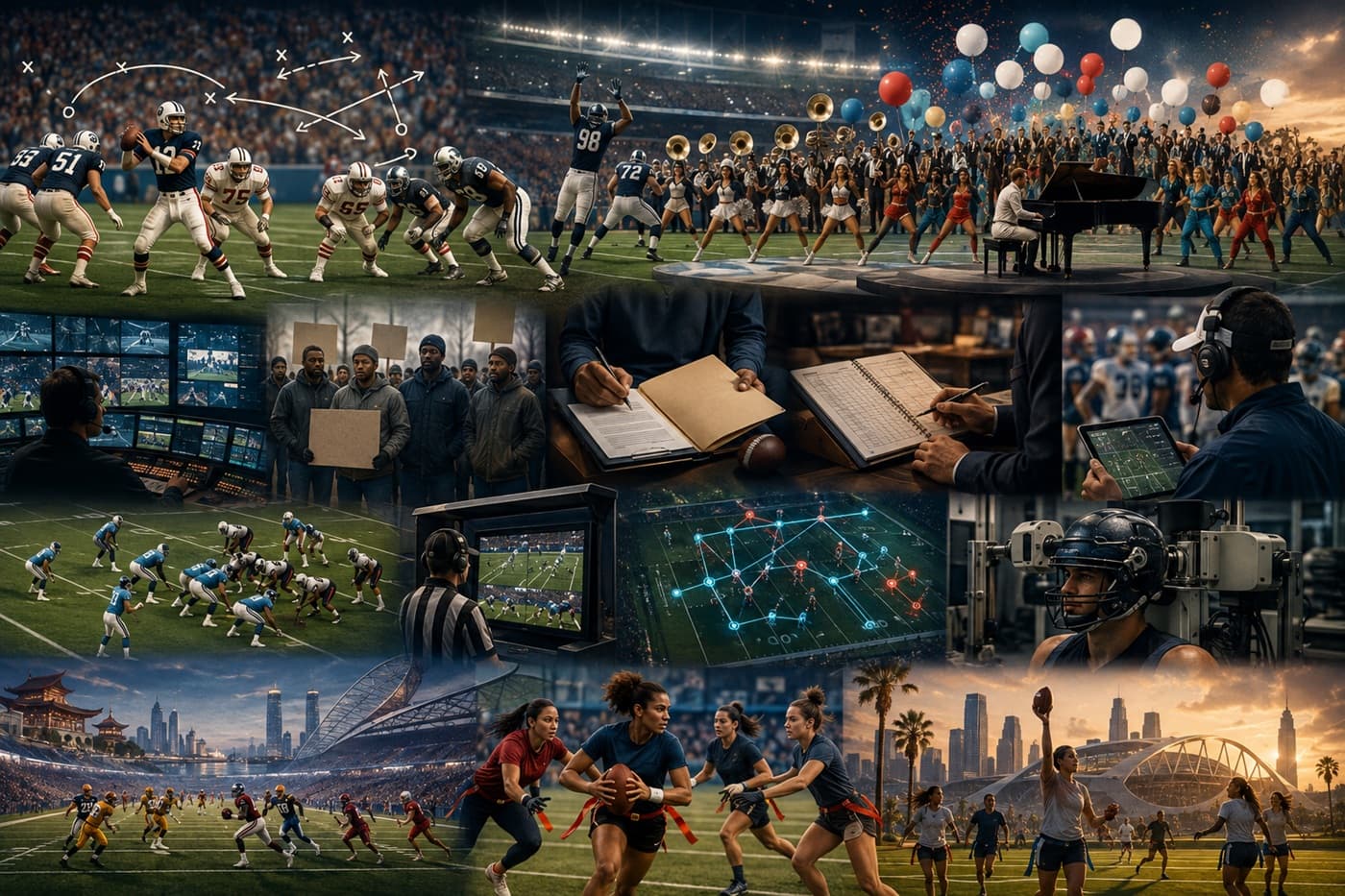
The phrase modern football can be misleading because football has always changed. What makes the period since 1980 distinctive is the speed and interdependence of that change. Strategy, labor law, television, digital technology, medicine, data, college governance, and global promotion now influence one another.
A passing concept developed in one league can appear in high school, college, and professional play within a few seasons. A rule intended to reduce one kind of injury can change roster value and play calling. A television contract can reshape conference membership. A court decision can alter player movement or compensation. Tracking data can create a new statistic that appears in broadcasts and eventually affects coaching.
The era also resists a simple story of progress. Players gained free agency, but careers remained insecure. Better medical procedures improved recognition of concussions, while research raised deeper concerns about repetitive impacts. More college games became available to viewers, while media money intensified realignment and governance conflict. Flag football opened new participation paths, while tackle football continued debating acceptable risk.
This article treats 1980 through August 2026 as an unfinished historical era. Current playoff formats, compensation systems, rules, and Olympic plans require periodic review.
The modern era at a glance
- Strategic shift
- Timing-based passing, spread formations, motion, zone running, RPOs, and disguised pressure
- Labor milestone
- Unrestricted NFL free agency established in 1993
- Economic structure
- NFL salary cap begins in 1994
- College television turning point
- The 1984 Supreme Court ruling expands school and conference control of media rights
- Professional structure
- A 32-team NFL realigned into eight four-team divisions in 2002
- College postseason
- BCS in 1998, four-team CFP in 2014, and 12-team CFP beginning in 2024–25
- Technology
- Replay, sideline tablets, player tracking, machine learning, and real-time analytics
- Safety
- Concussion protocols, independent spotters, equipment testing, and intensified CTE research
- College athlete movement
- Transfer Portal launches in 2018; broader transfer flexibility follows
- College compensation
- NIL policy changes in 2021 and settlement-era direct benefits beginning in 2025–26
- Global and participation growth
- International regular-season games and expanding women’s and girls’ flag football
- Near future
- Flag football scheduled to make its Olympic debut at Los Angeles 2028
Football in 1980 compared with football in 2026
The comparison is broad. College divisions, youth leagues, professional leagues, and local rule codes do not all change at the same pace.
| Feature | Football in 1980 | Football in 2026 |
|---|---|---|
| NFL regular season | 16 games per team | 17 games per team |
| NFL postseason | Ten playoff teams | Fourteen playoff teams |
| Player movement | Highly restrictive veteran movement | Unrestricted, restricted, and tagged free-agent systems operating within a salary cap |
| College postseason | Bowls, polls, and competing championship claims | A 12-team College Football Playoff alongside the bowl system |
| College athlete compensation | Scholarships and permitted educational benefits within amateurism rules | Scholarships, NIL opportunities, and settlement-era direct benefits at participating Division I schools |
| College transfers | Paper-driven permission and eligibility processes | A centralized Transfer Portal and broader immediate-eligibility pathways |
| Offensive structure | Pro sets, I formations, option systems, and emerging timing-based passing | Multiple personnel packages, spread spacing, motion, zone runs, RPOs, and hybrid college–pro concepts |
| Defensive structure | Established fronts and man/zone families | Pattern matching, nickel as a base package, simulated pressures, creepers, and positionless subpackages |
| Replay and officiating | No regular-season instant-replay system | Centralized replay support with expanded video and communication tools |
| Data | Film, charts, scouting notes, and conventional statistics | Player and ball tracking, advanced metrics, machine learning, and real-time analytical dashboards |
| Media | Broadcast television, radio, newspapers, and limited cable | Broadcast, cable, league-owned media, streaming, mobile video, social platforms, and international distribution |
| Safety systems | Team medical staffs and evolving equipment standards | Formal concussion protocols, unaffiliated consultants, medical spotters, video review, annual helmet testing, and injury-data programs |
| International reach | Exhibitions and limited overseas activity | Regular-season games across several countries and formal international player pathways |
| Alternative formats | Flag football largely recreational and local | Rapidly expanding youth, high-school, college, international, and Olympic flag football |
Timing and spacing changed the professional passing game
The 1978 rules had already restricted downfield contact and expanded legal pass-blocking technique. Coaches entering the 1980s built systems that used those rules more fully.
Bill Walsh’s offense emphasized short and intermediate throws delivered on rhythm, receivers arriving at exact landmarks, backs contributing as pass catchers, and formations that made the quarterback’s progression clearer. Don Coryell’s systems attacked vertically and stretched coverage through route combinations at several depths.
The popular label West Coast offense eventually covered many related ideas, but no single terminology became universal. What mattered was the shift from treating the pass as a separate gamble to using it as a controlled method of moving the chains.
Defenses responded by disguising coverage, matching routes, creating pressure without always sending extra rushers, and placing more value on versatile defensive backs.
Modern defenses learned to create pressure without revealing it
Offensive spacing created new defensive problems. Sending too many pass rushers could leave favorable matchups, while passive zones allowed precise quarterbacks to complete short throws.
The zone blitz provided one influential answer. A defense could rush an unexpected linebacker or defensive back while dropping a lineman into coverage. The pressure looked aggressive, but the defense still protected zones behind it.
Later defenses expanded the principle into simulated pressures and creepers: four defenders rush, but the offense may not know which four until after the snap. The goal is to force a protection error or a hurried read without sacrificing the numbers of a conventional coverage.
Nickel personnel also moved from a special passing-down package toward an everyday structure as offenses used three or more receivers more often.
The 1982 strike shortened the season and expanded player benefits
NFL players began a strike in September 1982 after disputes over revenue, salaries, benefits, and bargaining power. The work stoppage lasted 57 days and reduced the regular season from 16 games to nine.
The resulting collective bargaining agreement did not create the free agency players wanted, but it established minimum salary schedules, increased postseason and training-camp pay, strengthened medical and insurance benefits, and introduced severance pay.
The strike demonstrated a continuing imbalance. Television money was making the league more valuable, yet individual players had limited ability to move between teams or capture that growth through an open labor market.
The USFL challenged football’s calendar and labor market
The original United States Football League played spring and summer seasons from 1983 through 1985. It placed teams in major markets, signed prominent college players, and attracted coaches and executives who later influenced the NFL.
The league gave players bargaining alternatives and became a testing ground for passing systems, including versions of the run-and-shoot. Several future professional stars developed there before entering the NFL.
The USFL folded after attempting to move to a fall schedule and pursuing an antitrust case against the NFL. Its short life showed both the demand for more football and the difficulty of competing for television, stadiums, owners, and players.
A 1984 Supreme Court decision transformed college football television
For years, the NCAA limited the number and distribution of televised college games. Universities and conferences challenged that control.
In NCAA v. Board of Regents of the University of Oklahoma, the U.S. Supreme Court held that the NCAA television plan violated antitrust law. Schools and conferences gained greater ability to negotiate their own media arrangements.
The number of available games expanded rapidly. More television created exposure and revenue, but it also increased the economic power of conferences, broadcasters, and programs with large audiences.
Modern realignment, conference networks, national time slots, and media-rights negotiations cannot be understood without this shift in control.
The 1987 strike failed on the field but continued in court
Players struck after the second week of the 1987 season while seeking meaningful free agency. One weekend was canceled, and owners then staged games using replacement players and veterans who crossed the picket line.
The strike ended after 24 days without achieving its main goal. The union shifted toward antitrust litigation, eventually decertifying so players could challenge owner restrictions as individuals.
The legal strategy produced victories in cases involving Freeman McNeil and the class represented by Reggie White. A 1993 settlement established unrestricted free agency and restored the NFLPA as the players’ union.
Cable television and replay made football an always-available product
The NFL began regular cable packages on ESPN in 1987. Studio shows, highlights, draft coverage, and year-round analysis expanded football beyond the game broadcast.
Instant replay entered the regular season experimentally in 1986, disappeared after 1991, and returned in a revised challenge-based form in 1999. Later centralized review connected stadium officials with league experts in New York.
NFL Network launched in 2003 as the first league-owned, year-round television destination dedicated to the sport. Digital distribution later added mobile viewing, social clips, direct-to-consumer products, and streaming packages.
The audience no longer encountered football only on game day. The draft, free agency, schedule release, training camp, film analysis, and fantasy discussion became media events of their own.
Free agency and the salary cap remade roster construction
The 1993 settlement created unrestricted free agency for qualifying veterans and guaranteed players a share of league revenues. Reggie White became the era’s most visible early example when he changed teams through the new market.
The salary cap began in 1994. Teams could no longer build rosters only by accumulating expensive veterans, while players and agents had to evaluate contract structure, guarantees, bonuses, cap charges, and future flexibility.
The combined system produced controlled mobility rather than a completely open market. Franchise and transition tags, restricted free agency, rookie rules, contract guarantees, and collective bargaining continued to shape movement.
Modern front offices became exercises in football evaluation and financial planning at the same time.
Expansion and relocation created the 32-team league
The 1990s brought expansion teams in Carolina and Jacksonville, franchise relocations, and the return of Cleveland after a contested move.
Houston’s expansion club began play in 2002 as the league’s 32nd team. The NFL reorganized into eight four-team divisions, moved Seattle back to the NFC, and created a scheduling rotation under which every club would meet every other club at least once every four years.
Realignment made the standings easier to understand and stabilized a league structure that remains recognizable. It also showed that franchise identity, stadium finance, regional loyalty, and ownership decisions could be as historically important as results on the field.
College football moved from disputed polls to an expanding playoff
For most of the twentieth century, the highest level of college football relied on bowls, polls, conference agreements, and competing championship claims.
The Bowl Championship Series began with the 1998 season and attempted to match the top two teams in a designated championship game. Its rankings combined human polls and computer systems, producing a clearer title game but not eliminating controversy.
The College Football Playoff began after the 2014 regular season with four teams selected by a committee. The playoff expanded to 12 teams after the 2024 regular season, adding on-campus first-round games and a larger path to the championship.
For the 2025–26 format, the five highest-ranked conference champions received automatic access, while the bracket was seeded directly by the committee ranking and the four highest-ranked teams received first-round byes.
Because access rules, seeding, conference structures, and television agreements can change, this section requires annual review.
The spread offense dissolved old boundaries between levels
College coaches used wide formations, shotgun snaps, tempo, quarterback runs, option principles, and quick screens to force defenses to defend the entire field.
The spread was not one offense. Air raid systems emphasized repeated pass concepts and wide receiver spacing. Spread-option systems used the quarterback as a runner and decision-maker. No-huddle teams used pace to limit substitutions and simplify defensive disguises.
Run-pass options combined a running play with a quick passing answer. The quarterback read a defender after the snap and decided whether to hand off or throw into the space that defender abandoned.
Professional teams once treated some of these ideas as unsuitable for the NFL. Over time, they adapted shotgun formations, option reads, motion, packaged plays, and college terminology to professional personnel and rules.
Modern offense is therefore a conversation across levels rather than a one-way transfer from professional football downward.
Tracking data changed what teams and viewers can measure
Football analytics began long before electronic tracking. Coaches charted tendencies, scouts graded players, and researchers studied decisions such as fourth-down attempts.
Modern tracking systems record player location, speed, distance, and acceleration several times each second. The data can describe separation, time to throw, rushing lanes, defensive pursuit, pass probability, and player movement unavailable in traditional box scores.
The NFL’s Big Data Bowl invites analysts to use tracking information to study strategy, performance, and player safety. Some resulting metrics have entered team operations and broadcasts.
Machine learning can identify patterns, but it does not remove football judgment. A model depends on how the play, assignment, context, and outcome are defined. Analytics should inform coaching rather than pretend every decision has one context-free answer.
Head injuries became a defining public controversy
Concussions had always existed in football, but recognition, diagnosis, and public understanding changed substantially. Medical research also focused increasingly on repetitive head impacts that may occur without a diagnosed concussion.
Chronic traumatic encephalopathy can currently be confirmed only through postmortem examination. Research has identified CTE in some people with histories of repeated head impacts, including young amateur athletes, but scientists continue studying individual risk, exposure, diagnosis during life, and why outcomes differ.
The NFL’s formal game-day concussion protocol was developed in 2011 and is reviewed regularly. Independent athletic-trainer spotters began assisting injury identification in 2012, and medical timeouts were added later.
Helmet testing, reduced-contact practices, kickoff changes, defenseless-player protections, rules against using the helmet, field-surface research, and unaffiliated medical personnel are parts of modern risk reduction.
These measures do not make tackle football risk-free. Equipment can reduce some impact severity but cannot eliminate brain movement or all effects of repeated contact.
Collective bargaining continued to define the professional game
The 2011 labor agreement followed a lockout and reorganized rookie compensation, offseason practices, revenue sharing, and benefits.
The 2020 collective bargaining agreement runs through the 2030 season. It expanded the postseason to seven teams per conference beginning in 2020, increased active roster provisions, strengthened health and safety commitments, and permitted the regular season to grow to 17 games.
The 17-game format began in 2021. The additional game is an interconference matchup determined through the scheduling rotation and prior-year divisional finish.
Collective bargaining governs much more than salaries. It shapes practice contact, discipline, medical procedures, pension benefits, drug policies, roster rules, free agency, and the annual calendar.
Regular-season football became an international event
Professional football used overseas exhibitions for decades, but the modern international regular-season program began with a 2005 game in Mexico City and launched as an annual series in London in 2007.
The program later expanded to additional cities in Europe and the Americas. Games abroad serve existing supporters, attract new audiences, test markets, and create logistical challenges involving travel, fields, scheduling, player recovery, and competitive equity.
International player pathways have also brought athletes from different football backgrounds into professional development systems.
International growth should not be confused with equal global depth. Football still requires coaching, equipment, facilities, officiating, and domestic competition to become sustainable outside its largest markets.
College roster building changed through the portal and NIL
The NCAA Transfer Portal launched in October 2018 as a compliance tool that allowed athletes to make their interest in transferring visible to other schools.
Later eligibility changes made transfer movement more immediate and strategically important. Coaches increasingly manage returning players, high-school recruits, transfers, eligibility, and roster limits at the same time.
On July 1, 2021, an interim NCAA policy allowed college athletes to earn compensation from third parties for use of their name, image, and likeness. NIL agreements include endorsements, appearances, camps, social content, and other legitimate commercial uses.
NIL is not identical to a salary for playing. Rules, state laws, collective arrangements, school policies, and enforcement mechanisms continue to evolve.
The House settlement altered the economics of Division I athletics
A federal court approved the House settlement in June 2025. The agreement included approximately $2.78 billion in back damages over ten years and permitted participating Division I schools to provide direct financial benefits to athletes.
The initial annual cap for those benefits was approximately $20.5 million per school for 2025–26, tied to a percentage of average revenue from major conferences. The framework also replaced sport-by-sport scholarship limits with roster limits and introduced oversight of certain third-party NIL agreements.
The settlement does not make every college athlete an employee, does not require every school to spend the maximum, and does not create identical resources across divisions or institutions.
Because litigation, governance, federal law, and school participation may change the framework, financial figures and terminology require regular review.
Flag football created a second modern growth path
Five-on-five flag football emphasizes space, route timing, quarterback decisions, open-field movement, coverage, and flag pulling without conventional blocking or tackling.
The lower equipment and roster requirements make it easier for schools and communities to begin programs, although coaching, officiating, fields, heat planning, and injury procedures still matter.
Flag football is scheduled to make its Olympic debut at Los Angeles 2028 with separate men’s and women’s events. NFL players are permitted to seek national-team selection, but roster places are not automatic.
Women’s flag football entered the NCAA Emerging Sports for Women program in January 2026 and received a recommendation to continue toward National Collegiate Championship status. Final governance and funding steps remained incomplete at the review date.
Flag may serve as an introduction to tackle football for some athletes and as a complete independent discipline for others.
Football became a year-round media and business ecosystem
Modern football revenue comes from national and local media, tickets, sponsorship, licensing, hospitality, gambling-related partnerships, stadium development, digital products, and other commercial activity.
The sport’s calendar now includes free agency, the draft, schedule release, organized practices, training camp, preseason, the regular season, playoffs, all-star events, and year-round college recruiting and transfer coverage.
Streaming widened access but also fragmented viewing across services. League-owned platforms and social media let football organizations communicate directly with fans while collecting more behavioral and commercial data.
The commercial system funds salaries, facilities, media production, and benefits, but it also intensifies disputes about public stadium subsidies, scheduling, athlete workload, gambling integrity, conference realignment, and who receives the value created by the game.
Modern football is a negotiation rather than a finished form
No single strategy defines the era. A team may win through condensed formations and power runs, empty formations and quick throws, quarterback movement, zone defense, simulated pressure, or situational special teams.
The lasting change is adaptability. Coaches build systems around available players, rules, opponent tendencies, roster economics, injury information, and analytical evidence.
The same is true institutionally. The NFL’s schedule, college compensation, the playoff, player-safety procedures, flag football, and media distribution remain active subjects of negotiation.
The future may include more tracking, automated officiating assistance, alternative football formats, international development, and AI-supported analysis. Those tools will still need human definitions of responsibility, fairness, safety, and what football is meant to teach or entertain.