Learn Football
Defensive Fronts in American Football
A defensive front aligns box defenders to control gaps, influence blocking combinations, and generate pressure.
23 minute read
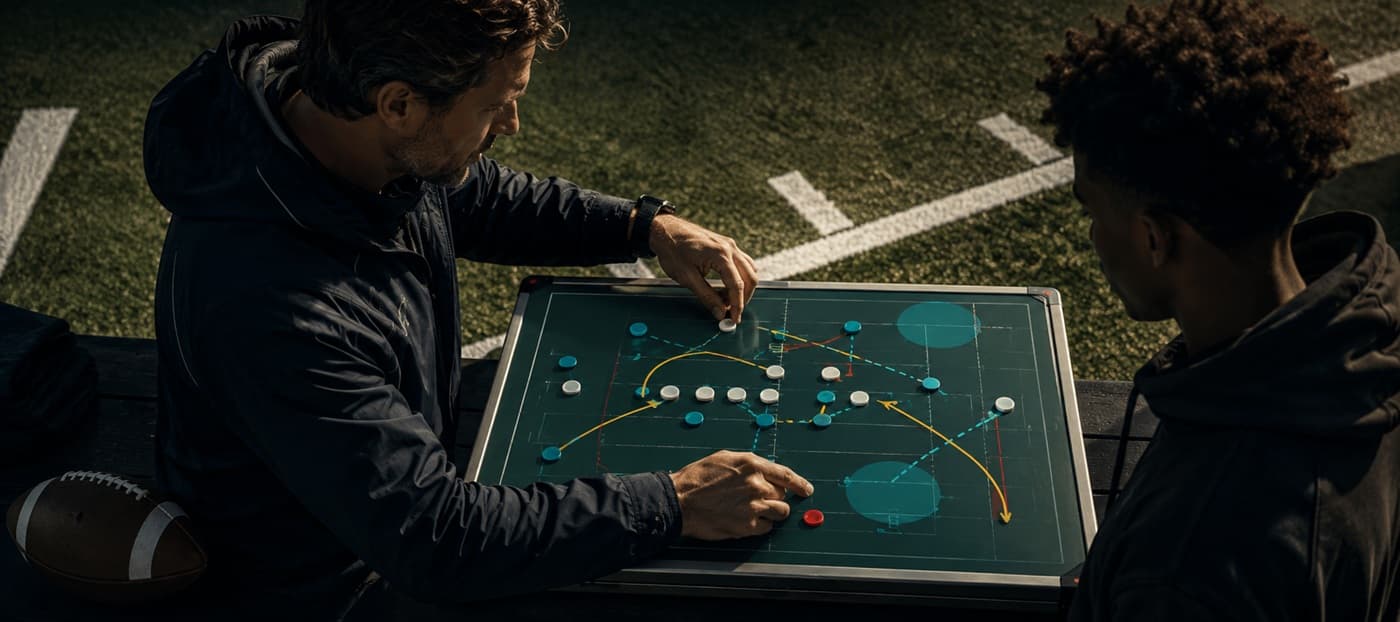
A defensive front is the alignment and structure of the defenders positioned near the line of scrimmage before the snap. It usually centers on the defensive linemen and linebackers—or hybrid edge players—who are responsible for controlling gaps, defending the run, rushing the passer, and creating pressure.
To understand a defensive front, start with the offensive line.
The offense normally provides five basic reference points:
- Left tackle
- Left guard
- Center
- Right guard
- Right tackle
Defensive coaches describe where defenders line up relative to those offensive players and the gaps between them.
A defender might line up directly over the center, shade one shoulder of the center, align outside a guard, or position much wider near the edge. Moving only a few feet can change the blocking problem dramatically.
That is the central idea of defensive fronts:
Alignment determines which gaps defenders can threaten, which blockers must account for them, and how the offense can organize its blocking scheme.
Fronts are closely connected to personnel, run fits, pressures, and coverage, but they are not the same thing. A defense can use the same personnel group and present several different fronts from one snap to the next.
Start With the Offensive LineLink to this section
Before identifying the defense, locate the offensive line.
From left to right:
Tackle – Guard – Center – Guard – Tackle
Tight ends may extend the offensive surface by aligning next to a tackle.
Defensive front terminology uses these offensive players as landmarks.
For example, a defensive tackle might be:
- Head-up on the center
- Shaded to one shoulder of the center
- Head-up on a guard
- On the outside shoulder of a guard
- Inside a tackle
- Outside a tackle
Those positions determine which offensive linemen can block the defender directly and where double teams or combination blocks may develop.
What Are A, B, and C Gaps?Link to this section
Football coaches use letters to identify the spaces between offensive blockers.
| Gap | General location | Why it matters |
|---|---|---|
| A gap | Between the center and each guard | Interior rushing and run-fit area |
| B gap | Between each guard and tackle | Common target for runs and pressures |
| C gap | Outside the tackle or between tackle and attached tight end | Important for off-tackle runs and edge control |
| Edge/perimeter | Outside the core blocking surface | Where contain, force, sweeps, and outside runs become important |
There is an A gap on each side of the center, a B gap on each side, and so on.
The presence of a tight end can create another useful reference point outside the tackle.
A defense ultimately needs a plan for the gaps the offense might attack.
That does not mean every defender simply stands in one gap and stays there. Defensive fronts can use movement, slants, stunts, two-gap techniques, pressures, and secondary support to account for the running lanes.
For a deeper look at how the offense attacks these spaces, see Running Plays.
Why Small Alignment Changes MatterLink to this section
Suppose a defensive tackle lines up directly over an offensive guard.
Now move that defender slightly toward the guard's outside shoulder.
It may look like a tiny adjustment, but it can affect:
- Which blocker has the best angle
- Whether the guard can receive help from the center
- Which gap the defender can penetrate
- Where a double team can form
- How easily a blocker can climb to a linebacker
- Which running lane appears open to the ball carrier
Defensive fronts are often built from these small positional advantages.
That is why coaches use technique numbers to describe defensive line alignment precisely.
Defensive Line Technique NumbersLink to this section
A common technique-numbering system describes where a defender lines up relative to an offensive blocker.
The system is widely used, but terminology and exact coaching definitions can vary.
| Technique | General alignment |
|---|---|
| 0-technique | Head-up on the center |
| 1-technique | Shaded on a center's shoulder |
| 2-technique | Head-up on a guard |
| 2i-technique | Inside shoulder of a guard |
| 3-technique | Outside shoulder of a guard |
| 4-technique | Head-up on a tackle |
| 4i-technique | Inside shoulder of a tackle |
| 5-technique | Outside shoulder of a tackle |
| 6-technique | Generally head-up on an attached tight end |
| 7-technique | Commonly an inside alignment on a tight end, though terminology varies |
| 9-technique | Wide outside alignment beyond the tight end or offensive edge |
The numbers are descriptive shorthand, not positions in themselves.
A player described as a 3-technique defensive tackle is aligned on the outside shoulder of a guard.
A 0-technique nose tackle is head-up on the center.
A 5-technique is commonly aligned outside an offensive tackle.
What Is a 3-Technique?Link to this section
The 3-technique is one of the most frequently discussed defensive alignments.
The defender lines up on the outside shoulder of an offensive guard, placing the defender in position to threaten the B gap.
That alignment can create several problems for the offense.
The guard may have difficulty receiving immediate help from the center because the defender begins farther away from the center.
Against a run, the defender may attempt to penetrate the B gap.
Against a pass, the alignment can create an advantageous interior rushing lane.
The term describes the alignment, however—not exactly what the defender will do after the snap.
A 3-technique might:
- Attack the B gap
- Slant inside
- Twist with another lineman
- Rush the passer
- Play a more controlled technique
What Is a 0-Technique?Link to this section
A 0-technique lines up directly over the center.
This defender is often called a nose tackle or nose, particularly in odd-front structures.
From that position, the defender can influence both A gaps.
Depending on the defensive scheme, the nose might:
- Attack one A gap
- Read the center and play both sides
- Occupy the center and a guard
- Slant after the snap
- Rush through an interior gap
A large, powerful nose tackle can make it difficult for the center to immediately help elsewhere.
But a 0-technique does not have to be a specific body type, and being aligned over the center does not automatically mean the defender is playing two gaps.
What Is a 1-Technique?Link to this section
A 1-technique is shaded to one side of the center rather than directly head-up.
That alignment generally places the defender closer to one A gap.
In an even front, you may see one defensive tackle in a 1-technique and another in a 3-technique.
That creates an asymmetrical front even though the defense still has four down linemen.
This is an early clue that phrases such as even front do not necessarily mean the defense is perfectly symmetrical.
Even FrontsLink to this section
An even front generally places an even number of down defensive linemen—commonly four—across the offensive front.
A familiar structure might involve:
- Two defensive ends
- Two defensive tackles
The interior tackles may align differently, such as:
- A 1-technique on one side
- A 3-technique on the other
The ends might align in 5-techniques or wider positions depending on the call.
An even front gives the defense multiple immediate threats across the offensive line while linebackers fit behind them.
But “even front” describes the basic structure, not one exact alignment.
A defense can shift the tackles, widen an end, walk a linebacker onto the line, or create pressure looks that change the picture considerably.
Odd FrontsLink to this section
An odd front commonly uses an odd number of down defensive linemen—often three.
A traditional picture might include:
- A nose tackle over the center
- A defensive end aligned around each offensive tackle
- Linebackers positioned behind or outside the linemen
A three-down structure does not necessarily mean the defense is rushing only three players.
An outside linebacker may rush on one snap and drop into coverage on another.
Another linebacker can blitz.
A defensive lineman can slant.
The front creates uncertainty partly because the offense may not immediately know which potential rushers will actually attack.
This is one reason simply counting players with a hand on the ground can provide an incomplete picture.
Even vs. Odd FrontsLink to this section
| Front family | Basic appearance | Common structural feature | Offensive concern |
|---|---|---|---|
| Even | Often four down linemen | Multiple immediate line-of-scrimmage threats | Identify interior shades and blocking combinations |
| Odd | Often three down linemen with linebackers around them | Center may be covered by a nose; edge rushers can vary | Determine which linebackers are rushers and how interior gaps are controlled |
| Over | Front shifted toward offensive strength | 3-technique commonly positioned toward strength in many systems | Adjust combinations and account for strengthened side |
| Under | Front shifted away from or differently relative to strength | Interior shade and edge structure change | Blocking angles differ from an Over picture |
| Bear | Interior offensive linemen heavily covered | Center and both guards can be occupied directly | Interior double teams and climbing to linebackers become difficult |
| Tite/Mint | Often three-down structure with interior tackle alignments | Attempts to close interior gaps while controlling edges with other defenders | Inside runs face reduced interior space |
These are conceptual descriptions. Teams can use different terminology or alignments under the same name.
What Is an Over Front?Link to this section
An Over front is a common even-front adjustment that shifts the defensive structure toward the offense's declared strength.
The exact definition varies by system, but a familiar version places the 3-technique toward the strong side of the formation.
“Strength” might be determined by:
- Tight-end location
- Number of receivers
- Passing strength
- Another team-specific rule
The front is therefore not simply “four defensive linemen.”
Their locations matter.
By shifting toward strength, the defense can change which offensive linemen are covered and where combination blocks are available.
What Is an Under Front?Link to this section
An Under front changes the structure in the opposite or complementary way.
Again, exact definitions vary.
A common version moves the interior defensive line so the 3-technique is away from the offense's declared strength, while the strong-side edge or linebacker alignment helps reinforce the other side.
For beginners, the useful distinction is:
- Over and Under are adjustments to where defenders are placed relative to offensive strength.
- They are not entirely different defenses.
- They can be played with similar personnel.
A shift of one defensive tackle from one guard to the other can change several offensive blocking combinations.
What Is a Bear Front?Link to this section
A Bear front is designed to cover much of the offensive interior directly.
A traditional Bear structure places defenders over or tightly aligned to:
- The center
- Both guards
That can make it harder for offensive linemen to create easy combination blocks.
Why?
Because if the center and both guards each have an immediate defender to deal with, they may have less freedom to help one another and then release cleanly to linebackers.
A Bear front can therefore create significant stress against interior running concepts.
But it does not guarantee the defense will stop the run.
The offense can respond with:
- Different formations
- Outside runs
- Pulling schemes
- Play-action
- Motion
- Passes
- Adjusted blocking rules
OpenPlay's Bear Run Pressure helps illustrate how a crowded interior front can change the offense's blocking problem. Watch which offensive linemen become covered and how that limits easy combination blocks.
Tite and Mint FrontsLink to this section
You may also hear terms such as Tite front or Mint front, particularly when discussing modern defenses.
Definitions vary, but these fronts commonly use a three-down structure with interior defensive linemen aligned in positions such as 4i techniques, inside the offensive tackles, with a nose near the center.
Conceptually, the defense is trying to make interior running lanes difficult to access without committing every second-level defender directly to the line.
A simplified objective is:
- Close interior gaps
- Make inside runs bounce or redirect
- Preserve linebackers for pursuit
- Use edge defenders or secondary support outside
The details differ significantly among systems, so it is safer to understand Tite and Mint as a family of modern interior-control structures rather than assume one universal diagram.
Double-Mug Pressure PresentationsLink to this section
A double-mug look places two linebackers or other potential rushers near the interior gaps, often threatening both A gaps around the center.
“Mugging” a gap means a linebacker moves close to the line of scrimmage as though ready to blitz.
Before the snap, the offense may see:
- A defensive front across the line
- One linebacker threatening one A gap
- Another linebacker threatening the other A gap
The protection must now determine:
- Are both linebackers rushing?
- Is only one coming?
- Are both dropping?
- Will a defensive lineman twist into another gap?
- Can the center handle one threat?
- Does the running back need to protect?
The defense may use the presentation to create pressure even without sending every potential rusher.
OpenPlay's Man Pressure can help illustrate the broader relationship between pressure structure and coverage responsibilities.
Defensive Line vs. Linebacker ResponsibilitiesLink to this section
A defensive front is not only about defensive linemen.
Linebackers and hybrid players are essential because the defensive line rarely controls every possible gap by itself.
Defensive linemen may be responsible for:
- Penetrating gaps
- Occupying blockers
- Controlling one or two gaps
- Setting an edge
- Rushing the quarterback
Linebackers may:
- Fit open gaps
- Read the running back
- Scrape over defensive linemen
- Blitz
- Cover receivers
- Replace another defender in the run fit
The responsibilities work together.
If a defensive tackle attacks one gap, that can influence which gap the linebacker behind the tackle must fit.
If an edge defender forces the run inside, another defender must be ready to make the tackle there.
One-Gap DefenseLink to this section
In a one-gap technique, a defender is generally responsible for controlling or penetrating a specific gap.
For example, a 3-technique might be assigned to attack the B gap.
The defender may try to:
- Get off the ball quickly
- Defeat the block
- Penetrate
- Disrupt the runner before the play develops
This approach can create aggressive defensive movement.
But penetration can also create risk if the defender loses gap integrity or runs past the play.
“One-gap” does not mean every defense using it attacks recklessly. Technique and responsibilities remain coordinated.
Two-Gap DefenseLink to this section
In a two-gap technique, a defender may be responsible for controlling the blocker and reacting to either gap on that blocker's sides.
A nose tackle head-up on the center is a classic conceptual example.
Instead of immediately choosing one A gap, the defender may:
- Engage the center.
- Control the block.
- Read where the runner is going.
- Shed toward the appropriate gap.
Two-gapping can allow the defense to cover multiple lanes with fewer defensive linemen, but it demands strength, technique, awareness, and disciplined reads.
Modern defenses can mix one-gap and two-gap ideas rather than using one philosophy on every snap.
What Is a Run Fit?Link to this section
A run fit is the defense's plan for accounting for the gaps and running lanes created by an offensive run.
If the offense has potential A, B, C, and perimeter lanes, the defense needs players responsible for closing those opportunities.
The front sets up the initial structure.
Then the fit develops after the snap.
For example:
- A defensive tackle controls the A gap.
- Another defender attacks the B gap.
- A linebacker fits the next available lane.
- An edge defender prevents the runner from escaping outside.
- A safety may become an additional run defender.
The responsibilities depend on the coverage, front, offensive formation, and defensive system.
A good run fit is coordinated.
If two defenders attack the same gap while another lane is left open, the running back may have an easy answer.
What Does Contain Mean?Link to this section
Contain refers broadly to preventing the ball carrier or quarterback from escaping freely around the defensive edge.
Suppose a run is moving right.
If the outside defender crashes too aggressively inside, the runner may bounce outside with nobody remaining between the runner and the sideline.
An edge player maintaining contain tries to preserve outside leverage.
That may force the runner:
- Back toward inside defenders
- To hesitate
- To take a wider, slower path
Contain is also important against quarterbacks who leave the pocket.
The precise assignment may be described differently from system to system.
Force and SpillLink to this section
Two related run-defense ideas are force and spill.
Terminology varies, but at a beginner level:
ForceLink to this section
A force defender tries to establish outside leverage and turn the ball carrier back toward defensive help.
The message is effectively:
You are not getting outside me. Go back toward my teammates.
SpillLink to this section
A spill technique may attack the blocking structure in a way designed to force the runner farther outside, where another defender is waiting.
Instead of containing the play directly, the defender helps redirect it toward support.
These concepts demonstrate why run defense requires coordination.
The first defender does not always need to make the tackle personally.
Sometimes the assignment is to force the runner toward the teammate who will.
How Fronts Affect Double TeamsLink to this section
One of the most important strategic effects of a front is determining where the offense can create double teams and combination blocks.
Consider Inside Zone.
Against one front, the center and guard might be able to work together against a defensive tackle before one releases to a linebacker.
Against another front, both offensive linemen might be covered by separate defenders.
Now the easy combination disappears.
This is one reason Bear fronts can create difficulty for interior zone concepts: by covering the center and guards, the defense can reduce the offense's opportunities to immediately double one defender and climb to a linebacker.
For a detailed explanation of these offensive techniques, see Running Plays.
Fronts Change Offensive Blocking AssignmentsLink to this section
Consider the same offensive play against two fronts.
Inside Zone against a lighter boxLink to this section
The offense may have favorable numbers.
Adjacent linemen can form combination blocks and work toward linebackers.
The running back reads the resulting leverage.
Inside Zone against a Bear frontLink to this section
Several interior offensive linemen are covered directly.
Combination blocks become more difficult.
The offense may have to rely on different blocking rules, a different read, or an adjustment.
The play is still Inside Zone.
The defensive front changed how the offense must execute it.
That is why OpenPlay animations become more useful when you examine both sides of the diagram rather than watching only the runner.
Fronts Affect Gap-Scheme Runs TooLink to this section
Gap concepts such as Power and Counter create different problems.
A pulling guard needs a path across the formation.
Down blocks need favorable angles.
The offense must know which defender is being kicked out and which defender the puller will lead toward.
A front that places a defensive lineman in an unexpected gap can disrupt the puller's path.
A linebacker aligned differently can change the lead block.
A defensive line stunt can create penetration before the pulling blocker arrives.
The offense and defense are continually changing the geometry of the same gaps.
How Offenses Respond to Defensive FrontsLink to this section
An offense is not required to run the original play exactly as planned against every front.
Depending on its system, the offense might:
- Change the run direction
- Adjust blocking calls
- Motion a tight end
- Add a blocker
- Read an unblocked defender
- Check to a pass
- Use play-action
- Attack the perimeter
- Change the protection
- Keep the call and trust its rules
An offense that can run several concepts from the same personnel group and formation can make it harder for the defense to choose an ideal front.
Front and Coverage Are Separate—but ConnectedLink to this section
A defensive front describes the structure near the line of scrimmage.
Coverage describes how the defense handles receiving threats and protects space against the pass.
They are separate concepts.
A team can show a similar front and play different coverages behind it.
For example, a defense may present a four-man front and then play:
- Cover 1
- Cover 2
- Cover 3
- Quarters
- Another coverage family
But front and coverage cannot be treated as completely independent.
If a safety becomes an extra run defender, that affects the coverage structure behind the front.
If a linebacker blitzes, another defender may need to replace that player's coverage responsibility.
If the defense uses a pressure such as Fire Zone Blitz, the rush and coverage are coordinated.
Likewise, Cover 3 Sky helps illustrate how a safety rotation can influence both coverage and run support.
Explore the broader relationship in Coverage Families.
Why 4-3 and 3-4 Do Not Tell the Whole StoryLink to this section
A 4-3 defense traditionally refers to personnel organized around:
- 4 defensive linemen
- 3 linebackers
- 4 defensive backs
A 3-4 defense traditionally refers to:
- 3 defensive linemen
- 4 linebackers
- 4 defensive backs
Those labels remain useful, but they can be misleading if treated as a complete description of what the defense will look like on every snap.
Imagine a 3-4 defense.
One outside linebacker walks down to the line beside the three defensive linemen.
To the offense, the front can now look much like a four-man surface.
On another snap, both outside linebackers might threaten the line.
On another, one drops into coverage.
Similarly, a nominal 4-3 defense may remove a linebacker for a nickel defensive back yet maintain a four-man defensive line.
Modern defenses can use:
- Hybrid edge defenders
- Nickel packages
- Five-man surfaces
- Odd spacing
- Even spacing
- Simulated pressures
- Late movement
So:
4-3 and 3-4 describe broad personnel structures. They do not fully describe the front presented on every snap.
This distinction is especially useful when watching modern football.
The Same Personnel Can Show Different FrontsLink to this section
Suppose the defense has:
- Three defensive linemen
- Four linebackers
- Four defensive backs
That could be called 3-4 personnel.
Before one snap, the defense shows a traditional odd structure.
Before the next:
- An outside linebacker walks onto the line.
- The nose shifts from head-up to a shade.
- A defensive end moves inside.
- Another linebacker threatens an A gap.
The offense now sees a dramatically different front.
Yet the defense never substituted.
This flexibility makes pre-snap identification more difficult.
A quarterback cannot simply say:
“They are a 3-4 team, so I know the front.”
The actual alignment must be read.
Pressure Can Change the Apparent FrontLink to this section
Defenses can also place potential rushers near the line without intending to send all of them.
Imagine two linebackers standing in the A gaps.
The offense may need to account for both.
At the snap:
- One blitzes.
- One drops.
- A defensive end drops.
- A different defender loops inside.
The defense has changed the protection problem without necessarily sending an unusually large number of rushers.
This is sometimes called a simulated pressure or related pressure presentation, depending on the exact design.
The front and pressure picture therefore influence pass protection before the quarterback even begins reading coverage.
Fictional Example: Inside Zone vs. an Over FrontLink to this section
The offense lines up in 11 personnel and calls Inside Zone.
The defense presents an Over-style front with a 3-technique aligned toward formation strength.
The offense identifies:
- Which linemen are covered
- Where the 3-technique is located
- Which combination blocks are available
- Which linebacker is the second-level target
At the snap, the 3-technique penetrates aggressively.
The running back presses the original track but sees the intended lane close.
A combination block elsewhere creates a cutback.
The back changes direction.
The front influenced both the blocking assignments and the runner's final decision.
Fictional Example: Bear Front Changes the InteriorLink to this section
The offense uses the same personnel on the next series.
This time the defense presents Bear.
The center and both guards have defenders directly threatening them.
The offense now has fewer easy opportunities to double an interior lineman before climbing to a linebacker.
The quarterback may:
- Keep the run
- Change the blocking call
- Check to another concept
- Motion a player
- Throw against the resulting coverage
Bear has not automatically stopped the offense.
It has changed the problem.
Fictional Example: Same Front, Different CoverageLink to this section
The defense shows the same four-man front on consecutive snaps.
Snap 1Link to this section
The secondary rotates into a three-deep structure.
A safety becomes involved in run support.
Snap 2Link to this section
The front looks almost identical.
This time the defense uses a different coverage structure and the safety stays deeper.
From the quarterback's perspective, the front was only the first layer of information.
The offense must identify:
- Front
- Potential pressure
- Coverage
- Post-snap movement
This is why Reading a Defense involves more than counting defensive linemen.
Common Beginner Misconceptions About Defensive FrontsLink to this section
“A 4-3 defense always has the same four-man front.”Link to this section
No. A defense can shift linemen, walk linebackers onto the line, use nickel personnel, or present different fronts without abandoning its broader system.
“A 3-4 defense rushes only three players.”Link to this section
No. One or more linebackers can rush, and the defense can create four-, five-, or larger pressure structures.
“A technique number tells you the defender's assignment.”Link to this section
Not completely. It primarily describes alignment. The defender may penetrate, slant, rush, stunt, or play another responsibility after the snap.
“A 3-technique is a type of player.”Link to this section
It is primarily an alignment: outside shoulder of an offensive guard. Certain player traits may fit the role well, but the term describes where the defender lines up.
“Bear means blitz.”Link to this section
No. Bear describes a front structure. The defense can rush different numbers of players from that structure.
“Every defender owns exactly one gap.”Link to this section
Not necessarily. Defenses can use one-gap, two-gap, exchange, spill, force, and other coordinated techniques.
“The edge defender always makes the tackle.”Link to this section
The edge player's job may instead be to force the runner toward another defender.
“Front and coverage are the same defensive call.”Link to this section
No. Front describes the structure near the line; coverage describes how the defense handles passing threats. They must coordinate, but they are distinct layers.
How to Identify a Defensive Front on TelevisionLink to this section
When watching before the snap, use this sequence.
1. Find the centerLink to this section
The center gives you the easiest interior reference point.
Ask:
- Is someone head-up on the center?
- Is a defender shaded into an A gap?
- Is the center uncovered?
2. Look at the guardsLink to this section
Ask:
- Is there a 3-technique?
- Are both guards covered?
- Does the picture resemble Bear?
3. Check the tacklesLink to this section
Look for defenders:
- Head-up
- Inside shoulder
- Outside shoulder
- Well outside as edge players
4. Count the apparent line-of-scrimmage threatsLink to this section
Do you see:
- Three?
- Four?
- Five?
- More potential rushers?
Remember that a linebacker near the line may still drop.
5. Find the linebackersLink to this section
Ask which gaps appear available to them.
A linebacker stacked behind a defensive tackle may be preparing to fit based on where that tackle moves.
6. Look for late movementLink to this section
Defenses often change the picture just before the snap.
A safety may walk down.
A linebacker may enter an A gap.
A defensive tackle may shift.
An edge player may widen.
Only after seeing the actual alignment can you begin predicting how the offense will handle it.
Why Defensive Fronts MatterLink to this section
A defensive front is the first layer of the defense's attempt to control space.
By changing where defenders align, the defense can:
- Close particular gaps
- Change blocking angles
- Disrupt combination blocks
- Make pullers alter their paths
- Create pressure threats
- Influence where a running back wants to go
- Force the offense to adjust protection
- Hide which defenders will rush
- Connect run defense to the coverage behind it
A 1-technique and 3-technique create one blocking problem.
A nose and two 4i defenders create another.
Bear creates another.
Double-mug linebackers create another.
The same offensive formation and personnel can therefore face very different problems without the defense changing all 11 players.
Once you learn to locate the center, identify gaps, recognize technique alignments, and notice where linebackers are positioned, a defensive front stops looking like a collection of defenders near the ball.
It becomes a map of the defense's first tactical problem:
Which spaces are we controlling, which blockers are we challenging, and where do we want the football to go?
Frequently Asked QuestionsLink to this section
What is a defensive front in football?Link to this section
A defensive front is the alignment and structure of defensive linemen, edge defenders, and often linebackers near the line of scrimmage. It helps determine how the defense controls gaps, defends the run, creates pressure, and interacts with coverage.
What are A, B, and C gaps?Link to this section
A gaps are between the center and guards. B gaps are between guards and tackles. C gaps are generally outside the tackles or between a tackle and an attached tight end. The edge or perimeter lies outside the core blocking surface.
What is a 0-technique?Link to this section
A 0-technique defender aligns head-up on the center. A nose tackle frequently uses this alignment, particularly in odd fronts.
What is a 1-technique?Link to this section
A 1-technique is shaded to one shoulder of the center, usually placing the defender in position to threaten an A gap.
What is a 3-technique?Link to this section
A 3-technique defender lines up on the outside shoulder of an offensive guard, generally placing the defender near the B gap.
What is the difference between an even and odd front?Link to this section
An even front commonly uses an even number of down defensive linemen, often four. An odd front commonly uses an odd number, often three. Actual alignments and linebacker positioning can make either structure much more complex.
What is a Bear front?Link to this section
A Bear front places defenders directly over or very near the center and both guards, reducing easy interior combination blocks and creating a crowded blocking surface.
What is the difference between a 4-3 and a 3-4 defense?Link to this section
Traditionally, a 4-3 uses four defensive linemen and three linebackers, while a 3-4 uses three defensive linemen and four linebackers. Modern defenses can create many different fronts from either personnel structure, so those labels do not fully describe every snap.
What is a run fit?Link to this section
A run fit is the coordinated defensive plan for accounting for gaps and running lanes. Defensive linemen, linebackers, edge defenders, and sometimes defensive backs work together so dangerous running lanes are covered.
What does setting the edge mean?Link to this section
Setting the edge means preventing a runner from freely escaping around the outside of the defense. An edge defender may maintain outside leverage and force the ball carrier back toward inside help.
Take it to the field