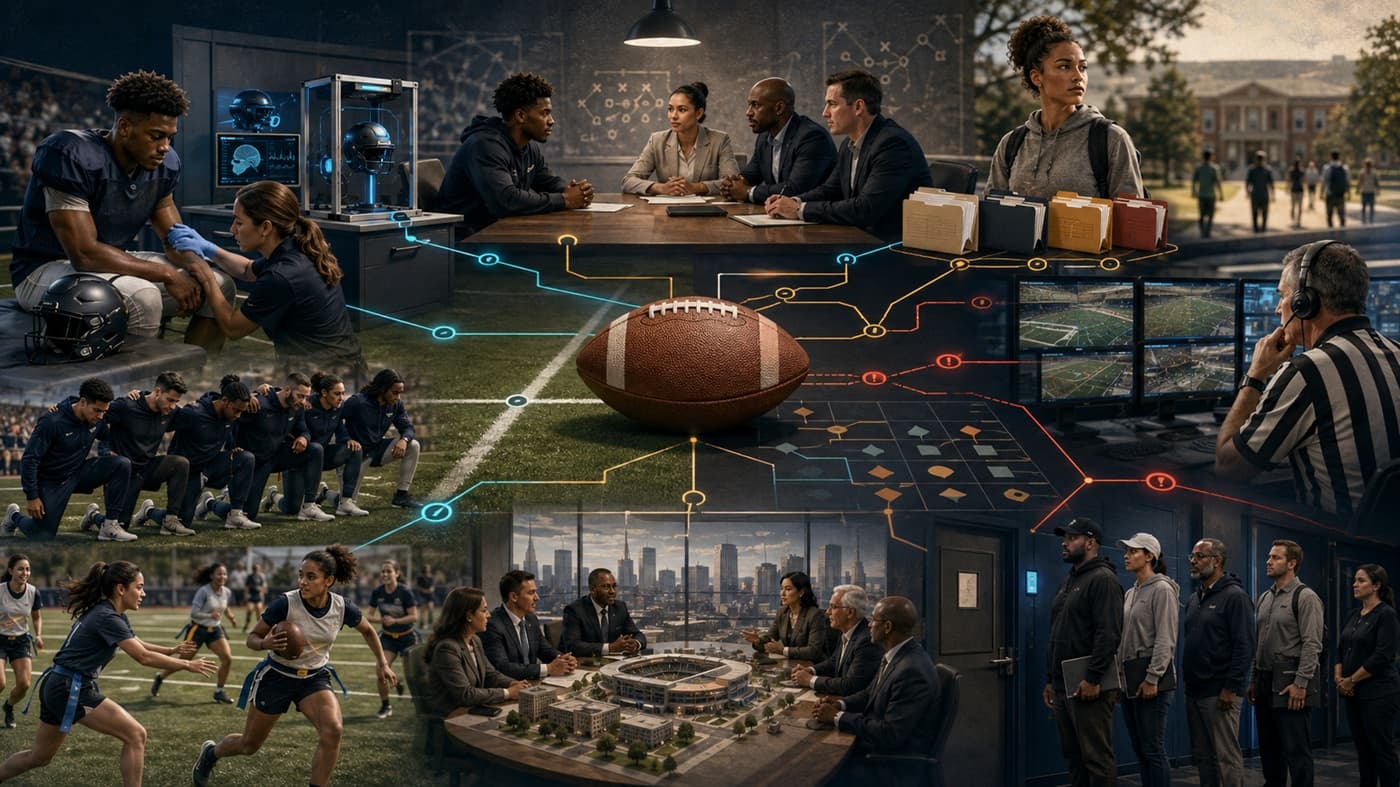
A controversy is not the same thing as a scandal. A scandal usually centers on alleged or documented wrongdoing. A controversy can continue even when everyone follows the existing rules because the rules themselves are disputed.
Football controversies also exist at different levels. A professional debate about a 17-game season is a collective-bargaining issue. A high-school concussion response is a medical, educational, and legal issue. College compensation involves antitrust law, school finances, conference power, roster limits, and the educational status of athletes.
Public discussion often collapses these levels. A rule designed for NFL athletes may be inappropriate for children. An NCAA policy may not apply to an NAIA or club team. A professional gambling partnership does not permit a player to bet on league games.
The most useful way to study a controversy is to identify the decision-maker, the people who bear the cost, the evidence available, the values in conflict, and the method for appeal or reform.
Major controversy groups
- Health and safety
- Concussions, repetitive head impacts, contact technique, youth participation, workload, surfaces, and medical independence
- Money and labor
- Revenue sharing, salaries, free agency, benefits, schedule length, college compensation, NIL, and roster limits
- Power and due process
- Commissioner authority, school and conference enforcement, investigations, discipline, appeals, and transparency
- Integrity of competition
- Gambling, officiating, replay, tampering, equipment, performance-enhancing substances, and incentives for illegal hits
- Race and representation
- Segregation, positional stereotyping, coaching and executive hiring, protest, and institutional leadership
- Identity and access
- Names and mascots, opportunities for women and girls, disability access, cost, geography, and pathways into the sport
- Public and commercial power
- Stadium financing, franchise relocation, media rights, advertising, streaming, fantasy products, and betting partnerships
- Technology and information
- Replay, tracking, biometric data, AI analysis, privacy, ownership, and unequal access to tools
Recurring arguments in major football controversies
The table summarizes common positions. It does not imply that each claim has equal evidentiary support.
| Issue | Argument for the current system or expansion | Argument for reform | Evidence or process that matters |
|---|---|---|---|
| Tackle football and head impacts | Rules, equipment, protocols, and coaching can reduce risk while preserving the sport’s benefits. | Repeated impacts remain inherent, and current reforms may not reduce exposure enough. | Independent injury surveillance, exposure data, long-term research, and transparent medical standards |
| Youth tackle football | Age-appropriate programs can teach skill, teamwork, and safer technique. | Children cannot fully assess long-term risk, and tackle participation should begin later or be replaced by flag. | Developmental research, contact exposure, program quality, informed consent, and local medical resources |
| Longer professional seasons | More games create fan access, revenue, media value, and player earnings through collective bargaining. | Additional games increase workload and may shift health costs onto players with short careers. | Injury and recovery data, rest differentials, compensation, roster changes, and collectively bargained terms |
| College athlete compensation | Scholarships, education, facilities, and new direct benefits create substantial value while preserving college competition. | Athletes generate major revenue and should have greater market freedom, bargaining power, and long-term protections. | Antitrust law, financial statements, educational outcomes, benefit distribution, and athlete representation |
| Transfer freedom | Athletes should be able to change schools more like coaches and other students. | Unrestricted movement can destabilize education, rosters, recruiting, and competitive balance. | Graduation, credit transfer, roster outcomes, tampering enforcement, and athlete experience |
| Legal sports betting partnerships | Regulated markets improve monitoring, consumer protection, and commercial revenue. | Constant promotion increases addiction risk, harassment, and suspicion around participants and officials. | Integrity monitoring, violation data, advertising exposure, public-health research, and conflict-of-interest controls |
| Instant replay | Video corrects consequential mistakes and improves consistency. | Extended review interrupts the game and still leaves subjective rulings disputed. | Accuracy, review time, overturn standards, transparency, and clearly defined reviewable elements |
| Diversity hiring requirements | Structured interviews interrupt closed networks and expand access to decision-making roles. | Critics argue that mandates can become performative or conflict with merit-based or legal principles. | Candidate pipelines, meaningful interviews, hiring and retention outcomes, legal review, and decision-maker accountability |
| Athlete protest | Players retain a moral voice and can use public visibility to challenge injustice. | Critics argue that ceremonies and games should remain politically unifying or employer-controlled. | Employment rules, collective bargaining, constitutional distinctions, protest purpose, and consistent treatment |
| Public stadium funding | A stadium can provide civic identity, development, events, and infrastructure investment. | Public subsidies may transfer risk to taxpayers while economic gains are overstated. | Independent cost-benefit analysis, opportunity cost, lease terms, tax treatment, and transparent public approval |
| Personal conduct discipline | Leagues and schools need authority to protect employees, communities, and institutional trust. | Private investigations can be inconsistent and may lack criminal-law safeguards or neutral appeals. | Written standards, trauma-informed investigation, due process, consistency, and independent review |
| Names and mascots | Supporters may view names as tradition, regional identity, or intended honor. | Critics and affected communities may view them as stereotypes, appropriation, or hostile representation. | Community consent, historical use, tribal and educational input, institutional impact, and current policy |
| Artificial turf | Synthetic surfaces provide durability, scheduling flexibility, and consistency in difficult climates. | Players and some research raise concerns about injury rates and prefer natural grass. | Surface-specific injury data, testing, maintenance, climate, usage, and jointly developed standards |
Seven questions for evaluating a football controversy
Who makes the decision?
Authority may belong to a league, union, school, conference, court, public agency, medical professional, or family.
Who receives the benefit?
Revenue, competitive advantage, exposure, education, and community value may be distributed differently.
Who bears the risk or cost?
Players, families, taxpayers, students, workers, and communities may carry costs that decision-makers do not.
What evidence would change the conclusion?
A claim that cannot be tested may be a value judgment, marketing assertion, or expression of loyalty rather than an evidence claim.
Are the rules applied consistently?
Unequal enforcement can undermine legitimacy even when the underlying rule is defensible.
Is there an independent appeal or review?
A system is more credible when the same institution is not investigator, prosecutor, judge, and final appellate authority without checks.
Does the policy fit the level of football?
Professional, college, high-school, youth, tackle, flag, and club environments have different participants and responsibilities.
Selected controversy case studies
These examples illustrate different kinds of disputes. They are not a complete list of football scandals or reforms.
The 1905 safety crisis
Deaths and severe injuries intensified demands to reform or abolish football.
- Lasting question
- How much can rules change violent play without changing the identity of the sport?
- Outcome
- Major rule reforms helped open the field and shaped the emerging national governance system.
Professional football’s 1946 reintegration
Black players had been excluded from the NFL during a long period of de facto segregation.
- Lasting question
- Does access to play produce equal access to leadership and institutional power?
- Outcome
- Kenny Washington, Woody Strode, Marion Motley, and Bill Willis permanently reintegrated major professional football.
Player strikes and the free-agency fight
Players challenged restrictions on movement, bargaining, salary, benefits, and workplace control.
- Lasting question
- How should a league balance competitive structure with individual labor rights?
- Outcome
- Strikes and litigation eventually produced modern free agency and a collectively bargained salary-cap system.
The NCAA’s 2005 Native-themed mascot policy
The association determined that some names and imagery were hostile or abusive at championship events.
- Lasting question
- Who has authority to define whether an institutional symbol honors or harms a community?
- Outcome
- Restrictions and an appeals process encouraged some institutions to change while others obtained support from a relevant tribe.
The 2012 bounty case
The NFL found that a prohibited incentive program rewarded hits associated with injuring opponents.
- Lasting question
- How should a violent sport distinguish legal performance incentives from rewards for injury?
- Outcome
- The league imposed unprecedented club, coaching, executive, and draft penalties, while player discipline went through appeals.
The 2014 personal-conduct policy overhaul
The league acknowledged that its response to a domestic-violence case had fallen short.
- Lasting question
- How should private sports organizations investigate and punish serious off-field conduct?
- Outcome
- The NFL created a revised process, stronger baseline discipline, and outside-expert involvement.
The national anthem protests
Players used a pregame ceremony to protest racial injustice and police violence.
- Lasting question
- How should athlete expression, employer rules, patriotism, and public protest coexist?
- Outcome
- The protests spread nationally, produced political conflict, and led to policy and labor disputes.
Alston, NIL, and the House settlement
College athletes challenged restrictions on education-related benefits and compensation.
- Lasting question
- Can college football preserve educational identity while operating a constrained market for athlete labor?
- Outcome
- The Supreme Court’s Alston decision, NIL changes, and the House framework transformed compensation without resolving employment and bargaining questions.
Football controversies are usually arguments about power
A disputed call may look like a rules problem, but the deeper issue can be who controls review and how much explanation the public receives.
A compensation dispute may look like a salary question, but it also concerns bargaining power, market restrictions, education, health benefits, and who owns the value created by athletes.
A safety policy may exist on paper while competitive pressure discourages reporting. The written rule and the actual power relationship must both be examined.
The same question returns throughout football history: who is allowed to decide when the cost of preserving the current game becomes too high?
Head injuries challenge the claim that risk can be fully controlled
Modern protocols recognize concussion as a traumatic brain injury and require removal, evaluation, and gradual return. Equipment testing, medical spotters, contact rules, and reduced-contact practices have improved risk management.
The deeper controversy concerns repetitive impacts that may occur without a diagnosed concussion. Research links repetitive head-impact exposure with chronic traumatic encephalopathy, while individual susceptibility and precise long-term prediction remain unresolved.
Supporters of tackle football argue that layered reforms can reduce risk to an acceptable level. Critics argue that frequent collision is intrinsic to the game and that institutions have sometimes acted more quickly to protect the product than to disclose uncertainty.
The evidence supports neither “football is safe” nor “every participant will suffer permanent brain disease.” It supports informed consent, reduced unnecessary exposure, independent care, honest uncertainty, and continued research.
Youth football raises questions adults cannot transfer entirely to children
Parents and programs make decisions for participants who may not understand long-term health risk, competitive pressure, or the quality of local medical systems.
Supporters argue that age-appropriate tackle football builds technique, confidence, teamwork, physical literacy, and community. They also warn that delaying all contact may postpone instruction until athletes are larger and faster.
Critics favor beginning with flag football, delaying tackle exposure, or limiting contact sharply because cumulative impacts may matter and program quality is uneven.
A responsible decision requires more than an age cutoff. Coaching education, contact frequency, medical access, emergency planning, equipment fit, athlete interest, and the availability of flag or modified football all matter.
Safety reform changes what the sport rewards
Rules against targeting, use of the helmet, blindside blocks, defenseless-player contact, bounty systems, and other high-risk behavior express a judgment about which violence belongs in football.
Some fans and former players view new restrictions as removing intimidation, defensive identity, and the physical contest that distinguishes tackle football.
Others argue that technique and strategy improve when players must win through leverage, positioning, wrapping, pursuit, and legal contact rather than head-first collision.
The central question is not whether football remains physical. It is whether the rules reward a football objective or an avoidable injury mechanism.
More football creates revenue and workload at the same time
The NFL’s 17-game regular season and expanded postseason create additional inventory for broadcasters, sponsors, fans, teams, and players.
Players and their union evaluate the same expansion through injury exposure, recovery time, short-week games, international travel, roster depth, compensation, and career length.
Because schedule length is collectively bargained, the controversy is not simply owners imposing games on players. It concerns whether bargaining outcomes distribute revenue and health costs fairly among current players, future players, stars, reserves, and retirees.
Proposals for an 18th game, additional international play, or a second bye should be assessed through workload data rather than tradition alone.
Grass and artificial turf remain a labor and evidence dispute
Synthetic surfaces can support multiple events, resist weather, and reduce maintenance uncertainty. Natural grass can be difficult to preserve in enclosed, cold-weather, or heavily used stadiums.
The NFL and NFLPA jointly maintain field-surface testing and safety structures, but the union has argued that players face higher lower-extremity injury risk on some artificial surfaces and has advocated for natural grass.
The label turf is not one material, and grass fields also vary. Surface design, infill, hardness, maintenance, footwear, climate, and stadium use affect performance.
A credible standard should evaluate actual surface characteristics and injury data while giving players meaningful influence over the conditions of their workplace.
Professional football’s labor rights were won through conflict
Modern free agency, salary rules, pensions, health benefits, neutral grievance procedures, practice limits, and revenue sharing emerged through union organization, strikes, litigation, and collective bargaining.
Owners have argued that draft rights, salary-cap systems, franchise tags, and shared revenue preserve competitive balance and viable markets.
Players have challenged restrictions that limit movement and compensation in a dangerous occupation with short careers.
The controversy continues because collective bargaining can produce a valid agreement without making every individual term fair in the eyes of every player.
College football’s amateur model has been transformed by law
College football long restricted athlete compensation while schools, conferences, coaches, and media partners built a major commercial system around the games.
Supporters of the traditional model emphasized education, scholarships, institutional identity, broad sports sponsorship, and a distinction from professional football.
Athletes and antitrust plaintiffs argued that schools were competitors agreeing to restrict compensation in a market for athlete labor.
In NCAA v. Alston, the U.S. Supreme Court unanimously upheld a ruling against certain NCAA limits on education-related benefits. The decision did not create unrestricted salaries by itself, but it weakened broad claims that amateurism automatically shields compensation rules from antitrust scrutiny.
The new college compensation system resolves one dispute and creates others
Athletes may earn legitimate third-party compensation for use of their name, image, and likeness. Participating Division I schools may also provide direct financial benefits under the House settlement framework.
The initial settlement-era cap was approximately $20.5 million per participating school in 2025–26 and is tied to a percentage formula. Sport-by-sport scholarship maximums were replaced by roster limits, with transition protections and exceptions.
Supporters view the framework as a major transfer of value to athletes and a more stable national structure. Critics challenge the cap, enforcement of third-party deals, unequal institutional resources, effects on nonrevenue sports, and the absence of collective bargaining.
NIL, scholarships, and direct school benefits are separate categories. Calling all three “paying players” can hide important legal and financial differences.
Transfer freedom can empower athletes and destabilize teams
The Transfer Portal gives athletes a formal way to indicate interest in changing schools. Broader immediate-eligibility pathways reduced some of the restrictions that once kept athletes in place while coaches changed jobs freely.
Athletes can pursue playing time, education, family proximity, coaching fit, or financial opportunity. Schools can rebuild rosters quickly.
Critics point to tampering, shortened academic planning, lost credits, uncertain roster promises, and a recruiting system that may treat current athletes as replaceable inventory.
The NCAA adopted strong 2026 penalties for programs using transfers who had not properly entered the portal, illustrating how increased freedom requires enforceable process.
Conference realignment tests whether college football remains regional and educational
The 1984 Supreme Court decision ending the NCAA’s centralized television plan expanded control by schools and conferences and helped create the modern media-rights environment.
Realignment can increase revenue, playoff access, exposure, and institutional stability for schools that move.
It can also break rivalries, expand travel across time zones, increase missed class time, weaken smaller conferences, and make non-football athletes bear costs created by football economics.
The controversy is difficult because a rational decision for one institution can produce a less coherent system for athletes and fans as a whole.
Football’s racial history includes exclusion as well as opportunity
Fritz Pollard became the first Black head coach in the early professional league, yet Black players were later excluded from the NFL for more than a decade before permanent reintegration in 1946.
After integration, stereotypes continued to affect which positions Black athletes were encouraged or permitted to play. Quarterback was treated especially as a test of leadership and intelligence rather than only performance.
Modern football has created visibility, scholarships, professional careers, and cultural influence for many Black athletes. It has not automatically distributed ownership, executive authority, coaching opportunity, medical trust, or post-playing careers in the same proportions.
Historical progress should therefore be measured without pretending that participation on the field resolves representation everywhere else.
The Rooney Rule addresses access to interviews, not guaranteed outcomes
The NFL adopted the Rooney Rule in 2003 after concern that qualified minority coaches were being excluded from head-coaching searches.
The rule has expanded and changed over time, applying structured interview requirements to additional football and business positions.
Supporters argue that formal requirements interrupt familiar hiring networks and force decision-makers to consider candidates who might otherwise be overlooked. Critics argue that interviews can become procedural or tokenistic and that current race- and sex-conscious requirements face legal and political challenges.
In 2026, the league stated that it intended to continue the Rooney Rule despite renewed legal and political pressure. The policy and its wording require ongoing review.
National anthem protests turned the sideline into a debate over patriotism and racial justice
Beginning in 2016, Colin Kaepernick and other players used pregame anthem ceremonies to protest racial injustice and police violence.
Supporters viewed kneeling as peaceful expression directed at inequality. Critics viewed it as disrespect toward the flag, military service, or a ceremony meant to unify spectators.
The legal question is often misunderstood. Constitutional free-speech rules restrict government action; private leagues and employers operate through employment law, contracts, workplace rules, and collective bargaining.
The NFL adopted a 2018 anthem policy, and the league and union later entered a standstill agreement while discussing the dispute. The controversy demonstrated how quickly an employment issue can become a national political symbol.
Tradition does not settle whether a symbol is respectful
Football institutions have used Native American names, imagery, songs, gestures, and mascots as team identity.
Supporters have described some uses as tradition, regional history, or intended honor. Native organizations, students, and critics have argued that many uses reduce living communities to stereotypes or encourage hostile behavior.
In 2005, the NCAA restricted the use of names and imagery it deemed hostile or abusive at championship events while allowing an appeals process that considered support from the relevant tribe.
The strongest analysis asks whose consent matters, whether the represented community controls the image, and what behavior the symbol produces—not only what the institution says it intends.
Football’s expansion for women and girls raises access and resource questions
For most of football history, organized participation and institutional investment were directed overwhelmingly toward boys and men.
Title IX requires federally funded schools to provide equal athletic opportunity, but it does not require identical teams or spending in every circumstance.
Girls’ and women’s flag football is expanding through high schools, colleges, national teams, and the Olympic pathway. The NCAA added women’s flag football to its Emerging Sports for Women program in 2026.
Growth creates new questions about coaching quality, scholarships, facilities, scheduling, media treatment, medical support, and whether women’s football receives durable resources rather than promotional attention.
Off-field misconduct tests the limits of private discipline
Football employers and schools face public pressure when players, coaches, executives, or other personnel are accused of domestic violence, sexual misconduct, child abuse, or other serious behavior.
Waiting only for a criminal conviction may leave workplaces and affected people unprotected, because criminal cases use a specific burden of proof and may not proceed for many reasons.
Acting through a private investigation can create a different problem: inconsistent penalties, limited transparency, weak due process, retraumatization, or discipline based on incomplete evidence.
The NFL overhauled its Personal Conduct Policy in 2014 after acknowledging failures in its handling of a domestic-violence case. The continuing controversy is whether investigation, interim restrictions, treatment, discipline, and appeal are fair and consistent.
A strong conduct policy still needs credible procedure
Professional football discipline can involve league rules, collective bargaining, independent disciplinary officers, commissioner appeals, arbitration, and federal court review.
College cases may involve school policy, conference rules, NCAA enforcement, criminal law, civil litigation, and Title IX procedures.
Fans often judge only the number of games in a suspension. A complete evaluation asks who investigated, what standard was used, whether similarly situated people were treated consistently, what evidence was disclosed, and who heard the appeal.
Both underreaction and overreach can damage trust. A policy must protect safety and institutional integrity without treating accusation, arrest, civil liability, and criminal conviction as interchangeable.
Football sells betting while restricting the people inside the game
Legalized sports betting has created sponsorship, data, advertising, and fan-engagement revenue for leagues, media companies, and teams.
The same institutions prohibit players, coaches, officials, and other personnel from betting in ways that threaten competitive integrity or use inside information.
Supporters of regulated betting argue that licensed markets improve monitoring and move activity away from illegal books. Critics argue that constant promotion normalizes risky behavior, increases harassment, and creates an appearance of conflict when leagues profit from wagers on games they regulate.
The NFL strengthened education and integrity monitoring after multiple policy violations. In college sports, the NCAA’s ban on betting on sports it sponsors remained in place after Division I schools rescinded a proposed 2025 change involving professional sports betting.
Integrity policy must address not only game fixing but also inside information, proxy bets, workplace access, advertising, athlete harassment, and problem gambling.
Technology can reduce mistakes without eliminating judgment
Football rules require officials to interpret possession, contact, timing, intent, forward progress, and player protection in real time.
Instant replay corrects some objective or clearly visible errors. Central review and replay assist give officials access to multiple angles and league expertise.
Replay also creates new disputes: which elements are reviewable, how clear the evidence must be, why similar plays appear to receive different treatment, and whether game flow is worth the delay.
A camera angle is not neutral evidence when it cannot show the necessary point. More video can increase certainty in some cases and expose ambiguity in others.
Trust improves when standards, review responsibility, timing, and explanations are clear.
Integrity disputes become arguments about evidence and institutional authority
Football has punished conduct involving prohibited incentives for injuring opponents, manipulation or preparation of game equipment, illegal scouting, tampering, and other competitive violations.
The 2012 New Orleans bounty case produced major penalties after the league found that a program rewarded plays associated with opponents being knocked out or removed from games.
The investigation into underinflated footballs used during the 2014 AFC Championship Game led to club penalties and a player suspension, followed by arbitration and federal litigation that focused partly on the commissioner’s disciplinary authority.
These cases remain controversial because supporters and critics may disagree about the evidence, proportionality of penalties, cooperation duties, and whether the league can protect integrity while investigating its own product.
An educational account should distinguish documented league findings, contested claims, appeal outcomes, and public mythology.
Drug testing balances fairness, health, privacy, and medical use
Performance-enhancing substances can create health risks and competitive advantages, giving leagues and unions a shared reason to prohibit them.
Testing systems also raise questions about scientific thresholds, contaminated supplements, therapeutic-use exemptions, privacy, confidentiality, proportional penalties, and independent appeals.
Substances of abuse and performance-enhancing substances serve different policy purposes and should not be treated as one category.
The NFL and NFLPA have revised the jointly governed policies repeatedly, including changes in 2024. The controversy is not whether rules should exist, but whether the prohibited list, testing, education, treatment, and discipline are accurate and fair.
A team can be a civic institution and a private business
Professional football teams can create identity, shared ritual, tourism, employment, and development around a stadium.
Owners may seek public land, bonds, infrastructure, tax benefits, operating support, or renovation funds while retaining franchise appreciation and stadium revenue.
Economists commonly warn that projected local growth is overstated because much game spending substitutes for other local entertainment and because public money has opportunity costs.
Supporters answer that conventional economic measures miss civic pride, national exposure, district redevelopment, and the cost of losing a team.
A credible public process should disclose ownership contributions, debt, maintenance, revenue rights, relocation terms, infrastructure obligations, and alternative uses for the same funds.
The game is shaped by what can be sold and scheduled
Media contracts fund salaries, college athletic departments, production, facilities, and broad public access to games.
They also influence kickoff times, commercial breaks, conference membership, playoff design, streaming fragmentation, and the length of the football calendar.
Fantasy football, betting integrations, documentaries, social media, and year-round transaction coverage turn players and teams into continuous content.
The controversy is not commerce versus purity; football has long been commercial. It is whether commercial partners have too much influence over athlete workload, educational schedules, fan cost, and the rules of competition.
Athletes increasingly receive abuse tied to wagers and fantasy outcomes
Direct social-media access allows fans to communicate with players, officials, coaches, and college athletes immediately.
That access can build community, but it also enables threats and harassment after a missed kick, turnover, injury, officiating decision, fantasy result, or lost wager.
College athletes may face national abuse without professional salaries, security, or communications staff.
The NCAA has developed betting-harassment education, monitoring, and state-policy advocacy. Leagues, platforms, sportsbooks, schools, and law enforcement each control different parts of the response.
New data creates strategic value and questions of ownership
Player tracking can measure location, speed, separation, acceleration, workload, and movement patterns. Medical systems can hold injury and treatment information. Wearables may produce additional physiological data.
Teams and leagues can use these tools for coaching, safety, broadcast explanation, scouting, and commercial products.
Players may question who owns the data, how long it is stored, whether it affects contracts or roster decisions, and whether consent is meaningful in a competitive workplace.
AI systems can identify patterns, but their conclusions depend on labels, access, assumptions, and incomplete context. A model should not turn an uncertain assignment or medical concern into an unexplained permanent judgment.
Future collective bargaining and college governance will need clearer rules for access, portability, privacy, commercial use, and appeal.
Football opportunity is not distributed evenly
Equipment, registration, travel, camps, private coaching, recruiting exposure, medical care, and safe facilities can make football expensive.
School programs may provide access that private clubs cannot, but districts differ in resources, transportation, staffing, and whether they sponsor tackle or flag football.
Rural programs may struggle with roster size and travel. Urban programs may face field shortages or high operating costs. Girls and athletes with disabilities may have fewer established teams.
Expanding participation requires more than marketing. It requires trained coaches, officials, insurance, fields, equipment, medical planning, and sustainable local competition.
Trust depends on knowing who produced the evidence
Football institutions fund safety research, investigate violations, select experts, negotiate media rights, and publish reports about their own systems.
Institutional research can be valuable because leagues and associations possess data unavailable elsewhere. It can also create perceived or actual conflicts of interest.
Independent replication, published methods, player and athlete representation, privacy protection, and access for qualified researchers strengthen credibility.
The same principle applies to officiating, discipline, gambling monitoring, stadium studies, and college-compensation projections: disclose assumptions and identify who benefits from the conclusion.
Controversy is one of football’s engines of reform
The forward pass, protective equipment, free agency, concussion protocols, replay, hiring rules, NIL, direct athlete benefits, and flag-football pathways did not appear because the earlier system was universally accepted.
Reform rarely ends the dispute. A safer rule creates enforcement questions. A new compensation system creates roster and competitive-balance questions. More replay creates delays and new boundaries around review.
The best reforms identify a measurable problem, include affected people in the decision, test consequences, publish results, and remain open to revision.
Football survives change not by denying controversy, but by deciding which traditions serve the game and which traditions mainly protect an older distribution of power.
The next disputes are already visible
Professional football will continue debating schedule expansion, international games, field surfaces, gambling relationships, player data, and automated officiating assistance.
College football will continue debating employment status, collective bargaining, compensation caps, NIL enforcement, roster limits, conference power, playoff access, and the financial future of nonrevenue sports.
Youth football will face questions about contact age, insurance, medical staffing, declining or shifting participation, and the relationship between tackle and flag.
Women’s flag football will test whether rapid promotional growth is matched by stable coaching, scholarships, facilities, media, and governance.
No permanent consensus is likely. The useful goal is a process capable of separating evidence, values, allegations, and institutional self-interest.