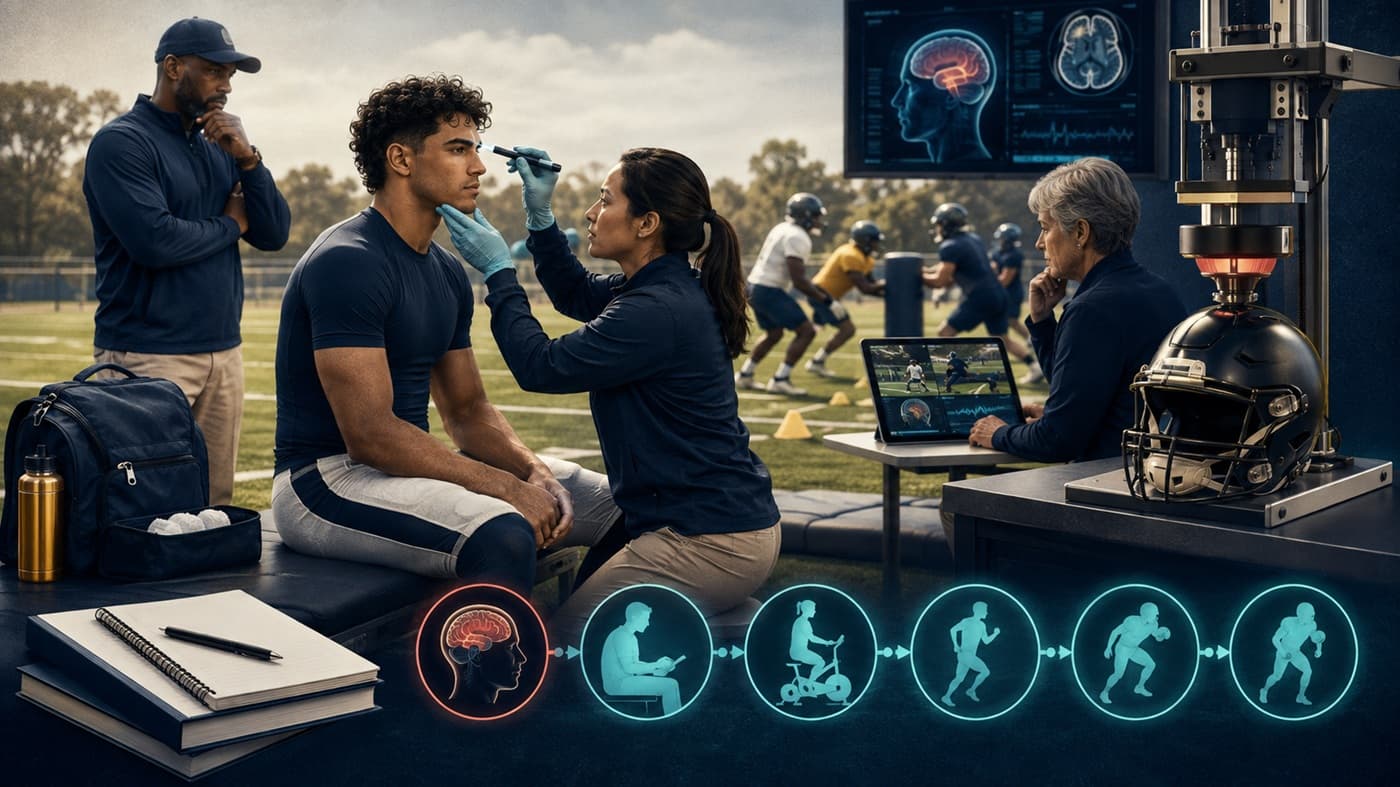
Head injuries have shaped football since its earliest reform crises. The sport has changed rules, equipment, coaching, medical procedures, practice structure, and disciplinary standards repeatedly in response to deaths, catastrophic injuries, diagnosed concussions, and concern about long-term brain health.
A concussion is a brain injury, not merely a hard hit, bell-ringer, or momentary daze. It may follow direct contact to the head or a force to the body that makes the head and brain move rapidly. Most concussions do not involve loss of consciousness, and symptoms may appear immediately or develop over hours or days.
Concussion is only one part of the issue. Football also exposes some players to repetitive head impacts that do not always produce recognizable symptoms. Researchers are studying how the number, intensity, timing, and duration of those impacts relate to later neurological outcomes.
Modern safety systems are better than they were in earlier eras, but they do not make tackle football risk-free. The central question is therefore not whether football can promise zero risk. It is whether programs recognize risk honestly, prevent avoidable exposure, respond correctly, support recovery, and allow athletes and families to make informed choices.
Head-injury risk at a glance
- Concussion
- A traumatic brain injury caused by force to the head or body that disrupts brain function
- Loss of consciousness
- Not required; most concussions occur without it
- Immediate response
- Remove from play, check danger signs, and arrange medical evaluation
- Same-day return
- Not appropriate after a suspected concussion
- Recovery
- Usually gradual and individualized, including school and sport progression
- Repeated impacts
- May occur with or without diagnosed concussion and remain an active research concern
- CTE
- A neurodegenerative disease associated with repetitive head-impact exposure and currently confirmed only after death
- Helmets
- Reduce certain forces and severe injury risk but cannot prevent every concussion
- Risk reduction
- Rules, technique, contact limits, medical independence, reporting, and equipment all matter
- Uncertainty
- Individual long-term risk cannot be predicted precisely from a simple concussion count
Concussion, repeated head impacts, and other head injuries compared
These categories can overlap. A healthcare professional must evaluate the individual injury rather than rely on a label from a website or sideline observer.
| Issue | What it means | Typical concern | Required response |
|---|---|---|---|
| Suspected concussion | A possible traumatic brain injury after a hit to the head or body | Changes in thinking, memory, balance, mood, vision, sleep, or physical symptoms | Immediate removal, danger-sign check, medical evaluation, and no same-day return |
| Diagnosed concussion | A clinician has determined that a concussion occurred | Recovery, symptom management, school participation, and risk of another injury before healing | Individualized care, return to learning and daily activity, then supervised return to sport |
| Repetitive head impacts | Repeated forces to the head that may or may not cause recognizable concussion symptoms | Cumulative exposure and possible long-term neurological effects | Reduce unnecessary contact, monitor exposure, follow technique and practice rules, and support ongoing research |
| Skull fracture | A break in one or more skull bones | Possible bleeding, brain injury, or damage to underlying structures | Emergency medical evaluation |
| Intracranial bleeding | Bleeding inside the skull | Pressure on the brain and rapid deterioration | Emergency medical care; danger signs require 911 or immediate emergency-department evaluation |
| Neck or cervical-spine injury | Possible injury to the neck bones, ligaments, spinal cord, or nerves | Weakness, numbness, paralysis, breathing problems, or instability | Do not move unnecessarily; activate trained emergency personnel |
| CTE | A progressive neurodegenerative disease associated with a history of repetitive head impacts | Later-life cognitive, behavioral, mood, or movement impairment in some affected people | No sideline diagnosis; prevention focuses on reducing repetitive exposure, while research continues |
Sideline response checklist
- 1
Stop participation
Remove the athlete from the play, drill, or game immediately.
- 2
Check danger signs
Activate emergency services for worsening or severe neurological signs.
- 3
Protect the neck when indicated
Avoid unnecessary movement when cervical-spine injury is possible.
- 4
Arrange evaluation
Use an appropriate healthcare professional under applicable policy and law.
- 5
No same-day return
Do not allow the athlete to resume participation that day after suspected concussion.
- 6
Inform family and school
Provide instructions and coordinate return-to-learn support.
- 7
Follow gradual progression
Use medical clearance and a stepwise return-to-sport process.
- 8
Document and review
Record the event and examine whether rules, technique, equipment, or drill design should change.
A concussion is a traumatic brain injury
A concussion can be caused by a bump, blow, or jolt to the head or by a force to the body that makes the head and brain move rapidly.
The movement can produce chemical changes in the brain and may stretch or damage brain cells.
The word mild in mild traumatic brain injury describes the usual initial classification, not a promise that symptoms are trivial or that recovery will be immediate.
A player does not need to be knocked unconscious, appear confused for a long time, or have a visible wound to have a concussion.
The important force is not limited to helmet-to-helmet contact
A direct helmet impact can cause injury, but so can the head striking the ground, a shoulder-to-head collision, or a body blow that produces rapid head motion.
Linear acceleration moves the head in one direction. Rotational acceleration causes the head and brain to turn. Real football impacts often contain both components.
The visible violence of a play does not perfectly predict injury. A dramatic collision may not produce a concussion, while a less spectacular impact may.
Sideline decisions should therefore be based on observed signs, reported symptoms, mechanism, medical evaluation, and the athlete’s condition—not on whether a replay looks severe.
Concussion can affect the body, thinking, mood, and sleep
Physical symptoms can include headache, dizziness, balance problems, nausea, fatigue, vision problems, and sensitivity to light or noise.
Thinking symptoms can include feeling slowed down, fogginess, trouble concentrating, confusion, and memory difficulty.
Emotional or behavioral changes can include irritability, sadness, nervousness, unusual behavior, or reduced tolerance for stress.
Sleep may increase, decrease, or become difficult. Symptoms can change over time and may not be obvious to spectators.
Athletes should report feeling different even when they cannot identify one dramatic symptom.
Some signs require emergency care
Call 911 or seek emergency care for worsening headache, repeated vomiting, seizure, increasing confusion or agitation, slurred speech, weakness, numbness, reduced coordination, one pupil larger than the other, double vision, inability to recognize people or places, or inability to wake.
Deteriorating consciousness, severe neck pain, or a rapidly changing condition should not be treated as a routine sports concussion.
Danger signs can indicate bleeding, swelling, or another serious injury that requires urgent assessment.
Do not leave an athlete with a concerning head injury alone while waiting for qualified help.
When concussion is suspected, remove the athlete
The safest immediate decision is to stop participation. The athlete should not finish the series, test the injury with one more play, or return because symptoms improve briefly.
Coaches, parents, teammates, and officials do not need to diagnose the injury. Their responsibility is to recognize possible signs and symptoms and prevent continued exposure.
The athlete should be evaluated by an appropriate healthcare professional and kept out for the rest of the day.
If a qualified medical professional determines that no concussion occurred, further participation depends on the applicable rules and medical judgment—not pressure from the game situation.
Same-day return can expose an injured brain to another hit
Symptoms can be minimized, hidden, or temporarily overlooked during competition. Continuing to play also makes a second injury more likely because balance, reaction, judgment, and vision may be impaired.
A second impact before recovery can worsen symptoms and extend recovery. Rare catastrophic deterioration has been associated with returning while a serious brain injury was unrecognized.
Youth-sports concussion laws across all states and the District of Columbia were built around education, removal from play, and medical clearance before return.
The guiding principle is simple: when in doubt, keep the athlete out.
Concussion diagnosis uses clinical judgment, not one perfect test
A clinician may evaluate symptoms, memory, orientation, balance, eye movements, neurological function, neck symptoms, medical history, and the circumstances of the injury.
Computerized tests, sideline tools, balance tests, and baseline results may add information but do not replace clinical judgment.
Routine CT or MRI scans often appear normal after concussion because these tests are used mainly to detect structural injuries such as bleeding or fracture rather than the functional disruption of a typical concussion.
An athlete should not self-clear based on a symptom checklist or mobile application.
Different clinicians—including primary care, sports medicine, emergency, neurology, and rehabilitation professionals—may be involved in concussion evaluation and recovery depending on a person's symptoms, age, injury severity, and stage of recovery. For persistent neurological symptoms or questions about a specialist's role, PickTheDoc explains what a neurologist treats (opens in a new tab) and when someone may be referred to one.
Modern recovery is not prolonged isolation in a dark room
Current guidance supports a brief period of relative rest followed by a gradual return to tolerable daily activity.
Light physical activity may be introduced under medical guidance when it does not meaningfully worsen symptoms.
Excessive physical exertion, risky activity, and activities that sharply increase symptoms should be avoided.
Sleep, hydration, regular meals, limited symptom-triggering screen use, and communication with the healthcare professional can support recovery.
Treatment should be individualized. Persistent dizziness, neck pain, headaches, vision problems, mood symptoms, or balance problems may require targeted rehabilitation.
Returning to learning is part of recovery
Students may have difficulty with reading, screens, noise, concentration, memory, deadlines, crowded hallways, or a full day of classes.
Most students return progressively rather than waiting for every symptom to disappear before entering school.
Temporary supports can include breaks, shortened days, reduced workload, extended time, quieter testing, limits on screen exposure, and postponement of high-stakes work.
Teachers, counselors, nurses, families, and medical providers should communicate so the student is supported without being isolated unnecessarily.
Return to full-contact sport should not advance ahead of recovery and safe participation in normal school activity.
Return to sport should follow a supervised progression
The CDC return-to-sport progression contains six stages, beginning with regular activities and moving through light aerobic activity, moderate activity, heavy noncontact activity, practice with full contact, and competition.
Each stage normally lasts at least 24 hours. The athlete advances only when the current stage does not produce new or worsening symptoms.
If symptoms return, the athlete stops, contacts the healthcare professional, and resumes at the appropriate earlier stage after guidance.
Medical approval and the applicable school, league, and state rules control the progression.
- 1
Back to regular activities
The athlete has returned to usual activities such as school and has approval to begin progression.
- 2
Light aerobic activity
Short, low-intensity exercise without resistance training or contact.
- 3
Moderate activity
Increased movement and moderate-intensity exercise.
- 4
Heavy, noncontact activity
High-intensity exercise and sport-specific drills without contact.
- 5
Practice with full contact
Normal controlled practice after medical clearance.
- 6
Competition
Return to game participation after successful completion of prior stages.
Recovery time differs among athletes
Many children improve within two to four weeks, but some recover faster and others have symptoms that persist longer.
Age, prior concussion, migraine history, mood or attention conditions, sleep, injury severity, access to care, and social environment may affect recovery.
A fixed calendar date should not replace symptom monitoring and medical progression.
Persistent symptoms do not prove permanent brain damage, but they deserve appropriate evaluation and treatment.
Not every concerning impact produces a diagnosed concussion
A player can experience repeated head impacts without obvious symptoms or a formal concussion diagnosis.
Researchers use sensors, video, exposure histories, imaging, blood markers, neurological testing, and postmortem examination to study cumulative exposure.
Impact count alone is incomplete. Force, rotation, direction, recovery time, age, years of exposure, position, technique, and individual biology may matter.
The uncertainty is not a reason to ignore exposure. It supports reducing unnecessary contact while research continues.
CTE is associated with repetitive head-impact exposure
Chronic traumatic encephalopathy is a progressive neurodegenerative disease identified by a specific pattern of abnormal tau protein in the brain.
Research links CTE with histories of repetitive head impacts, including exposure in contact sports.
CTE is not the same as a concussion, and one concussion does not establish that a person will develop CTE.
CTE can currently be confirmed only after death. Researchers are working on better methods for identifying disease during life and understanding which exposed people develop symptoms.
Severe CTE has been associated with dementia, but individual outcomes vary and many questions about risk remain.
No simple number predicts one player’s future
Science cannot currently convert a concussion count, number of seasons, or helmet-sensor total into a precise individual probability of CTE or dementia.
Brain-bank studies provide important evidence but may include selection bias because donated brains are not a random sample of all athletes.
A person can have persistent symptoms without CTE, and a person with CTE pathology may have had symptoms that overlap with other neurological or mental-health conditions.
Responsible communication should acknowledge evidence of risk without pretending uncertainty means there is no risk—or that every exposed athlete faces the same outcome.
Youth football requires developmentally appropriate safeguards
Children and adolescents are still developing physically, cognitively, and emotionally. Their schools and families also manage return to learning as well as return to sport.
Youth programs should reduce unnecessary contact, avoid adult-style collision drills, teach age-appropriate technique, fit equipment properly, and maintain clear medical and emergency procedures.
All states and the District of Columbia have youth-sports concussion laws, but the details and covered organizations differ.
Parents should ask who can remove a player, who provides medical evaluation, what clearance is required, how contact is limited, and whether coaches receive current concussion education.
A safety system fails when athletes are afraid to report symptoms
Players may hide symptoms because they fear losing a starting role, disappointing teammates, appearing weak, or missing an important game.
Coaches can change that calculation by praising reporting, refusing to negotiate with symptoms, and making medical decisions independent of competitive pressure.
Teammates also have a role. Reporting a concerning change in another player is protection, not betrayal.
A strong program makes clear before the season that health information will not be treated as a test of courage.
Helmets reduce risk; they do not make the brain immovable
Football helmets are designed to reduce impact forces and protect against injuries including skull fracture and severe focal trauma.
Laboratory testing can compare helmet performance under specified conditions, and better-performing models may reduce concussion risk in a given football environment.
No helmet can prevent the brain from moving inside the skull during every impact. Fit, condition, position, comfort, and the applicable performance data all matter.
NFL helmet rankings should not be applied automatically to youth or college players because the test conditions and impact environment are specific to professional football.
Helmet covers are one risk-reduction tool, not a guarantee
The NFL has required certain players to use padded helmet covers during portions of training camp and permits players to wear them in games.
League testing has reported reductions in impact force under specified conditions, especially when both players in a collision wear the covers.
The result depends on impact type, speed, angle, helmet, position, and testing method.
A padded cover does not replace technique, contact limits, medical evaluation, or a properly fitted helmet.
Reducing practice contact lowers avoidable exposure
A player needs practice to learn blocking, tackling, leverage, balance, and safe body positioning, but not every repetition requires full-speed collision.
Programs can use walk-throughs, bags, shields, controlled thud periods, limited live tackling, smaller groups, and video teaching.
Contact limits matter because practice exposure accumulates even when no single diagnosed concussion occurs.
The goal is not to eliminate skill development. It is to reserve higher-risk contact for repetitions that have a clear teaching purpose.
Playing rules can change which hits are rewarded
Rules against targeting, use of the helmet as a weapon, defenseless-player contact, blindside blocks, and certain kickoff formations are intended to remove or reduce high-risk actions.
Officials influence safety by enforcing rules consistently rather than waiting for an injury to occur.
Rule changes can create unintended consequences, so leagues use video, injury data, and competition review to evaluate effects.
Penalties cannot eliminate ordinary football contact. They can change technique incentives and identify actions the sport no longer accepts.
Medical decisions should be protected from competitive pressure
Professional and college systems increasingly use independent or unaffiliated clinicians, athletic-trainer spotters, replay review, and written protocols.
The NFL uses athletic-trainer spotters and unaffiliated neurotrauma consultants as part of its game-day concussion process.
NCAA schools must maintain concussion-management plans consistent with an annually reviewed checklist and protocol template.
No protocol is effective if medical personnel can be overruled by a coach, player, owner, parent, or scoreboard.
Lower reported injury totals do not end the question
Leagues may report reductions in diagnosed concussions after rule, equipment, practice, or medical changes.
Those trends are important, but interpretation depends on exposure, reporting, diagnostic practice, schedule, roster composition, and measurement methods.
A lower concussion count does not measure every repetitive impact or guarantee lower long-term neurological risk.
Transparency requires publishing methods, acknowledging uncertainty, and continuing independent research.
There is no universal concussion number that automatically ends a career
Retirement decisions may consider concussion history, symptom duration, recovery pattern, imaging or neurological findings, position, exposure, age, personal values, and alternative opportunities.
A simple three-concussion rule or any other fixed total cannot account for every case.
Some athletes may be advised to stop collision sports after fewer injuries, while others may be medically cleared after several fully resolved events.
These decisions belong to the athlete, family when applicable, and qualified clinicians—not a generic online calculator.
Flag football reduces collision exposure but is not injury-free
Flag football removes conventional tackling, blocking, helmets, and shoulder pads, which changes the primary mechanisms of head impact.
Players can still collide, fall, strike the ground, or experience other injuries.
Flag can provide a lower-contact participation option and a distinct elite pathway rather than serving only as a temporary step toward tackle football.
Programs still need concussion recognition, emergency procedures, safe fields, appropriate officiating, and return-to-play policies.
Informed participation requires direct questions
Who makes the final medical decision after a suspected concussion?
Is a qualified athletic trainer or other healthcare professional present at practices and games?
What emergency action plan is rehearsed, and how quickly can emergency services reach the field?
How many full-contact practice periods occur, and how are impacts reduced during instruction?
Which helmet standards, fitting procedures, reconditioning rules, and replacement schedules apply?
How does the school support return to learning, and who coordinates academic adjustments?
How are diagnosed concussions recorded, reviewed, and reported?
Coaches cannot eliminate risk, but they control important conditions
Coaches choose drill design, practice tempo, contact frequency, technique language, substitution, response to symptoms, and whether athletes feel safe reporting.
They can avoid celebrating reckless contact, remove drills whose collision risk exceeds their teaching value, and stop practice when fatigue degrades technique.
They can ensure every athlete knows the emergency plan and can invite medical staff to speak without being treated as outsiders.
The strongest safety message is behavior: a coach who immediately removes a star player shows that the policy applies when the competitive cost is real.
The changing game will require layered risk reduction
Future improvements may include better helmet designs, position-specific equipment, impact monitoring, improved field surfaces, video-assisted injury recognition, blood or imaging biomarkers, and more precise exposure data.
Technology will not replace reporting culture, independent medical authority, practice reform, and rules that discourage avoidable head contact.
Research may eventually identify which athletes are most vulnerable or provide better diagnosis of long-term disease during life.
Until then, honest communication matters. Football can offer education, community, competition, and enjoyment while still carrying risks that deserve neither denial nor sensationalism.