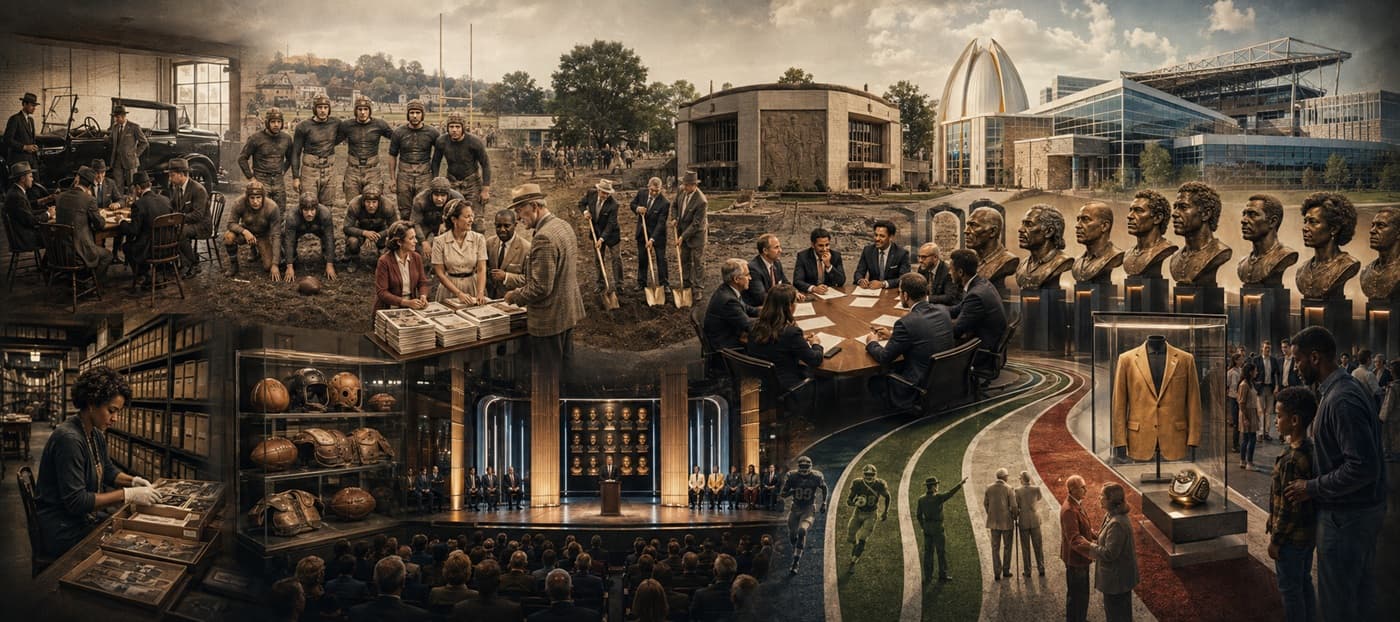
A hall of fame does more than identify famous people. It chooses which careers become permanent symbols of a sport and which stories remain outside the central gallery.
That makes the Pro Football Hall of Fame both a historical institution and an annual debate. Supporters compare statistics, awards, championships, innovation, longevity, peak performance, leadership, positional value, era, and influence. Selectors must compare candidates who played different jobs under different rules and schedules.
The physical museum performs a second role. It preserves equipment, photographs, contracts, game programs, league records, personal papers, oral histories, film, and other evidence that allows football history to be studied rather than remembered only through highlights.
The Hall is closely associated with the NFL, but its subject is the broader history of professional football. Its galleries and enshrinees include people whose careers crossed earlier leagues, rival leagues, merged leagues, ownership, officiating, administration, coaching, media, scouting, and other parts of the professional game.
The Hall of Fame at a glance
- Location
- Canton, Ohio
- Site approved
- 1961
- Groundbreaking
- August 11, 1962
- First Hall of Fame Game
- August 11, 1962, before the museum opened
- Museum opening
- September 7, 1963
- Charter class
- 17 members
- Original museum size
- 19,000 square feet
- Modern museum scale
- Approximately 120,000 square feet after multiple expansions
- Enshrined through 2025
- 382 people
- Membership including elected Class of 2026
- 387 people
- Core election threshold
- At least 80 percent approval
- Primary categories
- Modern-Era Player, Senior, Coach, and Contributor
- Iconic symbols
- Bronze Bust, Gold Jacket, and Ring of Excellence
- Archive scale
- More than 40 million pages of documents and primary sources
Why is the Pro Football Hall of Fame in Canton?
The NFL’s organizational roots
The American Professional Football Association, renamed the National Football League in 1922, was organized in Canton on September 17, 1920.
The Canton Bulldogs
The Bulldogs were a major early professional team and became the NFL’s first repeat champions in 1922 and 1923.
Jim Thorpe and early star power
Thorpe played professional football for Canton beginning in 1915 and later became the first president of the new association.
A successful civic campaign
The Canton Repository proposed the idea publicly in 1959, and residents, businesses, civic organizations, and city leaders organized the bid, donated land, and raised construction funds.
The charter class of 1963
The first class included players, coaches, owners, league organizers, and innovators whose careers represented several eras of early professional football.
- Sammy Baugh
- Bert Bell
- Joe Carr
- Earl “Dutch” Clark
- Harold “Red” Grange
- George Halas
- Mel Hein
- Wilbur “Pete” Henry
- Robert “Cal” Hubbard
- Don Hutson
- Earl “Curly” Lambeau
- Tim Mara
- George Preston Marshall
- John “Blood” McNally
- Bronko Nagurski
- Ernie Nevers
- Jim Thorpe
How the current selection process works
- 1
Nomination
Any fan may nominate a qualified person connected with professional football. The Hall processes nominations rather than choosing its preferred candidates.
- 2
Eligibility
Modern-Era players must have been out of professional football for at least five seasons and meet the Hall’s current recognition requirement. Coaches must be out of the game for one full season. Contributors have no mandatory retirement period.
- 3
Screening and reduction
Large nominee lists are reduced through screening and committee voting.
- 4
Category finalists
The annual finalist group can contain 15 Modern-Era players, one Coach, one Contributor, and up to three Seniors.
- 5
Discussion
Selectors receive detailed biographies and discuss the finalists before voting.
- 6
Modern-Era reduction votes
The Modern-Era list is reduced through staged votes before the final ballot.
- 7
Election threshold
A candidate must receive at least 80 percent approval under the applicable category rules.
- 8
Audit and announcement
Ballots are administered with independent procedural oversight, and the elected class is announced before summer enshrinement.
The three iconic symbols
Bronze Bust
A sculpted likeness permanently associated with the enshrinee in the Hall of Fame Gallery.
Gold Jacket
A wearable symbol of membership presented around Enshrinement Week and used at Hall gatherings.
Ring of Excellence
A personalized ring presented in connection with the enshrinee’s professional-football community.
Selection categories compared
The rules can be amended. These descriptions reflect the process used for the Class of 2026 and should be reviewed annually.
| Category | Who belongs in it | Waiting period | Current finalist path |
|---|---|---|---|
| Modern-Era Player | A player whose career ended fewer than 25 seasons ago | At least five full seasons after the last professional game | Broad nomination list, screening, semifinalists, 15 finalists, reduction votes, and final 80-percent threshold |
| Senior | A player whose career ended at least 25 seasons ago | Defined by the Senior category’s career-ending threshold | Senior screening and a nine-person blue-ribbon committee can advance up to three finalists |
| Coach | A head coach or other eligible coaching candidate evaluated for professional-football impact | Out of professional football for one full season | A separate nine-person Coach Blue-Ribbon Committee advances one finalist |
| Contributor | An owner, executive, administrator, scout, official, media figure, or other nonplayer and noncoach contributor | No mandatory retirement period | A separate nine-person Contributor Blue-Ribbon Committee advances one finalist |
Professional football developed before it had a central museum
Professional teams existed for decades before the NFL became a stable national league. Clubs formed, folded, relocated, changed names, joined rival leagues, and left records scattered among newspapers, private collections, team offices, and families.
As professional football’s television audience expanded during the 1950s, the absence of a central museum became more noticeable.
A hall of fame offered two connected solutions: honor the game’s most influential people and preserve evidence that might otherwise disappear.
A local newspaper turned the idea into a civic campaign
On December 6, 1959, the Canton Repository argued publicly that professional football needed a hall of fame and that Canton was the logical site.
Civic organizations and business leaders adopted the proposal. William E. Umstattd represented the city in its formal bid to the NFL.
The campaign was not simply a request for league money. The city donated wooded parkland, and local fundraising produced hundreds of thousands of dollars in pledges for construction.
The NFL approved Canton as the site in 1961.
Canton connected the museum to football’s earliest professional organization
The association that became the NFL was created in a Canton automobile showroom in 1920.
The Canton Bulldogs had already built a reputation as an early professional power, and the city was associated with Jim Thorpe’s professional career.
Locating the Hall in Canton connected the modern league’s growing national identity to a specific founding place.
The choice also created an unusual relationship: a major national sports museum anchored in a smaller city whose local identity became inseparable from professional football history.
The Hall of Fame Game came before the museum
Groundbreaking for the original museum took place on August 11, 1962.
That same day, the New York Giants and St. Louis Cardinals played the first Hall of Fame Game and finished in a 21–21 tie.
The game linked the unfinished museum to an annual football event and helped make Canton part of the professional preseason calendar.
The Hall of Fame Game remains connected to Enshrinement Week, although scheduling, participants, and event branding change.
The museum opened with 17 charter members
The Pro Football Hall of Fame opened to the public on September 7, 1963.
The charter class represented foundational players, coaches, owners, league leaders, and team builders.
The original complex contained approximately 19,000 square feet—small compared with the modern museum.
Opening day established the two permanent parts of the institution: the building would preserve history, and the annual class would continually redefine who belonged at the center of that history.
The building expanded as football’s history and audience grew
Major expansions were completed in 1971, 1978, 1995, and 2012–13, with additional gallery renovations in other years.
The museum grew from 19,000 square feet to approximately 120,000 square feet.
Expansion made room for more artifacts, larger galleries, interactive presentations, theaters, archives, educational programs, and visitor services.
Growth also changed the challenge of interpretation. A larger museum can tell more stories, but it still must choose what receives physical space and what remains in storage or digital records.
The Hall performs three different jobs
As a museum, it presents exhibits designed for the public.
As an archive and research institution, it preserves documents, photographs, film, oral histories, team records, league records, personal papers, publications, and artifacts.
As a hall of fame, it enshrines selected individuals through a formal election process.
These functions overlap but should not be confused. An artifact can be historically important without belonging to a Hall of Famer, and a person’s career can be documented extensively without resulting in election.
The archive preserves far more than the bust gallery
The Ralph Wilson Jr. Pro Football Research and Preservation Center protects more than 40 million pages of documents and primary-source materials.
Collections include rare documents, game programs, publications, personal papers, team and league records, oral histories, video, and millions of photographs.
The three-dimensional collection includes tens of thousands of helmets, jerseys, shoes, footballs, and other objects.
This archive allows historians to correct old assumptions. The Hall’s research, for example, helped document the 1892 payment to William “Pudge” Heffelfinger as a landmark in professional football history.
Enshrinement recognizes a professional-football career, not one uniform
A Hall of Famer’s biography records the complete professional career, including every applicable team and league.
The Hall does not use a baseball-style cap decision to assign an enshrinee permanently to one franchise.
Fans and teams naturally celebrate their connection to a new Hall of Famer, but enshrinement honors the individual’s total contribution to professional football.
Fans may nominate candidates, but they do not elect them
Any fan may submit the name of a qualified candidate connected with professional football.
The Hall processes each nomination and forwards eligible candidates into the selection structure.
A public nomination does not guarantee that a candidate will advance, become a finalist, or receive a direct vote at the annual selection meeting.
Fan discussion matters culturally, but there is no binding public popularity vote for enshrinement.
Modern-Era players wait five full seasons
A player becomes eligible only after being out of professional football for at least five full seasons.
The waiting period allows a career to be compared with its era and separates election from the immediate emotion of retirement.
Eligibility does not expire after one unsuccessful vote. Candidates can remain in the process, move into the Senior category after sufficient time, or never become finalists.
The Class of 2026 included first-year-eligible candidates and a Senior finalist whose election followed decades of debate.
A committee of football media and experienced observers casts the votes
The Selection Committee can contain up to 50 people.
Its structure includes representatives associated with current NFL markets, at-large selectors, and a representative of the Pro Football Writers of America.
Appointments are approved annually by the Hall’s governing board.
The committee meets before the Super Bowl, receives detailed candidate biographies, conducts discussion, and uses staged ballots under the Hall’s bylaws.
The museum staff administers the process but does not choose the winners
The Hall receives and processes nominations, coordinates meetings, prepares historical information, and administers voting.
The Hall’s official process states that its staff does not decide who is elected.
Independent procedural oversight has been used to validate ballot completeness and tabulation.
This separation does not eliminate debate about the selectors or bylaws, but it distinguishes museum operations from election decisions.
Modern-Era finalists pass through several reduction votes
For the Class of 2026, 15 Modern-Era finalists were reduced to 10 and then seven.
Selectors could vote for five of the remaining seven on the final ballot.
A candidate still needed at least 80 percent approval. The rules permitted between three and five Modern-Era candidates to be elected.
The reduction system forces comparison among elite careers rather than allowing every finalist to receive an independent yes-or-no vote without a class limit.
Separate categories address careers that do not fit the Modern-Era list
The Senior category considers players whose careers ended at least 25 seasons ago.
Coach and Contributor categories recognize that professional football history includes strategic leadership and institution building as well as on-field performance.
Separate nine-person blue-ribbon committees identify the final candidates in these categories.
The finalists still require 80 percent approval from the full Selection Committee, and category structure does not guarantee that every presented candidate will be elected.
Statistics inform selection but do not decide it
Football positions produce different statistics, and the meaning of those statistics changes with schedule length, rules, strategy, and era.
Selectors consider recognized honors, performance, longevity, peak dominance, postseason play, innovation, leadership, and influence.
Championships can strengthen a case but are team achievements. A player can be historically important without winning a title, and a contributor can enter the Hall without playing.
The absence of a formula makes historical comparison possible, but it also ensures disagreement.
Some positions are easier to compare and celebrate than others
Quarterbacks, running backs, receivers, pass rushers, and defensive backs produce familiar highlights and statistics.
Offensive linemen, interior defenders, special-teams players, officials, scouts, and executives often require more contextual explanation.
Ray Guy’s 2014 election as the first full-time punter enshrined illustrated how long a specialized position could wait for recognition.
Positional imbalance is not resolved by declaring fixed quotas. It requires selectors and historians to explain value across very different jobs.
Older candidates may have fewer statistics and less surviving film
Early professional football records are incomplete, and official statistical categories were added gradually.
Newspaper accounts, team records, game programs, photographs, contracts, oral histories, and later research may be needed to reconstruct a career.
The Senior pathway helps reconsider people whose cases were overlooked, misunderstood, or poorly documented when they first became eligible.
Historical correction is difficult because new evidence can improve understanding without making comparisons across eras simple.
The 2020 Centennial Class addressed a historical backlog
For the NFL’s centennial, the Hall approved a one-time change to the selection bylaws.
The special class contained 20 members: five Modern-Era players, 10 Seniors, three Contributors, and two coaches.
A special blue-ribbon panel reviewed the historical candidates.
The class showed that ordinary annual limits can leave a backlog, but its one-time size was not adopted as the normal model.
The bust, jacket, and ring turn election into a public identity
The Bronze Bust becomes part of the permanent gallery in Canton.
The Gold Jacket identifies living Hall of Famers during enshrinement events, reunions, ceremonies, and public appearances.
The Ring of Excellence connects the honor back to the communities and franchises associated with the enshrinee’s career.
Together, the three symbols make membership visible beyond a name on a list.
Enshrinement Week connects memory to a live football season
The annual Canton events generally include the Hall of Fame Game, Gold Jacket ceremonies, enshrinement, fan programs, and appearances by returning Hall of Famers.
The preseason game links the museum to the current league, while the ceremony allows each new member’s career to be narrated publicly.
Presenters, speeches, family participation, bust unveiling, and reunion traditions turn an administrative election into a ritual of professional football.
Schedules and event names change, so visitor information should be checked for the applicable year.
The elected Class of 2026 reflects several selection paths
Drew Brees, Larry Fitzgerald, Luke Kuechly, and Adam Vinatieri were elected through the Modern-Era process.
Roger Craig was elected from the combined pool of Senior, Coach, and Contributor finalists after advancing through the Senior pathway.
The class brought Hall membership, including the elected class, to 387.
As of this article’s August 6 review date, enshrinement was scheduled for August 8, 2026. The article should be updated after the ceremony to replace future-tense language.
Enshrinement is an honor, not a declaration that every part of a life was exemplary
The Hall evaluates contributions to professional football, but museum interpretation can also address discrimination, labor conflict, gambling, injury, business practices, and other difficult parts of the sport.
An enshrinee can be historically significant while remaining controversial.
Removing every difficult story would distort history; celebrating achievement without context can distort it in another direction.
A strong museum distinguishes commemoration from complete moral approval.
Hall of Fame arguments are really arguments about football values
One voter may emphasize peak dominance. Another may value long-term excellence. Others may prioritize innovation, postseason performance, awards, statistical standing, or influence on strategy.
Fans also disagree about whether a Hall of Fame should be extremely small or broad enough to represent every important era and position.
The bylaws create limits, but they cannot produce one uncontested definition of greatness.
The annual debate is therefore not evidence that the Hall has failed. It is part of how football history is interpreted in public.
The Hall can teach more than famous names
Artifacts can show how helmets, shoes, fields, contracts, communications, strategy, and media changed.
Biographies can connect individual careers to integration, league competition, free agency, television, safety reform, specialization, and new offensive or defensive systems.
Archives allow students to compare a later story with the documents produced at the time.
OpenPlay Football can use Hall-related history to connect a person’s legacy with the actual concepts, assignments, and decisions that made the career influential.