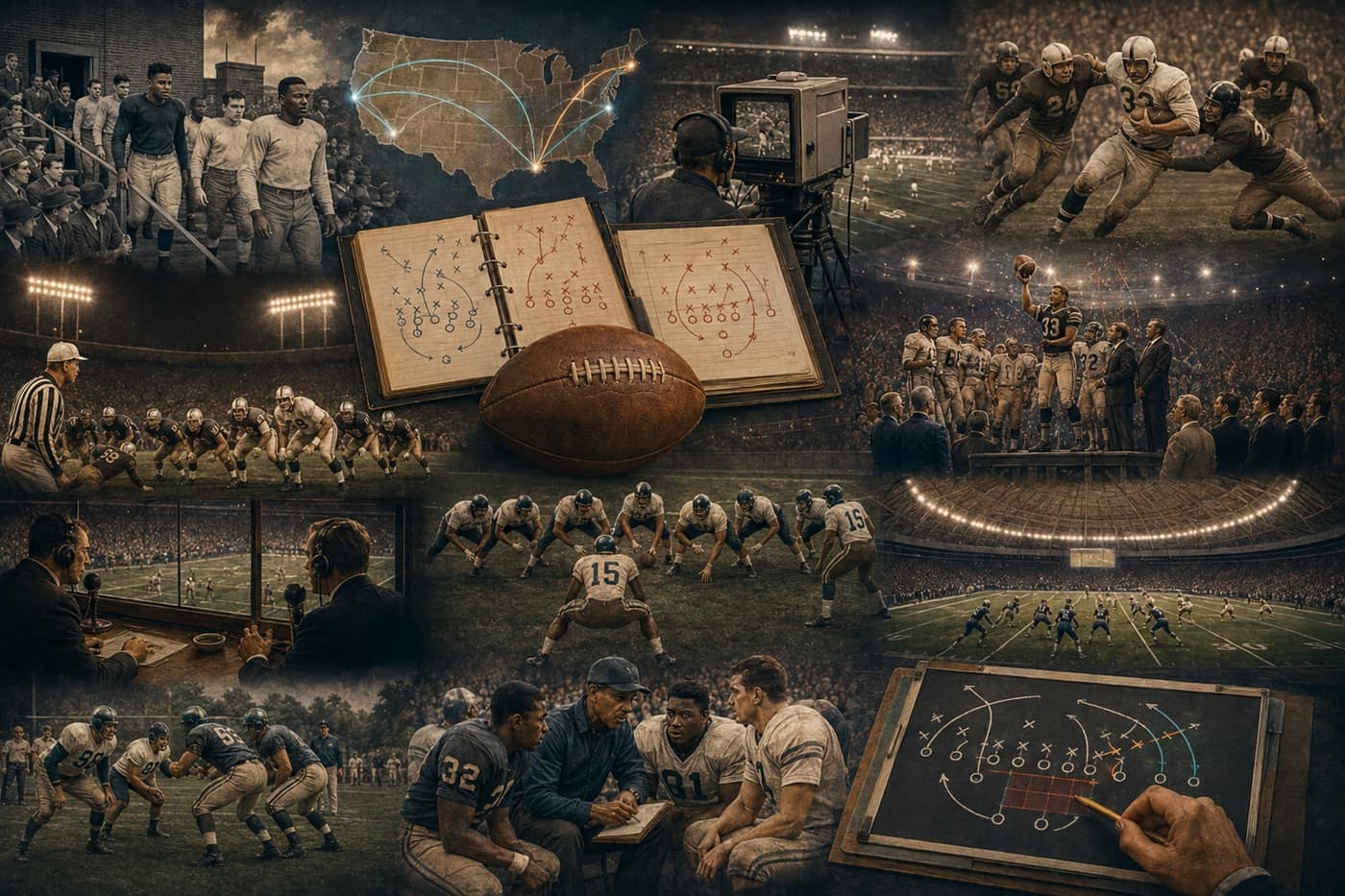
Football emerged from World War II with established rules and traditions but an uncertain place in American culture. College football remained deeply rooted in campuses and regions. Professional football had survived the war but still competed for attention with baseball, boxing, and the college game.
Between 1946 and 1979, that balance changed. Professional football expanded to the West Coast, reintegrated, absorbed a rival league, negotiated national television packages, developed a shared film language, and turned its championship into a national cultural event. The television camera did more than enlarge the audience: it changed schedules, presentation, revenue, replay, celebrity, and the public understanding of strategy.
The period was also shaped by conflict. The AAFC and AFL challenged the NFL. Players organized for pensions, minimum standards, representation, and greater freedom of movement. Black players broke barriers while still encountering discrimination at quarterback, in coaching, and in front offices. College programs integrated unevenly, often only after years of exclusion and the loss of talented players to northern schools and historically Black colleges and universities.
On the field, specialization accelerated. Passing became more precise, defenses became more organized, and coaches built systems around personnel, motion, option decisions, timing, and film study. The 1970s ended with rule changes intended to protect receivers, aid pass protection, improve safety, and create more offense.
By 1979, football had become a national media institution—but the modern game was still being negotiated between owners, players, coaches, broadcasters, institutions, and audiences.
The era at a glance
- Opening milestone
- Permanent reintegration of major professional football in 1946
- Rival league
- The AAFC operates from 1946 through 1949
- Television turning point
- The 1958 NFL Championship Game reaches a vast national audience
- Player organization
- The NFL Players Association forms in 1956
- New professional challenger
- The American Football League begins play in 1960
- Merger agreement
- The AFL and NFL announce their combination in 1966
- Championship transformation
- The first AFL–NFL title game is played in January 1967
- Prime-time breakthrough
- Monday Night Football begins in 1970
- College reorganization
- The NCAA creates three divisions in 1973 and splits Division I football in 1978
- Closing tactical change
- The 1978 five-yard contact and open-hand pass-blocking reforms
Football in 1946 compared with football in 1979
College and professional football developed differently, but both became more national, more specialized, more televised, and more strategically diverse during this era.
| Feature | Football in 1946 | Football by 1979 |
|---|---|---|
| Professional geography | Primarily concentrated in established eastern and midwestern markets, with the Rams beginning the move west | A 28-team national league with franchises from coast to coast and in the Southeast |
| Race and participation | Professional football had just ended a twelve-season exclusion of Black players | Black stars were central throughout the game, although barriers remained at quarterback, coaching, ownership, and leadership positions |
| League structure | The NFL faced the newly formed AAFC | The merged NFL contained the former AFL clubs in a two-conference structure |
| Championship | Separate NFL and AAFC title games | Conference playoffs led to the Super Bowl |
| Television | Limited and local experimentation | National Sunday packages, prime-time Monday games, major rights fees, and extensive filmed storytelling |
| Player labor | No established players’ union | A certified union, collective bargaining, strikes, litigation, and continuing disputes over player movement |
| Substitution | Restrictions still encouraged many two-way contributions | Specialized offensive, defensive, and kicking units were standard |
| Passing environment | Passing was established but often secondary to running and field position | Rule changes protected route development and expanded legal pass-blocking technique |
| College structure | One NCAA membership structure with established conferences and bowls | Three NCAA divisions, with Division I football divided into I-A and I-AA |
| College strategy | T-formation, single-wing remnants, balanced running, and early platoon experimentation | Wishbone and option systems, pro-style passing, multiple formations, and greater specialization |
| Stadium technology | Mostly outdoor grass stadiums | Domes, multipurpose stadiums, artificial turf, improved lighting, and larger broadcast infrastructure |
| Season length | A 10-game NFL schedule | A 16-game NFL regular season with expanded playoffs and wild cards |
Professional football permanently reintegrated in 1946
The NFL had employed no Black players from 1934 through 1945. That exclusion ended in 1946 when halfback Kenny Washington and end Woody Strode signed with the Los Angeles Rams.
The new All-America Football Conference also opened with Black players. Guard and middle guard Bill Willis and fullback Marion Motley joined the Cleveland Browns. All four pioneers faced racist abuse, targeted violence, and pressure far beyond ordinary competition.
Willis and Motley became long-term stars and helped Cleveland win championships in both the AAFC and NFL. Their success demonstrated what discrimination had denied the sport: elite talent had been excluded for reasons unrelated to performance.
Reintegration did not produce immediate equality. Teams integrated at different speeds, and Black players continued to face restrictions in leadership positions, housing, travel, contract negotiations, and public treatment.
The AAFC challenged the NFL—and Cleveland changed the balance
The All-America Football Conference began play in 1946 with eight teams. It competed with the NFL for players, markets, coaches, and attention.
Paul Brown’s Cleveland team dominated the new league, winning all four AAFC championships. Brown emphasized organization, detailed teaching, film, timed practices, playbooks, position specialization, and communication systems that helped make his team unusually prepared.
After the 1949 season, Cleveland, San Francisco, and Baltimore entered the NFL. The first two became durable franchises; the original AAFC Baltimore entry lasted only the 1950 NFL season.
Cleveland immediately defeated the defending NFL champion Philadelphia team in its first league game and won the 1950 NFL championship. The result weakened claims that the older league had faced inferior competition and helped establish the value of ideas and players developed in the AAFC.
Free substitution accelerated specialization
Professional football restored unlimited free substitution in 1950. Coaches could replace entire groups without forcing most players to perform full-time offensive and defensive roles.
Specialization changed roster construction and teaching. Offensive linemen could focus on blocking schemes, defensive linemen on defeating blocks and rushing the passer, and receivers and defensive backs on increasingly detailed route and coverage techniques.
The change also strengthened the coordinator model. Offensive, defensive, and special-teams plans could be developed as connected but distinct systems.
College football moved back and forth between substitution restrictions and platoon systems during the postwar decades. Those debates reflected concerns about roster size, participation, competitive cost, and whether specialization improved or weakened the educational character of the game.
Television turned professional football into a national weekly event
In 1950, the Los Angeles Rams arranged television coverage of all their games, and other clubs developed local packages. The 1951 NFL Championship Game became the first league title game televised coast to coast.
Television favored football’s structure. Each snap provided a natural pause for replay, explanation, advertising, and anticipation. The rectangular field fit the screen, while close-up cameras made collisions and individual personalities visible.
Broadcasting also created conflict. Home-game blackout policies were intended to protect ticket sales, and clubs differed in how much local television they allowed.
By the middle of the 1950s, national networks were carrying selected regular-season games. Football was no longer limited to the crowd inside the stadium or the audience of a local radio announcer.
Players formed an association to demand a voice
Professional players faced short careers, insecure contracts, limited medical protection, low offseason income, and little influence over league policy.
In 1956, players organized the NFL Players Association. Early demands included minimum salaries, maintained equipment, continued pay after injuries, pensions, insurance, and recognition that players should participate in decisions affecting their work.
The association initially functioned more as a trade organization than a modern union. The first collective bargaining agreement was not signed until 1968, after a player strike and an owner lockout.
When the leagues merged, the NFLPA and AFL Players Association had to combine competing organizations and represent players whose interests were not always identical. Labor conflict became a permanent part of the business of football.
The 1958 championship became football’s television landmark
Baltimore defeated New York 23–17 in the 1958 NFL Championship Game. It was the first league championship decided in sudden-death overtime.
Late in regulation, quarterback Johnny Unitas completed a sequence of passes that set up the tying field goal. In overtime, Baltimore drove 80 yards before Alan Ameche scored from one yard.
The game combined recognizable stars, late drama, passing, television, and a major-market audience. It is often called the “Greatest Game Ever Played,” a title that reflects its cultural effect as much as its tactical quality.
The contest did not create professional football’s audience by itself. It arrived after years of growing television exposure, but it gave the sport a widely shared national memory.
College integration advanced unevenly across regions
Black athletes had played major college football long before World War II, but access remained inconsistent. Some northern teams withheld Black players when opponents demanded segregation, and many southern institutions excluded Black athletes entirely.
Postwar players challenged those boundaries. Ernie Davis became the first Black winner of the Heisman Trophy in 1961. Sandy Stephens became the first Black quarterback to earn first-team All-America recognition and led Minnesota to the Rose Bowl.
Michigan State recruited outstanding Black players from the segregated South, and its 1966 team featured twelve Black starters. Historically Black colleges and universities continued to develop elite players and coaches while many predominantly white southern programs refused equal access.
Integration in the South accelerated during the late 1960s and early 1970s, but it did not occur through one game or one coach. It resulted from civil-rights pressure, court decisions, athlete choices, institutional competition, and the work of many pioneers.
Access on the field did not immediately produce equal opportunity at quarterback, coaching, administration, or athletic leadership.
The American Football League created a second path
Lamar Hunt and other owners organized the American Football League in 1959 after failing to secure NFL franchises. The AFL began play in 1960 with teams in markets the older league had not fully served.
The league adopted a two-point conversion, signed a television agreement with ABC, competed aggressively for college players, and gave coaches and quarterbacks room to build passing-oriented identities.
Competition was expensive. Players drafted by both leagues could use rival offers to improve their contracts, while owners fought over stadiums, markets, television, and public credibility.
The AFL’s survival mattered because it was not absorbed immediately. It developed its own stars, supporters, championship history, and media value before negotiating from a position of strength.
Coaches built recognizable systems around precision and personnel
The postwar game produced influential systems rather than one universal style. Paul Brown used detailed organization and quarterback instruction. Vince Lombardi’s Green Bay teams made a small number of concepts powerful through repetition, timing, and blocking technique.
The sweep associated with Lombardi was not merely a runner moving outside. It depended on formation, motion, pulling linemen, lead blockers, leverage, and the runner’s decision about where the defense had created space.
The AFL encouraged vertical passing and aggressive scoring, while NFL teams refined timing routes, play-action, zone defense, and sophisticated pressure packages.
Defenses responded with specialized fronts, rotating safeties, man and zone combinations, and disguised pressure. The strategic contest increasingly began before the snap.
Shared media made the league larger than any one club
Commissioner Pete Rozelle promoted television arrangements that treated league games as a shared national product rather than a collection of unrelated local broadcasts.
Large network contracts gave clubs a more stable common revenue source and reduced the gap between teams in the largest and smallest television markets.
In 1964, the league purchased Ed Sabol’s film company and renamed it NFL Films. Slow motion, field-level cameras, orchestral music, narration, close-up sound, and strategic graphics gave football a dramatic visual language.
NFL Films preserved games, promoted players, taught viewers how to see the sport, and turned past seasons into reusable stories. It helped create the idea that every game belonged to a continuing national history.
The AFL and NFL agreed to merge in 1966
Competition for players and markets increased costs for both leagues. Secret negotiations eventually produced a merger announcement on June 8, 1966.
The leagues agreed to conduct a common draft beginning in 1967 and to have their champions meet in an annual title game. Regular-season integration and one league structure would begin in 1970.
The agreement preserved all AFL franchises rather than simply eliminating the newer league. That decision shaped the geography, ownership, and conference structure of modern professional football.
Congressional action was needed to approve elements of the merger under antitrust law, demonstrating that professional football had become a business with national public-policy consequences.
The championship between leagues became the Super Bowl
The first AFL–NFL World Championship Game was played in January 1967. Green Bay defeated Kansas City, and the game was televised by both CBS and NBC.
Green Bay also won the second meeting. Those results reinforced the belief that the older NFL remained superior.
That assumption changed when the New York Jets defeated heavily favored Baltimore in the third championship game, played in January 1969. The NFL formally recognized the Super Bowl name that year.
Kansas City’s victory over Minnesota in January 1970 gave the AFL another championship immediately before the full merger. The results helped establish competitive legitimacy for the former AFL teams.
The 1970 merger reorganized the league and moved football into prime time
The completed merger created the American Football Conference and National Football Conference. Baltimore, Cleveland, and Pittsburgh moved with the former AFL teams to balance the conferences.
The new playoff format included wild-card teams, allowing strong non-division winners to reach the postseason.
Monday Night Football debuted on September 21, 1970. A single nationally televised game in prime time gave the NFL a weekly stage beyond Sunday afternoon.
The broadcast mixed football analysis, celebrity, entertainment, and event television. Teams and players could become nationally familiar through one night’s performance.
Black quarterbacks challenged a deeply protected barrier
Black athletes became stars at many positions, but teams remained reluctant to allow Black players to play quarterback, a position associated with leadership, decision-making, and public authority.
Marlin Briscoe started seven games for Denver in 1968 and became the first Black quarterback in modern professional football to play regularly.
James Harris became the first Black quarterback to open a season as the starter for an AFL or NFL team in 1969. With the Los Angeles Rams, he later became the first Black quarterback to start and win an NFL playoff game and earned Pro Bowl recognition.
These breakthroughs did not end positional discrimination. Many Black college quarterbacks were still asked to change positions, and opportunities remained tied to assumptions unrelated to performance.
College football made the option a defining strategic language
College football retained greater offensive variety than the professional game because roster composition, hash-mark width, coaching identity, and uneven talent created different incentives.
Option football forced a defender to become the quarterback’s key read. Instead of blocking every defender, the offense could leave one unblocked and decide after the snap whether to hand off, keep the ball, or pitch.
Texas installed the wishbone in 1968. Its backfield alignment supported the triple option, inside running, perimeter attacks, play-action, and misdirection.
The wishbone spread because it could convert disciplined reads and coordinated blocking into a powerful identity. Defenses responded by changing fronts, assigning option responsibilities, attacking mesh points, and forcing the quarterback to make decisions under pressure.
College football’s institutional structure became more layered
College football expanded across schools with dramatically different budgets, enrollments, scholarships, facilities, and competitive ambitions.
The NCAA approved freshman eligibility in football in 1972, allowing first-year students to compete at the varsity level.
In 1973, the NCAA reorganized its membership into Divisions I, II, and III. The structure recognized that institutions did not all operate under the same financial and competitive model.
In January 1978, Division I football divided into I-A and I-AA. Those classifications were later renamed the Football Bowl Subdivision and Football Championship Subdivision.
The changes did not create one national championship system for the largest programs. Polls, bowls, conference races, and competing championship claims remained central to top-level college football.
Domes, artificial turf, and expansion changed the football environment
The postwar stadium became a television studio, municipal project, multipurpose venue, and symbol of regional ambition.
The Houston team moved into the Astrodome in 1968, becoming the first major professional football team to play its home schedule in a domed stadium. Artificial turf made indoor football practical but changed footing, speed, heat, and the physical effect of falling.
Multipurpose stadiums brought football and baseball into shared facilities, often with symmetrical seating and synthetic surfaces designed for conversion rather than one sport.
Seattle and Tampa Bay entered the NFL in 1976, expanding the league to 28 teams. New franchises demonstrated both football’s national demand and the difficulty of building competitive rosters from an expansion draft.
Players challenged the limits of owner control
The first collective bargaining agreement in 1968 established minimum salaries and pension contributions but left players with limited bargaining power and no neutral arbitration.
After the merger, the combined players’ organization became a certified union and negotiated a broader benefits agreement in 1970.
The league’s Rozelle Rule required a team signing a free agent to compensate the player’s former club, with the commissioner able to determine compensation when the clubs could not agree. Players argued that the rule discouraged movement.
John Mackey and other players challenged those restrictions in court. Strikes and litigation during the 1970s established that the growth of television revenue did not automatically produce freedom or security for the athletes creating the product.
The era ended without modern unrestricted free agency, but labor had become an organized counterweight to ownership.
The 1970s produced perfection and powerful team identities
The 1972 Miami Dolphins completed a 17–0 season, the only perfect season in NFL history. Their success combined a dominant running game, defense, special teams, depth, and disciplined situational football.
The achievement also shows that the era’s best offense was not necessarily the one that threw most often. Miami used the passing threat to create space and balance for a run-centered attack.
The decade also produced sustained success from Dallas, Minnesota, Oakland, and Pittsburgh. The Steelers built much of their dynasty through exceptional drafting from 1969 through 1974, including extensive scouting of historically Black colleges.
Dynasties became national brands because postseason television and the Super Bowl allowed audiences to follow the same organizations across several seasons.
The 1970s rulebook sought more action, passing, and safety
In 1974, the NFL added regular-season sudden-death overtime, moved the goal posts from the goal line to the end line, changed kickoff placement, and adopted other rules intended to improve action and field position.
Later changes limited dangerous blocking and defensive contact. The head slap was prohibited, and rules increasingly protected receivers from repeated contact while routes developed.
The major 1978 reforms allowed a defender to contact a receiver within five yards of the line of scrimmage but restricted contact beyond that zone. Offensive linemen were permitted to extend their arms and use open hands in pass protection.
The same season expanded the schedule from 14 to 16 games. The rules created more room for receivers and more legal tools for blockers, helping passing become more efficient and strategically central.
Safety and entertainment were often discussed together. Some changes reduced dangerous techniques; others aimed to increase scoring and television appeal. The effects could overlap, but the motivations were not always identical.
By 1979, football had become a national media institution
Professional football entered the 1980s with one merged league, 28 teams, conference playoffs, wild cards, a 16-game schedule, a nationally dominant championship, and television packages spanning Sunday afternoons and Monday nights.
College football had integrated more broadly, developed powerful option and passing systems, created three divisions, and divided its largest football membership into I-A and I-AA.
The rulebook increasingly favored the development of the passing game, but the successful teams of the era still demonstrated many routes to victory: option football, power running, vertical passing, disciplined defense, field position, and roster depth.
Important struggles remained unresolved. Players lacked modern free agency, coaching and ownership remained unrepresentative, safety concerns continued, and the relationship among television, money, and competitive balance would keep changing.
The next era would bring cable television, free-agency battles, the West Coast offense, computerized analysis, new stadium economics, and an even larger passing revolution.