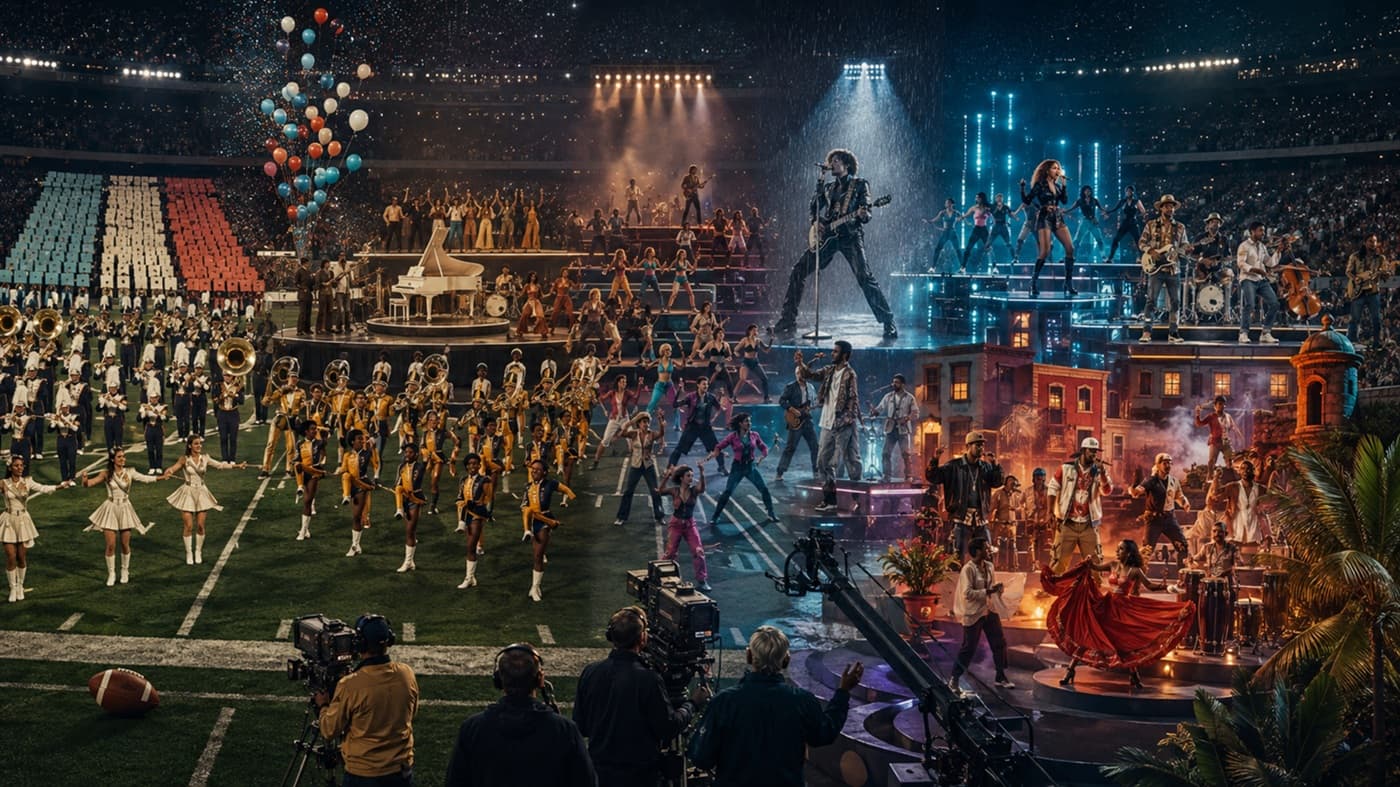
Halftime exists because football teams need a break. The Super Bowl turned that interval into a second live event staged inside the first.
The transformation was gradual. Early producers had to entertain the crowd in the stadium and fill television time without damaging the field or delaying the game. Marching bands were an obvious solution: they already understood football timing, could enter and exit efficiently, and could create shapes visible from high in the stands.
As the Super Bowl became a national television ritual, halftime absorbed ideas from bowl-game pageants, theme parks, Broadway, rock tours, music videos, television variety specials, dance teams, fireworks, and digital media. The audience increasingly expected not just music but a compressed visual argument about the performer, the host city, and the culture of the moment.
The result is unusually powerful and constrained. An artist may have about 13 minutes to summarize decades of work. Crews may have roughly eight minutes to assemble the field production and a little more than six to remove it. Everything must be safe for performers, cameras, volunteers, the playing surface, and the teams returning for the second half.
This article treats halftime as football culture, television history, music history, and industrial production—not as a ranked list of the “best” shows.
The main halftime-show eras
- 1967–1975: Marching bands and football pageantry
- College bands, HBCU performance traditions, drill teams, local music, and historical salutes dominate.
- 1976–1989: Mass-cast themed spectacle
- Up with People, audience card stunts, anniversary themes, fantasy narratives, pianos, and television effects take center field.
- 1990–1992: Pop transition
- Celebrity music becomes more important, but artists remain embedded in broad theme productions.
- 1993–1999: The megastar model
- Michael Jackson establishes the solo-headliner template, followed by country, Motown, soul, rock, and theatrical hybrids.
- 2000–2004: Cross-genre live television
- Multiple current stars, pop-rock collaborations, memorial storytelling, and MTV-style production broaden the show and its risks.
- 2005–2010: Classic-rock reset
- After the 2004 controversy, established rock acts provide a more controlled, catalog-driven format.
- 2011–2019: Modern pop spectacle
- Large female and male pop headliners, elaborate stage engineering, social-media moments, and surprise guests become standard.
- 2020–2022: Roc Nation and cultural specificity
- Latin identity, pandemic adaptation, and a hip-hop-centered Los Angeles show make local and cultural storytelling more explicit.
- 2023–present: Apple Music era
- Apple Music title sponsorship accompanies Rihanna, Usher, Kendrick Lamar, and Bad Bunny, with streaming data and global music culture integrated into promotion.
Early halftime and the modern show compared
These differences are broad tendencies. The archive contains exceptions in every era.
| Feature | Early Super Bowl halftime | Modern Super Bowl halftime |
|---|---|---|
| Central attraction | Bands, drill teams, mass pageantry, and a theme | One major headliner or a tightly curated artist ensemble |
| Primary audience | Stadium spectators with television coverage | A television and streaming audience designed into every camera angle |
| Musical structure | Marches, standards, salutes, and narration | A fast medley of catalog highlights, current work, guests, and transitions |
| Visual scale | Large human formations, placards, balloons, flags, and field-wide movement | Modular stages, LED surfaces, aerial systems, lighting, camera choreography, and cinematic close-ups |
| Local identity | Host-city themes and local bands | Host-city culture mixed with the headliner’s identity and global audience |
| Artist status | Celebrities were occasional participants within a larger pageant | Artist selection is a major announcement months before the game |
| Production partner | Broadcasters, local committees, bands, and entertainment producers | NFL, broadcast network, title sponsor, Roc Nation, specialist producers, artist team, and thousands of workers |
| Audience feedback | Ratings and press response | Ratings, streaming changes, Shazam activity, social video, memes, and international engagement |
| Accessibility | Limited formal accommodation | Captioning and dedicated signed performances, with evolving ASL and multilingual presentation |
| Cultural debate | Patriotism, taste, and family entertainment | Representation, race, gender, language, politics, censorship, labor, and cultural ownership |
All Super Bowl halftime shows, 1967–2026
This archive identifies the principal performers or public theme of each show. Early productions often involved additional bands, drill teams, choirs, dancers, local groups, narrators, and pageant casts, so the entries should not be treated as complete credit rolls.
| Year | Super Bowl | Principal performers or theme | Era |
|---|---|---|---|
| 1967 | I | University of Arizona and Grambling State marching bandsThe first show established the college-band foundation; Grambling’s appearance linked the event to HBCU performance traditions. | Marching Bands And Pageantry |
| 1968 | II | Grambling State University marching band | Marching Bands And Pageantry |
| 1969 | III | “America Thanks” with the Florida A&M University band | Marching Bands And Pageantry |
| 1970 | IV | Carol Channing with pageantry and marching-band elementsChanning is commonly identified as the first celebrity performer in a Super Bowl halftime show. | Marching Bands And Pageantry |
| 1971 | V | Florida A&M University band with additional pageantry performers | Marching Bands And Pageantry |
| 1972 | VI | Salute to Louis Armstrong with Ella Fitzgerald, Carol Channing, Al Hirt, and the U.S. Marine Corps Drill Team | Marching Bands And Pageantry |
| 1973 | VII | “Happiness Is” with the University of Michigan marching band and Woody Herman | Marching Bands And Pageantry |
| 1974 | VIII | “A Musical America” with the University of Texas band | Marching Bands And Pageantry |
| 1975 | IX | Tribute to Duke Ellington with Mercer Ellington and the Grambling State band | Marching Bands And Pageantry |
| 1976 | X | “200 Years and Just a Baby,” an Up with People bicentennial production | Themed Mass Pageantry |
| 1977 | XI | “It’s a Small World” with coordinated audience placardsThe show is remembered for large-scale audience participation. | Themed Mass Pageantry |
| 1978 | XII | “From Paris to the Paris of America” with the Tyler Junior College Apache Belles, Pete Fountain, and Al Hirt | Themed Mass Pageantry |
| 1979 | XIII | Caribbean carnival salute with Ken Hamilton and Caribbean ensembles | Themed Mass Pageantry |
| 1980 | XIV | Up with People salute to the big-band era | Themed Mass Pageantry |
| 1981 | XV | Mardi Gras festival | Themed Mass Pageantry |
| 1982 | XVI | Up with People salute to the 1960s and Motown | Themed Mass Pageantry |
| 1983 | XVII | “KaleidoSUPERscope,” a mass pageant of color and sound | Themed Mass Pageantry |
| 1984 | XVIII | Salute to motion-picture stars | Themed Mass Pageantry |
| 1985 | XIX | “A World of Children’s Dreams” | Themed Mass Pageantry |
| 1986 | XX | Up with People presents “Beat of the Future” | Themed Mass Pageantry |
| 1987 | XXI | Salute to Hollywood’s centennial | Themed Mass Pageantry |
| 1988 | XXII | “Something Grand” with 88 grand pianos, the Rockettes, and Chubby Checker | Themed Mass Pageantry |
| 1989 | XXIII | “Be Bop Bamboozled” with broadcast 3-D effects | Themed Mass Pageantry |
| 1990 | XXIV | New Orleans and Peanuts anniversary salute with Pete Fountain, Doug Kershaw, and Irma Thomas | Pop Transition |
| 1991 | XXV | New Kids on the Block in a Disney-produced 25th-anniversary salute | Pop Transition |
| 1992 | XXVI | “Winter Magic” with Gloria Estefan, Dorothy Hamill, and Brian Boitano | Pop Transition |
| 1993 | XXVII | Michael JacksonThe performance is widely treated as the turning point that established a single global music star as the center of halftime. | Megastar Headliner |
| 1994 | XXVIII | “Rockin’ Country Sunday” with Clint Black, Tanya Tucker, Travis Tritt, Wynonna, and Naomi Judd | Megastar Headliner |
| 1995 | XXIX | Indiana Jones theme-park promotion with Tony Bennett, Patti LaBelle, Arturo Sandoval, and Miami Sound MachineA highly scripted adventure narrative showed the continuing influence of corporate theme entertainment. | Megastar Headliner |
| 1996 | XXX | Diana RossThe finale used a helicopter departure as part of the spectacle. | Megastar Headliner |
| 1997 | XXXI | Blues Brothers Bash with Dan Aykroyd, John Goodman, Jim Belushi, James Brown, and ZZ Top | Megastar Headliner |
| 1998 | XXXII | Motown 40th-anniversary tribute with Boyz II Men, Smokey Robinson, Queen Latifah, Martha Reeves, and the Temptations | Megastar Headliner |
| 1999 | XXXIII | Celebration of soul, salsa, and swing with Stevie Wonder, Gloria Estefan, Big Bad Voodoo Daddy, and Savion Glover | Megastar Headliner |
| 2000 | XXXIV | “A Tapestry of Nations” with Phil Collins, Christina Aguilera, Enrique Iglesias, Toni Braxton, and a large choir | Cross Genre Spectacle |
| 2001 | XXXV | Aerosmith, NSYNC, Britney Spears, Mary J. Blige, and Nelly | Cross Genre Spectacle |
| 2002 | XXXVI | U2The show incorporated a memorial to people killed in the September 11 attacks. | Cross Genre Spectacle |
| 2003 | XXXVII | Shania Twain, No Doubt, and Sting | Cross Genre Spectacle |
| 2004 | XXXVIII | Janet Jackson, Kid Rock, P. Diddy, Nelly, and Justin TimberlakeA brief exposure during the finale triggered a national broadcast-standards controversy and had unequal career consequences for the performers involved. | Cross Genre Spectacle |
| 2005 | XXXIX | Paul McCartney | Classic Rock Reset |
| 2006 | XL | The Rolling Stones | Classic Rock Reset |
| 2007 | XLI | Prince with the Florida A&M University Marching 100Rain became part of the visual memory of the performance. | Classic Rock Reset |
| 2008 | XLII | Tom Petty and the Heartbreakers | Classic Rock Reset |
| 2009 | XLIII | Bruce Springsteen and the E Street Band | Classic Rock Reset |
| 2010 | XLIV | The Who | Classic Rock Reset |
| 2011 | XLV | The Black Eyed Peas with Usher and Slash | Modern Pop Spectacle |
| 2012 | XLVI | Madonna with LMFAO, Nicki Minaj, M.I.A., and CeeLo Green | Modern Pop Spectacle |
| 2013 | XLVII | Beyoncé with Destiny’s Child | Modern Pop Spectacle |
| 2014 | XLVIII | Bruno Mars with Red Hot Chili Peppers | Modern Pop Spectacle |
| 2015 | XLIX | Katy Perry with Lenny Kravitz and Missy Elliott | Modern Pop Spectacle |
| 2016 | 50 | Coldplay with Beyoncé, Bruno Mars, and Mark RonsonThe production explicitly referenced earlier halftime eras during the Super Bowl’s 50th anniversary. | Modern Pop Spectacle |
| 2017 | LI | Lady Gaga | Modern Pop Spectacle |
| 2018 | LII | Justin Timberlake and the Tennessee Kids | Modern Pop Spectacle |
| 2019 | LIII | Maroon 5 with Travis Scott and Big Boi | Modern Pop Spectacle |
| 2020 | LIV | Shakira and Jennifer Lopez with Bad Bunny, J Balvin, and Emme MuñizThe Miami production placed Latina identity and bilingual performance at the center of the show. | Roc Nation And Global Culture |
| 2021 | LV | The WeekndThe pandemic-era production used stadium architecture and a reduced in-person audience in unusual ways. | Roc Nation And Global Culture |
| 2022 | LVI | Dr. Dre, Snoop Dogg, Eminem, Mary J. Blige, and Kendrick Lamar, with 50 Cent and Anderson .PaakThe show placed a hip-hop-centered ensemble on the main halftime stage and drew strongly on Los Angeles music history. | Roc Nation And Global Culture |
| 2023 | LVII | RihannaThis was the first halftime show under Apple Music’s title sponsorship. | Apple Music Era |
| 2024 | LVIII | Usher with Alicia Keys, Jermaine Dupri, H.E.R., will.i.am, Lil Jon, and Ludacris | Apple Music Era |
| 2025 | LIX | Kendrick Lamar with SZALamar became the first solo hip-hop artist to headline and the show set the reported U.S. halftime audience record at 133.5 million. | Apple Music Era |
| 2026 | LX | Bad Bunny with Lady Gaga and Ricky MartinThe Puerto Rico-centered production averaged 128.2 million U.S. viewers and featured extensive Spanish-language performance. | Apple Music Era |
The Super Bowl inherited halftime from college football
College football already treated halftime as performance space. Marching bands, cheerleaders, drill teams, majorettes, card sections, and homecoming pageants entertained spectators while teams rested.
Bowl games expanded that tradition with destination themes, elaborate floats, large casts, and regional promotion.
The first Super Bowl therefore did not need to invent halftime entertainment. It borrowed a form football audiences already understood and placed it inside a new professional championship broadcast.
HBCU bands helped establish the show’s energy and movement
Grambling State performed during the first Super Bowl halftime and returned in later productions. Florida A&M appeared during several early shows, including performances built around its renowned Marching 100.
HBCU bands had developed a distinctive performance culture combining musical precision, high-stepping movement, dance, showmanship, and audience response.
Their contribution should not be reduced to background entertainment. The modern halftime show’s emphasis on movement, field geometry, crowd interaction, and Black musical culture has deep roots in football-band traditions.
Celebrity performers entered before celebrities controlled the show
Carol Channing appeared at Super Bowl IV in 1970 and is commonly identified as the first celebrity performer in halftime history.
Ella Fitzgerald, Al Hirt, Pete Fountain, Woody Herman, Mercer Ellington, and other artists appeared during the early decades.
These performers usually worked inside a larger salute, marching-band arrangement, or mass pageant. The theme—not the celebrity’s catalog—remained the organizing idea.
Up with People represented the mass-pageant era
Up with People became the most repeated non-band act associated with early Super Bowl halftime, appearing in several productions between 1971 and 1986.
Its shows used large casts, optimistic themes, synchronized movement, brightly colored costumes, and songs designed to communicate clearly to a broad family audience.
The format suited the stadium and television technology of the period. A large human pattern could be read from the upper deck and from a wide camera shot even when close-up concert sound was difficult.
Later audiences often remember the style as dated, but it solved real production problems before portable concert staging, modern LED systems, and reliable wireless technology.
The audience became part of the scenery
Super Bowl XI in 1977 used coordinated colored placards to turn spectators into a stadium-scale image.
Later shows used flashlights, light sticks, balloons, card sections, 3-D glasses, and other devices to create effects larger than the field cast alone.
These techniques anticipated modern LED wristbands and phone-light moments. The technology changed, but the idea remained: the audience could be choreographed as part of the production.
Themes sometimes mattered more than performers
The 1970s and 1980s included salutes to the bicentennial, Hollywood, Motown, big bands, children’s dreams, the Caribbean, and the future.
The 1995 Indiana Jones production promoted a theme-park attraction through a staged adventure involving recognizable entertainment-company intellectual property, musicians, stunts, fire, and skydivers.
These productions treated halftime like a short television variety special or theme-park spectacular rather than a concert.
Modern shows retain sponsorship and corporate coordination, but artists now generally expect the performance to express their own musical and visual identity.
The early 1990s tested pop without abandoning pageantry
New Kids on the Block appeared in the 1991 show, and Gloria Estefan performed in the 1992 winter-themed production with figure skaters Dorothy Hamill and Brian Boitano.
These events moved closer to contemporary pop television but still placed artists within anniversary or seasonal narratives.
The league was learning that halftime could compete with alternative programming and retain audiences through recognizable music stars.
Michael Jackson changed the expected scale in 1993
Michael Jackson entered alone, remained still long enough to build television anticipation, and then delivered a performance organized around his music, movement, image, and worldwide celebrity.
The production still included a large children’s finale and a stadium card stunt, but the central attraction was clearly one global artist.
The show demonstrated that halftime could become destination television rather than an intermission viewers tolerated. It established the model that later headliners would inherit: a compressed career statement designed for the field and the camera.
The shift was not instantaneous. Later shows continued to combine themes and ensembles, but the standard had changed.
The rest of the 1990s mixed solo stars, genre showcases, and theater
Country artists led the 1994 show. The 1995 production returned to scripted adventure. Diana Ross delivered a solo-star spectacle in 1996 and left by helicopter.
The next three shows used ensembles built around blues and rock, Motown, and a mixture of soul, salsa, swing, and tap.
The decade showed that the league had accepted major artists without settling on one fixed formula. Solo catalog show, tribute, crossover ensemble, and theatrical narrative all remained available.
The 2001 show treated the stage like a pop-culture crossover
Aerosmith and NSYNC shared the production with Britney Spears, Mary J. Blige, and Nelly.
The lineup brought rock, teen pop, R&B, and hip-hop into one rapid sequence built for a broad television audience.
That crossover model anticipated later shows in which surprise guests and genre contrasts became expected parts of the medley.
U2 used halftime as a national memorial in 2002
The first Super Bowl after the September 11 attacks carried unusual emotional weight.
During U2’s performance, the names of people killed in the attacks were projected on a large screen. The show connected a rock performance with public mourning and national television ritual.
It demonstrated that halftime could address loss and memory without becoming a conventional speech or ceremony.
The 2004 finale triggered a broadcast-standards crisis
During the final moments of the 2004 show, Justin Timberlake removed part of Janet Jackson’s costume and exposed her breast briefly on live television.
The incident produced complaints, government scrutiny, litigation, broadcast delay practices, and long-running debate about responsibility and censorship.
The professional consequences were unequal. Jackson experienced substantial exclusion from radio and television, while Timberlake’s career continued with far less disruption.
The controversy changed booking strategy. The following run of halftime shows emphasized established rock performers whose catalogs and presentation were considered easier to control.
From 2005 through 2010, veteran rock acts offered predictability
Paul McCartney, the Rolling Stones, Prince, Tom Petty and the Heartbreakers, Bruce Springsteen and the E Street Band, and the Who headlined six consecutive shows.
The approach favored well-known catalogs, live-band credibility, and relatively simple narratives.
The period was not visually plain. Prince performed through heavy rain, and Springsteen used energetic camera interaction. The reset concerned trust and control more than the absence of spectacle.
Prince turned weather into part of the performance
The 2007 show took place in heavy rain, creating technical risk for instruments, surfaces, lighting, cameras, and performers.
Prince and the production team continued, and the weather intensified the visual effect of the performance rather than appearing as a failure.
Florida A&M’s Marching 100 joined the show, connecting modern pop spectacle with the HBCU marching-band history present since the first Super Bowl.
The performance remains a useful production lesson: live events cannot control conditions, but preparation can make an uncontrollable condition feel intentional.
The 2010s restored pop, dance, and large-scale visual engineering
The Black Eyed Peas, Madonna, Beyoncé, Bruno Mars, Katy Perry, Coldplay, Lady Gaga, Justin Timberlake, and Maroon 5 led the decade’s shows.
Modular LED stages, aerial systems, projection, large dance casts, rapid costume and set transitions, and social-media-ready images became standard.
Guests served several purposes: widening genre appeal, producing surprise, representing the host city, and giving the headliner a transition between musical phases.
Memes such as the reaction to Katy Perry’s costumed shark demonstrated that an unplanned or secondary visual could become the most persistent part of a carefully controlled show.
Halftime became a place for cultural argument as well as celebration
Beyoncé’s appearances in 2013 and 2016 combined precision performance, Black musical traditions, visual symbolism, and major pop spectacle.
Her 2016 guest appearance during Coldplay’s show used imagery and choreography that generated debate about race, protest, policing, and the place of political expression at a football event.
Later artists also used costuming, staging, language, and local cultural references to communicate ideas beyond a neutral greatest-hits medley.
The NFL seeks a broad audience, but a global stage cannot remain culturally neutral once artists are invited to present their identities.
The Roc Nation partnership shifted attention toward cultural relevance
The NFL entered a long-term partnership with Roc Nation in 2019, making the company a strategic adviser on live music entertainment.
The relationship influenced artist selection, creative production, and the effort to connect halftime with the culture of the host region and the wider music audience.
The partnership does not mean one company acts alone. The artist’s team, NFL, broadcaster, sponsor, executive producers, director, stadium, and specialist crews all participate.
The 2020 Miami show centered Latina performers and bilingual culture
Shakira and Jennifer Lopez co-headlined with appearances by Bad Bunny, J Balvin, and Emme Muñiz.
The show combined Latin pop, reggaeton, salsa, dance, and references to the performers’ Colombian, Puerto Rican, and broader U.S. Latino identities.
Its imagery also generated political interpretation, including debate about immigration and children held in detention.
The performance demonstrated that a show could be highly specific to place and identity while still addressing a global mainstream audience.
The Weeknd’s 2021 production adapted to pandemic restrictions
Super Bowl LV was played with reduced in-person attendance and extensive public-health precautions.
The Weeknd used elevated stadium structures, a neon cityscape, a mirrored passage, and a field sequence with masked dancers.
The design reduced dependence on a conventional crowd-packed field stage and integrated the architecture of the stadium into the performance.
The show illustrates how constraints can change creative form rather than merely reduce scale.
The 2022 show placed hip-hop history at center field
Dr. Dre, Snoop Dogg, Eminem, Mary J. Blige, and Kendrick Lamar headlined, with appearances by 50 Cent and Anderson .Paak.
The set evoked a Southern California neighborhood and treated West Coast hip-hop history as local culture rather than as a guest element inside a pop or rock show.
Rap artists had appeared in earlier halftimes, but the 2022 production was the first show to organize the main stage around a hip-hop-centered ensemble at this scale.
Kendrick Lamar later became the first solo hip-hop artist to headline in 2025.
Apple Music became the title sponsor in 2023
Apple Music replaced Pepsi as the halftime show’s title sponsor beginning with Rihanna’s Super Bowl LVII performance.
The partnership connects the live broadcast to streaming playlists, artist interviews, spatial-audio replays, Shazam data, and post-show listening behavior.
Title sponsorship is distinct from creative control. The NFL, Roc Nation, artist, broadcaster, and production teams continue to share responsibility for the event.
Rihanna, Usher, and Kendrick Lamar used three different headliner models
Rihanna’s 2023 show relied on a single star, suspended platforms, a large dance ensemble, and a tightly controlled visual palette.
Usher’s 2024 production compressed a long R&B career into about 13 minutes and used guests associated with his catalog and Atlanta music.
Kendrick Lamar’s 2025 show emphasized theatrical storytelling and visual symbolism, with SZA as the announced musical guest and Samuel L. Jackson appearing as a character within the production.
Lamar’s show averaged a reported 133.5 million U.S. viewers, setting the halftime audience record reported by the NFL.
Bad Bunny placed Puerto Rico and Spanish-language music at the center in 2026
Bad Bunny headlined Super Bowl LX at Levi’s Stadium with Lady Gaga and Ricky Martin as featured guests.
The production used Puerto Rican settings, dance, reggaeton, salsa, and Spanish-language performance as the central narrative rather than as a short crossover segment.
Apple reported a sevenfold increase in simultaneous Bad Bunny listeners immediately after halftime, while Nielsen-based reporting placed the U.S. television audience at 128.2 million.
The show extended a longer movement toward culturally specific headliners capable of addressing the Super Bowl’s global audience without performing primarily in English.
The production is a temporary stadium built in minutes
A modern halftime performance generally lasts about 12 to 14 minutes, but the production problem is larger than the performance itself.
Stage sections, audio, power, instruments, lighting, props, cameras, dancers, and safety teams wait in stadium tunnels during the first half.
One documented modern production used about eight minutes for field setup and a little more than six minutes for removal.
Every cart and cable follows a route. A misplaced stage section can damage the field, block a camera, create an unsafe gap, or delay the second-half kickoff.
The design must work simultaneously for close television shots, aerial views, in-stadium spectators, performers standing on the stage, and players who need the field returned.
“Live” performance can include several audio systems
The halftime show is a live television event, but that does not mean every sound reaching the broadcast is produced in only one way.
Vocals, instruments, backing tracks, click tracks, prerecorded layers, crowd microphones, and broadcast mixes may be combined to protect timing and clarity in a difficult stadium environment.
Some artists emphasize live singing or playing; others use more recorded support during choreography. The balance can differ by performer, instrument, weather, and production design.
A responsible history should avoid labeling a performance fraudulent simply because it uses reinforcement or prepared tracks. Large live broadcasts routinely combine systems.
Headliners gain exposure rather than a conventional appearance fee
The NFL covers production costs and performer expenses, but headline artists generally do not receive a conventional fee for appearing.
The exchange is based on exposure to an enormous international audience and the potential for increases in streams, searches, sales, and touring attention.
That exposure is valuable, but it does not mean the show is costless. Staging, rehearsal, transportation, insurance, labor, music rights, costumes, technology, and artist-specific additions can require major spending.
Artists may also choose to contribute their own resources when their creative plans exceed the production allocation.
Halftime attracts an audience that is not identical to the game audience
Some viewers watch primarily for football, some for commercials, and some for the music performance.
The modern show can equal or exceed nearby game segments in U.S. viewership. Kendrick Lamar’s 2025 performance averaged 133.5 million viewers, while Bad Bunny’s 2026 show averaged 128.2 million.
Streaming and social metrics create a second measurement system. A performance can generate viewing after the live broadcast and change listening behavior around the world.
Comparisons across decades require caution because measurement methods, out-of-home viewing, streaming inclusion, and population change.
Accessibility is becoming part of the planned show
Modern Super Bowls include captioning and signed performances associated with pregame and halftime entertainment.
For Super Bowl LX, Puerto Rican deaf performer Celimar Rivera Cosme delivered the halftime performance in Puerto Rican Sign Language as part of a multilingual signing initiative.
A separate signed performance is not the same as placing an interpreter in a small corner of the main television image. Production, camera access, distribution, and promotion determine whether audiences can actually experience it.
Accessibility practices continue to evolve and should be reviewed for each broadcast.
A global live stage turns creative choices into public disputes
The show’s scale magnifies decisions about costume, gesture, language, race, patriotism, sexuality, policing, immigration, gender, and national identity.
Some controversies involve deliberate artistic expression. Others begin with technical failures, unexpected gestures, or moments understood differently by different audiences.
The league and broadcaster face pressure to avoid offense, while artists face pressure to make the opportunity meaningful rather than generic.
The tension cannot be removed completely. A culturally significant performance will not be interpreted identically by more than one hundred million viewers.
Halftime remains part of a football contest
Players and coaches spend the extended break making adjustments, receiving treatment, changing equipment, and preparing for the second half.
The unusually long Super Bowl halftime differs from a normal game break, so teams must manage warmup, hydration, concentration, and timing.
Production crews must protect the playing surface and clear every object before players return.
The performance may dominate public conversation, but it cannot be allowed to change competitive conditions unfairly or prevent the game from restarting safely.
The halftime show changes when football’s audience changes
The marching-band era reflected football’s campus roots. The pageant era reflected network variety television and civic celebration. The megastar era reflected global music marketing. The current era reflects streaming, cultural specificity, and direct artist storytelling.
No era disappeared completely. Marching bands still return. Audience participation remains important. Solo stars use mass pageantry. Modern shows continue to borrow from dance lines, bowl spectacles, Broadway, theme parks, and music video.
The show’s history is therefore cumulative. Each new production inherits a football field, a television clock, a live crowd, and sixty years of expectations.
The next major shift may come from new broadcast formats, augmented reality, accessibility, international audiences, or an artist who rejects the current visual scale in favor of something deliberately simple.