Learn Football
Pass Protection in American Football
Pass protection assigns blockers to preserve a pocket and account for likely rushers long enough for routes to develop.
26 minute read
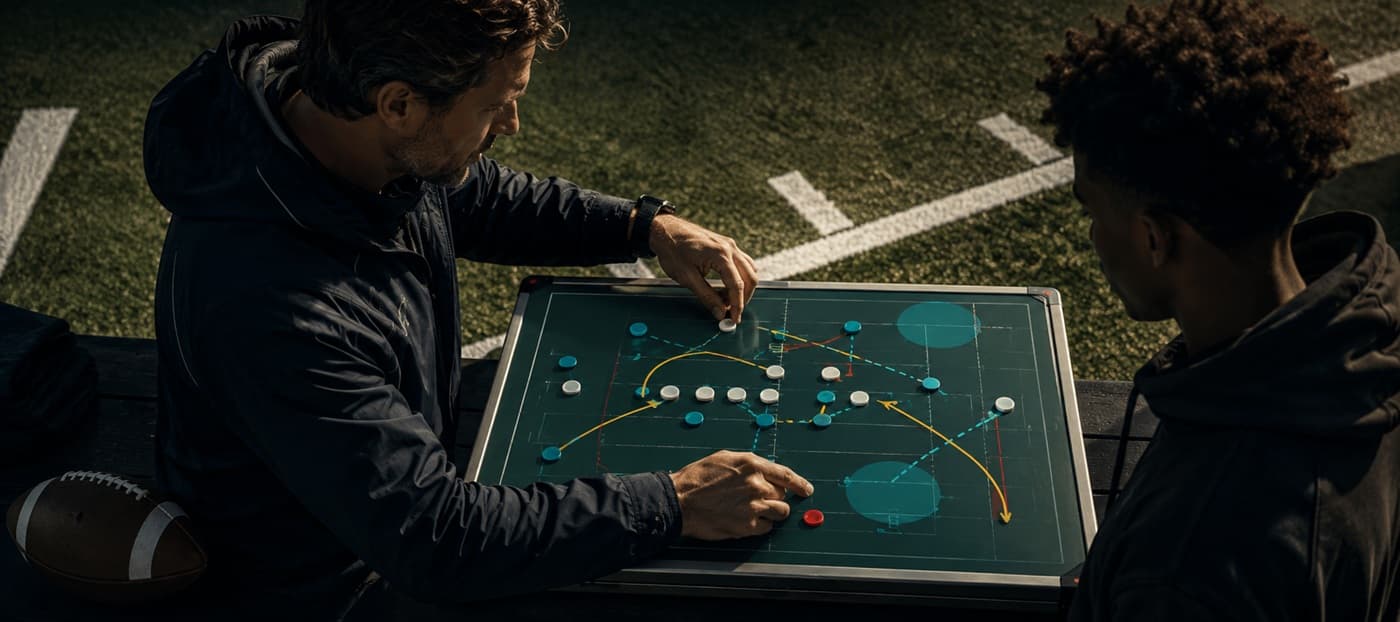
Pass protection is the offensive system for identifying, assigning, and blocking—or otherwise accounting for—defenders who can pressure the quarterback on a passing play.
It is much more organized than simply telling each offensive lineman to block the defender standing directly in front of him.
Before the snap, the defense may show:
- Four defensive linemen
- Linebackers threatening gaps
- A safety near the line of scrimmage
- An edge defender who might rush or drop
- Several potential blitzers
- A front designed to disguise which defenders are actually coming
The offense needs rules for deciding who blocks whom.
Those rules might involve the five offensive linemen alone or include a running back, tight end, or other eligible receiver. On some plays, the offense intentionally does not block every possible rusher. Instead, the quarterback is responsible for getting the ball out before the unblocked defender arrives.
That leads to the central idea of pass protection:
Protection is a coordinated assignment system involving the offensive line, quarterback, backs, tight ends, and passing concept—not five independent one-on-one blocks.
Protection terminology varies enormously among teams and coaching systems. Terms such as slide, half-slide, Mike, hot, scan, and big-on-big may be taught differently from one offense to another. The concepts in this guide are therefore general frameworks rather than one universal protection playbook.
What Is the Purpose of Pass Protection?Link to this section
The immediate objective is obvious:
Keep the quarterback from being pressured or sacked long enough to execute the play.
But that does not always mean creating an untouched pocket for several seconds.
The protection only needs to work in coordination with the passing concept.
A quick pass might require the offense to protect for a relatively short period.
A deep dropback concept may need substantially more time.
Play action can require blockers to initially present a run-like picture before protecting the quarterback.
A screen may intentionally encourage certain rushers to move upfield before blockers release.
Good protection therefore answers two related questions:
- Which defenders can threaten the quarterback?
- How much time does this passing concept require?
What Is the Pocket?Link to this section
The pocket is the protected area that forms around the quarterback during a passing play. NFL Football Operations describes it as the area formed by the quarterback's blockers to prevent defenders from sacking the passer.
The pocket usually develops with:
- Offensive tackles protecting the edges
- Guards and the center controlling interior rushers
- The quarterback positioned behind the line
Ideally, the pocket gives the quarterback room to:
- Complete the drop
- See the coverage
- Move through the progression
- Step into a throw
The pocket is not supposed to remain perfectly static.
Tackles may guide edge rushers around the quarterback.
Interior linemen try to prevent defenders from collapsing the middle.
The quarterback also has responsibilities. Proper depth, timing, and pocket movement affect the angles blockers must protect.
A quarterback who unnecessarily drifts backward can make the tackles' jobs more difficult because edge rushers can take a wider path toward the new launch point.
Pass Protection Starts With the Defensive FrontLink to this section
Before blockers can make assignments, they need to identify the defensive structure.
The offense may look for:
- Defensive lineman alignments
- A nose tackle
- 1-technique or 3-technique defenders
- Edge players
- Linebackers in the box
- Defenders threatening the A or B gaps
- Safeties positioned close enough to blitz
- Late movement before the snap
This is where Defensive Fronts connects directly to protection.
A blocker needs to know more than the number of defenders near the line. The alignment determines which rush threats can enter which gaps and how the offensive line can pass those threats between blockers.
Potential Rushers vs. Actual RushersLink to this section
One of the hardest protection problems is that the offense does not know with certainty who will rush until the play begins.
Imagine the defense shows:
- Four defensive linemen
- Two linebackers close to the A gaps
- A safety creeping toward the edge
That creates seven potential rushers.
But the defense may actually send:
- Four
- Five
- Six
- Seven
- Some combination in which one apparent rusher drops and another player attacks
The offense has to organize protection against possibilities.
That is why protection calls often create a defined set of rules rather than assigning each blocker to one visible defender before the snap.
What Is a Protection Count?Link to this section
A protection count asks a simple question:
How many offensive players are available to protect the quarterback?
The answer depends on the play.
Five-man protectionLink to this section
The five offensive linemen protect.
The eligible backs, tight ends, and receivers are generally available to enter the passing concept.
Six-man protectionLink to this section
The five linemen are joined by another protector, commonly:
- A running back
- A tight end
Seven-man protectionLink to this section
The offensive line plus two additional eligible players remain involved in protection.
This may be part of what is commonly called max protection, though terminology varies.
The tradeoff is fundamental:
More protectors usually mean fewer receivers immediately available in the route.
The offense is constantly balancing protection against receiving options.
Five-, Six-, and Seven-Man Protection ComparedLink to this section
| Protection structure | Basic idea | Potential advantage | Potential tradeoff |
|---|---|---|---|
| Five-man | Offensive line handles the protection | Maximum number of eligible receivers can release | Fewer blockers available against pressure |
| Six-man | Line plus one back or tight end | Adds an answer for a rusher or difficult matchup | Removes or delays one receiver from the concept |
| Seven-man / max protection | Line plus two additional protectors | Can strengthen protection for slower-developing routes | Fewer receivers available to stress coverage |
| Release/check protection | Back or TE checks a threat, then releases | Can add protection while preserving a late receiving option | Route may develop later |
| Hot-adjusted protection | Some pressure is handled by an immediate throw rather than a blocker | Preserves route distribution while accounting for extra rushers | QB and receiver must recognize pressure correctly and act quickly |
No structure is automatically superior. The correct choice depends on the defensive threat and what the offense wants to accomplish downfield.
Five-Man ProtectionLink to this section
In a five-man protection, only the offensive line is responsible for the primary blocking structure.
That allows five eligible receivers to release immediately.
This can give a passing concept excellent distribution across the field, but the arithmetic can become challenging if the defense sends more rushers than the line can account for.
Suppose the offense has five blockers and the defense sends six.
Five blockers cannot physically block six simultaneous rushers one-for-one.
The offense needs another answer.
That answer might be:
- A hot throw
- A sight adjustment
- A protection change
- A quarterback escape
- A route designed to replace a blitzer
- A pre-snap audible
The protection and passing concept have to be built together.
Six-Man ProtectionLink to this section
A six-man protection usually adds a running back or tight end to the five offensive linemen.
Suppose a linebacker is threatening the B gap.
The running back may be responsible for that linebacker if the defender rushes.
If the defender drops into coverage, the back might:
- Release into a route
- Check another possible rusher
- Remain in protection according to the call
These are system-specific rules.
Adding a sixth blocker can give the offense another answer against pressure, but it also means one fewer player is immediately stretching the coverage.
Seven-Man and Max ProtectionLink to this section
A seven-man structure may keep both a running back and tight end in protection along with the offensive line.
This is often associated with deep passing or situations where the offense wants substantial help against the rush.
For example, the offense might protect with seven while sending only three receivers into the route.
Those receivers now have fewer teammates helping stretch the coverage, but the quarterback may have additional time for deeper routes to develop.
Max protection illustrates one of football's basic tradeoffs:
You can use an eligible player to help block, or you can use that player to challenge the coverage—but usually not do both immediately.
Man-Based Pass ProtectionLink to this section
In a man-based protection concept, blockers are assigned particular defenders or use rules that produce defender-specific matchups.
A simplified version might identify:
- Tackles on edge defenders
- Guards on defensive tackles
- Center on an interior defender
- Running back on a linebacker
But real rules become more sophisticated when the defense moves.
A defender can:
- Slant
- Loop
- Drop
- Blitz from another level
So even man-oriented protections need rules for exchanging threats.
“Man protection” should not be interpreted as:
Everyone blindly chases the defender originally standing across from him.
What Is Full-Slide Protection?Link to this section
In a full-slide protection, the offensive line works in a coordinated direction, with each lineman responsible for an area or gap along the slide.
For example, the line might slide left.
Conceptually, blockers work together to account for threats entering the protected gaps in that direction.
Instead of saying:
“You have number 95 no matter where he goes,”
the protection may say something closer to:
“Protect your assigned gap in the slide and pass threats between blockers according to our rules.”
Full-slide concepts can simplify certain pressure problems because the offensive line is moving and thinking cohesively.
The tradeoff is that someone outside the slide may need to be handled by:
- A running back
- A tight end
- The quarterback
- Another protection rule
What Is Half-Slide Protection?Link to this section
Half-slide protection combines different protection ideas on opposite portions of the offensive line.
A common conceptual structure is:
- One side uses slide or zone-style protection rules.
- The other side uses more man-oriented assignments.
USA Football coaching material provides an example in which an offense sets a slide toward one side of a passing concept while using a man side opposite it, illustrating how the protection can be designed around the quarterback's progression.
This can give the offense flexibility against different defensive structures.
For example, the slide side may handle:
- A defensive lineman
- A linebacker entering an adjacent gap
- A stunt passing between blockers
The man side may create more defined matchups.
The running back can then be incorporated according to the offense's rules.
There is no single universal half-slide scheme. Different teams define the slide direction, linebacker count, back responsibility, and adjustment rules differently.
Protection Approaches ComparedLink to this section
| Protection approach | Basic idea | Advantage | Tradeoff |
|---|---|---|---|
| Man-based | Blockers identify specific rush threats using assignment rules | Can create clear matchups | Movement and pressure can complicate assignments |
| Full slide | Offensive line protects gaps in one coordinated direction | Helps organize interior movement and exchanges | Backside/edge threat needs another answer |
| Half slide | Part of line slides while other blockers use man-oriented rules | Combines gap integrity with defined matchups | Communication and identification are critical |
| Max protection | Additional backs/TEs stay to block | Adds numbers against rush | Fewer immediate receiving threats |
| Hot protection | Extra rusher is defeated by quick throw rather than blocked | Preserves route options | Requires rapid recognition and synchronized QB/receiver adjustment |
Running Backs in Pass ProtectionLink to this section
Running backs can have some of the most difficult protection responsibilities because they often have to diagnose the defense after the snap.
A back may need to:
- Block an inside linebacker
- Pick up an edge blitzer
- Scan from one side to another
- Check one threat and release
- Help an offensive lineman
- Recognize late pressure
Imagine the defense shows two linebackers in the box.
The back's rule might tell the player to scan from one linebacker toward another.
If the first linebacker rushes, the back blocks him.
If the first drops and the second blitzes, the back moves to the second.
If neither comes, the back may release into the passing concept.
Those exact rules vary, but the important idea is that pass protection can require a running back to read defenders rather than simply run toward one predetermined opponent.
Tight Ends in ProtectionLink to this section
Tight ends can also contribute to pass protection.
An attached tight end may:
- Block an edge defender
- Help an offensive tackle
- Check a defender before releasing
- Stay in protection throughout the play
This creates another strategic tradeoff.
If the tight end remains to block, the offense may gain help against an edge rusher.
But the defense no longer has to cover that tight end immediately downfield.
Versatile tight ends complicate the defense because the same personnel group can present either a stronger protection surface or an additional receiving threat.
Center and Quarterback CommunicationLink to this section
Protection often begins with communication between the quarterback, center, and offensive line.
NFL Football Operations notes that the center is responsible for communicating blocking information to fellow offensive linemen, reflecting the center's central role in organizing the front.
Depending on the offensive system, the quarterback may:
- Declare a defensive reference point
- Reset the protection
- Change the slide direction
- Identify a pressure threat
- Alert a hot receiver
- Change the entire play
The center may:
- Echo the call
- Identify defensive alignment
- Communicate with guards
- Adjust combinations
- Change responsibilities if defenders move
Football broadcasts sometimes make this sound as though the quarterback alone “sets the protection.” In practice, responsibilities vary considerably among offensive systems.
What Is a Mike Declaration?Link to this section
You may hear a quarterback point toward a linebacker and say something such as:
“54 is the Mike!”
This often causes beginner confusion.
The quarterback is not necessarily announcing:
“Number 54 plays middle linebacker on the roster.”
In many protection systems, the Mike declaration establishes a reference point for the offense's blocking count.
Once that defender is identified, the offensive line and running back can organize responsibilities around him.
Conceptually, the declaration can help determine:
- Which linebackers are counted by the line
- Which defender belongs to the running back
- Which direction the protection works
- Which defender might be left for a hot answer
The exact rules vary greatly.
One offense may identify the true middle linebacker when possible.
Another may declare a different defender as the “Mike” because that designation makes the protection mathematics work correctly.
So the useful definition is:
The Mike declaration is often a protection reference, not merely an identification of a player's listed defensive position.
What Is Blitz Pickup?Link to this section
A blitz sends one or more defenders who are not part of the defense's ordinary basic rush—or otherwise creates additional pressure through the defensive call.
Blitz pickup is the offense's process of recognizing and accounting for that pressure.
Suppose the defense shows four defensive linemen and one linebacker blitzes.
A six-man protection may be able to assign a blocker to all five rushers.
Now suppose two linebackers blitz.
The offense must determine:
- Can the line account for both?
- Does the running back take one?
- Does the protection need to change?
- Is one rusher hot?
- Is the quarterback responsible for an immediate throw?
Blitz pickup is therefore a team problem.
It involves:
recognition + communication + assignment + technique + quarterback response.
USA Football's quarterback material similarly treats pass protection, pressure identification, and hot principles as connected pre-snap responsibilities.
Stunts and TwistsLink to this section
The defense does not need extra rushers to create a difficult protection problem.
Defensive linemen can use stunts or twists.
Imagine two defenders:
- An edge rusher
- An interior defensive tackle
At the snap:
- The defensive tackle attacks outward.
- The edge defender loops behind that movement toward the interior.
- The offensive tackle and guard must recognize what happened.
- They exchange or pass the rushers according to the protection rules.
If both blockers chase the first defender, the looper can enter the pocket unblocked.
If both wait for the looper, the penetrator may win immediately.
This is why communication between offensive linemen is crucial.
Protection involves blocking movement—not static dots on a diagram.
Edge PressureLink to this section
Edge pressure attacks from outside the offensive tackles.
It may come from:
- Defensive ends
- Outside linebackers
- Nickel defenders
- Safeties
- Other blitzing defensive backs
The offensive tackle is often the first protector on the edge, but the offense may provide help from:
- A tight end
- A running back
- A chip block
A chip typically involves an eligible receiver briefly contacting or slowing an edge rusher before releasing into the route.
That can help the tackle without completely removing the tight end or back from the passing concept.
The tradeoff is timing: the receiver enters the route later.
Interior PressureLink to this section
Interior pressure can be especially disruptive because it attacks the space directly in front of the quarterback.
A rusher through an A or B gap can:
- Prevent the quarterback from stepping forward
- Compress the throwing lane
- Force the quarterback to move laterally
- Reach the quarterback quickly because the path is relatively short
Defenses may create interior pressure with:
- Defensive tackles
- Blitzing linebackers
- Twists
- Double-mug looks
- Simulated pressures
The center and guards therefore play a major role in preserving the depth and shape of the pocket.
What Is an Overload?Link to this section
An overload places more potential rush threats in one portion of the protection than the offense can comfortably block using its original rules.
Imagine the defense puts:
- A defensive end outside the right tackle
- A linebacker in the right B gap
- A nickel defender outside both of them
Three defenders threaten one side.
The offense may have only:
- Right guard
- Right tackle
immediately available there.
The offense needs an answer.
It might:
- Slide the protection
- Bring the running back across
- Keep the tight end in
- Change the play
- Throw hot
- Intentionally leave one defender unblocked
Overloads are designed not simply to create one-on-one wins but to stress the offense's assignment system.
Defensive Threats and Offensive AnswersLink to this section
| Defensive threat | Offensive consideration |
|---|---|
| Four-man rush | Can the five linemen handle it while preserving route options? |
| Linebacker blitz | Is the linebacker included in the protection count or handled by the back/QB? |
| Edge blitz | Can tackle handle it, or is chip/back/TE help needed? |
| A-gap pressure | Center and guards must communicate interior responsibility quickly |
| Double-mug linebackers | Determine which defenders actually rush and how the count is set |
| Stunt/twist | Blockers must exchange moving rushers without opening a lane |
| Overload | Protection may need to slide, add a blocker, or designate a hot rusher |
| Simulated pressure | Apparent rushers may drop while unexpected defenders attack |
| Extra unblocked rusher | QB may need hot throw, sight adjustment, escape, or protection change |
What Happens When the Defense Sends More Rushers Than Blockers?Link to this section
This is where protection becomes closely connected to quarterback decision-making.
Suppose the offense has six protectors.
The defense brings seven rushers.
If all seven truly rush and the offense does not change the blocking structure, one defender cannot be blocked by those six players.
The offense must account for that defender another way.
That might mean:
- Throwing immediately
- Adjusting a receiver's route
- Replacing the vacated area
- Changing the protection pre-snap
- Audibling to another play
The unblocked defender is not necessarily evidence that an offensive lineman “missed his assignment.”
Sometimes the scheme deliberately says:
That defender belongs to the quarterback.
What Is a Hot Read?Link to this section
A hot read is an immediate passing answer to pressure that the protection cannot or is not designed to block.
Imagine a linebacker is outside the protection count.
If that linebacker drops, the normal concept continues.
If the linebacker blitzes, the quarterback may immediately throw to a receiver in the area the linebacker vacated.
This is often described conceptually as replacing the blitzer.
USA Football instructional material describes sight adjustments in which a receiver replaces the area vacated by a blitzing defender and the quarterback releases the football quickly because the rusher is not being blocked.
The exact hot rules vary greatly by offense.
A hot answer could be:
- Slant
- Quick out
- Hitch
- Seam
- Flat
- Another adjusted route
What matters is that the quarterback and receiver reach the same conclusion.
If the quarterback throws hot but the receiver runs the original route, the play can fail badly.
Hot Read vs. Sight AdjustmentLink to this section
The terms are sometimes used interchangeably, but offenses may distinguish them.
At a general level:
Hot readLink to this section
The quarterback has a predefined quick answer because an extra rusher is not blocked.
Sight adjustmentLink to this section
The receiver and quarterback recognize a defensive pressure or leverage condition and alter the route accordingly.
A receiver might shorten or redirect a route when a particular defender blitzes.
Because terminology differs, it is better to focus on the purpose:
The passing game changes in response to pressure that cannot be handled conventionally by the protection.
Why a Defender May Be Intentionally UnblockedLink to this section
This is one of the most important ideas for a beginner.
Sometimes a television viewer sees a defender rush untouched and assumes:
Someone blew the block.
Perhaps.
But not always.
Suppose the defense has six potential threats and the offense uses a five-man protection.
The offense may intentionally identify the sixth defender as the quarterback's responsibility.
If that defender rushes, the ball must come out.
This allows the offense to send five eligible receivers into the pattern instead of keeping another player in protection.
The offense is essentially trading:
one blocker for one receiving threat
and using quarterback timing to handle the extra rusher.
Protection is therefore partly a numbers problem.
Protection and Route Timing Must MatchLink to this section
Consider two passing concepts.
Quick-game conceptLink to this section
The quarterback:
- Receives the snap.
- Makes a rapid read.
- Throws quickly.
The line may not need to sustain blocks for long.
Deep conceptLink to this section
Receivers need time to:
- Release
- Gain depth
- Create leverage
- Reach their route breaks
Now the protection must hold longer.
The offense might respond by:
- Keeping a tight end in
- Using a back in protection
- Chipping an edge rusher
- Using play action
- Moving the quarterback
This is why Passing Concepts cannot be understood independently of protection.
A route may eventually become open, but that does not matter if the quarterback is already under pressure before the throwing window develops.
Fictional Example: Five-Man Protection vs. Six RushersLink to this section
The offense aligns in an empty formation and uses five-man protection.
The defense shows six potential rushers.
The quarterback identifies one linebacker outside the protection.
At the snap:
- All six defenders rush.
- The five linemen block the five defenders included in the protection.
- The sixth linebacker runs free.
- A receiver immediately breaks into the space that linebacker vacated.
- The quarterback throws before the linebacker arrives.
The offensive line appears to have “left someone unblocked.”
But the protection worked exactly as designed.
The sixth defender belonged to the quarterback and hot receiver.
Fictional Example: Half-Slide Against a TwistLink to this section
The offense uses half-slide protection.
The left side slides.
The right guard and tackle have man-oriented responsibilities.
After the snap, the defensive tackle attacks the tackle's outside shoulder while the edge rusher loops inside.
The guard and tackle communicate the exchange.
Instead of chasing their original defenders, they pass the rushers:
- Tackle handles the outward penetrator.
- Guard recognizes the looping rusher.
- The interior lane remains closed.
This is why protection rules matter more than simply remembering who stood across from you before the snap.
Fictional Example: Running Back Blitz PickupLink to this section
The offense uses six-man protection with the running back responsible for a linebacker.
Before the snap, two linebackers appear near the interior.
The back scans according to the protection rule.
At the snap:
- The first linebacker drops.
- The second attacks the B gap.
- The running back steps inside and blocks the blitzer.
If neither linebacker had rushed, the back might have been allowed to release into the route.
One player has both protection and receiving possibilities depending on the defense.
Double-Mug and Simulated PressureLink to this section
Defenses frequently try to complicate identification before the snap.
A double-mug presentation may put two linebackers near the A gaps on either side of the center.
The offense has to treat both as potential rushers.
Then the defense might:
- Rush both
- Rush one
- Drop both
- Rush one while a defensive lineman drops
- Send another defender from somewhere else
The apparent front has forced the offense to declare protection before revealing the actual rush.
This is part of the problem shown by concepts such as OpenPlay's Man Pressure.
The key thing to observe is not simply how many defenders are near the line, but which rush threats the offense must account for before it knows the final answer.
Fire-Zone PressureLink to this section
A zone blitz or fire-zone concept demonstrates why counting defenders before the snap can be misleading.
A linebacker or defensive back may rush while a defensive lineman drops into coverage.
The defense can create a pressure picture without necessarily sending every apparent rusher.
OpenPlay's Fire Zone Blitz helps illustrate this relationship between rush and coverage.
Watch:
- Which defenders threaten before the snap
- Which actually rush
- Which drop
- How the offensive line reacts to the exchange
For the quarterback, the protection problem and coverage problem occur simultaneously.
Play-Action Pass ProtectionLink to this section
Play-action protection tries to make the beginning of a passing play resemble a running play.
The quarterback may fake a handoff while the offensive line uses action designed to influence defenders.
The protection must still keep the passer safe, but the offense is also attempting to affect defenders who are reading run or pass.
This creates special timing considerations.
A linebacker reacting aggressively to the run fake may step toward the line, potentially opening passing space behind.
But the quarterback may also have the back turned briefly during the fake, making immediate pressure dangerous.
Play-action protection therefore coordinates:
- Run-like presentation
- Blocking rules
- Quarterback footwork
- Fake timing
- Route development
- Pressure awareness
Different teams build these protections in different ways.
Screens Attack the Rush DifferentlyLink to this section
A screen uses an entirely different idea.
Instead of trying to stop aggressive pass rushers at the line for the duration of the play, the offense may intentionally allow them to advance.
On a Halfback Screen:
- The offense initially presents a pass.
- Rushers attack the quarterback.
- The running back releases into space.
- Selected offensive linemen release downfield according to the design.
- The quarterback throws behind the rush.
The offense has used the defense's aggressiveness against it.
A screen is therefore not conventional pass protection failing on purpose.
It is a coordinated concept in which the apparent protection and controlled release of rushers are part of the play design.
Personnel Changes Protection OptionsLink to this section
Personnel determines which eligible players are available to help protect.
With 11 personnel, the offense has:
- 1 RB
- 1 TE
- 3 WR
The offense could:
- Release all five eligible receivers
- Protect with the back
- Protect with the tight end
- Keep both in
- Chip with one and release
- Motion a player to change the protection picture
With 10 personnel, there is no traditional tight end, reducing certain protection options but adding another wide receiver.
With 12 personnel, two tight ends may give the offense additional ways to protect the edges.
See Personnel Groups for why the same personnel can support very different protection and formation structures.
Reading the Defense for ProtectionLink to this section
Protection recognition is part of the larger process of Reading a Defense.
Before the snap, the quarterback may examine:
Defensive frontLink to this section
Where are the linemen?
Box defendersLink to this section
How many linebackers or hybrid defenders are close enough to rush?
A-gap threatsLink to this section
Are linebackers threatening the interior?
Edge threatsLink to this section
Is a safety, nickel, or linebacker positioned to blitz outside?
Safety structureLink to this section
Does the secondary alignment suggest pressure or coverage?
Man indicatorsLink to this section
If defenders appear locked in man coverage, does that free additional rushers?
Then comes the essential step:
Confirm after the snap.
A linebacker showing blitz may drop.
A defensive end may drop while a safety rushes.
A defense may intentionally manipulate the protection count.
Pre-snap identification provides the offensive plan. Post-snap execution determines whether that plan matches reality.
Common Beginner Misconceptions About Pass ProtectionLink to this section
“Every offensive lineman blocks the defender directly in front of him.”Link to this section
No. Protection schemes use coordinated assignment rules. Linemen may slide, exchange defenders, help one another, or block a defender who began somewhere else.
“If a defender comes through untouched, someone missed a block.”Link to this section
Not necessarily. A defender can be intentionally left unblocked because the quarterback is responsible for throwing hot.
“The Mike declaration identifies the defense's actual middle linebacker.”Link to this section
Sometimes, but not always. In many systems, “Mike” is primarily a reference point that organizes the protection count.
“Five offensive linemen can block any blitz.”Link to this section
No. If the defense sends more rushers than the available blockers, the offense needs another answer.
“Keeping more blockers in is always safer.”Link to this section
It may strengthen protection, but it also reduces the number of receivers immediately available to challenge the coverage.
“The running back's main job on a pass is to catch the ball.”Link to this section
The back may have a crucial pass-protection assignment before becoming a receiver—or may remain in protection for the entire play.
“Slide protection means every lineman blocks toward one sideline.”Link to this section
It is more useful to think of slide protection as a coordinated gap-oriented protection structure. Exact footwork and assignment rules vary.
“Hot means the quarterback throws to one predetermined receiver every time.”Link to this section
The hot response depends on the offensive system, the location of the pressure, and the route adjustment rules.
“A screen is just a failed pass rush.”Link to this section
No. Screens deliberately manipulate the rush, allowing defenders to advance before throwing behind them.
“The best pass protection never allows pressure.”Link to this section
Protection is tied to timing. A quick passing concept may succeed even when a defender is about to reach the quarterback, because the ball is already gone.
How to Watch Pass ProtectionLink to this section
Watching only the quarterback makes protection difficult to understand.
Try this sequence instead.
Before the snapLink to this section
Ask:
- How many defensive linemen are showing?
- How many linebackers are near the box?
- Is anyone threatening an A gap?
- Is there an edge blitzer?
- Is the running back in the backfield?
- Is a tight end available to protect?
- Does the defense appear to have more potential rushers than obvious blockers?
At the snapLink to this section
Watch the offensive line.
Ask:
- Does the line slide together?
- Do blockers appear to have individual matchups?
- Does the running back scan inside?
- Does the tight end stay or release?
- Do two defenders stunt or twist?
- Does an apparent blitzer drop?
Then watch the quarterbackLink to this section
Ask:
- Was the ball thrown quickly?
- Did the quarterback identify a hot answer?
- Did the quarterback step forward in the pocket?
- Was pressure caused by a lost block or by an intentionally unblocked rusher?
- Did the route concept require more time than the protection provided?
These questions reveal much more than simply counting sacks.
Why Pass Protection MattersLink to this section
Pass protection is where several parts of offensive football meet.
The offensive line reads the front.
The quarterback identifies pressure.
The center communicates assignments.
The running back may scan for a linebacker.
The tight end may block, chip, or release.
Receivers may have hot or sight-adjustment responsibilities.
The route concept determines how much time is needed.
The defense is simultaneously trying to make all of those players wrong.
A good pressure does not always require one defender to physically beat one blocker. It may win by causing the offense to:
- Count incorrectly
- Block the wrong defender
- Mishandle a stunt
- Leave the wrong rusher free
- Delay the quarterback's read
- Keep extra receivers in protection and weaken the route distribution
Likewise, successful protection is not always a perfect semicircle around an untouched quarterback.
Sometimes protection succeeds because five linemen exchange a twist correctly.
Sometimes the running back stops a blitzing linebacker.
Sometimes the offense keeps seven players in and gives a deep route time to develop.
And sometimes the offense deliberately leaves a defender completely unblocked and the quarterback defeats that rusher by getting the football out immediately.
That is the larger lesson:
Pass protection is not merely blocking the rush. It is the offense's complete plan for accounting for pressure long enough to execute the pass.
Frequently Asked QuestionsLink to this section
What is pass protection in football?Link to this section
Pass protection is the offensive assignment system used to account for defensive pass rushers and give the quarterback enough time to execute a passing play. It can involve offensive linemen, running backs, tight ends, and the quarterback's own pressure reads.
How does an offensive line know who to block?Link to this section
The offense uses protection rules based on the defensive front, linebacker locations, potential blitzers, the protection call, and a reference point such as a Mike declaration. Linemen communicate and adjust when defenders move after the snap.
What is slide protection?Link to this section
Slide protection has offensive linemen work together in a coordinated direction, generally protecting assigned gaps and passing moving rush threats between blockers according to the system's rules.
What is half-slide protection?Link to this section
Half-slide combines a slide-oriented structure on one part of the line with more man-oriented assignments on another. Exact half-slide rules vary considerably among offenses.
What is a Mike declaration?Link to this section
A Mike declaration identifies a defensive player as a reference point for organizing the protection. The declared Mike may be the defense's actual middle linebacker, but the term can instead function primarily as a blocking-count designation.
What is blitz pickup?Link to this section
Blitz pickup is the offense's process of identifying, communicating, and blocking or otherwise accounting for additional pass rushers. Running backs, tight ends, linemen, and the quarterback can all have blitz responsibilities.
What is a hot read?Link to this section
A hot read is a rapid passing answer used when a defender rushes whom the protection does not block. The quarterback and receiver recognize the pressure and execute the offense's designated quick response.
What happens if seven defenders rush and the offense has only six blockers?Link to this section
One rusher cannot be blocked one-for-one by the six protectors. The offense must have another answer, such as changing the protection, throwing hot, making a sight adjustment, or otherwise accounting for the free rusher.
What is the pocket in football?Link to this section
The pocket is the protected area formed around the quarterback by offensive blockers. The quarterback uses it to complete the drop, read the defense, and deliver the pass.
Why would an offense intentionally leave a defender unblocked?Link to this section
Leaving a rusher unblocked can allow the offense to send another eligible receiver into the passing concept. The quarterback then accounts for the free defender by throwing quickly if that player rushes.
Take it to the field