Learn Football
Man Coverage vs. Zone Coverage in American Football
Man defenders track particular receivers, while zone defenders protect space and distribute routes by rules.
23 minute read
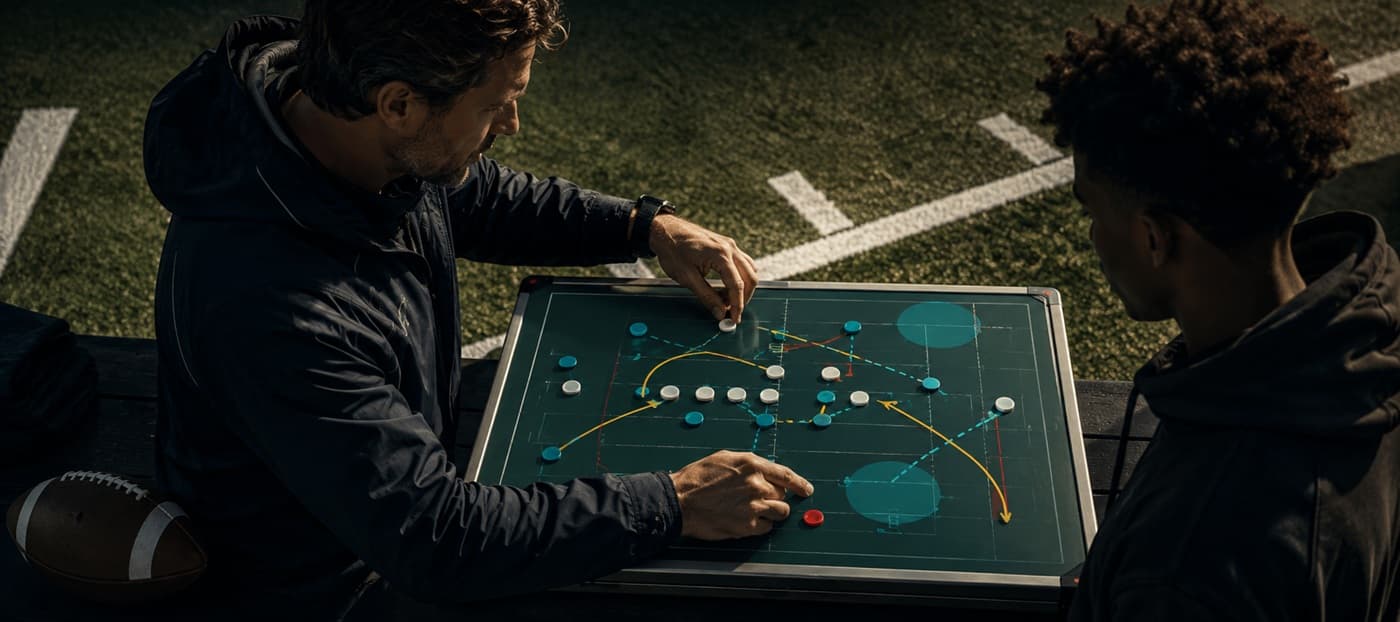
Man coverage assigns defenders primarily to individual eligible receivers. Zone coverage assigns defenders primarily to areas of the field and the routes entering those areas.
That is the simplest distinction, but modern pass defense is more complicated than dividing every coverage into two perfectly separate categories.
A defender in man coverage may play with inside leverage because a safety is helping over the top. A zone defender may carry a receiver vertically instead of simply stopping at a spot. A match coverage can begin with zone-like structure and then turn into tight receiver matchups according to which routes the offense runs.
The best way to think about modern coverage is:
Man coverage emphasizes responsibility for a receiver. Zone coverage emphasizes responsibility for space and route distribution. Match coverage uses rules that can turn zone structure into receiver-specific assignments after the routes declare.
Understanding those differences makes it much easier to follow quarterbacks, route concepts, defensive backs, and coverage diagrams.
What Is Man Coverage?Link to this section
In man coverage, a defender is assigned responsibility for a particular eligible receiver.
The basic rule sounds simple:
Where that receiver goes, the defender goes.
USA Football describes traditional man coverage in similar terms: each defender has a designated receiver and generally keeps vision focused on that matchup.
If an outside cornerback is responsible for the offense's outside receiver, the corner may follow that receiver on:
- A vertical route
- A slant
- An out
- A crossing route
- A post
- Another route within the coverage rules
But good man coverage is not simply chasing someone around the field.
The defender also uses:
- Leverage
- Technique
- Help from other defenders
- Knowledge of the receiver's split
- Down and distance
- Route tendencies
- The location of the quarterback and ball
Leverage in Man CoverageLink to this section
Leverage describes where the defender positions himself relative to the receiver and the space the defense wants to protect.
A man defender might play:
- Inside leverage
- Outside leverage
- Head-up
- Trail technique
- Press at the line
- Off coverage with cushion
The correct technique depends on the coverage and available help.
Inside leverageLink to this section
A defender positioned toward the receiver's inside shoulder is attempting to make inside access more difficult.
That can help against routes such as:
- Slants
- Posts
- Crossers
- Digs
But positioning inside may give the receiver more immediate room toward the sideline.
Outside leverageLink to this section
A defender positioned outside the receiver may try to funnel that player toward inside help.
If a safety or linebacker is available inside, this can be a coordinated choice rather than the corner simply surrendering space.
Trail techniqueLink to this section
A defender in trail position plays underneath or slightly behind the receiver while expecting help elsewhere, often deeper.
From the television angle, a defender trailing a receiver may initially appear beaten.
But if a safety is positioned over the top, the coverage may intentionally place the receiver between two defenders.
That is why individual alignment makes more sense when you understand the complete coverage.
Help Defenders in Man CoverageLink to this section
Man coverage does not necessarily mean every defender is isolated one-on-one with no help.
A defense can assign certain players to man coverage while keeping another defender available as:
- Deep help
- A robber
- A hole defender
- Double-team help
- A quarterback spy
- Help against specific routes
This leads to important coverage families such as Cover 1.
What Is Cover 0?Link to this section
Cover 0 is a man-coverage structure with no dedicated deep safety playing a traditional deep zone.
Defenders are generally matched with eligible receivers while the defense can use the remaining players to pressure the quarterback.
The advantage is numbers near the line of scrimmage.
The risk is equally obvious: if a receiver wins the individual matchup, there may be no deep safety waiting behind the defender.
Cover 0 can therefore create:
- Immediate pressure
- Difficult protection assignments
- Tight man coverage
- Opportunities for the offense if it wins quickly
Offenses may respond with:
- Quick throws
- Crossing routes
- Pick-up adjustments in protection
- Hot routes
- Screens
- Individual matchup throws
Cover 0 does not automatically mean the defense will successfully blitz, nor does identifying Cover 0 guarantee the offense knows exactly who will rush.
What Is Cover 1?Link to this section
Cover 1 generally combines man coverage underneath with one defender—usually a safety—protecting the deep middle of the field.
That deep player gives the man defenders some protection against vertical routes.
A typical structure includes:
- Man assignments on eligible receivers
- One deep middle defender
- Other defenders assigned to rush, cover a back, or perform another responsibility depending on the call
The presence of deep help changes how corners can play.
A corner who knows the middle safety can help on certain deep routes may use different leverage than a corner isolated in Cover 0.
This illustrates a central coverage principle:
Man technique depends on where the defender's help is located.
What Is Cover 1 Robber?Link to this section
A robber coverage adds an underneath or intermediate help defender who can read the quarterback and look for routes entering a targeted area.
In a Cover 1 Robber structure, the defense still maintains a single-high safety while another defender becomes the robber.
That defender may look for opportunities to:
- Cut crossing routes
- Jump intermediate throws
- Help against in-breaking routes
- Read the quarterback's intentions
The exact responsibilities vary by defensive system.
OpenPlay's Cover 1 Robber is a useful example because it shows that man coverage can contain more structure than simply assigning one defender to each receiver. Watch how the single-high defender and robber provide help around the individual matchups.
Strengths of Man CoverageLink to this section
Man coverage can provide several strategic advantages.
Tight coverageLink to this section
Defenders can stay close to receivers rather than intentionally allowing catches in an underneath zone.
Clear matchup responsibilityLink to this section
A defender often knows exactly which offensive player is the primary responsibility.
Pressure flexibilityLink to this section
Certain man structures can free other defenders to rush because coverage players are already assigned to receivers.
Ability to challenge timingLink to this section
Physical or tight coverage can disrupt the timing between receiver and quarterback.
Fewer easy zone windowsLink to this section
An offense cannot simply identify an open patch between static zone defenders if the coverage is matching receivers tightly.
These are potential advantages—not guarantees.
Vulnerabilities of Man CoverageLink to this section
Man coverage also creates problems the offense can attack.
Crossing routesLink to this section
A receiver running across the field can force a defender to navigate traffic.
Concepts such as Mesh can create this problem by sending shallow crossers in opposite directions.
Natural trafficLink to this section
Bunch and stack formations can make it difficult for defenders to follow receivers cleanly without colliding or losing leverage.
Individual matchup lossesLink to this section
If one receiver consistently beats one defender, the offense may continue attacking that matchup.
Quarterback scramblingLink to this section
When defenders turn their backs to the quarterback and follow receivers, a mobile quarterback may find open space after leaving the pocket.
Motion and formation stressLink to this section
Receivers moving before the snap can change leverage, force communication, or create a matchup the defense does not prefer.
Again, none of these automatically defeats man coverage. Defensive techniques, switches, brackets, pressure, and help defenders can provide answers.
What Is Zone Coverage?Link to this section
In zone coverage, defenders are primarily responsible for defending areas, route distributions, and throwing lanes rather than following one receiver everywhere.
At a beginner level, imagine the defense dividing the passing area into:
- Short outside areas
- Short or intermediate middle areas
- Deep outside areas
- Deep middle areas
Different defenders protect different portions of that structure.
Traditional zone teaching often allows defenders to keep more awareness of the quarterback than pure man defenders. USA Football notes that zone defenders commonly use vision on the quarterback while relating to the routes entering their areas.
But modern zone coverage is not simply:
“Stand in your assigned patch of grass.”
Defenders must react to receivers entering, leaving, or threatening their zones.
Underneath and Deep ZonesLink to this section
Zone defenses generally organize defenders at different depths.
Underneath defendersLink to this section
These may include:
- Linebackers
- Nickel defenders
- Safeties
- Occasionally other defensive backs
They can be responsible for areas commonly described with terms such as:
- Flat
- Hook
- Curl
- Hook/curl
- Seam-related areas
Terminology varies among systems.
Deep defendersLink to this section
Deep defenders protect larger areas farther downfield.
Depending on the coverage, the field might have:
- One deep middle defender
- Two deep-half defenders
- Three deep defenders
- Four deep defenders
- Match rules that make the actual distribution more complicated
The familiar Cover 2 and Cover 3 families provide useful examples.
What Is Cover 2 Zone?Link to this section
A traditional Cover 2 structure uses two deep defenders, usually safeties, who divide the deep field roughly into halves.
Underneath defenders protect shorter areas.
A simplified goal is to prevent the offense from easily attacking deep outside areas while forcing the quarterback to work through underneath defenders.
Potential stress points can include:
- The space between underneath defenders and safeties
- The deep middle
- Sideline windows
- Route combinations that force an underneath defender to choose between threats
OpenPlay's Cover 2 Zone can help you see the layered structure. Watch the relationship between the shallow defenders and the two safeties rather than following only the receiver with the ball.
Cover 2 is a family, not one universal set of landmarks and techniques.
What Is Cover 3 Zone?Link to this section
A traditional Cover 3 structure divides the deep field among three defenders.
Often that means:
- One deep outside third
- One deep middle third
- One deep outside third
Other defenders handle underneath areas.
This gives the defense an extra deep player compared with traditional Cover 2, while leaving a different number and distribution of underneath defenders.
Cover 3 can be useful for illustrating why offenses use concepts that stretch defenders horizontally and vertically.
But modern Cover 3 may also include match principles. USA Football's coverage material describes versions in which defenders carry vertical routes man-to-man according to route-distribution rules even though the overall structure belongs to the Cover 3 family.
So describing every Cover 3 call as pure spot-drop zone is misleading.
Zone Spacing and Passing WindowsLink to this section
Zone coverage naturally creates spaces between defenders.
Offenses try to manipulate those spaces.
A passing window is an area where the quarterback can deliver the ball before a defender closes it.
Consider an underneath defender responsible for an outside area.
The offense might place:
- One route inside that defender
- Another route outside
The defender cannot occupy both locations perfectly at once.
That is the basis of a horizontal stretch such as Slant-Flat.
The offense may also attack zones vertically by putting one route underneath a defender and another behind that player.
These windows move during the play.
A receiver who appears open may become covered by the time the ball arrives.
Quarterbacks therefore read both space and defender movement.
Strengths of Zone CoverageLink to this section
Zone structures can offer several advantages.
Vision on the quarterbackLink to this section
Certain zone defenders can keep their eyes toward the quarterback and react when the ball is thrown.
Ability to pass routes between defendersLink to this section
A defender may not need to chase a receiver across the entire field if another defender can take over responsibility.
Help against scramblingLink to this section
Because more defenders may face the quarterback, some zone structures can react more quickly when the quarterback leaves the pocket.
Ability to protect particular areasLink to this section
A defense can build the coverage around the parts of the field it considers most dangerous.
Opportunities to disguiseLink to this section
Defenders can show one structure before the snap and rotate into another after the ball moves.
As with man coverage, these are characteristics rather than guaranteed advantages.
Vulnerabilities of Zone CoverageLink to this section
Zone structures also create potential stresses.
Windows between defendersLink to this section
Well-spaced route concepts can place receivers between zones.
Defender conflictsLink to this section
The offense can make one zone defender choose between two threats.
OverloadsLink to this section
Multiple routes can attack one area and force defenders to sort them out.
Timing throwsLink to this section
A quarterback may throw into a window before the defender can close it.
Route distribution problemsLink to this section
Bunches, trips, crossing routes, and vertical combinations can make communication and passing responsibilities difficult.
This is why zone defenses increasingly use match principles rather than relying entirely on static spot drops.
What Is Match Coverage?Link to this section
Match coverage combines elements that beginners often associate separately with man and zone.
The defense may begin from a recognizable zone structure, but defenders use rules based on receiver releases.
Those rules might say, conceptually:
- Carry a receiver if that player goes vertical.
- Pass the receiver to another defender if the route breaks underneath.
- Switch responsibilities against crossing routes.
- Match a particular receiver once the route distribution becomes clear.
USA Football describes zone-match and man-match structures in which defensive responsibilities change according to the routes. In some zone-match systems, a defender begins with zone principles but converts into man coverage when a receiver enters or threatens the defender's area.
That means match coverage should not be understood as traditional defenders dropping to fixed spots and waiting.
Why Defenses Use Match CoverageLink to this section
Modern offenses are designed to manipulate static zones.
If the defense simply drops to landmarks, offenses can use combinations such as:
- Four Verticals
- Mesh
- Flood concepts
- Bunch routes
- Trips combinations
Match rules allow defenders to adapt to those routes.
For example, a defender in a Cover 3 match concept may carry a vertical receiver rather than releasing that player into what would otherwise become a vulnerable seam. USA Football's examples of Rip/Liz Cover 3 show defenders converting to receiver-specific responsibilities based on route stems while preserving a three-deep structure.
The result can look like man coverage after the snap even though the defensive call began with zone-based rules.
Man, Zone, and Match ComparedLink to this section
| Feature | Man coverage | Zone coverage | Match/hybrid coverage |
|---|---|---|---|
| Primary responsibility | Specific receiver | Area, route distribution, and throwing space | Area initially, then receiver responsibilities according to route rules |
| Defender eyes | Often focused heavily on assigned receiver | Often greater vision toward quarterback and routes | Changes according to match rules and route development |
| Leverage | Used to guide receiver toward help or deny route access | Used to protect zone and route threats | Used to trigger, carry, funnel, or pass routes |
| Reaction to motion | Defender may travel with receiver, depending on call | Defense may bump or exchange zones | Defense may adjust rules without obvious one-for-one movement |
| Crossing routes | Can create traffic and difficult pursuit | Routes may be passed between defenders | Switch/pass rules may be specifically designed for crosses |
| QB scrambling | Defenders may have backs turned while covering | More defenders may retain vision on QB | Depends on which defenders have converted to match responsibilities |
| Communication | Needed for switches, help and formations | Needed for zone distribution and route threats | Especially important because routes can trigger assignment changes |
| Vertical routes | Defender follows assigned receiver | Deep zone defender protects vertical area | A defender may carry the vertical route man-to-man |
| Route combinations | Stress individual matchups and traffic | Stress spacing and zone conflicts | Designed rules attempt to answer combinations dynamically |
| Coverage disguise | Can disguise help or pressure | Can rotate from one zone shell to another | Can look like zone or man before becoming something different post-snap |
How Man Coverage Handles Crossing RoutesLink to this section
Crossing routes are a classic man-coverage stress.
Suppose two receivers begin on opposite sides and run shallow routes across the field.
Their defenders must follow.
Near the middle, the four players can create traffic.
The receivers may cross close enough that defenders have to:
- Navigate around bodies
- Switch assignments
- Communicate quickly
- Maintain leverage despite changing space
Mesh is built around this type of relationship.
The concept does not automatically defeat man coverage. A defense can use switch rules, match principles, physical technique, or pressure.
But it forces man defenders to solve a difficult spatial problem.
How Zone Handles Horizontal StretchesLink to this section
Zone coverage faces a different kind of stress.
Imagine one defender responsible for an underneath outside area.
The offense calls Slant-Flat.
One receiver breaks inside.
Another moves into the flat.
If the defender widens aggressively, space may develop inside.
If the defender stays inside, the flat may open.
Slant-Flat demonstrates how an offense can place one zone defender between two threats.
This is why a quarterback does not always ask:
Which receiver is uncovered?
Sometimes the better question is:
What did that defender choose to protect?
How Four Verticals Stresses Zone RulesLink to this section
Four Verticals sends multiple receivers into deep lanes.
Against a static three-deep coverage, four vertical threats can potentially create difficult distribution problems.
But modern defenses have developed match rules partly to address this problem.
For example, defenders in Cover 3 match structures may carry inside vertical routes rather than simply dropping to landmarks and allowing seam routes to pass freely between deep zones.
This is a good example of why the simple phrase “Four Verticals beats Cover 3” is inadequate.
Coverage technique matters.
Route adjustments matter.
Match rules matter.
Protection and quarterback decisions matter.
How Quarterbacks Identify Man vs. ZoneLink to this section
Quarterbacks gather clues before the snap.
Those clues can include:
- Cornerback leverage
- Safety structure
- Linebacker positioning
- Defender depth
- Alignment over receivers
- Reaction to motion
- Bunch and stack adjustments
- Late defensive movement
But this rule should remain central:
Pre-snap clues are clues, not proof.
Defenses intentionally disguise coverages.
USA Football's quarterback coverage-identification guidance specifically warns that pre-snap information must be confirmed after the snap because defenses can disguise one coverage as another.
Cornerback LeverageLink to this section
Corner alignment can provide useful information.
Suppose a corner is:
- Pressed tightly over a receiver
- Playing inside leverage
- Following a receiver across the formation
Those features might suggest man coverage.
Alternatively, a corner aligned with outside leverage and vision toward the quarterback might suggest zone responsibilities.
But neither is conclusive.
A Cover 1 defender may play off.
A zone corner may press.
A match defender may look like man once the route begins.
Alignment should narrow the quarterback's possibilities, not end the diagnosis.
Safety StructureLink to this section
Quarterbacks commonly identify how many safeties appear deep before the snap.
A defense might present:
- Single-high — one safety in the deep middle area
- Two-high — two safeties aligned deep
- Another disguised or rotated structure
A single-high picture could support:
- Cover 1
- Cover 3
- Pressure coverage
- Match variations
A two-high picture could support:
- Cover 2
- Cover 4
- Two-man structures
- Match coverage
- A rotation into something completely different
Safety count is useful because it helps organize possibilities.
It does not reveal the final coverage by itself.
Linebacker PositioningLink to this section
Linebackers can also provide information.
A linebacker aligned directly over a running back may appear to have man responsibility.
Two linebackers threatening the A gaps may suggest pressure.
A linebacker showing unusual width may be preparing to relate to a slot receiver.
Again, the defense can manipulate those appearances.
A linebacker showing blitz may drop into a zone.
Another defender may replace that player.
Coverage recognition requires reading the complete defensive structure.
Does Motion Reveal Man Coverage?Link to this section
Motion is one of the most useful—and most misunderstood—tools for identifying coverage.
A common rule of thumb says:
If a defender follows a receiver across the formation, it is man coverage.
That can be a valuable clue.
But it is not proof.
Why following motion can indicate manLink to this section
If a corner is responsible for one receiver and that receiver moves across the formation, following the receiver maintains the matchup.
That is consistent with man coverage.
Why it does not prove manLink to this section
A zone defense may:
- Travel a defender with the motion to preserve spacing
- Bump responsibilities between defenders
- Rotate the secondary
- Change the front
- Use match rules
- Show man before transitioning into zone
Likewise, a man defense may not visibly chase the motion if defenders exchange assignments.
This is why experienced quarterbacks use motion to gather information, not to obtain an infallible answer.
What Does “Bumping” the Coverage Mean?Link to this section
Suppose a receiver motions from the left side to the right.
Instead of one defender following that player across the entire formation, the defense may adjust collectively.
For example:
- One defender releases responsibility.
- Another defender widens.
- A linebacker adjusts.
- The secondary shifts its spacing.
The defense has bumped or redistributed responsibilities.
That can be a sign of zone principles, but match and man systems can also exchange responsibilities.
The quarterback must continue reading after the snap.
Why Defenses Disguise CoverageLink to this section
If the quarterback knew the exact coverage before every snap, the offense could more easily choose the best route or matchup.
Defenses therefore attempt to make different calls look alike.
A defense might show two deep safeties and rotate one toward the line after the snap.
Another might show a single-high safety before spinning into a different structure.
A corner might show man leverage before playing a zone responsibility.
A linebacker might appear to blitz before dropping underneath a route.
Coverage disguise attempts to make the quarterback hesitate, misidentify a defender, or throw the ball into an unexpected area.
That is why quarterback coverage identification has two stages:
Pre-snap hypothesis → post-snap confirmation
How Post-Snap Rotation Changes the AnswerLink to this section
Imagine the offense sees two deep safeties before the snap.
The quarterback suspects a two-high coverage.
Then the ball is snapped.
One safety rotates toward the deep middle.
The other moves down toward an underneath area.
The defense now presents a single-high structure.
If the quarterback blindly relied on the pre-snap picture, the planned throw could go directly toward the rotating defender.
Experienced quarterbacks watch the safeties and key underneath defenders as the play develops.
The defense is moving.
The coverage read must move with it.
How Man Coverage Changes Offensive ThinkingLink to this section
Against likely man coverage, an offense may consider:
- Individual receiver matchups
- Crossing routes
- Bunches and stacks
- Motion
- Option routes
- Routes that exploit leverage
- Quarterback scrambling possibilities
- Protection against pressure
For example, Mesh can create traffic.
A slant can attack favorable leverage.
Motion can help a receiver avoid press contact.
But offenses still need answers if the defense changes coverage after the snap.
How Zone Coverage Changes Offensive ThinkingLink to this section
Against zone, offenses often think in terms of:
- Defender conflicts
- Passing windows
- Horizontal stretches
- Vertical stretches
- High-low reads
- Overloads
- Route spacing
Concepts such as Slant-Flat may horizontally stress an underneath defender.
Four Verticals can challenge deep distribution rules.
Curl-Flat can create layered conflicts.
But these concepts are not coverage cheat codes.
A defense can alter drops, use match rules, disguise rotations, or generate pressure before the concept develops.
Learn how these route relationships are constructed in Passing Concepts.
Communication Matters in Every CoverageLink to this section
Man coverage may look individually simple, but modern formations can create difficult communication.
Bunch formations, for example, force defenders to decide whether they will:
- Lock onto individual receivers
- Switch crossing routes
- Pass receivers between defenders
- Use bracket techniques
Zone defenses also require communication.
Defenders must identify:
- Receivers entering their area
- Vertical threats
- Crossers
- Formation changes
- Motion
- Routes that require matching or passing responsibility
Match coverage makes communication particularly important because receiver movement can trigger assignment changes. USA Football's discussions of match coverage emphasize switch rules and communication against bunches, stacks, tight splits, and Mesh-type route combinations.
Man vs. Zone and Quarterback ScramblingLink to this section
Quarterback mobility adds another layer.
Against man coverage, several defenders may be facing away from the quarterback while chasing receivers.
If the pass rush creates a lane, the quarterback may escape before those defenders recognize the scramble.
Against zone, underneath defenders often have greater vision toward the quarterback and may react more quickly.
That does not mean scrambling always works against man or never works against zone.
Defenses can:
- Assign a spy
- Keep rush-lane discipline
- Use a robber
- Trigger a zone defender when the quarterback escapes
The principle is simply that defender eye placement can affect how quickly the defense reacts.
Coverage and Pass Rush Work TogetherLink to this section
Coverage cannot be separated from pressure.
A defense playing tight man coverage may need the rush to reach the quarterback before receivers eventually separate.
A zone defense may use pressure to force the quarterback to throw before a window develops.
A match coverage may depend on route recognition that becomes more difficult if the quarterback has unlimited time.
Likewise, strong coverage can give the pass rush additional time.
The two parts of the defense reinforce one another:
Rush shortens the quarterback's time. Coverage makes that limited time harder to use.
Why “Man Is Aggressive and Zone Is Conservative” Is MisleadingLink to this section
Beginners sometimes hear:
- Man coverage is aggressive.
- Zone coverage is conservative.
- Man means blitz.
- Zone means prevent big plays.
Those descriptions are too simplistic.
A defense can play Cover 0 and send heavy pressure.
It can also play Cover 1 with a conventional four-man rush.
A zone defense can drop seven defenders.
It can also run an aggressive zone blitz.
A Cover 3 defense may involve a safety attacking downhill quickly against the run.
A match-zone defense may cover receivers tightly downfield.
Coverage aggressiveness depends on the complete call, not merely whether the label is “man” or “zone.”
Common Beginner MisconceptionsLink to this section
“Man coverage means every defender covers one player.”Link to this section
Not necessarily. Some defenders may rush, play deep help, act as a robber, spy the quarterback, or perform another assignment.
“Zone defenders just stand in one area.”Link to this section
No. Zone defenders react to routes, maintain spacing, pass receivers, carry vertical threats, and break on the football.
“Motion proves the defense is in man.”Link to this section
No. A defender following motion can suggest man coverage, but zone and match defenses can travel or adjust defenders, while man defenses can exchange responsibilities.
“Two safeties means zone.”Link to this section
No. Two-high structures can support both man and zone families.
“One safety means man.”Link to this section
No. Single-high structures can include Cover 1 man coverage or Cover 3 zone and match coverages.
“Cover 3 means every defender drops to a spot.”Link to this section
Not always. Modern Cover 3 calls frequently use pattern-match rules that require defenders to carry particular routes.
“Match coverage is just zone.”Link to this section
Match coverage may begin with zone structure, but route releases can convert defenders into tight receiver-specific responsibilities.
“Crossing routes automatically beat man.”Link to this section
Crossers can create difficult traffic and leverage, but defenses can switch, communicate, pressure, or win individual matchups.
“Find the coverage before the snap and the job is finished.”Link to this section
No. Defenses disguise and rotate. The quarterback must confirm the read after the snap.
How to Watch Man vs. Zone on TelevisionLink to this section
Before the snap, try this sequence.
1. Count the safetiesLink to this section
Is the defense showing:
- One high?
- Two high?
- Something less obvious?
Do not name the coverage yet.
2. Look at the cornersLink to this section
Are they:
- Pressing?
- Playing off?
- Inside or outside leverage?
- Looking toward the receiver or quarterback?
Treat those details as clues.
3. Find the slot defenders and linebackersLink to this section
Are they aligned directly over specific receivers?
Are they showing pressure?
Are they positioned to defend space?
4. Watch motionLink to this section
If the offense motions a receiver:
- Does one defender follow?
- Does the whole defense shift?
- Do two defenders exchange responsibilities?
- Does a safety rotate?
5. Watch the first steps after the snapLink to this section
This is often the most important part.
Ask:
- Do defenders immediately turn and run with receivers?
- Do they drop with eyes toward the quarterback?
- Does a safety rotate?
- Are vertical routes being matched tightly?
- Are shallow routes being passed between defenders?
The post-snap behavior often tells you more than the original alignment.
Why Man vs. Zone MattersLink to this section
Understanding man and zone coverage changes how you watch passing football.
Instead of asking only whether a receiver is open, you can ask:
- Who is responsible for that receiver?
- Where is the defender's leverage?
- Where is the help?
- Which zone is being stretched?
- Which defender is being placed in conflict?
- Did motion reveal useful information?
- Did the coverage rotate?
- Did a zone defender match a vertical route?
- Did the quarterback confirm the pre-snap picture?
You also begin to see why passing concepts exist.
Mesh creates one kind of stress.
Slant-Flat creates another.
Four Verticals asks the deep coverage a different question.
Defenses respond with man, zone, match principles, help defenders, leverage, disguise, and pressure.
That interaction is the real lesson:
Coverage is not simply about where defenders stand. It is a coordinated set of rules for how defenders respond when receivers begin to move.
Frequently Asked QuestionsLink to this section
What is man coverage in football?Link to this section
Man coverage assigns a defender primarily to an individual eligible receiver. The defender follows that receiver according to the coverage rules while using leverage, technique, and any available help.
What is zone coverage in football?Link to this section
Zone coverage assigns defenders primarily to areas, route distributions, and throwing lanes. Defenders react to receivers entering those areas while maintaining the spacing and rules of the coverage.
What is the main difference between man and zone coverage?Link to this section
Man coverage emphasizes who a defender is responsible for, while zone coverage emphasizes which space and routes the defender is responsible for. Modern match coverages combine elements of both.
How can a quarterback tell whether a defense is playing man or zone?Link to this section
Quarterbacks look at corner leverage, safety structure, linebacker positioning, defender depth, alignment over receivers, and reactions to motion. These are clues rather than proof, so the quarterback must confirm the coverage after the snap.
Does sending a receiver in motion prove the defense is in man coverage?Link to this section
No. A defender following motion may suggest man responsibility, but zone defenses can travel defenders or adjust their structure. Man defenses can also switch assignments instead of following the motion visibly.
What is match coverage?Link to this section
Match coverage uses rules that begin from a zone or hybrid structure but assign defenders to receivers according to how routes develop. A defender may carry a vertical receiver man-to-man while passing a short route to another defender.
Is Cover 1 man or zone coverage?Link to this section
Cover 1 is generally a man-coverage family underneath with one deep middle defender providing safety help. Variations such as Cover 1 Robber add other help responsibilities.
Is Cover 2 man or zone?Link to this section
Traditional Cover 2 is a zone structure with two deep defenders, but “two-high” does not automatically mean Cover 2. Other man, zone, and match coverages can begin with two deep safeties.
Is Cover 3 a zone defense?Link to this section
Cover 3 belongs to the zone family because the deep field is structured around three deep areas, but modern versions can use match rules that cause defenders to carry receivers according to their routes.
Which is better, man or zone coverage?Link to this section
Neither is universally better. The choice depends on personnel, offensive formations, route tendencies, down and distance, pressure plan, matchups, and defensive philosophy. Most sophisticated defenses use multiple coverage structures.
Take it to the field