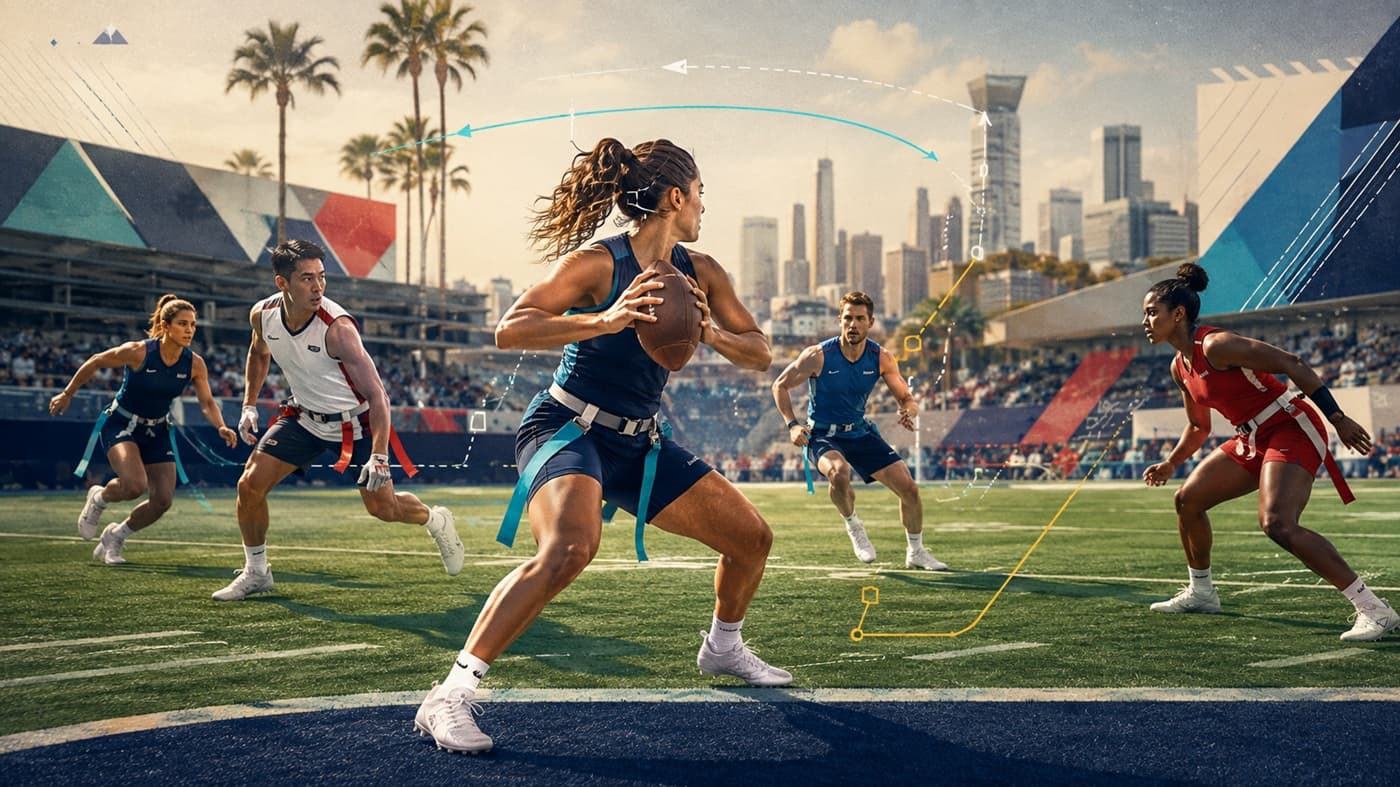
When flag football takes the field in Los Angeles in 2028, the Olympics will not simply be presenting tackle football with the collisions removed. It will be presenting a distinct version of the game built around speed, spacing, passing, route timing, flag pulling, open-field movement, and rapid changes of possession.
The Olympic decision gives football a new kind of international stage. Tackle football requires large rosters, extensive protective equipment, specialized line play, and significant facilities. Five-on-five flag football can be organized with fewer athletes, less equipment, and a much smaller field. Those differences make it easier for schools, clubs, and national federations in more countries to create programs.
Olympic inclusion also arrives during a period of rapid growth in women’s flag football, youth participation, international competition, and professional-league support. At the same time, important questions remain: Which athletes will make national teams? Will established flag specialists compete with professional tackle-football stars? How will countries build qualification pathways? And will flag football remain on the Olympic program after LA28?
This article separates what has been officially confirmed from what remains undecided.
LA28 flag football at a glance
- Olympic debut
- Los Angeles 2028
- Events
- One men’s tournament and one women’s tournament
- Teams
- Six national teams in each tournament
- Roster
- Ten athletes per national team
- Players on the field
- Five per team
- Game length
- Two 20-minute halves
- Field
- A 50-by-25-yard field of play with two 10-yard end zones, 70 yards long overall
- Venue
- Exposition Park Stadium
- Competition dates
- July 15–22, 2028
- Host qualification
- The United States receives one place in each event as host
Olympic-style flag football vs. tackle football
This comparison describes the international five-on-five flag format and conventional eleven-on-eleven tackle football. Local flag leagues may use different rules.
| Feature | Olympic-style flag football | Tackle football |
|---|---|---|
| Players on the field | Five per team | Eleven per team |
| Ending a run | A defender pulls a flag from the runner’s belt | A defender tackles or otherwise stops the runner under the applicable rule code |
| Blocking | Blocking and shielding an opponent are not allowed | Blocking is a central offensive and special-teams responsibility |
| Protective equipment | No helmets or shoulder pads in the international five-on-five format | Helmets, shoulder pads, and other protective equipment are required |
| Field | Compact field: 50 by 25 yards between the goal lines, plus two 10-yard end zones | 100 by 53⅓ yards between the goal lines, plus two 10-yard end zones |
| Possession objective | The offense receives a series of downs to cross midfield, then a new series to score | The offense generally receives four downs to gain ten yards and earn another first down |
| Passing clock | The quarterback normally has seven seconds to pass or hand off | No equivalent universal seven-second release rule |
| Rushing the quarterback | Designated blitzers begin at least seven yards from the line and signal before the snap under IFAF rules | Eligible defenders may rush according to alignment, formation, and the applicable rules |
| Kicking | No kickoffs, punts, field goals, or kicked extra points | Kicking controls field position and can score points |
| Scoring after a touchdown | The offense chooses a one-point play from five yards or a two-point play from ten yards | The scoring team generally chooses a kicked extra point or a two-point offensive play |
| Typical strategic emphasis | Spacing, route timing, quarterback decisions, flag avoidance, flag pulling, and open-field coverage | Those elements plus line play, blocking, pass rush, tackling, power, and kicking strategy |
Flag football is a distinct football discipline
Flag football preserves the central contest of football: one team uses a series of planned plays to move the ball toward the end zone while the other team tries to stop it and regain possession.
The defining change is how a runner is stopped. Each player wears a belt with removable flags. A defender ends the play by pulling one of the ball carrier’s flags rather than tackling the runner to the ground.
International five-on-five rules also remove blocking, tackling, and kicking. There are no offensive or defensive lines in the tackle-football sense. Every player must contribute in space, and most athletes switch between offense and defense during a game.
The result is not contact-free in the literal sense. Incidental contact, falls, collisions, and overuse injuries remain possible. The rules are designed to avoid significant contact, and players are expected to preserve one another’s right of movement rather than use their bodies as blockers.
How five-on-five flag football works
The standard IFAF field is 50 yards from goal line to goal line and 25 yards wide, with a 10-yard end zone at each end. That makes the complete playing area 70 yards long. LA28 describes the Olympic game as being played on a 70-yard-long field.
A team normally begins a possession near its own goal line. It receives four downs to advance beyond midfield. Crossing midfield for the first time earns a new series of four downs to score.
The quarterback has seven seconds after the snap to pass or hand off the ball. That rule prevents an offense from holding the ball indefinitely when there is no conventional pass rush. A legal blitzer begins at least seven yards behind the line of scrimmage and signals an intention to rush.
No-running zones near the goal lines require the offense to use a forward pass rather than simply handing the ball to a runner in the most compressed part of the field. This rule promotes passing decisions and reduces direct collisions near the end zone.
A touchdown is worth six points. The scoring team then chooses a one-point attempt from the five-yard line or a two-point attempt from the ten-yard line. There are no kicked extra points or field goals.
LA28 will stage equal men’s and women’s tournaments
The Olympic program includes one men’s event and one women’s event. Each tournament will contain six national teams, and each country may enter a ten-athlete roster. Five players from each team are on the field at one time.
That creates a total quota of 120 flag football athletes: 60 men and 60 women. Because rosters are small, each athlete’s versatility matters. A player selected primarily for receiving ability may also need to defend, pull flags, communicate coverage adjustments, and contribute after an interception.
The competition is scheduled for July 15 through July 22, 2028, at Exposition Park Stadium in Los Angeles. The official schedule and session plan may continue to be refined before the Games.
Why flag football fits a host-city Olympic program
Los Angeles proposed flag football as one of several additional sports for the 2028 Games. The International Olympic Committee ratified its inclusion in October 2023.
Flag football offers several qualities that suit a global multisport event. Games are relatively short. The field is compact. Teams require only ten rostered athletes. Equipment needs are lower than in tackle football. Separate men’s and women’s events can use the same venue and competition infrastructure.
The game is also easy for a first-time viewer to follow at a basic level: score in the end zone, stop the runner by pulling a flag, intercept a pass to change possession, and use a limited number of downs to reach the next objective.
Those advantages do not mean the sport is simple at the elite level. The smaller field and five-player structure make every alignment visible, every coverage space valuable, and every missed flag potentially decisive.
How countries qualify for Olympic flag football
The United States receives one place in each tournament as the host nation. That leaves five men’s places and five women’s places to be earned through international competition.
The first direct opportunity comes at the 2026 IFAF Flag Football World Championships. The two highest-placed eligible teams in each gender earn Olympic quota places for their national Olympic committees.
Countries that do not qualify directly remain in a pathway involving 2027 continental championships and the 2028 Olympic qualification series. The final qualification events award the remaining three places in each tournament.
A quota place belongs to a national Olympic committee, not automatically to the individual athletes who earned it. Each qualified country must later select and enter its Olympic roster according to the applicable national, IFAF, and Olympic requirements.
The Olympics sit at the top of an existing international game
Flag football did not become an international sport only when the Olympics selected it. The International Federation of American Football was formed in 1998, and the first men’s and women’s IFAF Flag Football World Championships were staged in Vienna in 2002.
The sport made its first appearance at a global multisport event at The World Games 2022 in Birmingham, Alabama. Men’s and women’s national teams returned at The World Games 2025 in Chengdu, demonstrating that elite international flag football already included established specialists, coaching systems, and rivalries before LA28.
Olympic qualification now gives world championships and continental tournaments an additional purpose. A country can build a national program through youth leagues, clubs, schools, domestic championships, regional events, and international competition rather than assembling a team only a few months before the Games.
NFL players may try out, but Olympic places are not reserved for them
In May 2025, NFL clubs approved a framework allowing league players to try out for and participate in LA28 flag football. Under that framework, participation must be coordinated with the players’ association, national governing bodies, Olympic authorities, medical standards, insurance, and club commitments.
The resolution does not place NFL players automatically on Olympic rosters. A tackle-football star must still be eligible for a country, enter the national selection process, and demonstrate skills suited to five-on-five flag football.
Professional speed, passing ability, coverage experience, and open-field movement may transfer well. Other flag-specific skills require adaptation: pulling flags without overrunning the hips, avoiding illegal shielding, working without blocking, releasing the ball within seven seconds, defending the full width with only five players, and playing both offense and defense when required.
Established flag specialists therefore have a legitimate competitive argument. They have spent years learning the sport’s timing, spacing, tournament pace, substitutions, and rules. National selectors must decide how to balance flag experience, tackle-football talent, chemistry, health, and a ten-player roster.
Flag strategy is built around space rather than line play
With five defenders covering a 25-yard-wide field, every route changes the geometry. A short underneath route can pull one defender forward and create space behind. A vertical route can clear the sideline for an out-breaking receiver. Motion can reveal whether defenders are matching players or protecting areas.
The quarterback must process quickly. Seven seconds may sound generous, but the defense can force immediate decisions with a legal blitzer, tight man coverage, disguised zone spacing, or a defender positioned to undercut the first read.
Offenses cannot solve pressure with conventional pass protection because blocking is prohibited. Their answers come from route timing, quarterback movement permitted by the rules, handoffs, quick throws, spacing, and making the blitzer defend a large amount of open field.
Defenses must pull flags consistently. A defender who wins the coverage but misses the flag can turn a short completion into a touchdown. Pursuit angles, leverage, hip position, communication, and controlled deceleration are therefore as important as interception opportunities.
Women’s flag football is creating a new competitive pathway
The Olympic program gives equal event space and equal roster quotas to men’s and women’s flag football. That matters because women’s flag is not a secondary exhibition attached to a men’s tackle tournament; it is its own medal event with an established international competitive history.
In the United States, women’s flag football entered the NCAA Emerging Sports for Women program in January 2026. In May 2026, an NCAA committee recommended that all three divisions sponsor legislation for a National Collegiate Championship. Under the projected process, divisional votes would occur in January 2027 and the first championship could be held in spring 2028 if the legislation and funding are approved.
College growth can connect high school participation to national-team development. It can also create coaching, officiating, administration, broadcasting, and sports-science opportunities around the women’s game.
The NCAA process is not complete. The article should not state that a championship is guaranteed until all required divisional and financial approvals occur.
Lower barriers can expand participation—but access is not automatic
Flag football can require fewer athletes, less protective equipment, and a smaller playing area than tackle football. Those practical differences allow schools and community programs to start teams where a full tackle program may be difficult to sustain.
The absence of tackling can also make the game more appealing to families and participants who do not want the collision exposure of tackle football. That does not make every flag program safe by default. Coaching quality, playing surface, heat, hydration, officiating, emergency planning, and enforcement against illegal contact still matter.
International growth also depends on more than Olympic recognition. Countries need trained coaches, officials, local competition, athlete-development systems, funding, travel opportunities, and transparent national-team selection.
The Olympics can create attention. Sustainable growth depends on what federations, schools, clubs, and communities build before and after the Games.
Olympic inclusion also creates debates
One debate concerns athlete selection. Supporters of professional tackle players argue that the Olympics should feature the best athletes available. Flag specialists argue that mastery of a distinct sport should matter more than fame or success under a different rule code.
A second debate concerns influence. The NFL has invested heavily in flag football’s expansion and supported Olympic inclusion. That support brings promotion, funding, and organizational reach, but it also raises questions about whether one professional league may shape the public image of an international sport too strongly.
A third debate concerns permanence. Flag football is confirmed for LA28, but host-proposed sports do not automatically remain on every future Olympic program. Continued inclusion will depend on future organizing committees and Olympic decisions.
A fourth debate concerns the relationship with tackle football. Some advocates view flag as an entry point into tackle. Others want it recognized as a complete sport with independent athletes, coaching methods, championships, and career pathways. Those visions can coexist, but they do not always produce the same development priorities.
What a new viewer should watch during an Olympic game
Start with the defensive alignment. Are defenders matched directly to receivers, sitting at different depths, or disguising which player will blitz?
Watch the quarterback’s eyes and first movement. A quick look can move a zone defender. A pump fake can open a second route. A handoff can change who is allowed to run and where the defense must pursue.
Notice how receivers create traffic without blocking. They may cross close to one another, but they cannot intentionally shield defenders. The best concepts create legal spacing conflicts rather than collisions.
On defense, follow the hips of the nearest flag puller. The defender must arrive under control, avoid grabbing clothing or the runner’s body, and pull the flag cleanly.
Near the goal line, remember the no-running zone. The offense must create a legal passing answer in compressed space, making leverage and route timing especially important.
What could happen after LA28?
A successful Olympic tournament could accelerate national investment, women’s and girls’ programs, coaching education, officiating development, international media coverage, and commercial sponsorship.
It could also clarify whether flag football will develop primarily as a pathway connected to tackle football or as a separate elite discipline. The answer may differ by country. Some nations may use flag to introduce football broadly, while others may focus entirely on five-on-five competition.
LA28 does not guarantee inclusion at later Olympic Games. The sport will need to demonstrate strong competition, international depth, operational reliability, athlete appeal, and continuing interest from future hosts and Olympic decision-makers.
Whatever happens after 2028, Olympic inclusion already changes the sport’s timeline. Young players can now imagine a route from a school or community flag team to a national roster and an Olympic medal.