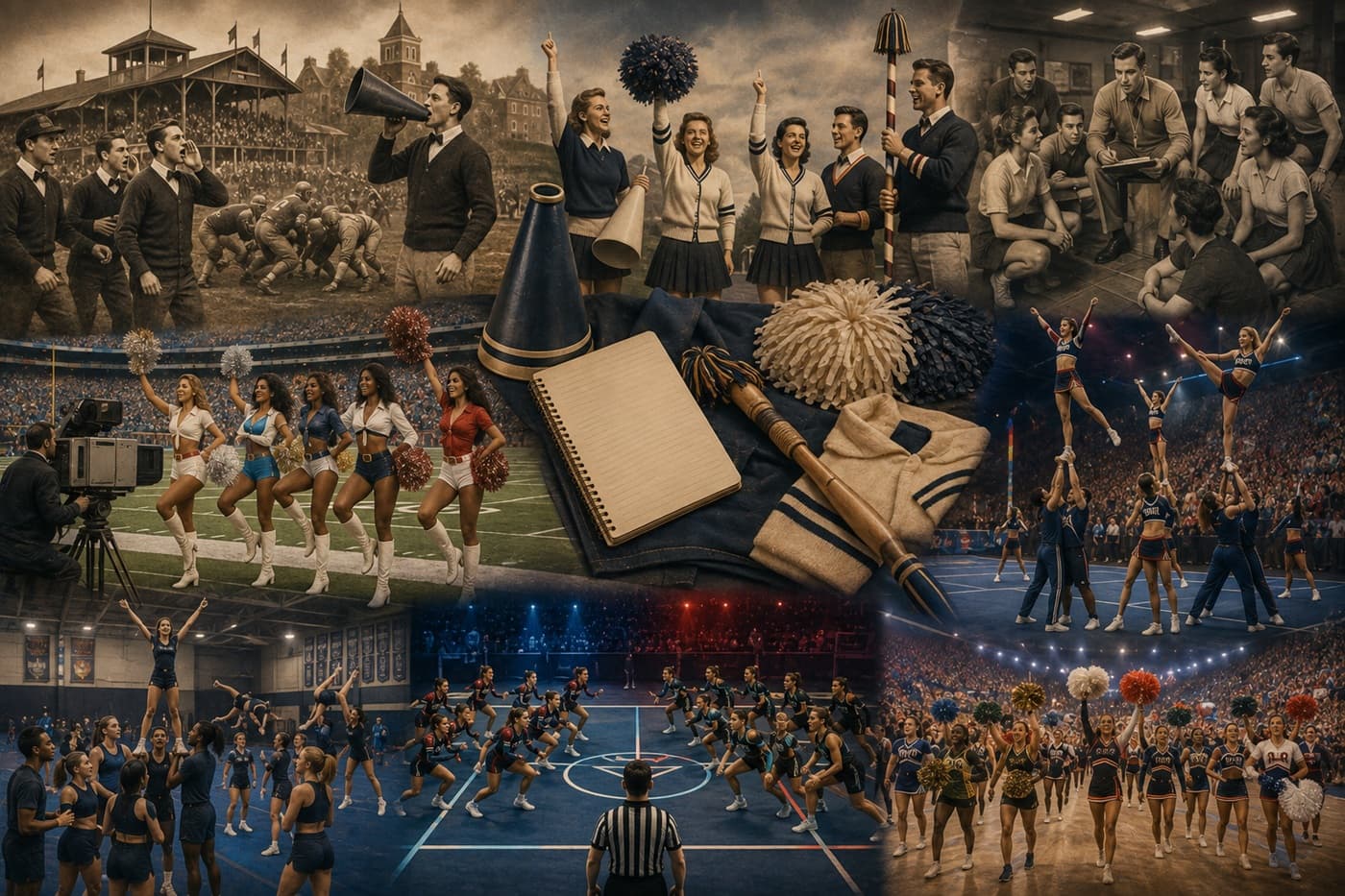
Cheerleading does not have one continuous history with one fixed purpose. It began as a way to organize spectators at college football games, but it later became a school activity, leadership role, athletic performance, judged competition, private-gym industry, professional entertainment job, international sport, and source of separate collegiate disciplines.
Those identities overlap without being interchangeable. A school sideline squad may lead chants, support several teams, appear at community events, and compete. An all star team is built primarily for competition. A professional football cheer or dance squad may emphasize choreography and public appearances. STUNT removes the crowd-leading role and turns selected cheer skills into a head-to-head team sport.
The history also contains tension. Cheerleading shifted from an elite male activity to an overwhelmingly female one, yet women’s labor and athleticism were often undervalued. Increased difficulty created new competitive possibilities and new injury risks. Commercial organizations expanded training and media exposure while also gaining substantial control over camps, uniforms, competitions, and standards.
The result is not a simple journey from sideline entertainment to sport. Modern cheerleading is a family of disciplines shaped by schools, football culture, gender expectations, business, safety research, television, and international organization.
Cheerleading history at a glance
- Early foundation
- Organized college cheers and student yell leaders
- Recognized starting point
- Johnny Campbell leads a Minnesota football crowd in 1898
- Early participants
- Predominantly male college students
- Gender transition
- Women join during the early twentieth century and become dominant after World War II
- Training revolution
- Lawrence Herkimer’s camps and the NCA begin in 1948
- Visual culture
- Megaphones, sweaters, pompons, uniforms, choreography, and television
- Professional-football model
- Dance-focused squads become major entertainment and marketing organizations in the 1970s
- Competition era
- National school championships and television expand in the 1980s
- Club pathway
- All star cheer develops outside schools in the late 1980s and 1990s
- Safety system
- Rulebooks, coach education, credentialing, mats, and skill progressions become central
- International organization
- The International Cheer Union is founded in 2004
- Modern college milestone
- STUNT gains NCAA championship status in 2026, with the first championship projected for 2027
Major modern cheer and cheer-derived disciplines compared
Names and rules vary among organizations. These categories explain the primary purpose of each activity rather than ranking one above another.
| Discipline | Primary purpose | Typical setting | Defining features |
|---|---|---|---|
| School sideline cheer | Lead crowds, support school teams, represent the institution, and build game-day atmosphere | High school and college sporting events | Cheers, chants, signs, motions, jumps, dance, tumbling, stunts, and community appearances |
| School competitive cheer | Represent a school in judged routine competition | State, regional, and national school events | Timed routines combining crowd-leading elements with jumps, tumbling, stunts, pyramids, and choreography |
| All star cheer | Train and compete primarily as a club team | Private gyms and sanctioned competitions | Age and skill divisions, highly structured routines, tumbling, building skills, choreography, and championship pathways |
| Recreational cheer | Provide community participation and support youth or local sports | Parks, recreation programs, youth leagues, and community organizations | Modified skills and rules based on age, experience, and program resources |
| Professional football cheer or dance | Game presentation, entertainment, brand representation, and community appearances | Professional football organizations | Choreographed dance, sideline performance, auditions, public relations, and varying use of traditional cheer skills |
| Performance cheer | Compete through choreographed dance-oriented disciplines | International, school, and club competition | Pom, hip hop, jazz, high kick, and related performance categories depending on the governing body |
| STUNT | Compete head-to-head using selected technical skills derived from cheerleading | High school and college varsity sport | Four quarters featuring partner stunts, pyramids and tosses, jumps and tumbling, and team routines scored play by play |
| Acrobatics and tumbling | Compete in a separate meet structure derived partly from gymnastics and cheer skill traditions | College varsity sport | Acrobatics, pyramids, tosses, tumbling, and team events without a game-day crowd-leading role |
| National-team cheer | Represent a country in international competition | ICU world and continental championships | National selection, international rules, medal divisions, cheerleading, and performance-cheer disciplines |
Crowds cheered before cheerleaders existed
Nineteenth-century college spectators used songs, calls, chants, and organized responses to support their teams. The practice grew alongside intercollegiate football, marching bands, school colors, and student clubs.
A cheer did not initially require a separate squad. Students in the stands might begin a call spontaneously, while designated yell leaders later stood where the crowd could see and follow them.
This distinction matters because the history of cheering is older than the history of the cheerleader as a recognized role.
Princeton traditions traveled to Minnesota
Princeton developed organized college cheers during the nineteenth century. Thomas Peebles, a member of Princeton’s Class of 1882, became familiar with those traditions.
After moving to Minnesota in 1884, Peebles introduced organized crowd cheering around University of Minnesota football.
The transfer shows how early football culture spread: students, graduates, coaches, and spectators carried traditions between schools before national spirit organizations existed.
Johnny Campbell became the recognized first cheerleader
On November 2, 1898, University of Minnesota student Johnny Campbell left the stands during a football game and led the student body in an organized chant.
Minnesota and USA Cheer treat the event as the recognized beginning of organized cheerleading and Campbell as the first cheerleader.
The significance was not that no crowd had cheered before. Campbell occupied a distinct public position between the team and spectators and accepted responsibility for directing a unified response.
Early cheerleading was a male leadership role
College yell leaders were predominantly men. The position involved voice, confidence, humor, school knowledge, and the ability to command a large crowd.
Cheerleading could be associated with campus leadership and public influence rather than with a separate women’s activity. Several future public figures participated as college cheerleaders.
Megaphones, sweaters, letter insignia, and coordinated motions gradually made yell leaders more visible, while squads replaced the single student leader at many schools.
Women entered cheerleading before becoming its majority
Women began joining college cheer squads during the early twentieth century, although access differed among institutions.
The gender transition was gradual. Male yell leaders remained common, and schools disagreed about whether women should hold the role or how they should appear and perform.
World War II accelerated the shift as many college men entered military service. Women filled positions on spirit squads and remained central after the war.
Cheerleading’s later identification as a girls’ and women’s activity was therefore historically constructed rather than part of its origin.
Cheerleaders helped create traditions, not merely repeat them
School cheers often seem timeless even when they were invented by identifiable students or squads.
Cheerleaders adapted words, pacing, pauses, signs, motions, and call-and-response structures so that thousands of spectators could participate together.
Penn State’s modern “We Are” stadium chant, for example, was introduced by cheerleaders during the 1976 football season as they sought stronger crowd participation.
This creative role makes cheerleading part of institutional memory. A successful chant can outlast the athletes, coaches, and students who first performed it.
Cheerleading reflected the exclusions and integration of American schools
Because cheerleading was tied to schools and colleges, access reflected segregation and discrimination within education.
As institutions integrated, Black students also challenged barriers in highly visible campus roles. Murray State selected its first Black cheerleaders in 1970, while Ron Hurdle became Texas Christian University’s first Black cheerleader and the first in the Southwest Conference in 1969.
These examples should not be reduced to symbolic diversity. Cheerleaders represented institutions publicly, so selection could become a contest over belonging, student voting, beauty standards, leadership, and who was permitted to embody school identity.
Modern programs are more diverse, but debates about race, hair, body standards, judging, leadership, and representation have not disappeared.
Dance and drill teams developed alongside cheerleading
Football sidelines and halftimes included bands, baton twirlers, majorettes, song leaders, drill teams, and dance groups as well as cheerleaders.
The Kilgore College Rangerettes, created in 1939 and first presented at a football halftime in 1940, helped establish the precision dance-team model.
These neighboring traditions influenced costuming, formations, high kicks, choreography, pom use, and professional football entertainment.
Modern audiences often use the word cheerleader for several types of performers, but dance teams and cheer teams can have different histories, techniques, and competitive rules.
Lawrence Herkimer turned cheer instruction into a national system
Lawrence “Herkie” Herkimer cheered at Southern Methodist University and developed a distinctive jump later known as the Herkie.
He organized an early cheerleading camp at Sam Houston State Teachers College in 1948. The first session drew 52 girls and one boy, and later sessions expanded quickly.
Herkimer founded the National Cheerleaders Association, creating a professional organization devoted to camps, instruction, crowd leadership, jumps, partner stunts, and team development.
Camps spread techniques between schools and created a national network of instructors, coaches, athletes, awards, and shared vocabulary.
Objects helped define the visual language of cheer
Herkimer established a ready-made cheer uniform company in 1951, helping schools purchase coordinated clothing rather than assemble every outfit locally.
In the mid-1950s, he developed and patented a handled paper pompon designed to create color and movement visible from the stands and on color television.
The Spirit Stick began in 1957 as a camp award recognizing attitude, leadership, teamwork, and support rather than only technical skill.
Megaphones, signs, pompons, uniforms, and awards became tools for making school identity visible. They also supported a growing commercial industry around cheerleading.
Professional football created a different cheer and dance model
Professional football organizations used cheerleaders, majorettes, and mixed-gender spirit groups before the modern dance-line model became dominant.
The Dallas organization began with the CowBelles & Beaux in 1961. In 1972, the Dallas Cowboys Cheerleaders introduced a new choreography-centered presentation that required extensive dance training and rehearsal.
Their appearance at Super Bowl X and later television, tours, merchandise, and public events made the squad internationally recognizable.
Professional football cheer and dance became part of sports marketing and entertainment, but it did not replace school cheer, competitive cheer, or coed collegiate stunting.
Visibility brought opportunity and restrictive expectations
Professional and televised cheerleading expanded performance careers, public recognition, travel, and brand partnerships.
It also strengthened narrow expectations around age, body type, hair, makeup, uniform design, femininity, and appearance.
The athlete, crowd leader, dancer, ambassador, and promotional model could be treated as one job even when those roles required different skills and labor.
A complete history must therefore recognize both the opportunities cheerleading created for women and the ways institutions commercialized their appearance while sometimes minimizing compensation, workplace rights, or athletic credibility.
Competition and television changed what squads trained to do
Jeff Webb founded the Universal Cheerleaders Association in 1974 with an emphasis on combining crowd leadership, athletic skill, and entertainment.
UCA instructors created an influential cheer routine performed to music in 1976. National high-school competition followed in 1980, and a national college championship began in 1983.
Televised competitions allowed athletes and coaches to see advanced skills performed by teams from other regions. The competition routine became a specialized product with music, transitions, difficulty, execution, and time limits.
Television helped expand cheerleading but also encouraged routines designed for judges and cameras rather than only for leading spectators at a football game.
All star cheer separated competition from school affiliation
The first all star programs formed outside schools in the late 1980s. Athletes joined private gyms whose primary purpose was training and competition.
All star cheer expanded age divisions, skill levels, choreography, tumbling, building skills, travel events, and end-of-season championships.
The U.S. All Star Federation was founded in 2003 to establish more consistent rules, coach credentialing, safety judging, event sanctioning, age verification, and competition standards.
All star cheer is not simply school cheer without a sideline. Its season, team selection, costs, judging, training environment, and competitive purpose are different.
Jumps, tumbling, stunts, and pyramids became increasingly technical
Early yell leaders relied primarily on voice, signs, and motions. Over time, gymnastics, dance, partner stunts, tosses, pyramids, and synchronized tumbling became central in many programs.
A modern routine requires strength, power, flexibility, body control, spatial awareness, timing, trust, and precise group execution.
Different athletes perform specialized roles. Bases create stability and force, flyers or top persons maintain body positions in the air, spotters assist safety, and tumblers contribute individual acrobatic skills.
Technical difficulty created new athletic recognition, but it also made coaching education, surfaces, progressions, and rule enforcement more important.
Safety systems grew in response to greater difficulty
As cheerleading added more airborne skills, organizations developed rules, manuals, coach education, credentialing, mat requirements, and emergency planning.
The American Association of Cheerleading Coaches and Administrators formed in 1987 to address risk and later became part of USA Cheer.
A 2006–07 rule change prohibiting basket tosses on hard surfaces was followed by a major reduction in catastrophic basket-toss injuries.
CDC data indicate that most high-school cheer concussions are connected to stunts and that many occur during practice. Spotters, appropriate surfaces, skill progressions, trained supervision, and immediate concussion response remain essential.
Safety improvement does not make advanced cheer risk-free. Programs must match skills to athlete preparation and follow the rules for the specific level and discipline.
School cheer can serve game day and competition at the same time
A school squad may lead crowds at football and basketball games, perform at pep rallies, represent the school in the community, and enter judged competitions.
Those obligations can reinforce one another, but they can also compete for practice time. A routine optimized for a competition floor may not teach the same crowd communication required in a stadium.
NFHS spirit rules distinguish cheer and dance requirements and emphasize risk minimization across practices, performances, and competitions.
In the 2024–25 NFHS participation survey, competitive spirit recorded more than 200,000 high-school participants and ranked among the most popular girls’ sports.
The question “Is cheerleading a sport?” often combines several different activities
A competitive all star routine, a school sideline performance, an NFL dance squad, and a head-to-head STUNT game do not share one organizational structure.
Some cheer programs operate as varsity athletic teams with coaches, medical services, competitions, and institutional resources. Others are classified as student activities, spirit programs, entertainment units, clubs, or independent businesses.
The NCAA historically did not conduct a championship for traditional cheerleading. That fact did not determine whether individual cheerleaders were athletic, but it affected Title IX treatment, scholarships, governance, and access to varsity resources.
A useful answer identifies the discipline, rules, schedule, opponent, scoring, governing body, and institutional treatment instead of trying to classify every activity with one word.
STUNT turned cheer skills into a head-to-head college sport
USA Cheer developed STUNT beginning in the 2010–11 period to create an objective team-sport format derived from cheerleading skills.
STUNT removes the crowd-leading role. Teams compete in four quarters covering partner stunts, pyramids and tosses, jumps and tumbling, and a team routine.
Divisions I and II added STUNT to the NCAA Emerging Sports for Women program in 2023, and Division III followed in 2024.
At the 2026 NCAA Convention, all three divisions approved STUNT as an NCAA championship sport. The first National Collegiate Championship is projected for spring 2027.
STUNT’s success does not mean traditional school cheer has been renamed. It is a separate competition structure with its own rosters, rules, season, and championship.
Acrobatics and tumbling is related but separate
Acrobatics and tumbling uses skills familiar to cheer and gymnastics, including acrobatics, pyramids, tosses, tumbling, and team routines.
Its meet structure and governance are separate from traditional cheerleading and STUNT.
The NCAA approved acrobatics and tumbling as a championship sport in 2026, with its first National Collegiate Championship projected for spring 2027.
The parallel growth of STUNT and acrobatics and tumbling shows that cheer-derived skills can support more than one formal sport.
Cheerleading became an international sport
American camps, competitions, military and cultural exchange, professional tours, schools, private gyms, and media helped spread cheerleading internationally.
Countries adapted cheerleading to local sport systems and developed their own clubs, national federations, coaches, judges, and championships.
The International Cheer Union was founded in 2004 and now governs cheerleading and performance cheer through national federations on every continent.
International competition includes youth, junior, senior, adaptive, all-girl, coed, and performance divisions depending on the event and rules.
IOC recognition did not automatically place cheerleading in the Olympics
The International Olympic Committee granted the International Cheer Union provisional recognition in 2016 and full recognition in 2021.
Recognition confirms the ICU as part of the recognized international federation system and makes the sport eligible for further Olympic consideration.
It does not guarantee a place on an Olympic Games program. Cheerleading is not currently scheduled as an Olympic medal event.
Future inclusion would require additional decisions involving the IOC, host organizing committees, event formats, quotas, venues, and international participation.
Cheerleading is female-dominated but not exclusively female
Women and girls make up the large majority of modern participants, especially in school and all star programs.
Men remain important in coed college, all star, national-team, professional-performance, and coaching traditions. Their participation is not a recent exception; men led the earliest organized squads.
Adaptive and exceptional-athlete divisions have expanded opportunities for athletes with disabilities. Programs also continue working through questions of affordability, race, body diversity, gender expression, safeguarding, and access to qualified coaching.
A complete modern history should avoid both stereotypes: cheerleading is neither naturally a women-only activity nor an activity whose athletic legitimacy depends on male participation.
Cheerleading remains connected to football even after becoming independent
Organized cheerleading began in a college-football environment, and football still provides its most visible traditional sideline.
Cheerleaders help translate a game into collective experience. They respond to touchdowns, defensive stops, timeouts, rivalry moments, and changes in crowd energy.
That role requires football awareness. A squad must recognize when to celebrate, when the offense needs quiet, when an injured athlete requires restraint, and when a chant could interfere with sportsmanship.
Competitive and all star cheer can exist without football, while professional dance squads and STUNT may have different relationships to the game. The shared origin does not make every modern cheer discipline subordinate to football.
Cheerleading’s future will remain plural
School squads will continue balancing crowd leadership, competition, community service, and school identity.
All star programs will continue refining age grids, skill levels, judging, safeguarding, and championship pathways.
STUNT and acrobatics and tumbling will develop as NCAA championship sports, while international cheer seeks wider recognition and possible multisport opportunities.
Technology may improve training, judging review, injury monitoring, and broadcast explanation, but it cannot replace trained coaching, athlete trust, and clear safety responsibility.
The central historical question remains the same as in 1898: how can a group organize energy, movement, voice, and shared identity? Modern cheerleading answers that question in far more ways than its founders could have imagined.