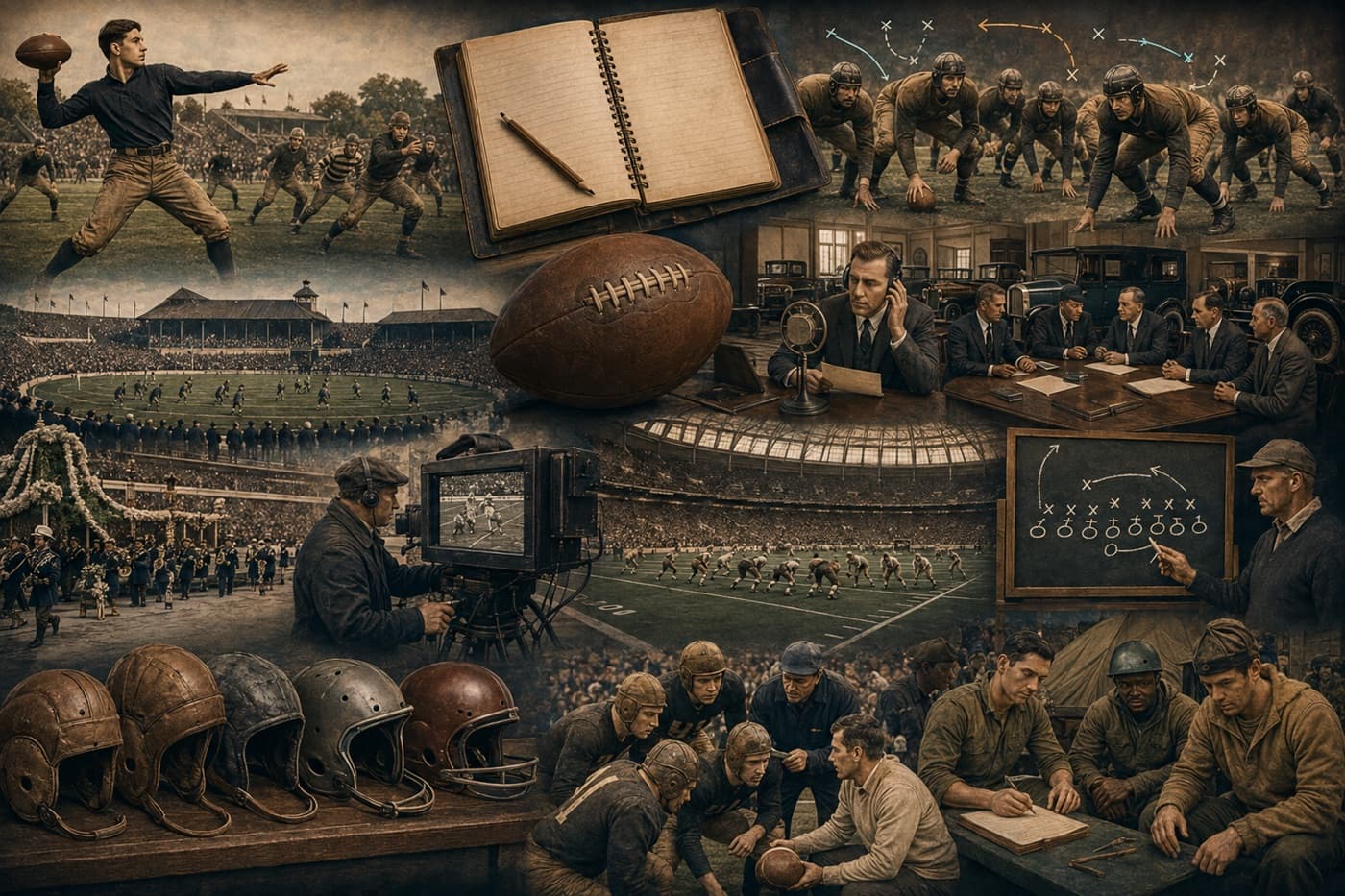
The 1905 crisis ended with football’s future uncertain. The sport had developed formations, blocking, and a possession structure, but mass momentum and severe injuries had generated demands for abolition. The reforms of 1906 did not make football safe or instantly modern. They did create room for a different kind of game.
The forward pass is the clearest symbol of this era, but its growth was gradual. Early rules made an incomplete pass costly and required the passer to begin well behind the line. Coaches had to learn how to teach throwing mechanics, receiver timing, protection, and spacing before passing could become a dependable offensive system.
At the same time, football became an institution. College programs traveled nationally, bowl games linked regions, radio carried descriptions beyond the stadium, and newspapers created rankings and heroes. Professional clubs formed a league, adopted centralized rules, scheduled championship games, and created a draft intended to distribute new talent.
The era also contained exclusions and contradictions. Black players and coaches helped establish early professional football, but the NFL entered a twelve-season period without Black players from 1934 through 1945.
By the end of 1945, football had the field dimensions, scoring values, four-down structure, media presence, league institutions, and strategic vocabulary that would support its postwar expansion.
The era at a glance
- Opening reform
- The forward pass becomes legal in 1906
- Modern structure
- Four downs, six-point touchdowns, and the modern field by 1912
- College turning point
- Notre Dame’s passing performance against Army in 1913
- Bowl growth
- The Rose Bowl returns permanently in 1916 and expands its broadcast reach
- Professional organization
- The APFA forms in 1920 and becomes the NFL in 1922
- Media transformation
- Radio creates national audiences; professional football reaches television in 1939
- Competitive balance
- The NFL begins its annual player draft in 1936
- Wartime ending
- Depleted rosters, temporary mergers, and league survival through 1945
Football in 1906 compared with football in 1945
The sport did not change at the same speed everywhere. College and professional rules sometimes diverged, and many older formations remained effective even as passing expanded.
| Feature | Football in 1906 | Football by 1945 |
|---|---|---|
| Forward pass | Newly legal, heavily restricted, and often treated as a risky surprise | A central strategic weapon supported by specialized passers, receivers, routes, and protections |
| Downs | Three downs to gain 10 yards | Four downs to gain 10 yards |
| Field | Longer field without the modern end-zone layout | 100 yards between goal lines with two 10-yard end zones |
| Touchdown value | Five points | Six points |
| Typical offense | Mass runs, kicking, laterals, and tightly packed formations | Single-wing, T-formation, passing attacks, motion, balanced running, and field-position football |
| Professional structure | Independent clubs and regional circuits | An established league with divisions, a championship game, a draft, and centralized rules |
| College postseason | Limited postseason tradition | Established bowl games linking regions and attracting national attention |
| Rankings | Championship claims based on local and retrospective judgment | A national weekly Associated Press poll operating since 1936 |
| Broadcasting | Newspapers and spectators at the field | Radio audiences, national broadcasts, and experimental television |
| NFL player acquisition | No national league or centralized talent system | An annual draft selecting college players in inverse order of finish |
| Substitution | Players commonly performed both offensive and defensive duties | Two-way play remained important, but wartime free substitution accelerated specialization |
| Race and access in the NFL | Professional opportunities were limited but not governed by a formal league color line | The NFL had no Black players from 1934 through 1945 after earlier pioneers had participated |
The 1906 reforms gave football another path
The organization formed after the 1905 reform conferences began operating in 1906, and football rulemakers adopted changes intended to open play and reduce the dominance of dangerous mass formations.
The most famous change legalized one forward pass during a scrimmage play. The offense also had to gain 10 yards rather than five to earn a new series, making it harder to advance only through short mass runs.
The reforms did not eliminate violence or instantly create a modern passing game. They altered the incentives and gave offenses a legal way to threaten space beyond the line of scrimmage.
The first legal forward pass was a dangerous gamble
The 1906 passing rule was far more restrictive than a modern rule. The passer had to operate from well behind the line of scrimmage, and an untouched incomplete pass could give possession to the defense at the spot of the throw.
Only one forward pass was allowed on a scrimmage play. Coaches therefore could not build a familiar dropback series with several routine attempts.
The first authenticated completion in a professional game came in October 1906 when George “Peggy” Parratt of Massillon completed a pass to Dan “Bullet” Riley.
The modern field and four-down structure arrived in 1912
In 1912, football added a fourth down to the offensive series. Teams still needed 10 yards for a first down, but the extra opportunity created more room for strategy.
The touchdown value increased to six points. The field was shortened to 100 yards between the goal lines, and 10-yard end zones were added at both ends.
Together, the changes made the sport more recognizable and established the field and scoring framework still used today.
Notre Dame showed that passing could be planned
On November 1, 1913, Notre Dame defeated Army 35–13 in a game remembered for the passing combination of quarterback Gus Dorais and end Knute Rockne.
They did not invent the legal forward pass, and other teams had used it before them. Their performance mattered because it showed a prominent audience that passing could be practiced, repeated, and integrated into an offense.
The game demonstrated the skills the pass required: timing, protection, route placement, and a coach willing to make the throw part of the game plan.
College football linked regions, traditions, and national reputations
College football remained the more prestigious and culturally established version of the game during much of this era. Rivalries, campus traditions, marching bands, newspaper coverage, and alumni travel turned important games into public events.
The Tournament of Roses staged the first postseason college football game in 1902 and returned football permanently to its New Year’s celebration in 1916. The game later became known as the Rose Bowl.
Other bowl games emerged during the 1930s. Because college football lacked one national playoff, bowls, polls, selectors, and championship claims existed side by side.
Coaches turned football into a complete system
As programs became larger and more competitive, coaching expanded beyond choosing a lineup. Staffs organized practices, taught position technique, studied opponents, developed signals, and created complete offensive and defensive systems.
The single-wing became one of the era’s defining formations. It used an unbalanced line, direct snaps, multiple ball carriers, pulling blockers, deception, and powerful running angles.
The T-formation used a quarterback under center and later became especially effective with motion and fast backfield exchanges. George Halas became known for daily practices, opponent film study, tours, and radio promotion.
The professional league began in an automobile showroom
On September 17, 1920, representatives of professional teams met in a Hupmobile automobile showroom in Canton, Ohio, and organized the American Professional Football Association.
Jim Thorpe became the association’s first president. Membership and scheduling remained unstable, but the organization gave teams a structure for coordinating rules, player movement, standings, and championships.
The association adopted the National Football League name in 1922. Many franchises still operated in smaller industrial cities, and teams continued to fold or relocate.
Black pioneers helped build the league before owners excluded them
Fritz Pollard starred for the Akron Pros and became the first Black head coach in league history when Akron named him co-coach in 1921.
That participation did not lead to steady integration. By the early 1930s, the number of Black players had fallen sharply. After the 1933 season, the NFL entered a twelve-season period without Black players.
The exclusion reflected owner decisions and wider racial discrimination, not a legitimate performance-based rule. Reintegration would begin in 1946.
Red Grange brought college celebrity into professional football
Harold “Red” Grange was already one of college football’s most famous players when he joined the Chicago Bears after his final college season in 1925.
His professional debut drew more than 36,000 spectators in Chicago. Days later, more than 70,000 attended a Bears game at the Polo Grounds in New York.
A demanding barnstorming tour showed that a college star could transfer fame to the professional game and attract national publicity.
Radio allowed football to travel without the team
Radio transformed football from an event experienced mainly in the stadium or newspaper into a live narrative. Announcers translated formations, runs, kicks, and passes into language listeners could visualize.
The Rose Bowl became the first East–West bowl game broadcast locally by radio in 1926 and the first transcontinental radio broadcast of a sporting event in 1927.
In 1934, the Thanksgiving game between Detroit and Chicago became the first NFL game broadcast nationally.
A weather emergency produced lasting rule ideas
The Chicago Bears and Portsmouth Spartans finished the 1932 season tied for first place, forcing the NFL to arrange an additional game to determine the champion.
Severe winter weather moved the game into Chicago Stadium. Organizers used an 80-yard field, moved the goal posts, and drew inbounds lines to keep plays away from the walls.
The NFL adopted versions of the inbounds lines—later known as hash marks—and other innovations in 1933. The experience also helped push the league toward scheduled championship games.
In 1933, the NFL began shaping rules for professional football
The NFL had long followed the college rulebook. In 1933, it began adopting rules intended for its own style and business needs.
The league allowed a forward pass from anywhere behind the line of scrimmage, adopted inbounds lines, divided into two divisions, and scheduled a championship game between the division winners.
These changes encouraged passing and made the season easier to follow as a race toward a title game.
The 1930s created new ways to rank teams and distribute players
Before the NFL draft, college players could negotiate with any professional club. Bert Bell proposed an annual draft in which teams selected in inverse order of finish.
The first draft took place in 1936. Philadelphia selected University of Chicago back Jay Berwanger first, although he never played in the league.
The Associated Press began its weekly college football poll on October 19, 1936, creating a shared national ranking conversation in a decentralized college sport.
Don Hutson and Sammy Baugh made passing harder to dismiss
Don Hutson joined Green Bay in 1935 and became the era’s defining receiving specialist. His speed, route skill, and production showed that an end could be more than a blocker who occasionally caught a pass.
Sammy Baugh entered the NFL in 1937 and demonstrated the value of a dedicated passer. In 1943 he led the league in passing, punting, and interceptions.
Passing remained connected to running and kicking, but it had gained strategic legitimacy. Teams could build route combinations, protect a passer, and attack the width and depth of the field.
Television and the T-formation arrived before wartime disruption
On October 22, 1939, NBC televised an NFL game between Philadelphia and Brooklyn to a small experimental audience in the New York area.
In 1940, Chicago defeated Washington 73–0 in the NFL Championship Game, popularizing a modernized T-formation with a quarterback under center and a man in motion. The game was also the first NFL championship carried on network radio.
World War II then depleted rosters. Philadelphia and Pittsburgh merged for 1943, while the Cardinals and Pittsburgh merged in 1944. In 1943, the NFL adopted free substitution and made helmets mandatory.
After the war ended in 1945, the league counted 638 people with NFL playing experience on its service roster, including 21 who had died in action.
By 1945, football had built the platform for postwar growth
The sport now used four downs, a 100-yard field, 10-yard end zones, six-point touchdowns, legal forward passing, recognizable hash marks, and organized championship structures.
College football had bowls, radio traditions, national rankings, celebrated coaches, and powerful regional identities. Professional football had a national league, a draft, divisions, a title game, passing stars, and early television experience.
Important changes remained ahead. The NFL had not yet permanently reintegrated, television had not yet become the sport’s central economic engine, and rival leagues and labor systems would reshape the game after the war.
The next era begins in 1946, when football moved from wartime survival into television-driven national growth.