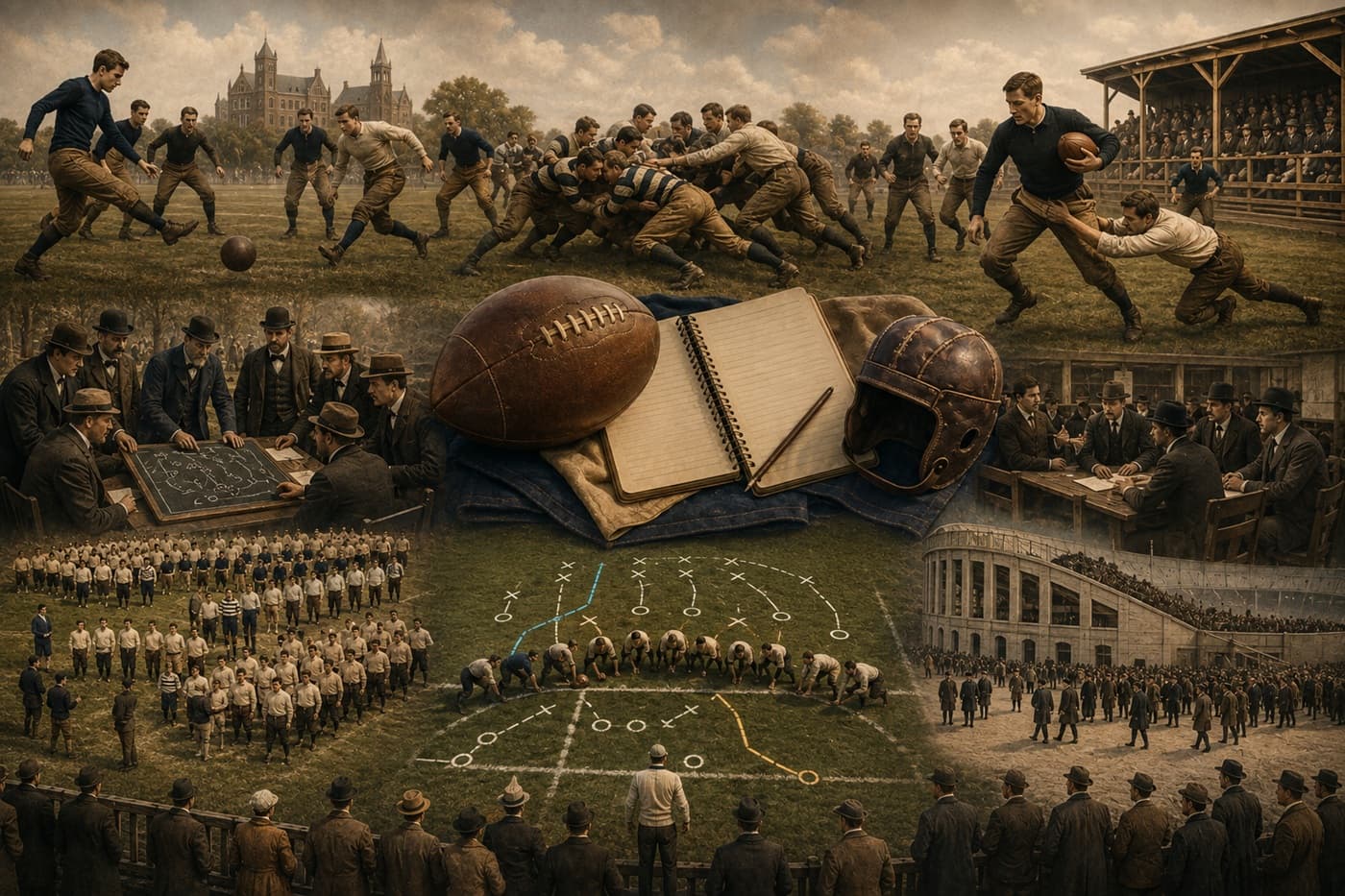
Modern football begins with a snap, an invisible line of scrimmage, an offense in possession, and a defined number of downs. None of those features was inevitable in 1869. Students used the word football for several related games whose rules could change from one campus to another.
The period from 1869 through 1905 is therefore a story of invention through argument. Colleges debated whether players could carry the ball, how play should restart, how many players belonged on each side, how possession could be retained, how points should be counted, and whether teammates could legally clear a path for a runner.
Each successful reform created new strategy and new problems. The line of scrimmage made set plays possible but allowed a team to hold the ball. Downs solved indefinite possession but encouraged coordinated blocking. Blocking created formations and deception but also produced dangerous mass momentum.
The forward pass was still illegal when 1905 ended. The next era would begin with the 1906 reforms that opened the field and gave football another chance to survive.
The era at a glance
- Starting point
- The 1869 Rutgers–Princeton intercollegiate contest
- Early influences
- Association football, local college games, and rugby
- Defining structural change
- The line of scrimmage and controlled possession
- New strategic framework
- A required gain within a limited number of downs
- Primary style
- Running, kicking, blocking, field position, and mass formations
- Professional milestone
- Documented payment to William “Pudge” Heffelfinger in 1892
- Cultural growth
- Rivalries, Thanksgiving games, newspapers, athletic clubs, and permanent stadiums
- Ending crisis
- The 1905 campaign for safety reform and national governance
How the game changed between 1869 and 1905
The transition was gradual and uneven. Different schools sometimes used different rules even while a broader American code was taking shape.
| Feature | Early intercollegiate games | Football by 1905 |
|---|---|---|
| Ball | Could be round or shaped according to the local code | An elongated leather ball suited to carrying and kicking |
| Rules | Negotiated locally and influenced by association football or rugby | A recognizable intercollegiate American code revised through committees |
| Starting play | Kicks, scrums, and locally defined restarts | A controlled snap from a line of scrimmage |
| Possession | Often contested continuously | One team controls the ball for a sequence of plays |
| Advancing the ball | Primarily kicking, with carrying dependent on the code | Running, lateral exchanges, kicking, and blocking; no legal forward pass |
| Team size | Large sides, including 25-player teams in 1869 | Eleven players per side |
| Series of plays | No modern down-and-distance structure | Required yardage within a limited number of downs |
| Strategy | Territory, kicking, physical contests for possession, and improvisation | Formations, signals, assigned blocking, field position, and set plays |
| Coaching | Often led by student players and captains | Specialist coaches and increasingly formal preparation |
| Spectatorship | Campus and local interest | Large rivalry crowds, newspaper coverage, and permanent stadiums |
| Player status | Presented as intercollegiate amateur competition | Amateur ideals existed alongside athletic-club payments and professional teams |
| Safety governance | Limited shared oversight | Public controversy produced a national reform organization |
Before football had one meaning
In the middle of the nineteenth century, schools and clubs used the name football for games connected mainly by a ball, opposing goals, and restrictions on using the hands. Some versions resembled association football and emphasized kicking. Others allowed carrying and tackling in ways associated with rugby.
A visiting team could not assume that its home rules would apply. Schools had to agree on the code, number of players, field, scoring method, and how play would restart.
The sport was not created at one moment and then merely refined. It emerged as colleges selected, rejected, and combined features from several football traditions.
Rutgers–Princeton gave intercollegiate football a starting point
Rutgers hosted Princeton in New Brunswick, New Jersey, on November 6, 1869. Rutgers won 6–4 in the contest commonly recognized as the first intercollegiate football game.
The match used 25 players per side, a round black-rubber ball, and rules closer to association football than to modern American football. Players advanced mainly by kicking and striking the ball rather than by organizing snaps, runs, and passes.
Its importance lies in the institutions: two colleges arranged a football match, created teams, agreed on rules, and established a model other schools could repeat.
Harvard and McGill helped shift the game toward rugby
Harvard developed its own carrying game and declined to join an early association of schools using different rules. In May 1874, Harvard hosted McGill University for two matches: one under Harvard’s rules and another under McGill’s rugby-influenced rules.
The rugby-style match allowed carrying and tackling and impressed Harvard players. Harvard incorporated elements of that game and used them in its first football meeting with Yale in 1875.
The exchange demonstrates that American football has a cross-border history. Canadian rugby traditions helped push U.S. colleges toward the carrying, tackling, and possession game from which the American code would diverge.
The 1876 convention created a common foundation
Representatives from leading colleges met at the Massasoit House in Springfield, Massachusetts, in 1876 and wrote the first common rules for the emerging American intercollegiate game.
The rules still leaned strongly toward rugby, but standardization made continuing competition possible. Schools could prepare for a shared code rather than renegotiating the sport before every major contest.
Walter Camp, then a Yale student and player, entered the rulemaking world during this period. His later influence was extraordinary, but he worked through committees rather than inventing football alone.
The line of scrimmage separated American football from rugby
Rugby restarted play through a contested scrum. In 1880, rulemakers adopted a controlled scrimmage in which one team put the ball into play and began with possession. The number of players was also reduced to eleven.
The change created the basic geometry of modern football: offense on one side, defense on the other, a line neither side could cross before the play began, and a center initiating action to a quarterback.
Once possession began in an orderly way, teams could plan formations, signals, assignments, and coordinated movement. The game became a sequence of designed plays rather than a largely continuous struggle around the ball.
Downs prevented a team from keeping the ball forever
Controlled possession solved one problem and created another. A team could protect the ball and avoid taking risks, producing slow games in which the opponent had little opportunity to possess it.
The 1882 down-and-distance rule required an offense to gain five yards within three downs or surrender the ball. The exact distance and number of downs would change later, but the principle became permanent.
Every play now had a cost. A short gain could be useful on an early down but dangerous later in the series. Teams had to choose when to run, kick for field position, or attempt a more ambitious play.
The modern concepts of down, distance, line to gain, and first down descend from this effort to balance possession with competitive opportunity.
Set plays encouraged formations—and dangerous mass momentum
The line of scrimmage made coordination possible. Players could align in recognizable positions, receive signals, and execute assigned movement. Teammates learned to interfere with defenders, an early form of legal blocking.
Some schemes used deception and spacing. Others concentrated players into wedges and tightly packed groups intended to carry momentum through the defense.
The flying wedge, introduced in the early 1890s, represented the danger of mass play. Players formed a moving wall and collided with defenders at speed.
The same ability to coordinate eleven players that made football intellectually distinctive also allowed teams to concentrate force.
Coaching became a specialized activity
Early teams were often led by players and captains, but regular competition rewarded dedicated preparation. Coaches studied opponents, organized practice, selected lineups, developed signals, and taught coordinated technique.
Positions became more specialized as formations stabilized. The center initiated the play. The quarterback received the ball and directed action. Linemen created paths. Backs carried or kicked. Defenders learned to fit gaps and control edges.
The language was not yet standardized as it is today, but the logic of a playbook had arrived: each player began from an alignment, received an assignment, and worked with teammates to create or deny an advantage.
Rivalries turned a campus game into public culture
Repeated games gave football a calendar and a memory. Harvard and Yale first met in 1875. Army and Navy began their series in 1890. Other schools developed annual contests connecting players, students, alumni, newspapers, and local communities.
Thanksgiving became especially associated with football during the late nineteenth century. Major college games attracted crowds on a national holiday, while newspapers debated whether the spectacle supported school spirit or disrupted the day’s intended meaning.
Rivalries encouraged songs, colors, cheers, organized spectators, and traditions that continued even as rules and players changed.
Growth did not mean equal access or a simple amateur ideal
Football’s most visible institutions were largely colleges for men, and participation reflected exclusions built into American education and public life. Access varied by race, class, institution, region, and citizenship.
The Carlisle Indian Industrial School began playing football during this period and returned to the sport in the mid-1890s. Carlisle players later became nationally prominent, but the program existed inside a federal boarding-school system designed to assimilate Native children and suppress Indigenous cultures.
College leaders defended amateur ideals, yet successful players could receive jobs, expenses, gifts, or hidden payments through athletic clubs and supporters. The boundary between amateur and professional football was contested long before a stable league existed.
Professional football began before it had a league
Private athletic clubs fielded football teams in the late nineteenth century. Rival clubs wanted talented college players and sometimes found indirect ways to compensate them while preserving an appearance of amateurism.
On November 12, 1892, the Allegheny Athletic Association paid former Yale guard William “Pudge” Heffelfinger $500 to play against the Pittsburgh Athletic Club. A surviving accounting sheet provides documentary evidence.
Professional development continued unevenly. The Pittsburgh Athletic Club used a season contract in 1893, John Brallier openly accepted payment in 1895, Allegheny fielded a fully professional team for a short 1896 season, and Latrobe played a full season with professional players in 1897.
These clubs did not yet form a stable national league, but football had become both a college institution and paid entertainment.
Equipment changed slowly while the spectacle grew quickly
Players in the earliest games wore ordinary athletic clothing and little protection. By the turn of the century, some used padded clothing and soft leather headgear, but protection was inconsistent and could not control the forces generated by mass collisions.
Fields became more formal. Yard lines helped officials measure required gains and gave the surface its gridiron appearance. Permanent seating replaced temporary grandstands as institutions recognized the size and persistence of football audiences.
Harvard Stadium opened in 1903 as America’s first intercollegiate concrete stadium. Its scale signaled that football was no longer a temporary campus diversion.
The 1905 season forced national action
Football had critics long before 1905. Faculty members, college presidents, physicians, journalists, clergy, and families questioned whether severe injuries and deaths could be justified as education or entertainment.
Reports of deaths and serious injuries during the 1905 season intensified an established reform campaign. The exact totals varied among contemporary accounts, but the political and institutional effect was unmistakable.
President Theodore Roosevelt, a supporter of strenuous athletics who also objected to brutality and rule evasion, invited representatives connected with Harvard, Yale, and Princeton to the White House in October 1905.
Roosevelt’s intervention added pressure, but it did not single-handedly save the sport. College presidents, faculty, coaches, committees, journalists, players, and public critics had already been debating reform.
A December 1905 conference involving dozens of football-playing schools formed the Intercollegiate Athletic Association of the United States. It began operating in 1906 and was renamed the National Collegiate Athletic Association in 1910.
The era ended before the game’s central safety reform
By the end of 1905, football had the line of scrimmage, eleven-player teams, downs, measured distance, specialized positions, legal blocking, organized formations, coaches, rivalries, paid players, and permanent stadiums.
It did not yet have the legal forward pass. Offenses remained heavily concentrated around runs, lateral exchanges, and kicks.
The 1906 rules would legalize the forward pass and make other changes intended to open the field and reduce dangerous mass play. Those reforms begin the next historical era.