OpenPlay Player Profile
Tom Brady: What Made Him Exceptional?
Solved pressure and coverage with timing, anticipation, and pocket control.
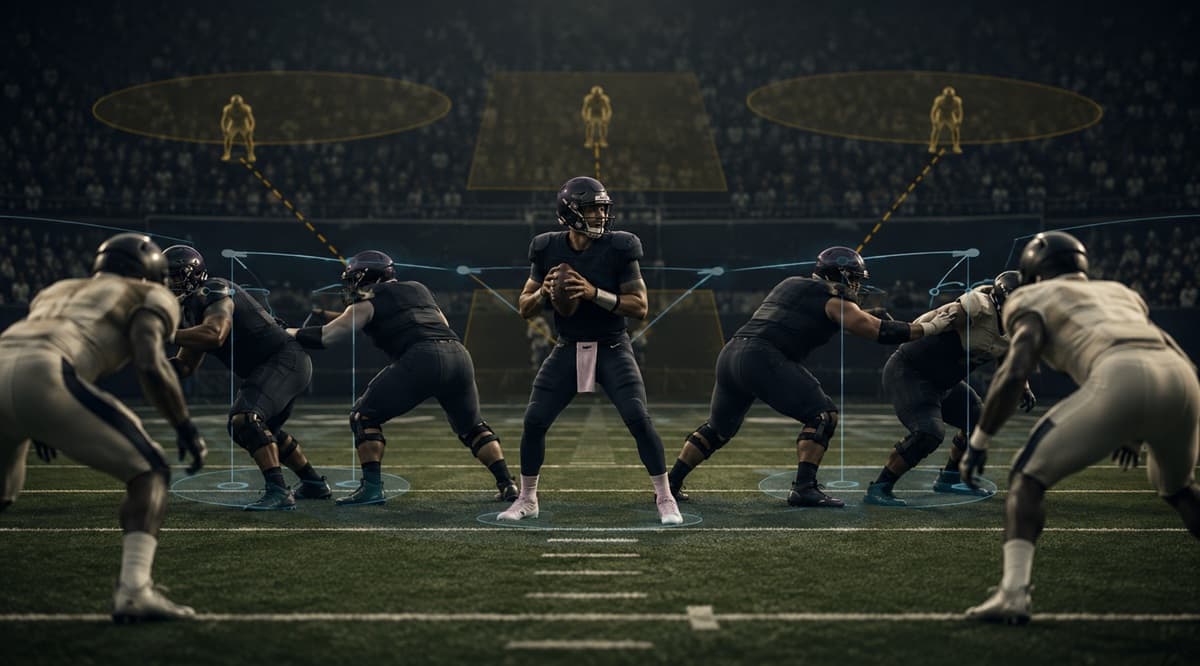
Tom Brady was never the fastest quarterback on the field, and he didn't have the strongest arm in his own draft class, let alone the league. What he had instead was an unusually complete answer to the question every quarterback faces: how do I get the ball to the right place, at the right time, against a defense that's trying to disguise what it's doing?
Brady's value was often visible before the throw. Identifying leverage, locating pressure, controlling protection and getting to the correct matchup could remove much of the defense's advantage before the ball was snapped. That habit — solving the defense early, then executing without hesitation — is the throughline of a 23-year career that spanned two franchises, three different competitive eras, and a level of postseason success no other quarterback has matched.
Career at a Glance
| Category | Information |
|---|---|
| Position | Quarterback |
| Primary teams | New England Patriots (2000–2019), Tampa Bay Buccaneers (2020–2022) |
| Era | 2000–2022 |
| Major honors | Associated Press NFL Most Valuable Player (2007, 2010, 2017); Super Bowl MVP (a record five times) |
| Super Bowl championships | Seven |
| Hall of Fame | Eligible; widely expected first-ballot inductee |
Why Brady Was So Good
Brady's game was built on removing uncertainty. Rather than relying on physical tools to bail him out of a bad decision, he worked to make sure the decision was rarely bad in the first place — reading the defense's shape before the snap, anticipating where a receiver would be open rather than waiting to see it, and getting the ball out on rhythm so defenders couldn't close the window in time. This is a repeatable process rather than a series of individual highlights, which is part of why his production held up across two decades, multiple coordinators, and a constantly changing supporting cast.
The other piece was situational awareness under pressure — not just physical pressure from a pass rush, but the pressure of the game clock, the score, and the moment. Brady's postseason record and his string of comebacks in close games reflect a quarterback who consistently made sound decisions when the cost of a mistake was highest.
How Brady Played
Mechanically, Brady was efficient rather than flashy: a quick, repeatable release, disciplined footwork tied to his read progression, and subtle pocket movement that bought just enough time without turning a clean pocket into a scramble. He rarely tried to do more than a play called for. If the first read was open, he threw it. If it wasn't, he moved through his progression quickly enough that the defense's disguise usually came apart before he was forced into a difficult throw.
His accuracy was strongest in the short and intermediate range — the passes that decide most NFL games — where placement mattered more than velocity. He also understood how to use his eyes to manipulate a defender, holding a safety in the middle of the field for a beat before delivering the ball to the opposite side, a skill that depends entirely on processing speed rather than arm talent.
That process repeated itself across three distinct competitive stretches of his career, which is part of what makes his longevity notable in a football sense rather than just a biographical one. The version of Brady who won his first championship in 2001 relied more on game management and situational execution within a run-heavy offense. By the late 2000s, he was the focal point of one of the most prolific passing offenses in NFL history. By the time he reached Tampa Bay in his forties, his surrounding cast and scheme had changed again, yet the underlying process — read the defense, throw with anticipation, protect the football — required no reinvention. Systems changed around him; the decision-making that made those systems work largely didn't have to.
The Skills That Changed the Matchup
- Pre-snap and post-snap processing — recognizing coverage rotations and blitz packages quickly enough to adjust protection or get to a better play.
- Anticipation — throwing receivers open based on leverage and timing rather than waiting for separation.
- Short and intermediate accuracy — placing the ball where only his receiver could make a play, minimizing risk on high-volume throws.
- Pocket movement — subtle shifts that extended a play without abandoning structure.
- Situational discipline — protecting the football and taking what a defense gave him in low-value situations, then attacking aggressively when the moment called for it.
- Command of protection — identifying the free rusher before the snap and adjusting blocking assignments to take away a defense's best answer.
What Opponents Had to Do Differently
Facing Brady, defensive coordinators generally had to abandon disguises that relied on late movement, because he processed coverage rotations quickly enough to catch them before the snap or in the first half-second after it. Exotic pressure packages were often less effective against him than straightforward four-man rushes, since Brady's protection identification and quick release limited the value of extra blitzers — and a missing rusher elsewhere on the field was often a bigger cost than the pressure it created.
Defenses also had to be unusually disciplined in coverage, because Brady was patient enough to take the checkdown or throw away a play rather than force a low-percentage throw into a well-covered receiver. That patience meant a defense couldn't simply wait him out; it had to consistently win its individual matchups, because he wouldn't hand possessions away with a rushed decision.
Plays and Concepts That Fit His Strengths
Brady thrived in systems built around timing-based passing concepts — quick outs, slants, and option routes that rewarded anticipation over arm strength. Play-action was a particularly effective tool for him, since his ability to sell the run fake without wasting time let him access intermediate throws before a defense's coverage had fully rotated. He was also comfortable operating from under center with tight, quick-developing route combinations that depended on precise timing between him and his receivers, rather than scramble drills or improvised plays outside of structure.
His protection scheme benefited heavily from five-man pass protection with a hot route built in, since his ability to identify the extra rusher pre-snap let the offensive line play more aggressively against four-man fronts.
Compared to Peyton Manning, another quarterback built around pre-snap command, the difference is largely in emphasis. Manning's greatness leaned more heavily on diagnosing and rebuilding a play before the snap through cadence and checks; Brady's leaned more on anticipation and precision after the snap, inside a stable system that didn't need to be rebuilt play to play. Both approaches solved the same problem — beating a defense that knows what's coming — from slightly different directions.
Where the Player Was Less Dominant
Brady was never the quarterback who could consistently create a positive outcome from a broken play using pure athleticism. When his protection failed completely and he was forced to move well outside the pocket, his effectiveness dropped more than it did for a mobile quarterback built around off-script creation. His arm strength, while more than sufficient for the offenses he ran, limited how often he could threaten a defense purely with a deep vertical throw compared with quarterbacks who had a bigger arm advantage.
This isn't a criticism so much as a description of his design: Brady's value depended on structure, preparation, and anticipation, and he was at his best in systems built to take advantage of those strengths rather than ones that demanded frequent improvisation.
OpenPlay Impact Profile
Archetype Field General QB
| OpenPlay Trait | Impact |
|---|---|
| Pre-snap recognition | Exceptional |
| Processing | Exceptional |
| Anticipation | Exceptional |
| Short accuracy | Elite |
| Intermediate accuracy | Elite |
| Pocket movement | Strong |
| Off-script creation | Moderate |
| Arm strength | Moderate |
| Mobility | Limited relevance |
These descriptive traits are future-ready metadata for the planned Challenge Lab Impact Player concept—not numerical ratings or live simulation bonuses.
What Changes When He's on the Field?
Situation: 3rd-and-7 from the opponent's 38-yard line, defense showing a two-high shell with a disguised blitz.
Without the exceptional-player advantage
A quarterback who processes the disguise late is likely to hold the ball an extra half-second, either taking a sack from the delayed blitzer or forcing a throw into a coverage that has already rotated to take away the first read. The drive stalls, or worse, ends in a turnover.
With this player's traits
Brady's pre-snap recognition identifies the blitz look before the snap, prompting a protection adjustment or a check to a quicker-developing route. Because he's already anticipating where the coverage will rotate, he can deliver the ball to the intermediate area before the extra rusher arrives — converting the down rather than absorbing a negative play. The defense's disguise, which was designed to create hesitation, instead gets solved before it can do its job.
Coach Riley's Film Room
"People ask me what made Brady special, and they expect me to talk about his arm. I don't. I talk about his eyes. Most quarterbacks look at the receiver they want to throw to — and a good defense can read that like a book. Brady looked off safeties the way a poker player controls his face. He'd hold a defender with his eyes just long enough, then put the ball where the defender wasn't. That's not a physical gift. That's years of film work turned into instinct.
What I respected most was how little he wasted. No happy feet, no extra hitch, no throw he didn't need to make. When the defense gave him a checkdown, he took it and lived to play the next down. When they gave him a crack in the coverage, he hit it before it closed. That's the whole job, and very few players ever do it that consistently, for that long."
What Tom Brady Can Teach About Football
Brady's career is a lesson in what actually wins football games over time: not flashes of physical brilliance, but consistent decision-making under pressure, applied at a high level for two decades. His game rewards study rather than spectacle — the value is in the half-second before the throw, not the throw itself. For anyone trying to understand quarterback play, Brady is proof that recognition and anticipation can outweigh arm strength and speed, provided they're paired with the discipline to execute the same process on the 1st snap of the season and the last snap of a Super Bowl.
Build the connections