Learn Football
American Football Positions Explained: Offense, Defense & Special Teams
Meet the players on offense, defense, and special teams, and learn how each position contributes before and after the snap.
24 minute read
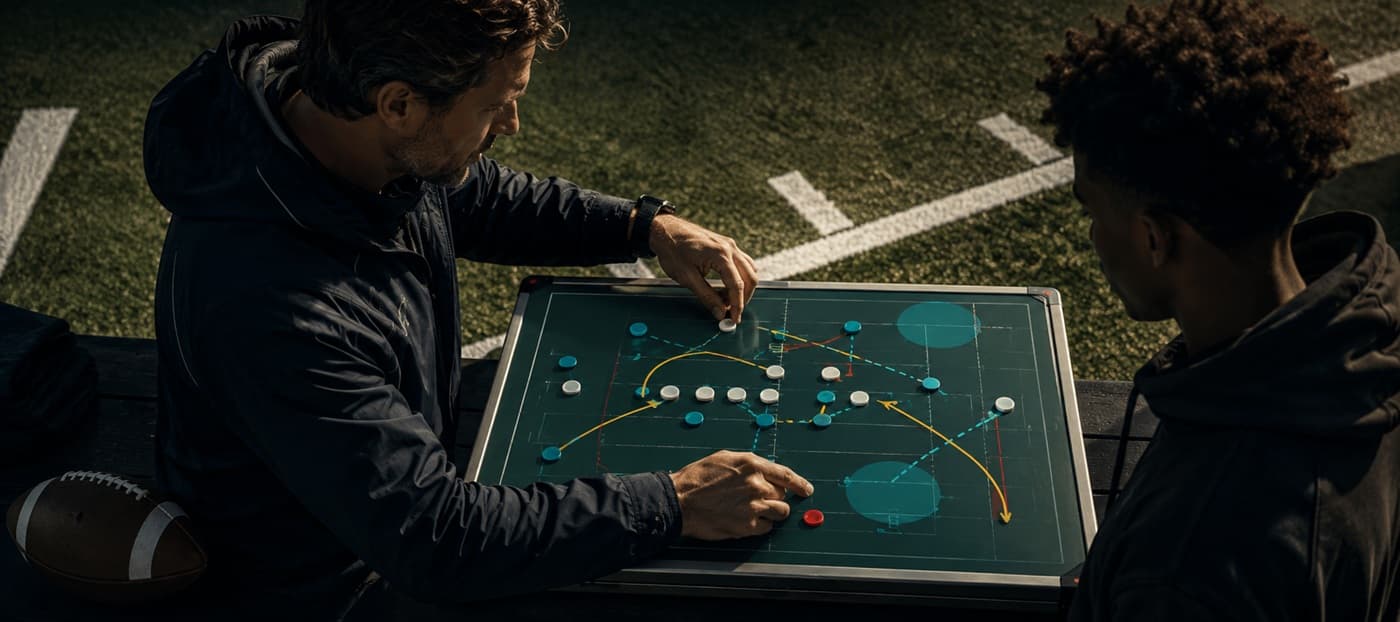
American football positions are generally divided into three units: offense, defense, and special teams.
- Offense controls the ball and tries to advance it down the field and score.
- Defense tries to stop the offense, prevent points, and gain possession.
- Special teams handles kicking plays such as punts, field goals, extra points, kickoffs, and returns.
A standard football play has 11 players from each team on the field, but that does not mean football has only 11 positions. Teams substitute different types of players according to the situation, and the same player can perform different roles from one play to another. NFL rules specify 11 players per team, while the exact positions and alignments are strategic choices rather than a fixed list required on every play.
That leads to one of the most useful ideas for a new fan:
Position describes what kind of player someone is. Personnel describes which types of players are on the field. Formation describes where they line up. The play or concept describes what they do after the snap.
Learning the positions first makes concepts such as formations, personnel packages, running plays, passing concepts, defensive fronts, and coverages much easier to understand.
Quick Guide to Football PositionsLink to this section
| Position | Abbreviation | Unit | General location | Primary responsibility |
|---|---|---|---|---|
| Quarterback | QB | Offense | Backfield | Directs offense and distributes the ball |
| Running Back | RB | Offense | Backfield | Runs, receives, and helps protect |
| Fullback | FB | Offense | Backfield | Blocking, short-yardage work, receiving |
| Wide Receiver | WR | Offense | Outside or slot | Runs routes, catches passes, blocks |
| Tight End | TE | Offense | Edge of line, slot, or backfield | Blocks and receives |
| Center | C | Offense | Middle of offensive line | Snaps, blocks, communicates |
| Guard | G | Offense | Beside center | Interior run and pass blocking |
| Tackle | T | Offense | Outside guard | Edge pass protection and run blocking |
| Defensive Tackle | DT | Defense | Interior defensive line | Controls gaps and rushes inside |
| Nose Tackle | NT | Defense | Near or over center | Controls interior and occupies blockers |
| Defensive End | DE | Defense | End of defensive line | Rushes passer and defends run |
| Edge Defender | EDGE | Defense | Outside of defensive front | Pass rush, edge control, run defense |
| Linebacker | LB | Defense | Behind or around defensive line | Run fits, coverage, pressure |
| Cornerback | CB | Defense | Near receivers | Pass coverage and run support |
| Nickel/Slot Defender | NB | Defense | Near slot receiver | Slot coverage, run support, pressure |
| Safety | S | Defense | Usually deeper secondary | Coverage, support, communication |
| Kicker | K | Special Teams | Kicking formation | Field goals, extra points, some kickoffs |
| Punter | P | Special Teams | Punt formation | Punts for distance and field position |
| Long Snapper | LS | Special Teams | Center of kicking formation | Specialized long snaps |
| Holder | H | Special Teams | Behind line on place kicks | Receives snap and places ball |
| Returner | KR/PR | Special Teams | Deep on kicks | Returns kickoffs and punts |
These are position families, not rigid boxes. A player listed as a safety might align near the line of scrimmage. A tight end might line up like a wide receiver. A defensive end and an outside linebacker may perform nearly identical edge-rushing jobs in different systems.
Offensive PositionsLink to this section
The offense possesses the football and attempts to move it toward the opponent's end zone.
On a typical offensive snap, the five offensive linemen provide the core blocking structure while the quarterback and five other eligible skill players are arranged according to the personnel package and formation.
Understanding offensive formations and personnel groups becomes much easier once you know what each position can do.
QuarterbackLink to this section
The quarterback (QB) normally receives the snap and directs the offense during the play.
Depending on the formation, the quarterback may line up:
- Directly under center
- Several yards behind the center in shotgun
- At intermediate depth in pistol
After receiving the snap, the quarterback can:
- Hand the ball to a running back
- Throw a forward pass
- Keep the ball and run
- Execute an option concept
- Fake a handoff during play action
- Make another decision built into the play
But quarterback responsibility begins before the snap.
A quarterback may communicate:
- The play
- Formation adjustments
- Motion
- Protection changes
- Defensive identifications
- Audibles
- Cadence
The cadence is the quarterback's verbal or nonverbal sequence used to coordinate the snap. It can also help the offense control timing or gather information about the defense.
Quarterbacks may examine the defensive front, safety structure, potential blitzers, and coverage leverage. The amount of control given to the quarterback varies greatly by offensive system.
That is why the position connects directly to Passing Concepts, Pass Protection, and Reading a Defense.
A quarterback does much more than throw the football. The position connects the play call to what the defense actually does.
Running BackLink to this section
The running back (RB) usually aligns in the offensive backfield, often behind or beside the quarterback.
Running backs may be responsible for:
- Carrying the ball
- Reading blocks
- Finding running lanes
- Catching passes
- Running routes
- Pass protection
- Picking up blitzes
- Faking or carrying out play-action responsibilities
On a running play, the back does not necessarily sprint through one predetermined hole.
For example, an Inside Zone runner may begin toward an aiming point, read how blocks and defenders develop, and choose an available lane. On Outside Zone, the runner may threaten the perimeter before cutting inside or back against defensive pursuit.
Those decisions are explained in more detail in Running Plays.
Running back vs. halfbackLink to this section
The terms running back and halfback are sometimes used almost interchangeably, particularly when referring to a team's primary ball carrier.
Other systems use running back as the broad category and halfback as a more specific role.
Terminology varies, so the player's actual responsibilities matter more than the label.
FullbackLink to this section
The fullback (FB) is another backfield position historically associated with:
- Lead blocking
- Short-yardage carries
- Pass protection
- Receiving from the backfield
A traditional two-back formation might put a fullback ahead of the primary running back, allowing the fullback to enter a running lane first and block a linebacker.
Modern offenses do not all use fullbacks at the same rate or in the same way. Some systems use them extensively, while others accomplish similar jobs with tight ends, H-backs, or other hybrid players.
The position has not disappeared. It is simply more prominent in some offensive systems than others.
Wide ReceiverLink to this section
The wide receiver (WR) is primarily associated with the passing game, but the position involves more than catching passes.
Receivers are responsible for skills such as:
- Route running
- Creating separation
- Reading leverage
- Catching
- Blocking
- Adjusting routes when required by the offense
- Understanding formation and motion rules
Receivers can align in several places.
Outside receiverLink to this section
An outside receiver commonly lines up nearer the sideline.
That player may have room to attack:
- Vertically
- Inside
- Toward the sideline
Slot receiverLink to this section
A slot receiver aligns inside another receiver but outside the core offensive line.
Slot alignment can create different route angles and matchups against:
- Nickel defenders
- Safeties
- Linebackers
X, Z, and slot terminologyLink to this section
You may hear receivers called X, Z, or slot.
These labels often communicate formation and assignment information rather than representing three completely separate universal positions.
For example, one system may define the X as the receiver who commonly lines up on the line of scrimmage, while another offense may organize its terminology differently.
A receiver's split—how far the player aligns from the offensive formation—also affects route spacing and defensive leverage.
Those relationships become especially important in Passing Concepts.
Tight EndLink to this section
The tight end (TE) is one of football's clearest hybrid positions because the player may perform both offensive-line-like and receiver-like responsibilities.
A tight end may:
- Block a defensive lineman
- Block a linebacker
- Help in pass protection
- Release into a short route
- Attack the seam downfield
- Align in the slot
- Line up outside
- Go in motion
- Align in the backfield
An attached tight end lines up beside an offensive tackle.
A detached tight end is separated from the line and may resemble a slot or wide receiver before the snap.
This versatility creates strategic problems for defenses.
Suppose an offense uses two tight ends who can both block and receive. If the defense responds with larger run defenders, the offense may spread the tight ends and force those defenders to cover in space. If the defense answers with smaller coverage players, the offense may bring the tight ends closer to the formation and emphasize blocking.
That is one reason tight ends are central to understanding Personnel Groups.
The Offensive LineLink to this section
The offensive line consists of five core positions:
- Left tackle
- Left guard
- Center
- Right guard
- Right tackle
These players work as a unit.
Their responsibilities include:
- Protecting the quarterback
- Creating running lanes
- Controlling defensive penetration
- Executing double teams
- Passing defenders during stunts
- Working combination blocks
- Communicating protection and run assignments
Offensive-line play is highly coordinated. It is usually inaccurate to think of each lineman as simply blocking whichever defender happens to stand directly across from that player.
| Position | Alignment | Common responsibilities |
|---|---|---|
| Center | Middle of line | Snap, interior blocking, communication |
| Guard | Beside center | Interior blocking, pulling, combination blocks, pass protection |
| Tackle | Outside guard | Edge protection, run blocking, combination blocks |
Left TackleLink to this section
The left tackle (LT) lines up outside the left guard.
Responsibilities can include:
- Blocking edge rushers
- Protecting the quarterback
- Blocking on outside and inside runs
- Working with the left guard or tight end
- Handling stunts and twists
You may hear that the left tackle “protects the blind side.” That can be true for a right-handed quarterback in certain protections, but it should not be treated as a universal definition of the position.
Quarterback handedness, launch point, formation, and protection design all matter.
Left GuardLink to this section
The left guard (LG) lines up between the left tackle and center.
A guard may:
- Block defensive tackles
- Help the center or tackle
- Pull across the formation
- Work to a linebacker
- Protect an interior pass-rush lane
CenterLink to this section
The center (C) lines up in the middle of the offensive line and begins most scrimmage plays by snapping the football.
The center also frequently has major communication responsibilities.
Depending on the offensive system, the center may help:
- Identify the defensive front
- Communicate blocking combinations
- Organize pass protection
- Identify linebacker threats
- Adjust calls after defensive movement
The quarterback and center often work together to establish the offense's protection picture.
Right GuardLink to this section
The right guard (RG) lines up between the center and right tackle.
Its general responsibilities mirror those of the left guard, though play design can give either guard different assignments.
Gap-running concepts such as Power and Counter frequently demonstrate why guards must be mobile as well as strong: a guard may pull away from the original position to become a blocker elsewhere.
Right TackleLink to this section
The right tackle (RT) is the outside lineman on the right side of the five-man offensive line.
Like the left tackle, the right tackle handles:
- Edge pass rush
- Run blocking
- Combination blocks
- Defensive movement
- Communication with adjacent blockers
Both tackle positions can be critical in pass protection; the idea that one side is inherently responsible for all important edge protection is too simplistic.
Defensive PositionsLink to this section
The defense tries to prevent the offense from advancing and scoring while creating opportunities to regain possession.
Defensive positions can be more fluid than beginner diagrams suggest.
A player's roster designation does not necessarily describe that player's alignment or responsibility on every play.
For example:
- A safety can move into the box.
- A linebacker can align on the edge.
- A defensive end can move inside.
- A nickel defender can blitz.
- A defensive tackle can rush from several techniques.
This flexibility is why Defensive Fronts and Coverage Families are best learned separately from basic position names.
Defensive TackleLink to this section
A defensive tackle (DT) generally lines up along the interior of the defensive line.
Responsibilities may include:
- Defending A or B gaps
- Stopping inside runs
- Disrupting blocking combinations
- Penetrating into the backfield
- Collapsing the pocket
- Occupying multiple blockers
- Executing stunts with other rushers
A defensive tackle may align in different techniques, such as a 1-technique or 3-technique, depending on the front.
Those technique numbers describe alignment relative to offensive linemen rather than entirely different positions.
Nose TackleLink to this section
A nose tackle (NT) or nose generally aligns near or directly over the center.
The position is particularly associated with odd defensive fronts.
A nose tackle may be asked to:
- Control an interior gap
- Influence both A gaps
- Occupy the center
- Demand help from a guard
- Collapse the pocket
Some defenses use one-gap techniques, while others ask the nose to control a blocker and react to either side in a two-gap approach.
Not every defense using a nominal 3-4 structure teaches the nose tackle identically.
Defensive EndLink to this section
A defensive end (DE) generally aligns toward the outside of the defensive line.
Responsibilities can include:
- Rushing the quarterback
- Defending off-tackle runs
- Setting or controlling the edge
- Pursuing runs away
- Moving inside on passing downs
- Participating in stunts
The exact role depends heavily on scheme.
A defensive end in one system may be a lighter speed rusher, while another defense uses a larger end who frequently plays closer to an offensive tackle and controls blockers.
Edge Defender / Edge RusherLink to this section
Edge defender or edge rusher is often a functional description rather than one universal roster position.
An edge player may officially be listed as:
- Defensive end
- Outside linebacker
- EDGE
The common feature is where and how the player operates—near the outside of the defensive front.
Typical edge responsibilities include:
- Rushing the passer
- Preventing runs from escaping outside
- Defending option plays
- Pursuing from the backside
- Occasionally dropping into coverage
This is why asking whether a player is a defensive end or outside linebacker may not completely explain the role.
In one scheme, a player stands with a hand on the ground and is called a defensive end.
In another, a very similar player stands upright and is called an outside linebacker.
Functionally, both may spend much of the game attacking from the edge.
LinebackerLink to this section
Linebackers (LBs) generally operate behind or around the defensive line.
Their responsibilities can include:
- Run fits
- Tackling
- Pass coverage
- Blitzing
- Pursuit
- Communication
- Quarterback spying
- Adjusting to formations and motion
Traditional terminology includes Mike, Will, and Sam.
MikeLink to this section
The Mike is commonly associated with an inside or middle linebacker role and may carry important communication responsibilities.
WillLink to this section
The Will traditionally refers to a weak-side linebacker.
SamLink to this section
The Sam traditionally refers to a strong-side linebacker.
These labels are useful vocabulary, but their exact jobs vary considerably by system. A modern defense might use two inside linebackers with different names or hybrid players whose responsibilities do not fit traditional definitions cleanly.
The word Mike also appears in offensive pass protection as a declared reference point and does not always mean that the offense is simply identifying the defense's official middle linebacker.
CornerbackLink to this section
A cornerback (CB) generally aligns near wide receivers and plays a major role in pass defense.
Corner responsibilities can include:
- Man coverage
- Zone coverage
- Match coverage
- Press technique
- Off coverage
- Route recognition
- Playing the football in the air
- Tackling
- Run support
A corner may use inside leverage or outside leverage based on the coverage and location of defensive help.
Cornerbacks do not simply “cover one receiver” on every snap.
In Man Coverage vs. Zone Coverage, a corner might follow an assigned receiver in one call but defend an area or use route-matching rules on the next.
Nickel / Slot CornerLink to this section
A nickel package generally means the defense has five defensive backs on the field.
The additional defensive back is often called the nickel, nickelback, or slot corner.
That player often aligns against a slot receiver and may need to:
- Cover inside routes
- Defend crossing routes
- Tackle in space
- Fit the run
- Blitz
- Communicate against bunch and motion
There is an important distinction:
- Nickel can describe the defensive personnel package.
- Nickel defender can describe the player performing the slot role.
The nickel role can be strategically different from playing outside corner because the player operates closer to the formation, where runs, blocks, routes, and blitz opportunities can arrive from many directions.
SafetyLink to this section
A safety (S) often begins deeper than the cornerbacks and linebackers, although safeties can align in many locations.
Responsibilities can include:
- Deep pass coverage
- Route matching
- Run support
- Tackling
- Defensive communication
- Blitzing
- Rotating into underneath coverage
Safeties are central to concepts such as:
- Single-high coverage
- Two-high coverage
- Cover 1
- Cover 2
- Cover 3
- Quarters
- Cover 6
See Coverage Families for how safety structure helps organize the secondary.
Free SafetyLink to this section
Historically, the free safety (FS) has often been associated with deeper coverage, range, and help responsibilities.
Strong SafetyLink to this section
The strong safety (SS) has traditionally been associated with alignment closer to formation strength and greater involvement near the box.
Modern defenses frequently blur those distinctions.
Either safety may rotate deep, move toward the box, match a receiver, blitz, or exchange roles based on the call.
Defensive Position ComparisonLink to this section
| Position | Typical alignment | Primary concerns | Can commonly participate in |
|---|---|---|---|
| Defensive Tackle | Interior line | Interior run, pocket | Run defense, pass rush |
| Nose Tackle | Near/over center | A gaps, interior blocking | Run defense, pocket compression |
| Defensive End | End of line | Edge and adjacent gaps | Pass rush, run defense |
| Edge Defender | Outside front | Outside run, quarterback | Pass rush, contain, occasional coverage |
| Linebacker | Second level | Run/pass conflict | Run fits, coverage, blitz |
| Cornerback | Near receivers | Route coverage | Man, zone, match, run support |
| Nickel Defender | Slot/interior secondary | Slot routes, run support | Coverage, blitz, run fit |
| Safety | Deeper or variable | Deep routes, support | Coverage, rotation, run support, blitz |
Special Teams PositionsLink to this section
Special teams handles plays involving kicking and returns.
These units appear primarily during:
- Kickoffs
- Punts
- Field goals
- Extra points
Some special-teams jobs belong to dedicated specialists. Others are performed by players whose main positions are on offense or defense.
KickerLink to this section
The kicker (K) is responsible for place kicks such as:
- Field goals
- Extra points
- Kickoffs when assigned that role
A field-goal operation requires precise coordination among the long snapper, holder, protection unit, and kicker.
The kicker's job involves much more than leg strength. Placement, accuracy, timing, and consistency all matter.
PunterLink to this section
The punter (P) receives a long snap and punts the ball downfield, usually as part of a field-position decision.
A punter tries to combine factors such as:
- Distance
- Hang time
- Direction
- Placement
The purpose is often to make the opponent begin its next possession in less favorable field position.
Long SnapperLink to this section
The long snapper (LS) specializes in delivering accurate snaps over a longer distance on:
- Punts
- Field goals
- Extra points
The mechanics and timing differ from an ordinary center-to-quarterback snap.
Accuracy is essential because a poor snap can disrupt the entire kicking operation before the punter or holder has a chance to perform the next job.
HolderLink to this section
The holder (H) receives the long snap on a field-goal or extra-point attempt and positions the football for the kicker.
The job requires coordination among:
- Snapper
- Holder
- Kicker
The holder is often a player who has another primary roster position, commonly a punter or sometimes a quarterback depending on the team.
ReturnerLink to this section
A kick returner (KR) or punt returner (PR) receives kicks and attempts to advance the ball.
Important responsibilities include:
- Securing possession
- Reading coverage
- Following blocks
- Understanding field position
- Making appropriate decisions about whether and how to return a kick under the applicable rules
Kick and punt rules can differ by competition and can change over time, so the precise details should be understood within the relevant NFL, college, high school, or youth rulebook.
Coverage and Blocking UnitsLink to this section
Many special-teams players are not dedicated specialists.
Coverage and return units commonly draw players from positions such as:
- Linebacker
- Safety
- Cornerback
- Wide receiver
- Running back
- Tight end
A gunner, for example, is a coverage role on a punt team rather than necessarily a player's primary roster position.
Return units also contain blockers whose job is to create a safe path for the returner.
This reinforces a theme that appears throughout football:
A player's position and the player's assignment on one particular play are not always the same thing.
Position vs. RoleLink to this section
Football positions provide useful categories, but modern football is increasingly built around flexible roles.
Consider several examples.
Defensive end vs. outside linebackerLink to this section
One might be listed as a defensive end and another as an outside linebacker, but both can function as edge rushers.
Outside receiver vs. slot receiverLink to this section
Both players may be wide receivers, but their alignments create different route angles, releases, blocking responsibilities, and defensive matchups.
Tight endLink to this section
A tight end can align:
- Attached to the line
- In the slot
- Wide
- In the backfield
The position stays the same while the role changes.
SafetyLink to this section
A safety may begin 12 yards deep on one play and align close to the linebackers on the next.
LinebackerLink to this section
A linebacker may fit a running lane, cover a tight end, blitz the quarterback, or drop into zone coverage.
Running backLink to this section
A running back may carry the football on one play, protect the quarterback on the next, and align like a receiver on another.
The position name gives you a starting point.
The formation and assignment tell you what that player is actually doing.
Position vs. Personnel vs. Formation vs. ConceptLink to this section
These four terms answer different football questions.
| Term | Answers which question? | Example |
|---|---|---|
| Position | What kind of player is this? | Tight end |
| Personnel | Who is on the field? | 11 personnel |
| Formation | Where are they lined up? | Trips |
| Concept/play | What are they doing? | Mesh |
Suppose an offense uses 11 personnel:
- 1 running back
- 1 tight end
- 3 wide receivers
Those are the skill-position players available.
The offense could arrange them in:
- 2x2
- Trips
- Bunch
- Condensed alignment
- An empty-style structure with the back detached
Then those same players could execute:
- Inside Zone
- Stick
- Mesh
- Four Verticals
- Another run or pass
Personnel does not determine formation.
Formation does not determine the play.
That distinction is foundational to understanding football strategy.
Who Is Eligible to Catch a Pass?Link to this section
Not every offensive player is normally eligible to receive a forward pass.
At a useful beginner level, eligible receivers commonly include players such as:
- Wide receivers
- Tight ends
- Running backs
- Fullbacks
- Quarterbacks in situations where the rules allow them to be eligible
Alignment matters.
In the NFL, offensive players on the ends of the line or legally positioned in the backfield can be eligible if they also satisfy the league's numbering/reporting requirements. Ordinary offensive linemen are generally ineligible, although NFL rules include procedures allowing certain normally ineligible-numbered players to report as eligible in specific circumstances.
The exact eligibility rules and numbering systems differ among levels of football.
For a beginner, the main lesson is:
Being a receiver-capable player is not enough by itself. Legal pre-snap alignment also helps determine who is eligible.
That is one reason Offensive Formations carefully distinguishes players who are on the line from those positioned in the backfield.
How Positions Change With SchemeLink to this section
Memorizing one diagram of 11 offensive players and one diagram of 11 defensive players will not teach you how modern football actually looks.
Scheme changes the roles.
4-3 vs. 3-4 defenseLink to this section
A traditional 4-3 contains four defensive linemen and three linebackers.
A traditional 3-4 contains three defensive linemen and four linebackers.
But the actual front can change after linebackers move toward the line.
A 3-4 outside linebacker may function much like a defensive end.
Nickel defenseLink to this section
Adding a fifth defensive back changes which defensive position groups are represented without necessarily changing the coverage.
Spread offenseLink to this section
A spread formation may move receivers across much of the field's width and force defenders into space.
Two-tight-end offenseLink to this section
Using two tight ends can create a heavy blocking surface or, if the tight ends detach from the line, a spread-looking formation.
Safety rotationLink to this section
A safety may line up deep before the snap but move toward the box once the play begins.
These are all reasons why a position label should be treated as the starting description of a player, not a complete description of every assignment.
Which Positions Touch the Football?Link to this section
Some positions possess the ball frequently, while others rarely do.
QuarterbackLink to this section
The quarterback normally receives the snap and then distributes or keeps the football.
Running backsLink to this section
Running backs carry the ball and receive passes.
Wide receivers and tight endsLink to this section
These players are frequent passing targets and can also carry the ball on designed runs.
CenterLink to this section
The center touches the ball on the snap even though centers normally do not become ball carriers.
ReturnersLink to this section
Returners field punts and kickoffs.
Kicker and punterLink to this section
Kickers and punters contact the ball during specialized kicking plays.
Many other players may go an entire game without possessing the football while still having crucial responsibilities.
How often a position touches the ball is not a useful measure of its importance. A block, protection assignment, coverage responsibility, or run fit can determine the outcome of a play without appearing in a basic possession statistic.
How Positions Work TogetherLink to this section
Football is not 11 individual assignments happening independently.
Every successful play requires position groups to coordinate.
Example 1 — Inside ZoneLink to this section
Consider Inside Zone.
Offensive lineLink to this section
The linemen use zone blocking rules, including combinations where appropriate, to account for defensive linemen and linebackers.
Tight endLink to this section
Depending on the formation and play design, the tight end may block an edge or second-level defender.
QuarterbackLink to this section
The quarterback receives the snap and handles the exchange with the running back. In some offensive systems or variations, the quarterback may also have an additional read or complementary responsibility.
Running backLink to this section
The running back presses the initial track, reads leverage, and chooses the developing lane.
Wide receiversLink to this section
Receivers may be responsible for blocking defensive backs or carrying out other assignments away from the core run.
Now look at the defense.
Defensive lineLink to this section
Interior defenders try to control gaps, defeat combinations, and disrupt the runner's track.
LinebackersLink to this section
Linebackers read the play and fit the available running lanes.
Edge defenderLink to this section
The edge player helps determine whether the runner can escape toward the perimeter.
SafetiesLink to this section
A safety may become an additional run defender.
CornerbacksLink to this section
Corners may need to defeat receiver blocks and support the run if it reaches the perimeter.
The play is called Inside Zone, but nearly every position contributes to whether it succeeds.
Example 2 — Stick Passing ConceptLink to this section
Now consider Stick.
QuarterbackLink to this section
The quarterback evaluates the defensive structure before the snap, confirms the read after it, and determines where the ball should go.
Offensive lineLink to this section
The line executes pass protection long enough for the concept to develop.
ReceiversLink to this section
Receivers create the route spacing necessary to stress the defense.
Tight end or slot receiverLink to this section
Depending on the formation and personnel, an inside receiver may run the Stick portion of the concept while another eligible receiver threatens the outside area.
Running backLink to this section
The back might release into the pattern, check a pass rusher, or remain in protection depending on the play.
Now consider the defense.
Defensive line and edge rushersLink to this section
They attempt to reach or pressure the quarterback before the throw.
Linebackers and nickel defendersLink to this section
One of these defenders may be placed into the concept's key underneath conflict.
CornerbacksLink to this section
Corners handle the outside receiving threats according to the coverage.
SafetiesLink to this section
Safeties provide deeper structure and may rotate after the snap.
The quarterback is not simply finding “the open receiver.” The offense has created a coordinated problem involving routes, protection, leverage, timing, and defensive responsibility.
That is why learning individual positions eventually leads naturally into Reading a Defense.
Common Beginner Misconceptions About Football PositionsLink to this section
“There are only 11 football positions.”Link to this section
No. There are 11 players per team on a standard play, but teams choose among many different positions and roles when selecting those 11 players.
“Every team uses the same positions.”Link to this section
No. Football has common position families, but teams use different personnel, terminology, and hybrid roles.
“Wide receivers only catch passes.”Link to this section
Receivers also block, use motion, adjust routes, create spacing, and sometimes carry the ball.
“Running backs only run.”Link to this section
Running backs can carry, receive, run routes, block, recognize pressure, and participate in play-action or option concepts.
“Offensive linemen each block one defender.”Link to this section
Not necessarily. Blocking schemes involve combination blocks, double teams, zone rules, pulls, protection exchanges, and adjustments to defensive movement.
“Cornerbacks always play man coverage.”Link to this section
No. Cornerbacks can play man, zone, or match responsibilities depending on the defensive call.
“Safeties always stay deep.”Link to this section
No. Safeties can rotate toward the line, enter the box, cover receivers, blitz, or participate in run fits.
“Defensive end and edge rusher always mean the same position.”Link to this section
No. Edge describes a functional role. Both defensive ends and outside linebackers can serve as edge defenders.
“Nickel is just another name for cornerback.”Link to this section
No. Nickel can describe a five-defensive-back personnel package, while nickel or slot corner can describe the defender playing the inside defensive-back role.
“Special teams players are all specialists.”Link to this section
No. Kicker, punter, and long snapper are highly specialized positions, but many coverage and return-unit players also have primary offensive or defensive positions.
Frequently Asked QuestionsLink to this section
How many positions are there in American football?Link to this section
There is no single fixed number of position types. Each team uses 11 players on a standard play, but offenses, defenses, and special teams choose among many different positions and hybrid roles depending on personnel, scheme, formation, and situation.
What are the 11 positions on offense?Link to this section
There is no mandatory set of 11 named positions beyond the formation and eligibility requirements. A common offense has five offensive linemen—a center, two guards, and two tackles—plus a quarterback and five skill-position players chosen from running backs, fullbacks, tight ends, and wide receivers.
What are the main defensive positions?Link to this section
The major defensive families are defensive linemen, edge defenders, linebackers, cornerbacks, nickel or slot defenders, and safeties. Exact combinations change with defensive personnel and scheme.
What does a linebacker do?Link to this section
A linebacker can defend the run, fit gaps, tackle, cover receivers, blitz the quarterback, pursue the football, and communicate defensive adjustments. Specific responsibilities vary considerably by defensive system.
What is the difference between a cornerback and a safety?Link to this section
Cornerbacks commonly align closer to receivers and frequently handle outside or slot coverage. Safeties often begin deeper and have broader coverage, help, rotation, and run-support responsibilities. Modern systems can blur those distinctions.
What is the difference between a defensive end and an edge rusher?Link to this section
Defensive end is a traditional position label. Edge rusher describes a player whose role is to attack from the outside of the defensive front. Depending on the scheme, an edge rusher may be listed as either a defensive end or outside linebacker.
What is a nickel corner?Link to this section
A nickel or slot corner is a defensive back who commonly aligns against inside or slot receiving threats. Nickel also refers to a defensive personnel package containing five defensive backs.
What is the difference between a running back and fullback?Link to this section
A running back is often the primary ball carrier and also contributes as a receiver and pass protector. A fullback has traditionally emphasized lead blocking, short-yardage work, protection, and complementary receiving, although roles vary by offense.
What is the difference between a position and a personnel group?Link to this section
A position describes a type of player, such as running back or tight end. A personnel group describes which types of skill players are on the field together—for example, 11 personnel contains one running back and one tight end, normally leaving three wide receivers.
Which offensive positions can catch passes?Link to this section
Running backs, fullbacks, wide receivers, tight ends, and other legally eligible players can receive forward passes. Eligibility also depends on legal alignment and the rules of the competition; ordinary offensive linemen are generally ineligible unless specific rules make them eligible.
What positions play on special teams?Link to this section
Specialist positions include kicker, punter, and long snapper. Holders and returners also have specialized assignments, while linebackers, defensive backs, receivers, running backs, tight ends, and other players frequently participate on coverage and blocking units.
Which football position is easiest to understand?Link to this section
There is no objective “easiest” position. Some positions have responsibilities that are easier for a new viewer to recognize—for example, seeing a kicker attempt a field goal—but every position involves techniques, assignments, and situational decisions that become more complex at higher levels of play.
Take it to the field