OpenPlay Player Profile
Peyton Manning: What Made Him Exceptional?
Rebuilt plays before the snap through recognition, cadence, and protection control.
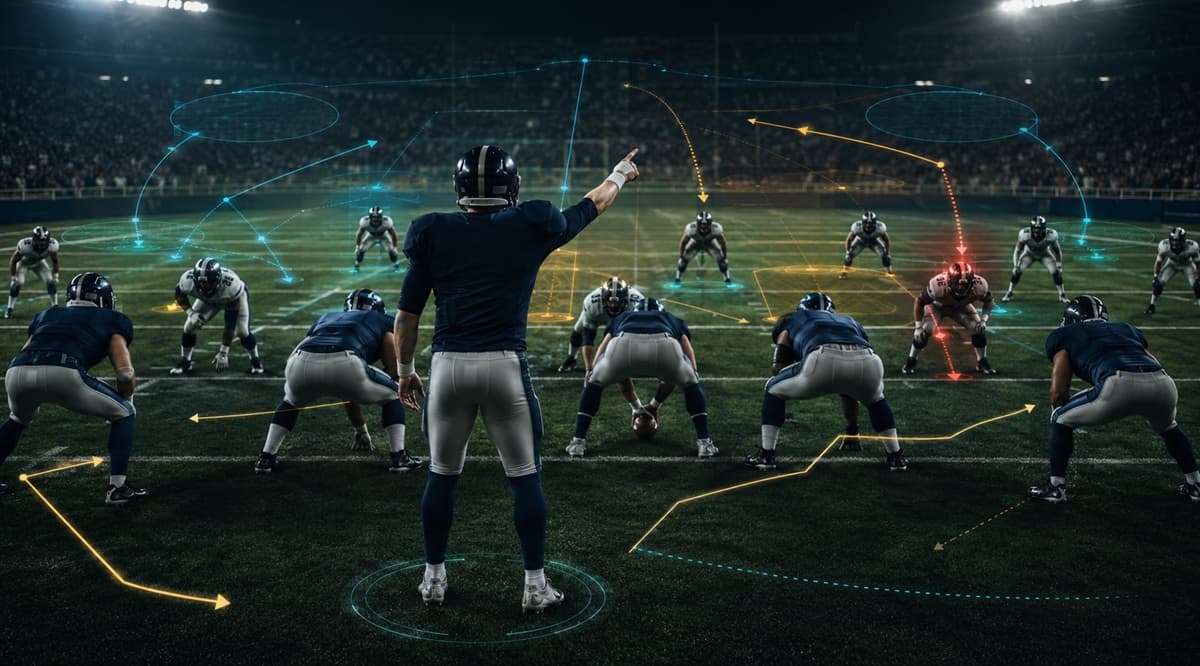
No quarterback in NFL history made the moments before the snap look more like a chess match than Peyton Manning. Long before the ball was in his hands, Manning was already dismantling a defense — pointing, shifting protection, checking into a different play entirely — based on what he read in the alignment across from him.
The central question his career answers is simple to ask and hard to execute: how much of quarterback play can be won before the snap? Manning's answer was "most of it," and he spent 18 seasons proving it against defenses that knew exactly what he was trying to do and still couldn't stop him from doing it.
Career at a Glance
| Category | Information |
|---|---|
| Position | Quarterback |
| Primary teams | Indianapolis Colts (1998–2011), Denver Broncos (2012–2015) |
| Era | 1998–2015 |
| Major honors | Associated Press NFL Most Valuable Player, a record five times (2003, 2004, 2008, 2009, 2013); Super Bowl MVP (Super Bowl XLI) |
| Super Bowl championships | Two, with two different franchises |
| Hall of Fame | Inducted 2021 |
Why Manning Was So Good
Manning's defining skill was recognition — the ability to correctly identify a defense's coverage and pressure plan before it happened, not after. Where many quarterbacks read a defense as the play develops, Manning did most of that work standing over center, using cadence, motion, and a wide vocabulary of checks to get his offense into a play that already had an advantage built in.
That recognition was paired with intermediate accuracy and anticipation that let him capitalize the moment a defense showed its hand. Once he had diagnosed a coverage, he rarely wasted the advantage — the ball came out on time, to the spot the defense could least defend. The combination made him extraordinarily difficult to disguise against, because disguises only work if the quarterback doesn't see through them, and Manning frequently did.
How Manning Played
Manning's process began well before the snap. His cadence wasn't just rhythm — it was a tool, drawing defenders offside, forcing a defense to show its hand by shifting late, or simply buying him an extra half-second to finish his read. Once he identified a look he didn't like, he had the authority and the football knowledge to change the play entirely, not just tweak a protection call.
At the snap, he played with efficient, compact mechanics and a quick release that suited an offense built on getting the ball out before a rush could develop. His accuracy was sharpest on intermediate routes — the kind of throws that punish a defense for guessing wrong before the play even started.
Manning's command extended beyond his own reads. Because he understood the entire offensive concept — not just his job within it — he could adjust protection, motion a receiver, or change a run call into a pass based on the same information he was using to set up his own throw. That level of command required years of institutional knowledge and trust from his coaching staffs, built up first in Indianapolis under Tony Dungy and continued in Denver, where he took over an offense in his mid-thirties and still functioned as its primary play-caller in everything but name.
The Skills That Changed the Matchup
- Pre-snap defensive recognition — identifying coverage shells, blitz indicators, and leverage before the ball was snapped.
- Command of the offense — the authority and knowledge to check into a better play based on what he saw.
- Cadence manipulation — using snap timing to draw penalties or force a defense to reveal its disguise.
- Anticipation and intermediate accuracy — delivering the ball into windows that had been identified, not discovered, before the throw.
- Option-route command — connecting with receivers who adjusted their routes based on the same coverage read Manning was making.
- Protection identification — directing pass protection to account for the most dangerous rusher on a given look.
What Opponents Had to Do Differently
Against Manning, disguising a defense had diminishing returns, because he was often better at diagnosing the disguise than the defense was at executing it. Coordinators frequently had to simplify their pre-snap looks or risk a checked-into play that attacked the exact weakness they were trying to hide, which meant Manning could effectively strip a defense of some of its most valuable tools before the ball was even snapped.
Defenses also had to communicate cleanly and quickly, since any hesitation or miscommunication in the secondary was something Manning was well-positioned to notice and exploit. Facing him often meant choosing between a simpler defensive plan that was harder to disguise, or a more complex one that carried a higher risk of being read and beaten.
Plays and Concepts That Fit His Strengths
Manning's game was built around option routes — where the receiver and quarterback are reading the same defender and adjusting in real time — because that concept rewards exactly the kind of shared recognition Manning specialized in. He also thrived in no-huddle and up-tempo formats, which limited a defense's ability to substitute personnel or communicate a disguised call, playing directly into his strength of diagnosing whatever look he was given.
Play-action was effective for him not because it hid his intentions particularly well, but because his pre-snap read told him which of his outlets would be open after the fake, letting him throw with unusual anticipation off of it.
Compared to Tom Brady, whose command was expressed largely through anticipation and accuracy inside a stable structure, Manning's command was expressed earlier in the sequence — reshaping the structure itself before the ball was even snapped. Both were "field general" quarterbacks in the broad sense, but Manning's version of the job looked more like a coordinator standing at the line of scrimmage, while Brady's looked more like a precision instrument operating within a system that rarely needed to change.
Where the Player Was Less Dominant
Manning's game depended heavily on structure and preparation, and it was less effective when protection broke down completely and he needed to create outside of it. He was not a running threat, and once forced off his spot by pressure, his advantages narrowed considerably compared to a more mobile quarterback. Late in his career, a decline in arm strength — most visible after his 2011 neck surgery — did limit some of his deep-passing ability, though his recognition and accuracy in the short and intermediate game remained elite well into his final seasons in Denver.
OpenPlay Impact Profile
Archetype Field General / Pre-Snap Commander QB
| OpenPlay Trait | Impact |
|---|---|
| Pre-snap recognition | Exceptional |
| Processing | Exceptional |
| Anticipation | Elite |
| Intermediate accuracy | Elite |
| Short accuracy | Elite |
| Deep accuracy | Strong |
| Off-script creation | Limited relevance |
| Mobility | Limited relevance |
These descriptive traits are future-ready metadata for the planned Challenge Lab Impact Player concept—not numerical ratings or live simulation bonuses.
What Changes When He's on the Field?
Situation: 3rd-and-7 from the opponent's 38-yard line, defense showing a two-high shell with a disguised blitz.
Without the exceptional-player advantage
A quarterback taking the defense at face value snaps the ball into a look that's about to change, gets caught by a late-rotating blitzer, and either takes a sack or is forced into a rushed, low-percentage throw.
With this player's traits
Manning's pre-snap read catches the disguise before the snap — a subtle shift in leverage from a safety, a linebacker cheating toward the line. He checks the protection, and possibly the play itself, into something that attacks the space the blitz is about to vacate. By the time the ball is snapped, the defense's disguise has already been solved, and the down is converted before the rush ever arrives.
Coach Riley's Film Room
"Watching Manning at the line was like watching a coach call his own plays live, in real time, with the whole stadium yelling at him. Most quarterbacks are reacting to the defense. Manning was interrogating it. He'd shift the protection, point out the free hitter, and sometimes just wave off the whole play and start over — and he was right often enough that nobody argued with him.
The thing young quarterbacks miss is that this wasn't a gift. It was work. He spent more hours in the film room than anybody I coached against, and it showed up as instinct on Sundays. If you want to understand pre-snap football, you don't study his throws first. You study his eyes and his hands before the ball is even snapped."
What Peyton Manning Can Teach About Football
Manning's career makes the case that football is decided earlier than most fans think — not in the scramble after a broken play, but in the ten seconds before the snap, when a prepared quarterback can identify a defense's plan and beat it before it starts. His game is a reminder that recognition is a skill you can build through preparation, and that the smartest player on the field doesn't need to be the fastest or the strongest to control it.
Build the connections