OpenPlay Player Profile
Ray Lewis: What Made Him Exceptional?
Diagnosed runs before the snap, directed the front seven, and closed downhill.
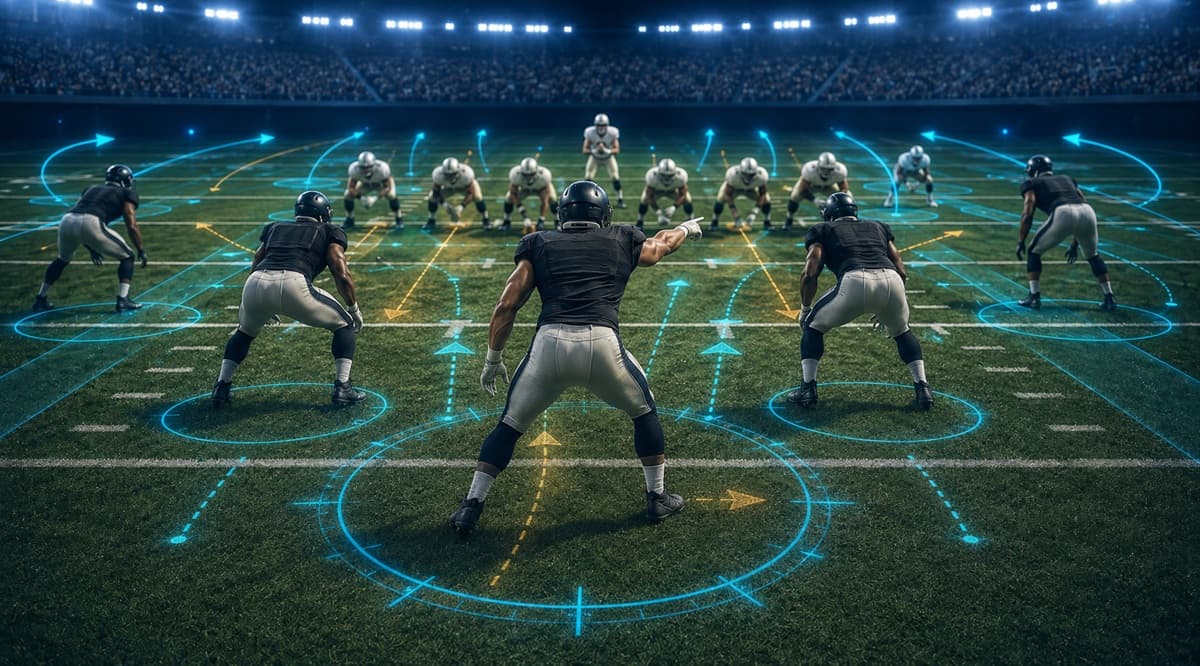
Every quarterback profiled on this site wins games, in part, by diagnosing a defense before the snap. Ray Lewis's career asks what happens when a defense has that same kind of processing power — a player at the center of the formation reading blocking schemes, identifying run direction, and directing his teammates into position before an offense's play has even started to develop. That's the strategic question this profile answers: how does an off-ball linebacker function as a defense's version of a field general?
Lewis spent 17 seasons in Baltimore turning that recognition into results, becoming the emotional and tactical center of some of the most dominant defenses in NFL history — a player whose value showed up not just in tackles, but in how completely he could take away an offense's element of surprise.
Career at a Glance
| Category | Information |
|---|---|
| Position | Middle linebacker |
| Primary team | Baltimore Ravens (1996–2012) |
| Era | 1996–2012 |
| Major honors | NFL Defensive Player of the Year, twice (2000, 2003); Super Bowl MVP (Super Bowl XXXV) |
| Career totals | 2,059 career tackles (NFL record), 41.5 sacks, 31 interceptions |
| Super Bowl championships | Two (Super Bowls XXXV, XLVII) |
| Hall of Fame | Inducted 2018, first year of eligibility |
Why Lewis Was So Good
Lewis's defining skill was pre-snap and post-snap recognition applied at a position that most defenses treat as reactive rather than diagnostic. He read offensive linemen's splits, backfield alignment, and formation tendencies quickly enough to identify run direction and blocking scheme before the ball was snapped, then communicated that read to the rest of the defense in real time. That process meant Baltimore's defense frequently played with an answer already in place for a play the offense hadn't executed yet — a structural advantage similar to what an elite pre-snap quarterback creates for his own offense, just from the opposite side of the ball.
His closing speed made that recognition dangerous rather than merely accurate. Diagnosing a play correctly only matters if a defender can still get there in time, and Lewis's combination of instincts and pursuit speed meant a correct read reliably turned into a tackle at or behind the line of scrimmage, rather than a modest gain a slower defender might still allow even after guessing right.
How Lewis Played
Lewis operated from the middle of Baltimore's defense both physically and functionally — the point through which run fits, coverage calls, and blitz packages were organized and communicated. Before the snap, he read the offensive line's stance and depth, the running back's alignment, and formation tendencies built from extensive film study, then used hand signals and vocal calls to adjust the front seven's alignment accordingly. This wasn't a passive read; it actively reshaped what the defense was doing on a given play, similar in function to a quarterback checking a run to a pass at the line of scrimmage.
Once the ball was snapped, Lewis played downhill with explosive closing speed, taking efficient angles to the ball rather than relying purely on straight-line speed to make up for a late read. His tackling was physical and decisive, frequently stopping plays at or behind the line of scrimmage rather than only after several yards of additional gain — the kind of value that compounds across a full game by consistently keeping an offense off schedule.
The Skills That Changed the Matchup
- Pre-snap recognition — reading formation, splits, and backfield alignment to diagnose a play before it started.
- Communication and command — directing run fits and coverage checks for the entire front seven in real time.
- Closing speed — converting a correct read into a tackle at or near the line of scrimmage rather than a delayed one.
- Tackling efficiency — taking correct angles and finishing plays decisively, limiting yards after contact.
- Coverage range — enough athleticism to be a credible factor against tight ends and running backs in the passing game, not just a run-stopping specialist.
- Sustained leadership — organizing a defense's answer to a new offensive wrinkle mid-game, not just mid-week in preparation.
What Opponents Had to Do Differently
Offenses facing Lewis and Baltimore's defense generally couldn't rely on standard misdirection or tendency-breaking calls with the same success they'd expect against a less disciplined front seven, because Lewis's recognition often caught those wrinkles before they could develop. Coordinators frequently had to disguise formations and backfield alignment more elaborately than usual, since a normal pre-snap look was something Lewis had likely already diagnosed from film study.
His presence also affected personnel decisions in the passing game. A tight end or running back working over the middle of the field had to account for Lewis's closing speed and coverage range, which meant some offenses avoided attacking the middle of Baltimore's defense altogether — a concession similar to what an elite cornerback forces on the outside, but applied to the interior of the field.
Plays and Concepts That Fit His Strengths
Lewis was most disruptive in base defensive fronts that let him read and react from the middle of the field without being tied down by a specific coverage assignment on every snap — a role that maximized his recognition and closing speed rather than limiting him to a single technique. He was equally effective against gap-scheme and zone-scheme running plays, since his diagnostic process was built around reading the offense's structure rather than reacting only to a single blocking style.
Blitz packages that used him as a delayed rusher took particular advantage of his instincts, since his ability to read protection and identify where a blocker would be absent let him time his rush more effectively than a purely speed-based blitzer might.
Where the Player Was Less Dominant
Lewis's game was built primarily around recognition and closing speed rather than the kind of raw coverage technique that defines an elite cornerback, and against the fastest, most dynamic receiving backs and tight ends in true man coverage in open space, his advantage narrowed compared to what he could generate in a run-first or zone-coverage context. His individual sack and pressure numbers, while respectable, were never the primary source of his value, meaning his profile is somewhat harder to appreciate through box-score pass-rush statistics alone. His legal troubles early in his career, well documented publicly, are not part of the football evaluation of his playing career.
OpenPlay Impact Profile
Archetype Defensive Quarterback / Downhill Enforcer LB
| OpenPlay Trait | Impact |
|---|---|
| Pre-snap recognition | Exceptional |
| Run-fit direction | Exceptional |
| Closing speed | Elite |
| Tackling efficiency | Elite |
| Communication/command | Elite |
| Coverage range | Strong |
| Pass-rush burst | Moderate |
These descriptive traits are future-ready metadata for the planned Challenge Lab Impact Player concept—not numerical ratings or live simulation bonuses.
What Changes When He's on the Field?
Situation: 2nd-and-3, offense in a run-heavy personnel grouping using a play-action fake and misdirection to disguise the ball's true direction.
Without the exceptional-player advantage
A standard middle linebacker reacting to the play as it develops, rather than diagnosing it beforehand, is likely to be a step slow reading through the misdirection — flowing initially toward the fake before redirecting, which gives the actual ball carrier extra room to operate before the defense can fully react.
With this player's traits
Lewis's pre-snap read of the offensive line's splits and backfield alignment has already flagged this formation as a run to a specific side, regardless of the fake. He directs the front seven into the correct gaps before the snap, and his own downhill pursuit takes an efficient angle straight to the ball rather than getting drawn off by the misdirection. The play that was designed to buy an extra half-second of hesitation from the defense instead meets a defender who was never fooled in the first place, and the gain is limited to a yard or less.
Coach Riley's Film Room
"Most defenses have a smart player who studies extra film. Baltimore had a smart player who could make the other ten guys around him play smarter too, in real time, live. That's the part that separated Lewis. He wasn't just diagnosing the play for himself — he was pointing, yelling, adjusting a safety's depth or a defensive end's gap assignment before the snap, and he was right often enough that the whole defense trusted him completely.
I used to tell my offensive coordinators: it doesn't matter how good our disguise is if the guy reading it has already seen it a hundred times on film. You could dress up the same running play five different ways against Lewis, and by year three or four of his career, he'd seen enough tape that very little actually surprised him. That's not talent alone. That's obsessive preparation turned into split-second instinct."
What Ray Lewis Can Teach About Football
Lewis's career shows that a defense can have its own version of a field general — a player whose preparation and recognition let him solve an offense's plan before it fully unfolds, the same way an elite quarterback solves a defense from the other side of the ball. For anyone learning to watch defensive football, Lewis is proof that discipline and film study can be just as decisive as speed or size, and that a defense's best player is often the one organizing everyone else's job, not just doing his own.
Build the connections