OpenPlay Player Profile
Barry Sanders: What Made Him Exceptional?
Created viable running lanes when the blocking picture had already failed.
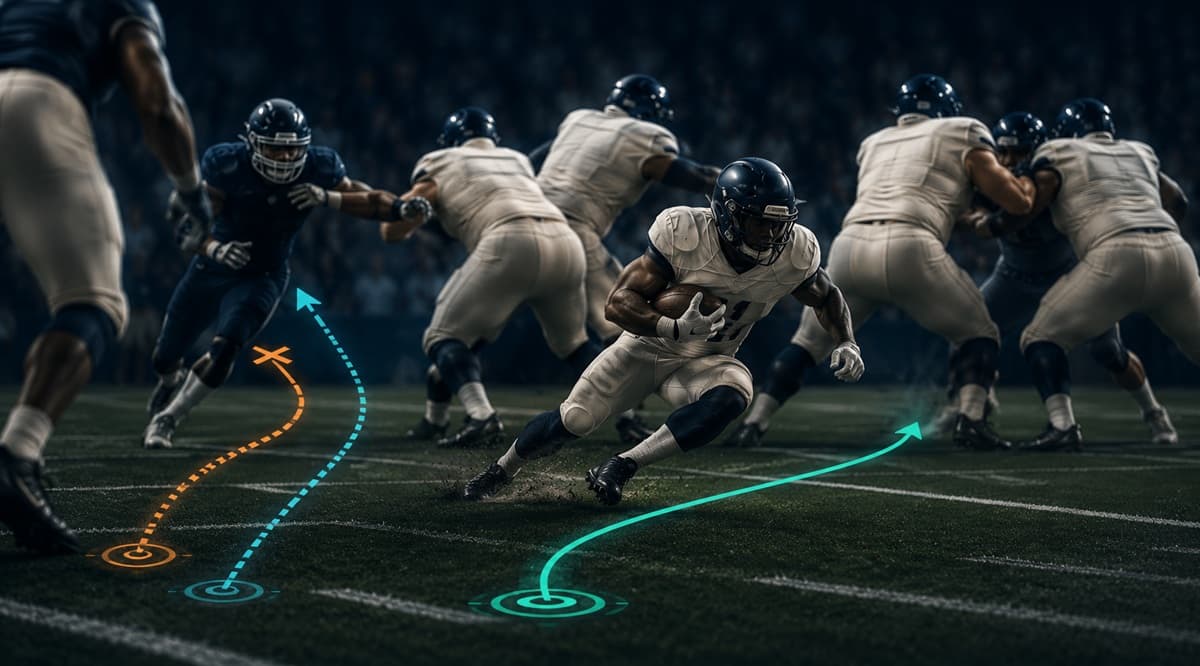
A well-blocked running play is a rare thing. Even the best offensive lines miss an assignment, get beaten by a stunt, or simply lose a one-on-one matchup at the point of attack — and most running backs are limited by that failure, because the play's success was designed to depend on the block succeeding. Barry Sanders' career answers a different question: how can a running back create successful outcomes when the blocking is imperfect?
Sanders didn't need a clean lane to produce a positive gain. His vision, acceleration, and ability to change direction let him treat a busted play as raw material rather than a lost down — and he did it consistently enough, for a decade, that "what would Barry do with this" became a real question defenses had to answer for every single running play they faced.
Career at a Glance
| Category | Information |
|---|---|
| Position | Running back |
| Primary team | Detroit Lions (1989–1998) |
| Era | 1989–1998 |
| Major honors | NFL Most Valuable Player (1997); NFL Offensive Player of the Year (1994, 1997) |
| Career rushing | 15,269 yards, 99 rushing touchdowns over ten seasons |
| Hall of Fame | Inducted 2004 |
Why Sanders Was So Good
Sanders' defining trait was his ability to decouple his own production from the quality of his blocking. Where most backs need a defined lane to hit, Sanders processed the defense in real time behind the line of scrimmage — reading which gap was actually open rather than which gap was designed to be open — and adjusted his path before committing. That decision-making, combined with an extraordinary ability to accelerate and change direction without losing speed, let him consistently turn plays that should have gone nowhere into meaningful gains.
Just as importantly, his change of direction wasn't just about avoiding a tackler in front of him. It forced defenders into bad pursuit angles, meaning even players who correctly diagnosed the play often ended up out of position by the time they arrived, because Sanders' path wasn't where the play was designed to go.
How Sanders Played
Sanders ran with patience that looked, at first glance, like hesitation — but was actually a deliberate scan of the defense unfolding in real time. Rather than committing immediately to the play's designed gap, he'd press toward the line, read which defenders had over-pursued or been sealed off, and cut into space that hadn't existed when the play was called. His acceleration out of a cut was exceptional, meaning a defender who had the right angle to make a tackle often didn't have the closing speed to finish it once Sanders redirected.
He also ran with excellent balance for his size, absorbing glancing contact without going down, which gave him extra opportunities to make a second or third move after initial contact rather than being stopped at first touch.
Sanders' low center of gravity — listed at 5-foot-8 — worked in his favor here in a way that's easy to underestimate. Tacklers arriving at a normal hitting angle for a taller back often found themselves aiming too high, and by the time they adjusted, Sanders had already redirected. That combination of size, balance, and change of direction meant a single defender rarely finished a play against him with a first hit; the tackle usually had to be a gang effort, and even then it often came several yards past where the play was originally supposed to end.
The Skills That Changed the Matchup
- Vision — reading the defense behind the line and identifying where the play was actually developing, not just where it was designed to go.
- Acceleration — hitting top speed almost immediately out of a cut, denying pursuing defenders time to recover.
- Elusiveness and lateral change of direction — making defenders miss in tight spaces without losing forward progress.
- Contact balance — staying upright through arm tackles and glancing hits, extending plays that looked finished.
- Forcing bad pursuit angles — making correct reads look wrong by the time defenders arrived.
- Creating value independent of blocking — consistently gaining yardage on plays where the initial design had already failed.
What Opponents Had to Do Differently
Defenses facing Sanders couldn't simply assign gap responsibility and trust that a correct read would result in a tackle, because his change of direction made a "correct" pursuit angle wrong within a step or two. Defensive coordinators often had to add extra run support — an additional defender in the box, tighter gap discipline across the entire front — knowing that a single missed assignment anywhere on the field could turn into an explosive gain rather than a modest one.
This also meant defenses had to be unusually disciplined in their leverage and contain responsibilities on the edges, since Sanders was equally capable of bouncing a run outside as he was of cutting back against the grain, and either instinct from a defender could be exploited if not perfectly executed.
Plays and Concepts That Fit His Strengths
Sanders' game translated well into any scheme that gave him room to read and react rather than committing him to a single predetermined gap — outside zone concepts in particular, where the blocking is designed to create multiple potential cutback lanes rather than one fixed point of attack. Gap schemes with pulling linemen also worked well for him, since a blocker in space gave him another read to work off of as he decided where to attack.
He was also a credible receiving threat out of the backfield, which kept defenses from committing extra defenders purely to stop the run and gave Detroit's offense another way to get him into open space.
Compared to a more downhill runner, the trade-off in Sanders' game is worth naming directly: he wasn't the back to call on for a short-yardage, no-doubt gain between the tackles, where a bigger, more decisive runner might simply fall forward for the necessary yardage. What he offered instead was a much higher ceiling on ordinary plays, converting routine 3-yard gains into 30-yard ones often enough that defensive coordinators had to weigh that risk on every single running down, not just the explosive ones.
Where the Player Was Less Dominant
Sanders' game involved genuine trade-offs. His patience behind the line, while often a strength, occasionally cost him easy positive yardage that a more straightforward downhill runner would have simply taken — a small loss on individual plays in exchange for a higher ceiling on many others. Playing behind offensive lines that were not consistently among the league's best for much of his career also meant he frequently had to create yardage that a back with a more dominant line might not have needed to. His statistical peak also came without the benefit of a truly explosive passing offense around him for most of his career, which allowed defenses to focus resources more heavily on stopping the run than they might have against a more balanced attack.
OpenPlay Impact Profile
Archetype Elusive Creator RB
| OpenPlay Trait | Impact |
|---|---|
| Vision | Exceptional |
| Elusiveness | Exceptional |
| Acceleration | Exceptional |
| Open-field creation | Exceptional |
| Contact balance | Elite |
| Receiving | Strong |
| Power | Moderate |
These descriptive traits are future-ready metadata for the planned Challenge Lab Impact Player concept—not numerical ratings or live simulation bonuses.
What Changes When He's on the Field?
Situation: 2nd-and-8, designed outside zone run where the playside tackle is beaten immediately off the snap.
Without the exceptional-player advantage
Most running backs hit the designed cutback lane out of necessity once the primary gap is lost, often running directly into a defender who correctly diagnosed the cutback and is already there to make the tackle for a minimal gain or a loss.
With this player's traits
Sanders reads the beaten block before committing, presses just long enough to draw the second-level defender out of position, then redirects into a lane that opened specifically because of how the defense pursued the original play. The defender who "correctly" filled the expected cutback lane is now out of position, and Sanders converts a play that was designed to fail into a positive gain — sometimes an explosive one — purely through recognition and change of direction.
Coach Riley's Film Room
"I've coached against a lot of backs who could make you miss. Sanders made whole defenses miss, one guy at a time, on the same play. What got me wasn't the jukes — it was the patience before the jukes. He'd let a play die right in front of him, let defenders commit to where it was supposed to go, and then go somewhere else entirely.
You cannot defend that with better tackling alone. You have to defend it with discipline — everybody staying in their gap, nobody guessing. And even then, if one guy bit on his first move, that was often the whole game. I've never seen a back turn a blown block into a highlight as consistently as he did."
What Barry Sanders Can Teach About Football
Sanders' career is a lesson in the value of recognition over pure physical dominance. His statistics don't come from running behind consistently great blocking — they come from a skill set that treated blocking failures as an opportunity rather than a limitation. For anyone learning to watch football closely, Sanders is proof that a running back's value isn't just measured by what the offensive line gives him, but by what he's able to create when it doesn't.
Build the connections