OpenPlay Player Profile
Patrick Mahomes: What Made Him Exceptional?
Preserved downfield threats after structure broke through movement and rare arm talent.
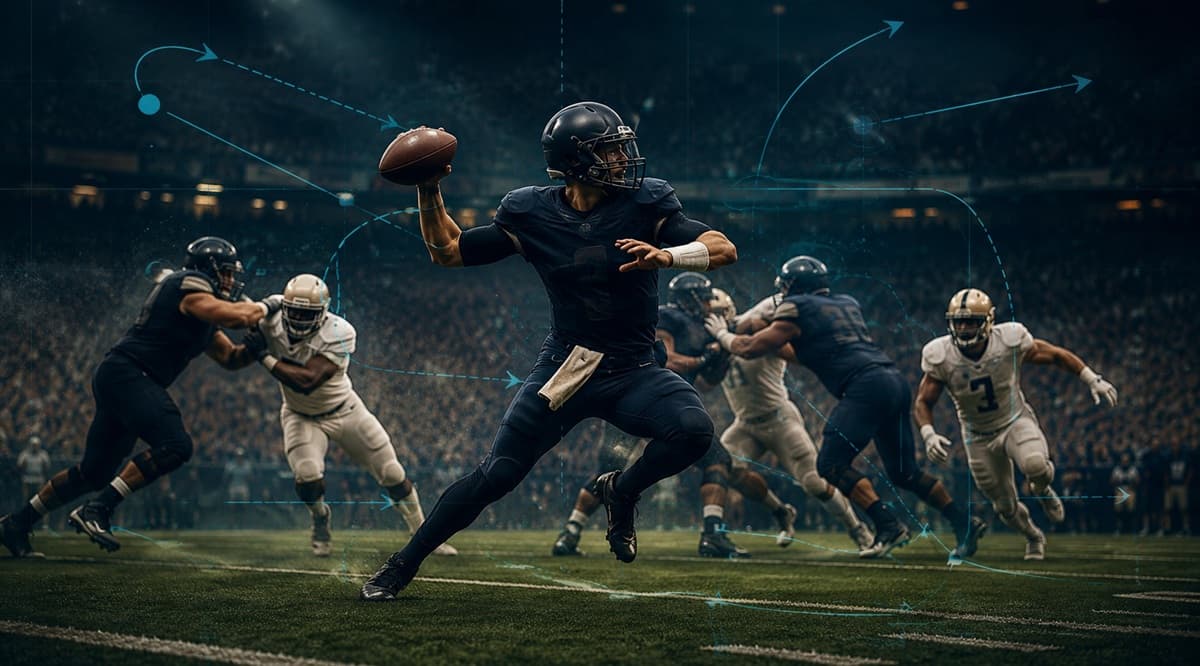
Patrick Mahomes forces a question that doesn't come up often in quarterback evaluation: what happens when elite structure and elite improvisation exist in the same player? Most quarterbacks are strong at one or the other — precise operators within a system, or dangerous playmakers once a play breaks down. Mahomes has built his career on being genuinely excellent at both, and switching between them in the same drive, sometimes the same play.
That combination is what makes him difficult to defend even when a defense executes its plan correctly. A well-covered receiver and a clean pass rush don't guarantee a stop against Mahomes the way they might against a more conventional quarterback, because the "failure" of the original play is often just the beginning of a new, improvised one.
Career at a Glance
| Category | Information |
|---|---|
| Position | Quarterback |
| Primary team | Kansas City Chiefs (2017–present) |
| Era | 2017–present |
| Major honors | Associated Press NFL Most Valuable Player (2018, 2022); Super Bowl MVP (three times) |
| Super Bowl championships | Three (Super Bowls LIV, LVII, LVIII), with additional Super Bowl appearances |
| Hall of Fame | Not yet eligible (active player) |
Why Mahomes Was So Good
Mahomes' improvisation is valuable specifically because it's built on top of structure, not instead of it. He understands the original design of a play — the route concepts, the protection, the coverage it was designed to attack — well enough that when it breaks down, he isn't guessing. He's making a second, informed decision based on where defenders have vacated as they reacted to the first one. That's a meaningfully different skill from simply being athletic enough to run around and make a play; it's structured improvisation, grounded in the same processing that governs his play within the pocket.
His arm strength and ability to throw accurately from unconventional platforms — off-balance, moving sideways, across his body — let him convert plays that would be dead for most quarterbacks, turning a broken pocket into one of his most dangerous weapons rather than a problem to be avoided.
How Mahomes Played
Within structure, Mahomes reads coverage quickly and delivers accurate short and intermediate throws on rhythm, not unlike other elite pocket passers of his era. What separates his game is what happens once the play stops going as scripted. Rather than immediately looking to run, he continues scanning downfield while moving, using pocket movement and elusiveness to buy time and keep his eyes up. His arm strength lets him make full-field throws even from compromised platforms, meaning a play that has technically broken down can still stretch a defense sideline to sideline.
His deep passing is another significant weapon — not just as a big-play threat, but as a way to punish a defense that plays too aggressively against his short and intermediate game.
That combination has shown up most clearly in the postseason, where the margin for error shrinks and defenses are better prepared than they are during the regular season. Mahomes' string of Super Bowl performances — three Super Bowl MVP awards across a run of appearances with Kansas City — has repeatedly featured fourth-quarter and overtime execution under exactly the conditions his game is built for: a defense that has spent three quarters trying to contain him, worn down by the cumulative effect of plays that never quite end when they're supposed to.
The Skills That Changed the Matchup
- Off-script creation — extending plays after the original design breaks down, without losing sight of the field.
- Arm strength and throwing from unconventional platforms — completing accurate throws while moving, off-balance, or outside the pocket.
- Spatial awareness — tracking open receivers and closing defenders simultaneously while extending a play.
- Deep accuracy — stretching a defense vertically, which discourages overly aggressive underneath coverage.
- Mobility as a weapon — using his legs to buy time or convert yardage directly, not just to survive pressure.
- Processing within structure — the pre-snap and rhythm-based reading that makes his improvisation additive rather than a fallback.
What Opponents Had to Do Differently
Defenses facing Mahomes generally cannot treat a collapsed pocket as the end of a play. Pass rushers have to maintain lane discipline and contain rather than simply converging on the quarterback, because a rusher who overruns the play opens exactly the kind of running or throwing lane Mahomes is built to exploit. Coverage defenders likewise have to sustain their assignments longer than usual, since a receiver who is well covered against the original route can become open again once Mahomes extends the play and the route continues to develop.
This combination forces a defense to defend for a longer window than a standard play clock would suggest, which is physically and mentally taxing across four quarters — a cumulative advantage that shows up disproportionately in close, high-leverage games.
Plays and Concepts That Fit His Strengths
Mahomes' offense uses vertical concepts and route combinations designed to stretch a defense both down the field and from sideline to sideline, taking advantage of his arm strength and downfield accuracy. His offensive line and scheme also lean on structured pocket movement — not a fixed pocket, but designed movement that keeps him in position to throw rather than forcing him to run purely to survive.
Play-action remains effective for him for a different reason than it is for a pure pocket passer: it buys the extra half-second his improvisational instincts can use to identify a soft spot in the defense once the play starts to extend.
Compared to Tom Brady, the contrast is instructive rather than a simple hierarchy. Brady's value was built almost entirely on structured efficiency — solving a defense before or immediately after the snap, then executing without needing to improvise. Mahomes can play that way too, but his ceiling comes from what happens when structure isn't enough, which is a different and complementary form of quarterback value rather than a more advanced version of the same skill. Both approaches have produced sustained championship success; they simply locate their advantage in different parts of the play.
Where the Player Was Less Dominant
Mahomes' game generates more variance than a quarterback whose value is built almost entirely on structure and timing. Extending plays and throwing from difficult platforms occasionally produces high-risk throws and turnovers that a more conservative decision-maker would avoid — a trade-off that comes with the territory of playing with this much improvisation. His game also places a heavier physical burden on him individually, since so much of his value depends on movement and extended plays rather than a quick, low-contact release.
OpenPlay Impact Profile
Archetype Creative Playmaker QB
| OpenPlay Trait | Impact |
|---|---|
| Off-script creation | Exceptional |
| Arm strength | Exceptional |
| Deep accuracy | Elite |
| Mobility | Elite |
| Pocket movement | Elite |
| Processing | Elite |
| Short accuracy | Strong |
| Intermediate accuracy | Strong |
These descriptive traits are future-ready metadata for the planned Challenge Lab Impact Player concept—not numerical ratings or live simulation bonuses.
What Changes When He's on the Field?
Situation: 3rd-and-7 from the opponent's 38-yard line, with a clean initial pass rush collapsing the pocket in under three seconds.
Without the exceptional-player advantage
Most quarterbacks facing a collapsed pocket on 3rd-and-7 either take a sack, throw the ball away, or force a low-percentage throw under duress. The down is likely lost.
With this player's traits
Mahomes escapes the initial pressure while keeping his eyes downfield rather than immediately looking to run. As the play extends, a defender who was in coverage begins to lose discipline tracking the scramble, and a receiver who continued working finds space behind him. Mahomes delivers an accurate throw from an unconventional platform to convert the down — turning what should have been a lost play into a positive one, purely because the defense's execution had a shelf life his game was built to outlast.
Coach Riley's Film Room
"Here's what I tell my quarterbacks about Mahomes: don't try to copy the highlight, copy the discipline underneath it. He doesn't scramble around hoping something opens up. He knows the concept, he knows where his guys are supposed to end up, and when the play breaks, he's still working that same information — just with his feet moving.
A lot of young players think improvisation means abandoning the plan. Mahomes shows you it's the opposite. The plan is still running in his head the whole time. That's why he can throw a guy open forty yards downfield while he's moving sideways and getting hit — because he never stopped processing the defense, even when the play stopped looking anything like the drawing on the whiteboard."
What Patrick Mahomes Can Teach About Football
Mahomes' career shows that improvisation and discipline aren't opposites — the best improvisers are usually the ones who understand structure well enough to know exactly what's changed when a play breaks down. For anyone learning football, his game is a useful reminder that "off-script" doesn't mean "no plan." It means a second plan, built on the same information as the first, executed under much less favorable conditions.
Build the connections