OpenPlay Player Profile
Deion Sanders: What Made Him Exceptional?
Removed usable space with elite man coverage and recovery speed.
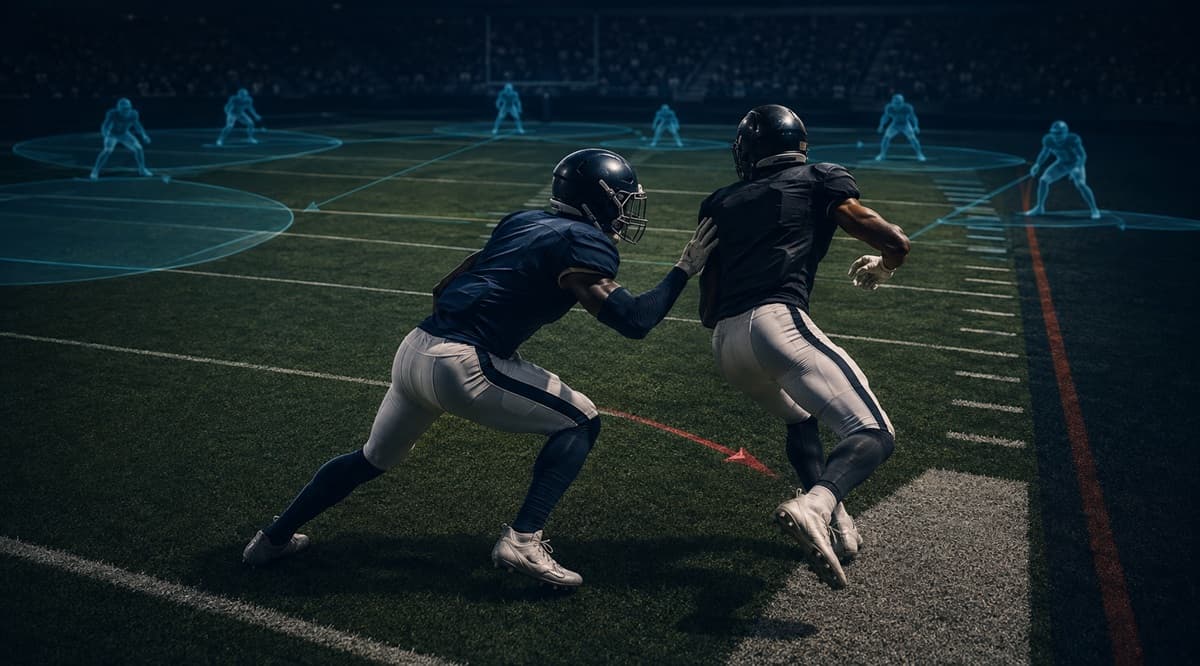
Deion Sanders built a career around a strategic idea rather than a simple statistic: how can a cornerback change an offense by taking away space? Sanders didn't just cover his assigned receiver well — he covered him confidently enough, and consistently enough, that opposing offenses frequently avoided his side of the field altogether. That avoidance was the real measure of his impact, even in games where his individual statistics looked ordinary.
Because he could be trusted in single coverage against nearly any receiver, Sanders effectively freed the rest of his defense to allocate resources elsewhere — double-teaming a different threat, disguising pressure, or committing extra defenders to the run — without worrying about his matchup.
Career at a Glance
| Category | Information |
|---|---|
| Position | Cornerback |
| Primary teams | Atlanta Falcons (1989–1993), San Francisco 49ers (1994), Dallas Cowboys (1995–1999), Washington Redskins (2000), Baltimore Ravens (2004–2005) |
| Era | 1989–2005 |
| Major honors | Associated Press NFL Defensive Player of the Year (1994) |
| Career totals | 53 interceptions, nine interceptions returned for touchdowns |
| Super Bowl championships | Two, with two different franchises |
| Hall of Fame | Inducted 2011 |
Why Sanders Was So Good
Sanders' recovery speed and technical man-coverage skill meant he rarely needed safety help to handle even the fastest and most talented receivers in the league. That self-sufficiency was strategically valuable in a way that goes beyond individual coverage grades: a defense that trusts one cornerback in complete isolation can use its extra defender — the safety who would otherwise be shading toward that matchup — anywhere else on the field.
His ball skills, honed in part by his background as a professional baseball player, made him a genuine threat to intercept passes rather than merely a defender who prevented completions, which added a layer of risk for offenses that did decide to test him.
How Sanders Played
Sanders played primarily in press-man and off-man coverage with excellent technique — a quick backpedal, disciplined hip movement, and the recovery speed to close on a route even if he was initially beaten by a step. His confidence in his own coverage ability was well earned: he rarely needed to look back at the quarterback to locate the ball, instead tracking his receiver closely enough that route recognition alone told him what was coming.
Once the ball was in the air, his ball skills and closing speed let him compete for interceptions rather than simply playing to prevent a completion, and his return ability after an interception — including several touchdowns — added a game-changing dimension that many shutdown corners of his era didn't offer.
Sanders' background as a professional baseball outfielder is a genuinely relevant part of his football profile, not just a biographical footnote — the hand-eye coordination and ball-tracking skills that made him a capable major league hitter translated directly into a cornerback's ability to locate and attack a football in flight. That cross-sport skill set is part of why his interception totals, while not the highest of his era in raw volume, came with an unusually high conversion rate on the chances he did get.
The Skills That Changed the Matchup
- Man coverage — technically sound, confident coverage that rarely required safety help.
- Recovery speed — closing quickly enough to erase an early separation advantage by a receiver.
- Ball skills — converting coverage into turnovers rather than simply preventing completions.
- Route recognition — anticipating a receiver's break well enough to play the route rather than just the man.
- Reducing viable targets — making his assigned receiver a low-value option for opposing quarterbacks.
- Allowing a defense to allocate help elsewhere — freeing a safety or extra defender for use against a different part of the field.
What Opponents Had to Do Differently
Offenses facing Sanders frequently avoided targeting his assigned receiver altogether, effectively taking a full third of the field out of the passing game by design rather than by individual play outcome. This is a different kind of impact than a high interception total — a receiver who is simply never thrown to doesn't generate a counted statistic, even though the strategic effect on the offense's game plan is just as real.
Coordinators also had to account for the risk that any pass into his coverage carried, since his closing speed and ball skills meant a contested throw was more likely than usual to become a turnover — raising the cost of testing him even in situations where an offense might otherwise have taken the chance.
Plays and Concepts That Fit His Strengths
Sanders was most effective in press-man and single-high coverage schemes that put him in direct, isolated coverage against a top receiver, since that alignment let his defense use its extra safety elsewhere rather than providing him help he didn't typically need. His teams frequently used him specifically to match up against an offense's best receiving threat, shifting him across the formation as needed rather than assigning him to a single side of the field.
His speed and ball skills also made him a weapon in punt and kick return situations for stretches of his career, adding a dimension to his overall value that went beyond his primary defensive role.
Compared to Randy Moss, the two players represent opposite ends of the same strategic exchange. Moss forced a defense to commit extra resources to contain a single receiver; Sanders was the rare defender good enough that his team didn't have to make that same concession on his side of the field. A cornerback like Sanders lined up across from a receiver like Moss is one of the genuine marquee matchups football produces — a vertical threat capable of beating a cushion against a corner who often didn't need one.
Where the Player Was Less Dominant
Sanders was not, by reputation or by his own statistical profile, a strong tackler or a significant factor in run support, and his game was built around coverage value rather than physical run-defense contributions. Because opposing offenses so often avoided throwing in his direction, his individual interception and tackle totals across a full season sometimes understated his actual defensive value — a genuine measurement challenge for evaluating a player whose primary effect was making himself a non-option rather than making splash plays every week.
OpenPlay Impact Profile
Archetype Shutdown Corner
| OpenPlay Trait | Impact |
|---|---|
| Man coverage | Exceptional |
| Recovery speed | Exceptional |
| Ball skills | Elite |
| Coverage range | Elite |
| Route recognition | Strong |
| Run discipline | Limited relevance |
These descriptive traits are future-ready metadata for the planned Challenge Lab Impact Player concept—not numerical ratings or live simulation bonuses.
What Changes When He's on the Field?
Situation: 3rd-and-7 from the opponent's 38-yard line, offense with its top receiving threat aligned to Sanders' side of the field.
Without the exceptional-player advantage
A standard cornerback in this matchup likely needs safety help to have a realistic chance against a top receiver, which means the defense has to commit an extra resource to that side of the field — a resource unavailable to help with a blitz, a different route, or run support elsewhere.
With this player's traits
Sanders' coverage is trusted enough in isolation that the defense doesn't need to shade a safety toward his matchup, freeing that defender to help elsewhere or disguise a different coverage look entirely. The quarterback, recognizing the difficulty of the matchup and the turnover risk it carries, is more likely to look elsewhere on the field — meaning the down is affected by Sanders' presence even if the ball is never thrown anywhere near his coverage.
Coach Riley's Film Room
"You know how you measure a shutdown corner? Not by his interceptions. By how many times the quarterback never even looks his way. I used to chart it during games — targets to Deion's side versus targets everywhere else — and some weeks the numbers barely existed. That's not a coincidence. That's a quarterback deciding the risk isn't worth it before the play even develops.
And here's the part that doesn't show up on a stat sheet: every time an offense avoided his side, that's one less thing my safety had to worry about. I could use that safety to help somewhere else, disguise a blitz, whatever I needed. One great corner in true isolation changes what your whole defense is capable of doing."
What Deion Sanders Can Teach About Football
Sanders' career is one of the clearest examples in football of value that resists easy measurement. His biggest impact often wasn't a play he made — it was a play an offense chose not to attempt because of him. For anyone learning to evaluate defensive backs, his game is a reminder to look past raw interception totals and ask a more useful question: how much of the field did this player take away, and what did that free the rest of the defense to do?
Build the connections