OpenPlay Player Profile
Randy Moss: What Made Him Exceptional?
Forced safety help and stretched coverage before the ball was snapped.
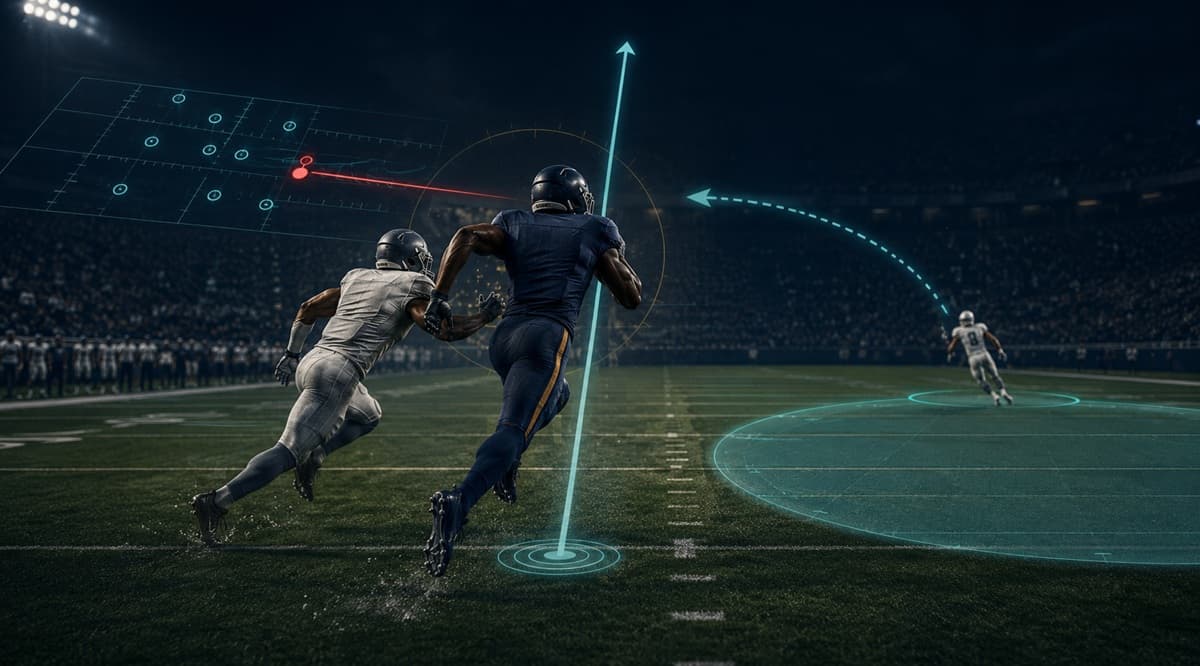
Randy Moss changed defenses before the ball was ever snapped. His career poses a question that gets at the heart of how modern defenses allocate their resources: how can one receiver change a defense before the ball is even snapped? For Moss, the answer was simple in concept and devastating in practice — he was such a credible deep threat that defenses had to plan around him structurally, shading coverage in his direction regardless of the actual play call.
That single fact — that an offense could threaten a defense's whole shape just by having Moss on the field — is the strategic core of his career, and it's a different kind of impact than pure receiving production alone.
Career at a Glance
| Category | Information |
|---|---|
| Position | Wide receiver |
| Primary teams | Minnesota Vikings (1998–2004, 2010), Oakland Raiders (2005–2006), New England Patriots (2007–2010), Tennessee Titans, San Francisco 49ers |
| Era | 1998–2012 |
| Major honors | AP Offensive Rookie of the Year (1998); NFL single-season receiving touchdowns record (23, in 2007) |
| Career receiving | 982 receptions, 15,292 receiving yards, 156 receiving touchdowns |
| Hall of Fame | Inducted 2018, first year of eligibility |
Why Moss Was So Good
Moss combined rare vertical speed with an unusually large catch radius, meaning even a well-thrown deep ball that wasn't perfectly placed was often still catchable. That combination made him a threat on nearly every vertical route he ran, which is a very different proposition for a defense than facing a fast receiver whose catch radius forces a quarterback to be precise.
Because that threat was real on every snap, defenses frequently used a safety to provide deep help over Moss regardless of the specific play, shifting a defender away from the rest of the field before the ball was even snapped. That single adjustment — one extra defender committed to Moss's side of the field, on plays where he wasn't even the primary target — created space for his teammates that had nothing to do with their own routes or ability.
How Moss Played
Moss's vertical routes were built around consistent, explosive top-end speed and the ability to track a deep ball over his shoulder without losing stride — a skill that's harder than it looks and separates true deep threats from receivers who are merely fast in a straight line. His catch radius, combined with strong hands and body control, let him win contested catches in coverage that would be incompletions for most receivers, particularly in the red zone and along the sideline.
He was also an effective route runner at shorter depths when defenses tried to take away the deep ball by playing more conservatively, using his size and physicality to create separation even on routes that didn't rely on his top-end speed.
His best statistical season, in 2007 with the Patriots, illustrates the ceiling of this approach. Paired with Tom Brady's anticipation and timing, Moss set the NFL's single-season touchdown-reception record, largely because a quarterback who could diagnose exactly when a defense had over-committed resources elsewhere gave Moss's vertical speed a runway it didn't always get from every quarterback he played with earlier in his career. The pairing showed how much a gamebreaking receiver's production depends on the decision-making of the passer delivering the ball.
The Skills That Changed the Matchup
- Vertical speed — consistent, sustained speed that threatened a defense on every deep route, not just occasionally.
- Deep tracking — locating and adjusting to the ball in the air over long distances without losing stride.
- Catch radius — turning imperfectly thrown deep balls into completions.
- Contested catches — winning jump-ball and red-zone situations even when tightly covered.
- Forcing safety help — a threat significant enough that defenses committed extra resources to his side of the field by default.
- Creating space for teammates — opening up underneath and intermediate space purely through the defense's structural response to him.
What Opponents Had to Do Differently
Defenses facing Moss frequently had to shift a safety into a shaded or rotated position over him before the snap, which meant fewer resources were available to help elsewhere on the field — a structural cost that benefited his teammates even on plays where Moss wasn't targeted at all. This is the strategic concept commonly described as "taking the top off the defense": by making the deep ball a genuine threat on every snap, Moss forced defenses to play with a deeper cushion across the board, conceding underneath and intermediate space they might otherwise have contested more aggressively.
Cornerbacks assigned to him in single coverage also had to play with unusual discipline, since any lapse in technique or leverage could be instantly punished by his speed and catch radius in a way that a less explosive receiver couldn't threaten as consistently.
Plays and Concepts That Fit His Strengths
Moss was the signature weapon in vertical passing concepts — go routes, deep posts, and comebacks off a vertical stem — that stressed a defense's deep coverage on every snap. His presence also made play-action and other explosive-pass concepts more effective for his offenses generally, since the threat of the deep ball forced linebackers and safeties to respect the pass even on running downs.
He was similarly effective in isolation and one-on-one situations on the outside, where his combination of speed and catch radius gave him an advantage that didn't depend heavily on scheme or design.
Compared to Jerry Rice, whose separation came primarily from technique and timing, Moss represents almost the inverse case study in how a receiver can dictate defensive structure. Rice made individual defenders wrong through detail; Moss made entire defensive game plans conservative through the threat of speed alone. Both effects were valuable, but they placed different demands on the defenses trying to solve them — one required better technique to counter, the other required more resources.
Where the Player Was Less Dominant
Moss was not primarily known for the same technical route precision that defined some of his contemporaries at shorter, more nuanced route depths, and his effort level on plays where he wasn't the primary target was, at points in his career, a subject of criticism from coaches and media. His blocking, particularly earlier in his career, was not a significant strength of his game. Against defenses willing to commit two defenders to him consistently regardless of the down-and-distance cost elsewhere, his individual production could be limited, even as his presence still created value for his teammates.
OpenPlay Impact Profile
Archetype Vertical Gamebreaker
| OpenPlay Trait | Impact |
|---|---|
| Vertical speed | Exceptional |
| Catch radius | Exceptional |
| Contested catch | Elite |
| Route separation | Elite |
| Yards after catch | Strong |
| Route precision | Moderate |
| Blocking | Limited relevance |
These descriptive traits are future-ready metadata for the planned Challenge Lab Impact Player concept—not numerical ratings or live simulation bonuses.
What Changes When He's on the Field?
Situation: 3rd-and-7 from the opponent's 38-yard line, with Moss lined up outside and a secondary route running underneath him.
Without the exceptional-player advantage
A defense without a genuine deep threat to account for can play its safety closer to the line, adding a defender to underneath and intermediate coverage. The underneath route is more tightly defended, and the 3rd-down conversion becomes significantly harder.
With this player's traits
The safety is shaded toward Moss's side of the field before the snap, regardless of whether he's the intended target on this particular play. That single adjustment removes a defender from underneath coverage, and the route running beneath him finds more room to operate than the design alone would suggest. The conversion happens not because Moss touched the ball, but because the defense had already committed resources to the possibility that he would.
Coach Riley's Film Room
"People remember Moss for the highlight catches, and fair enough — some of those catches shouldn't have been possible. But if you want to understand why he mattered strategically, watch the safety, not the receiver. Watch where that safety lines up before the snap on early downs, in games that have nothing to do with a deep shot. That safety is playing scared of a route that hasn't even been called yet.
That's real value, even on the plays where Moss never touches the ball. A defense that has to respect the deep threat on every single snap is a defense playing with one hand behind its back everywhere else on the field."
What Randy Moss Can Teach About Football
Moss's career is a reminder that a player's value isn't limited to what shows up in his own statistics. His presence reshaped how defenses allocated their resources on every snap, whether or not he was targeted — a strategic effect that's easy to overlook if you only track receptions and touchdowns. For anyone learning to watch football at a deeper level, Moss is proof that the biggest impact a player makes is sometimes the one that happens before the ball is even in the air.
Build the connections