OpenPlay Player Profile
Aaron Donald: What Made Him Exceptional?
Collapsed the pocket from the shortest path through leverage, burst, and power.
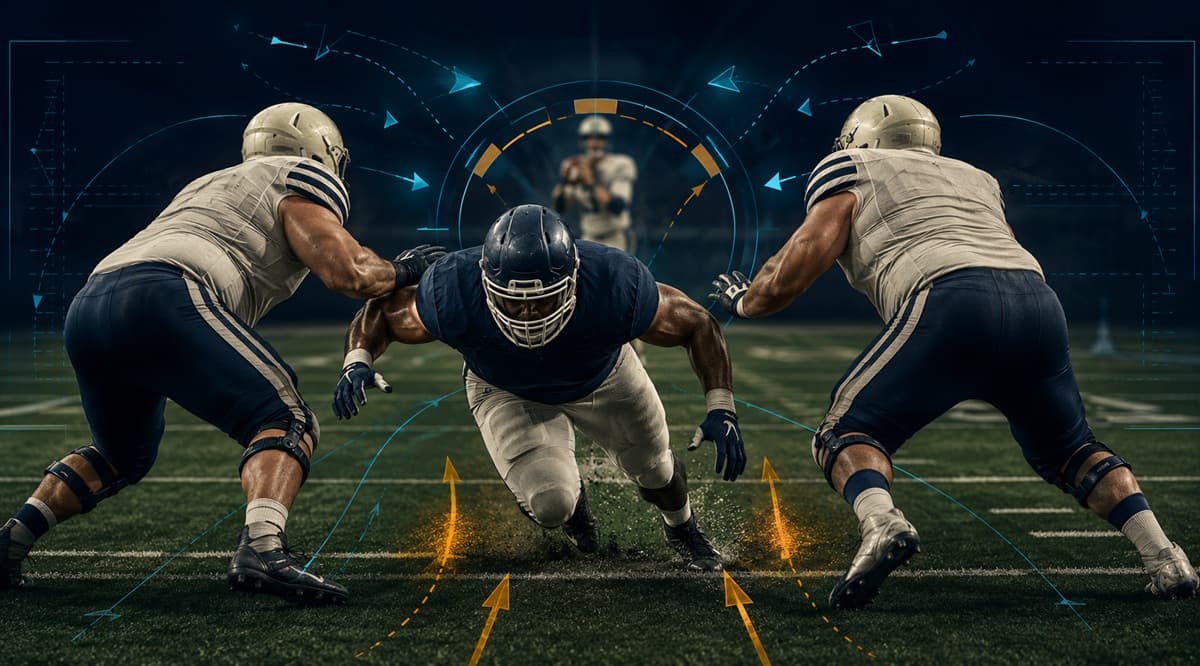
Most of football's most celebrated pass rushers work from the edge, where there's more space to build speed and an angle to the quarterback. Aaron Donald built his career from the interior, a position that's supposed to be about occupying blockers more than making plays — and in doing so, he raised a question that reshaped how teams think about interior defensive linemen: why can interior pressure be even more disruptive than edge pressure?
The answer, demonstrated across a decade with the Rams, is that a quarterback's first instinct under edge pressure is to step up into the pocket. Donald took that escape route away directly, from the middle of the formation, which is why offenses built entire game plans around a player who wasn't even lined up on the edge.
Career at a Glance
| Category | Information |
|---|---|
| Position | Defensive tackle |
| Primary team | Los Angeles Rams (2014–2023) |
| Era | 2014–2023 |
| Major honors | NFL Defensive Player of the Year, three times (2017, 2018, 2020); NFL Defensive Rookie of the Year (2014) |
| Career totals | 111 sacks, 543 tackles, 176 tackles for loss |
| Super Bowl championships | One (Super Bowl LVI) |
| Hall of Fame | Not yet eligible; officially eligible in 2029 |
Why Donald Was So Good
Donald's game combined an explosive first step with leverage and hand technique that let a player generously listed under 290 pounds consistently beat and defeat much larger offensive linemen at the point of attack. His get-off was fast enough to win before a blocker could establish position, and his hand usage let him disengage from blocks that did make contact — a combination that meant double teams, the standard answer to a dominant interior lineman, were frequently insufficient to fully contain him.
That interior pressure carries a different strategic weight than pressure off the edge. A quarterback facing an edge rusher can often step up into a clean pocket to escape; a quarterback facing pressure from directly in front of him has nowhere obvious to go, which collapses the pocket in a way that limits his options far more severely.
How Donald Played
Donald played with an unusually low pad level and quick hands, generating leverage against much heavier blockers and using that leverage to redirect them rather than simply trying to overpower them in a straight line. His get-off was frequently among the fastest at his position, letting him beat a guard or center's initial punch before it landed, and his ability to counter — switching from a speed rush to a power move, or vice versa, based on how the blocker reacted — made him difficult to prepare for with a single technique.
He was also relentless in pursuit away from obvious passing situations, showing the same explosiveness against the run that he showed rushing the passer, which prevented offenses from treating him as a pure passing-down specialist they could plan around on early downs.
Donald's sustained excellence over a full decade also meant offensive coordinators couldn't simply wait him out or manage around a single dominant season. He earned NFL Defensive Player of the Year honors three times across a seven-year window, spanning multiple coaching staffs, offensive line units around the league, and rule changes — a level of week-to-week consistency at his position that made him a fixture of opposing game plans for the entirety of his career rather than a peak that opponents eventually adjusted to.
The Skills That Changed the Matchup
- Leverage — generating power against much larger blockers through technique rather than size.
- Burst — an interior get-off fast enough to beat a block before it was established.
- Hand usage — disengaging from contact quickly enough to finish plays that appeared blocked.
- Power — collapsing the pocket directly in front of the quarterback, denying the most common escape route.
- Defeating double teams — remaining disruptive even when an offense committed extra resources to blocking him.
- Penetration — consistently getting into the backfield on running plays, not just passing downs.
What Opponents Had to Do Differently
Offenses facing Donald frequently had to commit a double team to his side of the line, tying up both a guard and a center or tackle who would otherwise have been available to help elsewhere on the play — a resource cost similar to what an elite edge rusher creates, but from a position with fewer natural help options nearby. Even those double teams were not a complete answer, since his leverage and hand usage let him win at least a share of those reps anyway.
Quarterbacks also had to adjust their pocket movement specifically to account for interior pressure, since stepping up — the standard answer to edge pressure — often moved them directly into Donald's path rather than away from danger, which meant protection plans had to be built with him in mind well beyond a single blocking assignment.
Plays and Concepts That Fit His Strengths
Donald's disruptive value showed up most clearly against standard drop-back protection schemes where a lone guard or center was responsible for the interior, since his combination of burst and leverage created an immediate one-on-one advantage in those situations. He was similarly effective against zone-blocking running schemes that relied on offensive linemen reaching a gap quickly, since his first step frequently beat that reach before the blocker could establish his angle.
Stunts and twists involving Donald and an edge rusher were an effective way for the Rams to create additional confusion, since blockers already occupied with tracking his explosive first step were often slow to pick up a looping teammate.
Compared to Lawrence Taylor, whose disruption came from the edge, Donald's interior version created a distinct problem for offensive coordinators: edge pressure can often be managed with a tight end or running back added to one side of the formation, but interior pressure is harder to reinforce without weakening the offensive line's ability to handle everything else up front. Both are forms of the same underlying idea — one player changing an offense's blueprint — arrived at from opposite ends of the same offensive line.
Where the Player Was Less Dominant
Donald's game depended heavily on the specific leverage and technique advantages that came from his size relative to the offensive linemen blocking him, and against a small number of blockers with unusually good hand technique of their own, his advantage narrowed compared to what he could generate against typical competition. His statistical sack production, while still elite, was also naturally affected by the frequency of double teams he faced — a testament to how seriously offenses treated him, even if it occasionally limited raw numbers relative to his overall disruptive impact.
OpenPlay Impact Profile
Archetype Interior Disruptor
| OpenPlay Trait | Impact |
|---|---|
| Pass-rush burst | Exceptional |
| Hand usage | Exceptional |
| Pass-rush power | Elite |
| Run discipline | Elite |
| Pursuit | Strong |
| Coverage range | Limited relevance |
These descriptive traits are future-ready metadata for the planned Challenge Lab Impact Player concept—not numerical ratings or live simulation bonuses.
What Changes When He's on the Field?
Situation: 3rd-and-7 from the opponent's 38-yard line, offense in standard drop-back protection with a single interior lineman responsible for Donald's gap.
Without the exceptional-player advantage
A standard interior lineman facing a single blocker in his gap can typically be handled without disrupting the quarterback's timing, allowing him to step into a clean pocket if edge pressure develops and complete his read progression without immediate pressure from the middle of the formation.
With this player's traits
Donald's first step beats the block before it's established, and his leverage lets him disengage even if the guard gets a hand on him. The quarterback's usual answer to pressure — stepping up into the pocket — now moves him directly toward the threat rather than away from it, forcing a rushed throw or a sack that a step-up escape would normally have avoided. The down is lost not because the offense's overall protection failed, but because the one gap that mattered most wasn't actually safe.
Coach Riley's Film Room
"Every quarterback I ever coached, I told them the same thing about edge rushers: if you feel heat, step up. That's rule one. Aaron Donald broke rule one. Stepping up into a pocket with him in the middle of it was like stepping into traffic. I had to teach guys a new rule just because of one player: check the middle before you move at all.
What got me about him wasn't just the get-off, though that was special. It was that double-teaming him didn't fully solve the problem. You'd put two blockers on him and he'd still win half a step, and half a step from the middle of the pocket is worth more than a full step from the edge. That's the whole argument for interior pressure right there."
What Aaron Donald Can Teach About Football
Donald's career reframes how football fans and evaluators think about interior defensive linemen — a position often undervalued relative to edge rushers because it's less associated with highlight sacks. His game shows that pressure from the middle of the pocket can be more disruptive precisely because it removes a quarterback's default escape route. For anyone learning to evaluate defensive impact, Donald is proof that where pressure comes from matters as much as how often it arrives.
Build the connections