OpenPlay Player Profile
Anthony Muñoz: What Made Him Exceptional?
Won one-on-one at left tackle so the offense could release every other eligible receiver.
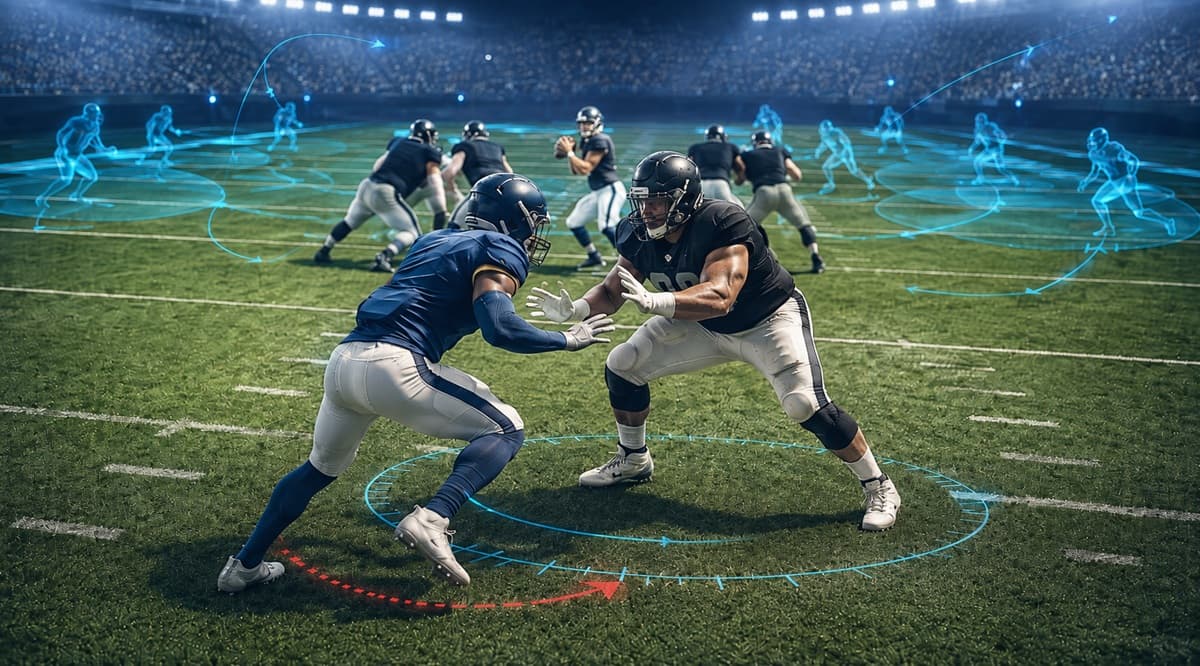
Every profile in this section so far describes a player who created disruption — a quarterback solving a defense, a receiver breaking a coverage, a pass rusher forcing an offense to divert resources just to slow him down. Anthony Muñoz's career answers the opposite question, and it's just as important to understanding football: what does it look like when a single blocker doesn't need any help at all?
For 13 seasons in Cincinnati, Muñoz was so consistently dominant at left tackle that opposing pass rushers were routinely neutralized in true one-on-one blocking, without a tight end chipping in or a running back staying home to help. That's a different kind of exceptional than the players profiled elsewhere on this site — not disruption, but the complete absence of it, on a scale rare enough to define the position for a generation.
Career at a Glance
| Category | Information |
|---|---|
| Position | Offensive tackle |
| Primary team | Cincinnati Bengals (1980–1992) |
| Era | 1980–1992 |
| Major honors | NFL Offensive Lineman of the Year (1981, 1987, 1988); 11 consecutive Pro Bowl selections (1981–1991); First-team All-Pro nine times |
| Career starts | 183 of 185 games played |
| Super Bowl appearances | Two (Super Bowl XVI, Super Bowl XXIII) |
| Hall of Fame | Inducted 1998, first year of eligibility |
Why Muñoz Was So Good
Muñoz's defining trait was a combination that simply wasn't supposed to exist in a 6-foot-6, 280-pound frame: the footwork, balance, and hand technique of a much smaller, quicker player, married to the size and raw strength to control defenders who outweighed him. That combination let him win in pass protection through technique rather than simply absorbing contact, and win in run blocking through leverage and footwork rather than pure mass — a rare double threat that meant opposing defensive coordinators couldn't game-plan a single weakness to attack.
Just as important was his consistency. Muñoz started all but two games across 13 seasons, meaning his offense could build its entire pass-protection scheme around his side of the line without contingency planning. A left tackle who might get hurt, get beaten, or need occasional help is a variable an offensive coordinator has to account for. Muñoz, for over a decade, wasn't a variable at all.
How Muñoz Played
In pass protection, Muñoz played with an unusually low, athletic pass set for a tackle of his size, mirroring a rusher's first move without over-committing his weight in either direction. His hand placement and punch were precise enough to stop a rush at the numbers before it could turn the corner, and his recovery quickness meant that even a rusher who won the first step rarely converted that advantage into a sack. This combination of patience and controlled aggression let him handle speed rushers and power rushers with the same technique, rather than needing a different approach for each.
In the running game, Muñoz was equally effective moving forward — capable of driving a defensive end off the ball in a straight line or reaching a linebacker in space on an outside run, a range of blocking assignments that most tackles of his era weren't asked to execute at a high level. His athleticism was rare enough that the Bengals occasionally used him as a tackle-eligible receiver in short-yardage and goal-line situations, where he caught seven passes and scored four touchdowns over his career — a statistic almost unheard of for a player at his position.
The Skills That Changed the Matchup
- Pass-set technique — a low, athletic kick-slide that neutralized a rusher's first move before it developed.
- Hand technique and punch — stopping a rush at the point of contact rather than absorbing it deep in the pocket.
- Recovery quickness — erasing a rusher's initial advantage rather than losing the rep once beaten to a spot.
- Run-blocking versatility — equally effective driving a defender off the ball or reaching a linebacker in space.
- Durability and consistency — 183 starts in 185 games, removing uncertainty from an offense's entire blocking plan.
- Functioning without help — winning true one-on-one reps that would otherwise require a chip block or extra blocker.
What Opponents Had to Do Differently
Defenses facing Muñoz generally had to accept that his side of the offensive line was not a productive place to spend extra pass-rush resources. A stunt, a twist, or a blitz sent toward his side carried a lower expected return than the same call directed elsewhere, because Muñoz's technique made even a numbers advantage difficult to convert into pressure. Over time, opposing coordinators often shifted their best individual pass rusher away from his side entirely, conceding that matchup rather than spending a series testing it.
That concession had a compounding effect on Cincinnati's offense. Because Muñoz didn't require a tight end or running back to help in protection, those players were free to release into routes or attack the other side of the formation — the same kind of structural advantage that a great pass rusher takes away from an offense, but working in the opposite direction, for the offense's benefit.
Plays and Concepts That Fit His Strengths
Muñoz was equally valuable in drop-back passing schemes that isolated him on an island against an edge rusher and in outside zone and pulling run schemes that asked him to move in space rather than simply drive block in a phone booth. His versatility meant Bengals coaches didn't have to scale back the offense's running concepts to protect a tackle who could only handle one blocking style — he was a fit for man-blocking schemes that demanded raw power at the point of attack and zone-blocking schemes that demanded athleticism and lateral movement.
His presence also supported aggressive, five-man protection calls, since Cincinnati rarely needed to devote extra resources to his side of the formation, letting the passing game use its full route concepts on early downs rather than keeping additional blockers in as insurance.
Where the Player Was Less Dominant
Muñoz's game, for all its versatility, was still built around a standard tackle's toolkit, and he didn't offer the same value as an ancillary weapon that a tight end or receiver provides on most snaps — his tackle-eligible touchdowns were rare, situational plays rather than a consistent feature of Cincinnati's offense. Playing his entire career for a Bengals franchise that reached two Super Bowls but won neither also means his individual dominance, however complete, wasn't matched by a championship on his statistical resume the way some other tackles from more successful franchises can claim. Like any offensive lineman, his impact is also harder to isolate cleanly from the play calls and quarterback decisions around him — evaluating a tackle always requires more inference than evaluating a player who touches the ball.
OpenPlay Impact Profile
Archetype Immovable Protector OT
| OpenPlay Trait | Impact |
|---|---|
| Pass-set technique | Exceptional |
| Hand technique | Exceptional |
| Recovery quickness | Elite |
| Run blocking | Elite |
| Durability | Elite |
| Space blocking | Strong |
| Ball skills (tackle-eligible) | Situational |
These descriptive traits are future-ready metadata for the planned Challenge Lab Impact Player concept—not numerical ratings or live simulation bonuses.
What Changes When He's on the Field?
Situation: 3rd-and-7 from the opponent's 38-yard line, offense in a standard drop-back passing formation with an elite edge rusher lined up across from Muñoz's side.
Without the exceptional-player advantage
A standard tackle facing an elite edge rusher in isolated one-on-one protection is a genuine risk on a down where a sack would end the drive. Most offenses account for that risk by keeping a tight end or running back in to help on that side, which removes a receiver from the route concept and simplifies the coverage the quarterback has to read.
With this player's traits
Because Muñoz can be trusted in true one-on-one protection, the offense keeps its tight end and running back in their route assignments rather than pulling one back to help block. That extra receiver in the route stresses the defense's coverage in a way a four-receiver route concept can't be defended as easily as a three-receiver one — and the quarterback has an additional, unaccounted-for option working against a defense that has to cover one more man than it was expecting to. The conversion happens not because Muñoz touched the ball, but because his side of the line never became a problem the offense had to solve.
Coach Riley's Film Room
"I spent more hours than I'd like to admit trying to find a wrinkle against Muñoz, and most weeks I came up empty. You'd bring a blitzer to his side hoping to overload him, and he'd pick up his guy clean and the running back would still have his check-down responsibility on the other side, because Cincinnati never had to keep him in just to help Muñoz out.
What people underrate about great tackles is that their value isn't really about the plays where they're tested. It's about every single play where a coordinator looks at the depth chart, sees who's lined up across from him, and quietly decides not to bother sending extra pressure that way. You can't count that on a stat sheet, but I promise you it happened constantly, and it's the difference between a good tackle and a genuinely great one."
What Anthony Muñoz Can Teach About Football
Muñoz's career is a useful corrective for anyone who evaluates football purely by what shows up in a box score. His value never appeared in a stat line, yet it shaped nearly everything Cincinnati's offense could do — every route concept it could run, every protection call it could make, every resource it didn't have to spend worrying about his side of the field. For anyone learning to watch the offensive line, Muñoz is proof that the absence of a problem can be just as decisive as the presence of a great play, even when it's much harder to see.
Build the connections